Trocars and Cavity Injection · Volume 2
The Water-Jet Aspirator: Suction From a Tap
How a hydro-aspirator makes vacuum out of nothing but mains water — the Venturi jet pump with no moving parts — why it lives or dies by line pressure, and the plumbing hazard that kept the trade honest about it.
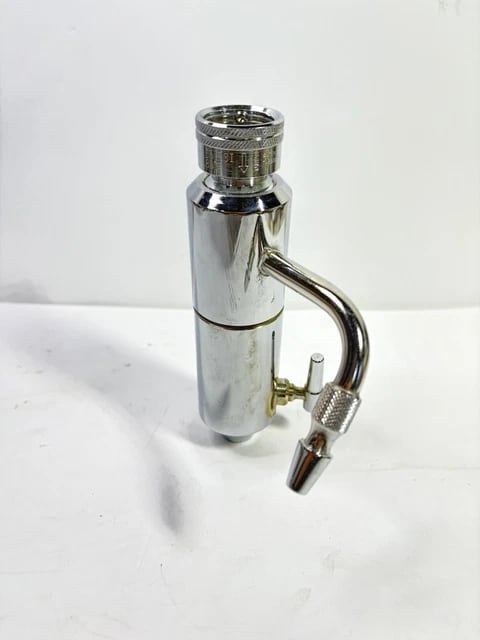
Contents
2.1 About this volume
Vol 1 — The Instrument and Why Cavity Work Exists left one question deliberately open. It established the trocar as a hollow, pointed tube that first withdraws the contents of the body’s hollow organs and interspaces and then delivers preservative into them, and it noted that the withdrawal — the aspiration — needs a source of suction plugged into the instrument’s rear hose. It named the candidates (hand and foot pumps, electric aspirators, and the water-powered hydro-aspirator) and then handed the whole subject of the water device forward. This volume takes it up.
The hydro-aspirator deserves a volume of its own because it is the one piece of apparatus in the entire cavity-treatment branch that is genuinely elegant physics rather than plumbing. It makes a partial vacuum out of nothing but the pressure already sitting in the building’s cold-water main — no motor, no pistons, no valves, nothing that moves. The trick is the Venturi effect, and once you see how it works you also see exactly why the device is fussy about water pressure, why it consumes a startling amount of water, and why it hides a real public-health hazard that the funeral-supply trade spent decades engineering around.
The discipline of Vol 1 holds here without exception. This is the fluid mechanics of a jet pump and the trade history of a shop fixture, described at the level of apparatus only. No procedure on a body is narrated, and every figure shows hardware, a plate, or a diagram.
2.2 The problem: suction without a suction pump
Aspiration needs a vacuum — a region of below-atmospheric pressure that the higher outside pressure will drive fluid toward, up the trocar and out. The obvious way to make one is a mechanical pump that physically pulls a piston back or spins an impeller, and the early trade did exactly that: hand-worked and foot-treadle suction pumps, then, in the electrical age, small motor-driven aspirators of the same family as the arterial machines covered in the Electric Embalming Machines dive. All of them share the drawbacks of any machine — moving parts that wear, seals that the corrosive traffic of cavity work destroys, a motor to burn out, and, for the foot pump, an operator tied to a treadle.
The hydro-aspirator throws all of that away. It has no moving parts at all. Every other suction source in the shop converts mechanical or electrical work into a pressure difference through some moving element; the hydro-aspirator converts the pressure energy already in the water main into a pressure difference by simply changing the shape of the pipe the water flows through. That is the whole device. Understanding it is understanding one paragraph of eighteenth-century fluid mechanics.
2.3 The Venturi effect, in one paragraph
Water is very nearly incompressible, so the same volume must pass every cross-section of a pipe each second. Force that flow through a constriction and it has no choice but to speed up — a narrower channel carrying the same throughput demands a higher velocity. Here the counter-intuitive part arrives, and it is Daniel Bernoulli’s: in a smooth flow, the total energy is shared between pressure and motion, so where the fluid moves faster, its pressure falls. The stream trades pressure for speed as it enters the throat and trades speed back for pressure as it leaves. If the throat is narrow enough, the pressure there drops below atmospheric, and a small port opening into that fast, low-pressure region will have surrounding air or fluid pushed into the stream to be swept away. Fast flow through a constriction makes suction on a side hole — that is the entire principle, named for the Italian physicist Giovanni Battista Venturi (1746–1822), who studied the pressure drop in constricted flows around the close of the eighteenth century. ⟨verify the ~1797 date for Venturi’s publication — sources give 1797 to 1799.⟩
A device built to exploit it is a jet pump (an eductor or ejector): a nozzle, a throat, and a diffuser, with a suction port at the throat. The one in the preparation room uses water as its working jet and is called a water aspirator or, in the trade, a hydro-aspirator.
2.4 Inside the hydro-aspirator
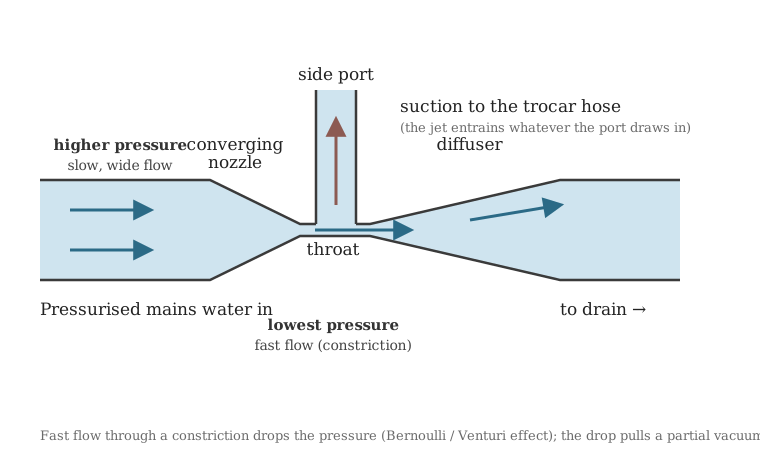
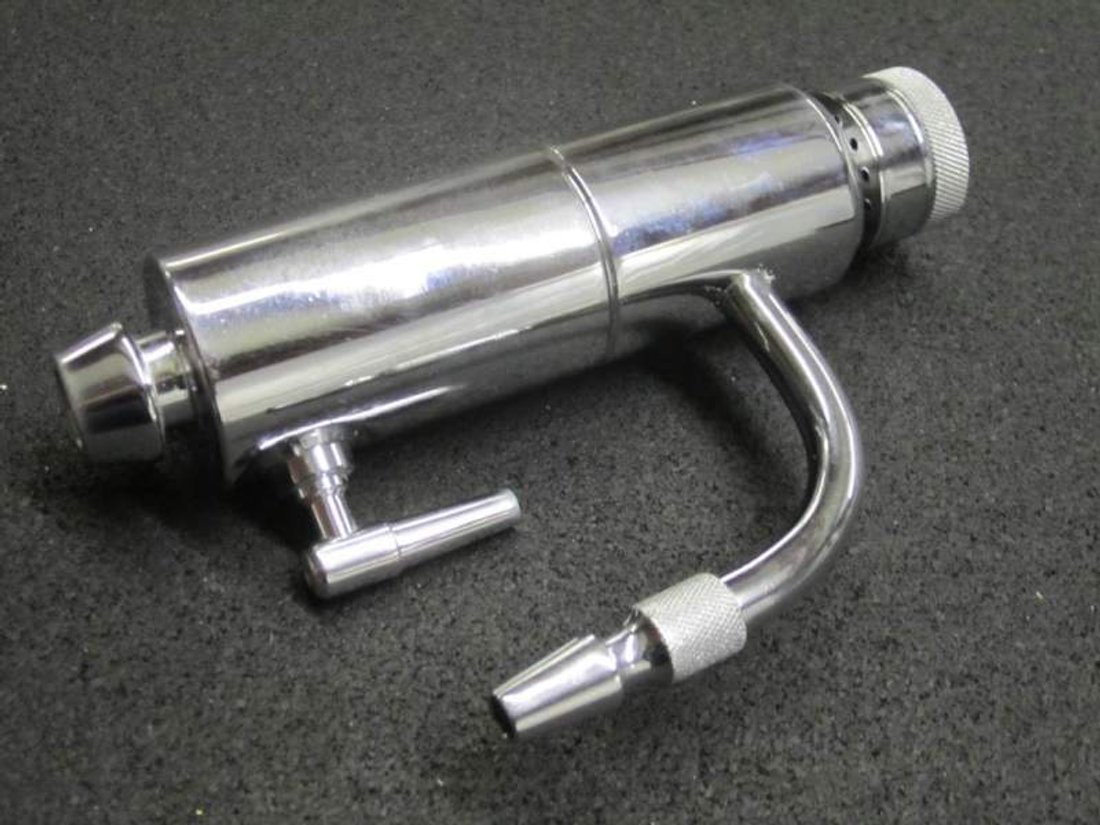
The casting itself is unassuming — a compact body of brass, bronze, or chromed metal that threads onto a preparation-room faucet or a dedicated water valve. Follow the water through it and the three functional zones of any jet pump appear in order. First a converging nozzle narrows the incoming bore, accelerating the mains water into a fast, coherent jet. That jet crosses the throat, the narrowest section, where by Bernoulli’s exchange the pressure is at its lowest — below atmospheric when line pressure is adequate. Opening into that throat is the side port, and it is the only connection that matters to the embalmer: a barbed fitting to which the trocar’s rear hose is joined. Beyond the throat a diverging diffuser lets the mixed stream slow and recover pressure, and everything — the driving water plus whatever the side port entrained — runs out to the sanitary drain.
Nothing in that path moves except the water. The suction at the trocar is a standing consequence of the flow’s geometry: turn the tap on and the vacuum exists, turn it off and it vanishes, with no spin-up, no priming, and no wearing part between the two states. This is why surviving specimens are so often intact where an electric aspirator of the same age is a corroded ruin — there was simply nothing inside to fail. For the same reason a collector should read a hydro-aspirator as a solid casting with an inlet thread, a hose barb, and a drain, not as a mechanism; the intelligence is entirely in the internal profile of the bore, which is invisible from outside.
2.5 Why line pressure is everything
Because the suction is made from the water main’s pressure, the depth of vacuum a hydro-aspirator can pull is set almost entirely by the pressure feeding it. The trade figure repeated across supply houses is a design point of roughly 60 psi of water pressure, at which a good unit will develop up to about 26 inches of mercury of vacuum (American Mortuary Coolers). That is a strong vacuum — twenty-six inches below atmospheric leaves only about four inches of mercury’s worth of absolute pressure — but it is more suction than cavity work usually wants, and the same source notes that something nearer 15 inches of mercury is often preferred in practice because the gentler pull is less prone to collapsing soft tissue against the trocar’s ports. The operator throttles between the two simply by opening or closing the tap; the water valve is the vacuum control. ⟨verify the 60 psi / 26 inHg / 15 inHg figures — these come from a present-day funeral-supply vendor, not a primary engineering source, and should be read as representative trade values rather than exact constants.⟩
Two physical limits sit behind those numbers. The first is the obvious one: inadequate line pressure starves the device. If the incoming water is slow, the throat velocity never rises enough to drop the throat pressure far below atmospheric, and the suction is weak or absent — the standard complaint of a hydro-aspirator on a low-pressure or heavily-shared water supply, and the reason the trade insists on a vigorous feed. The second limit is a hard floor that no amount of pressure can beat: the vacuum can never go below the vapour pressure of the water itself, because at that point the driving water simply boils into the vacuum it is making. A laboratory reference puts the ceiling concretely — a water-jet pump run at a water temperature of 15 °C (59 °F) bottoms out at about 17 mbar absolute, roughly half an inch of mercury, and colder water lowers that floor while warmer water raises it (Leybold). The mortuary literature’s claim of an ideal maximum “as low as 10 mm Hg” sits right at that water-vapour boundary and is consistent with it. In plain terms: the colder and higher-pressure the tap, the better the suction — and the water’s own tendency to evaporate is the wall you cannot climb past.
The elegance has a running cost. Making vacuum by throwing water away means throwing a great deal of it away: a working hydro-aspirator draws on the order of two gallons a minute, which the same trade source tallies at roughly fifty thousand gallons a year in a busy shop (American Mortuary Coolers). It has no motor to pay for, but it pays in water. ⟨verify the ~2 gpm / ~50,000 gal-per-year figures — same vendor source.⟩
2.6 From the chemistry bench to the preparation room
The water-jet aspirator did not originate in the funeral trade, and treating it as an embalming invention gets the history backwards — a caution the whole Embalming Machines wing keeps repeating about its apparatus. The jet pump was a laboratory instrument first. The chemist’s “filter pump” or “water-air pump,” clamped to a bench tap to pull suction filtrations and evacuate flasks, is the same device; the continuous Venturi water aspirator is commonly credited to the Swiss chemist Jules Piccard (1840–1933) around 1865, alongside the water-air pump Robert Bunsen described about 1868 on the principle of an earlier mercury pump — two closely-dated laboratory devices of the same era rather than one refining the other. ⟨verify the Piccard ~1865 credit and the Bunsen ~1868 attribution — both come from secondary histories of laboratory apparatus, and priority for the water aspirator is loosely told.⟩ The mortuary trade adopted a ready-made piece of nineteenth-century laboratory hardware and pointed it at cavity aspiration, exactly as the Hand Pump and Bulb Machines dive shows the trade borrowing the syringe and the piston pump. The physics arrived complete; the trade supplied only the application and the faucet fitting.
2.7 The cross-connection hazard, and how the trade answered it
The hydro-aspirator’s one serious flaw is a direct consequence of its virtue. Because the suction line and the potable water supply meet inside a single casting, the device is, in plumbing terms, a cross-connection — a point where clean water and contaminated matter share a fitting. So long as the tap runs at pressure the jet carries everything to the drain, but let the supply pressure fail — a main break, a nearby fire hydrant opened, any sudden draw that drops the line below atmospheric — and the flow can reverse, siphoning aspirated cavity fluid backward into the building’s drinking-water system. This is back-siphonage, and it is not hypothetical trade folklore.
The hazard is documented in the patent record itself. In U.S. Patent 2,836,877, “Embalming Apparatus,” filed 22 November 1954 and granted 3 June 1958 to William F. Hannahan and assigned to The Champion Company of Springfield, Ohio, the inventor describes the prior-art hydro-aspirator plainly — a stream of water directed through “a venturi,” with “a chamber communicating with the throat or low pressure area of the venturi which is in turn connected to the trocar” — and then states its problem outright: the arrangement created a risk that “body fluids could be drawn into the household water system.” Hannahan’s answer was to abandon the direct tap connection for a separate positive-displacement (rotary) pump with an isolated water supply, so that no cross-connection to the potable main existed at all.
The rest of the trade answered the same danger by keeping the hydro-aspirator but breaking the cross-connection with a backflow preventer. Modern units are sold with a built-in atmospheric vacuum breaker — a valve that vents the suction line to the atmosphere the instant the water pressure goes sub-atmospheric, so a reversing flow draws air instead of siphoning backward (Mopec). Plumbing codes reinforce it from the building side, requiring aspirators used to remove body fluids to be protected by a vacuum breaker on the discharge side of the control valve and the supply guarded by an air gap or a reduced-pressure-zone assembly. It is a satisfying piece of engineering history: a device whose whole principle is a deliberate pressure drop had to be fitted with a second device whose whole job is to notice when that pressure drop happens in the wrong place.
2.8 What it replaced — and what it did not
The hydro-aspirator is often said to have “replaced” hand, foot, and electric suction, and the claim needs the same plain trimming this wing gives every marketing line. What it actually offered was a specific bargain: no electricity, so it works in a power cut; no moving parts, so almost nothing to maintain; and a low purchase price — present-day units run roughly thirty to a few hundred dollars against several hundred to a few thousand for an electric vacuum pump (American Mortuary Coolers). Those advantages were real and they made the water aspirator the default cavity-suction source in a great many shops. But it did not sweep the field: it needs a strong, cold water supply it cannot itself guarantee, it wastes water prodigiously, and its cross-connection hazard made electric aspirators — and, as Hannahan’s patent shows, purpose-built isolated-pump machines — the preferred choice wherever water pressure was poor or plumbing separation was demanded. The honest summary is that the hydro-aspirator won on simplicity and price where the water supply was good, and lost to powered suction where it was not — which is why a well-stocked preparation room of the mid-twentieth century often kept both.
2.9 Where this volume hands off
You now have the second half of the cavity outfit explained: a trocar that reverses flow through one bore (Vol 1), and the water-jet aspirator that supplies the withdrawing half of that flow with no machinery beyond a shaped casting and a running tap. The story turns next from physics to people and priority. Vol 3 — Origins and Makers takes up the genuinely tangled question of who invented the embalming trocar — the Samuel Rodgers credit, the conflicting 1868/1870s/1880 dates that Vol 1 already began to untangle against the actual patent, and the surgical-instrument lineage the trocar descends from — and sorts the makers a collector will meet on a casting. From there, Vol 4 — Cavity Treatment and the Durable-Preservation Trade shows how cavity work turned arterial embalming into transport-ready preservation, and Vol 5 — Collecting Trocars and Aspirators closes on identifying, dating, and displaying the instruments — including telling a hand aspirator from an electric one and a water aspirator from a corroded pump. A reader arriving from the Quack Devices wing — from the Violet Ray Wands dive and its glowing electrode sold as a cure — will recognise the contrast again: the hydro-aspirator is honest plumbing that does precisely what its geometry permits and claims nothing it cannot deliver.
Sources
- Everything You Need to Know About Hydro Aspirators — American Mortuary Coolers & Equipments — the trade figures used throughout: the Venturi operating principle, the ~60 psi design pressure, up to ~26 inHg vacuum, the ~15 inHg preferred working level (less tissue collapse), the ~10 mmHg ideal maximum, ~2 gpm / ~50,000 gal-per-year water use, no-electricity/no-moving-parts advantages, and the ~$30–300 vs. ~$500–3,000 price contrast. Secondary vendor source — its numbers are flagged ⟨verify⟩ in the text as representative trade values.
- U.S. Patent 2,836,877, “Embalming Apparatus” — Google Patents — the primary document: William F. Hannahan for The Champion Company (Springfield, OH), filed 22 Nov 1954, granted 3 Jun 1958. Describes the prior-art hydro-aspirator’s venturi-throat-to-trocar suction and states the back-siphonage hazard (“body fluids could be drawn into the household water system”) that its isolated positive-displacement pump was designed to remove.
- How does a water jet pump work — Leybold — the jet-pump physics (nozzle, entrainment, momentum transfer) and the hard vacuum floor set by water’s vapour pressure (~17 mbar at 15 °C), which the water temperature raises or lowers. Used for the “vapour-pressure wall” limit.
- Venturi effect — Wikipedia and Bernoulli’s principle — Wikipedia — the pressure-drop-with-constricted-flow principle, its Bernoulli basis, and attribution to Giovanni Battista Venturi (1746–1822). The exact publication year (~1797) is flagged ⟨verify⟩.
- The Invention of the Water-Air-Pump — Nature (historical note) — the laboratory filter/water-air pump lineage — Jules Piccard (1840–1933) credited with the continuous Venturi water aspirator (~1865), alongside Robert Bunsen’s water-air pump (~1868), as two closely-dated devices rather than one refining the other. Both attributions flagged ⟨verify⟩ as loosely-told priority.
- Vacuum Hydro Aspirator with built-in vacuum breaker — Mopec — a current maker’s unit showing the integral atmospheric vacuum breaker that answers the cross-connection hazard; corroborated by plumbing-code backflow/cross-connection requirements (vacuum breaker on the discharge side; air gap or RPZ on the supply).
- Cross-references named in prose, not linked: the Electric Embalming Machines and Hand Pump and Bulb Machines dives (electric/hand suction and the trade’s borrowing of laboratory pump hardware), and the Violet Ray Wands dive in Quack Devices (the register contrast).
Comments (0)