Trocars and Cavity Injection · Volume 1
The Instrument and Why Cavity Work Exists
What an embalming trocar physically is — a long hollow tube with a pointed tip that both withdraws and delivers — and why cavity treatment stands alongside arterial injection rather than replacing it.
Contents
1.1 About this volume
The three dives that precede this one in the Embalming Machines wing all follow a single technology: arterial injection, the practice of tying into an artery and pushing preservative fluid through the body’s own blood vessels. That story runs from an elevated bottle worked purely by gravity (the Gravity Injection Systems dive), through squeeze-bulbs and hand pumps that gave the operator control of pressure (Hand Pump and Bulb Machines), to the electric, gauge-fronted pump that standardised the trade in the twentieth century (Electric Embalming Machines). This dive turns to the second branch of the process — the one that exists because arterial injection, however good the pump, does not finish the job on its own.
That branch is cavity treatment, and its defining instrument is the trocar. This volume is the establishing one of five, and it is deliberately narrow. Its job is to say plainly what the trocar is as a piece of apparatus, and why cavity work has to exist at all — the engineering rationale that makes it a complement to arterial injection rather than a rival to it. It stops short of the deeper arguments its siblings take up. The applied fluid mechanics of the water-powered aspirator — the Venturi jet pump that made suction out of the household tap — is the whole subject of Vol 2 — The Water-Jet Aspirator. The tangled origin story and the makers are Vol 3 — Origins and Makers’s to sort out; how cavity work turned embalming into transport-ready preservation is Vol 4 — Cavity Treatment and the Durable-Preservation Trade; and identifying, dating, and displaying surviving instruments is Vol 5 — Collecting Trocars and Aspirators.
One discipline holds throughout, as it does across the whole sub-project. This is trade history and engineering — the instrument, the physics, the makers, the patents — described at the level of apparatus and process only. It is never step-by-step instruction, and every figure here shows hardware, a catalog plate, or a patent drawing, nothing else.
1.2 The instrument in the hand
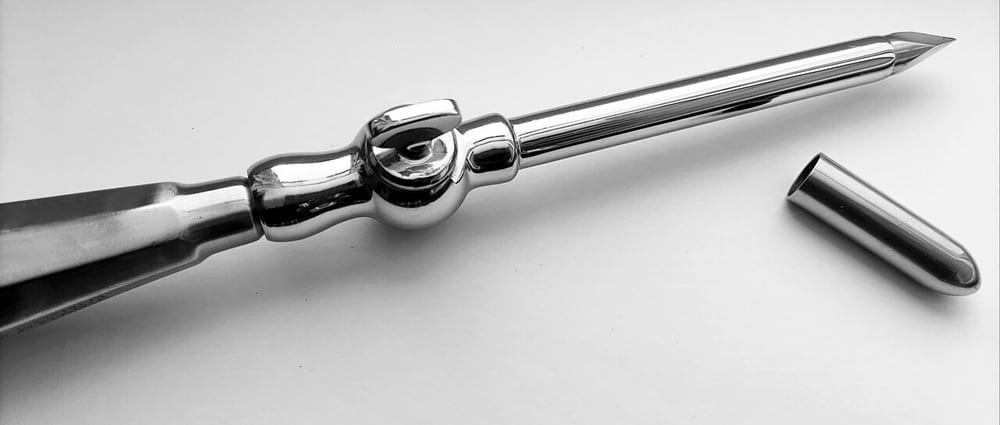
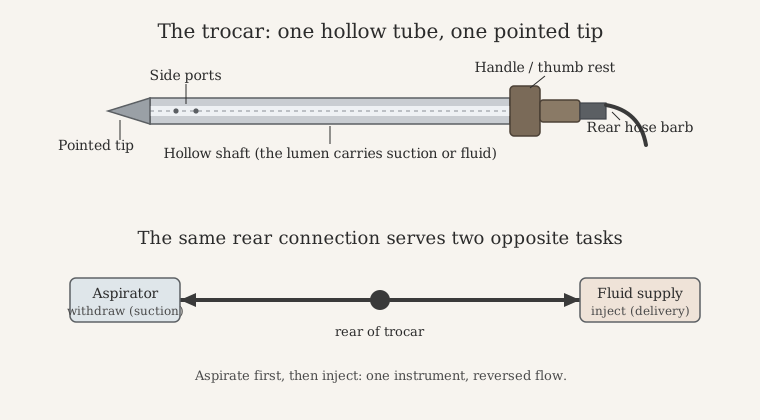
Strip away the trade vocabulary and an embalming trocar is a strikingly simple object: a long, rigid, hollow metal tube, sharpened to a point at one end and fitted with a handle at the other, with a connection for a hose behind the handle. Everything about its function follows from that hollow bore. The tube is a channel, and depending on what its rear end is joined to, that channel carries flow in one of two directions — out of the body, or into it.
The classic hand trocar is essentially a single piece. A hardened, tapered point is formed on, or fixed to, the front of the shaft; the shaft is the hollow tube itself; and the rear carries a thumb-rest or knurled handle and a barbed fitting onto which a length of rubber or (later) clear plastic tubing is pushed. Openings sit not only at the very tip but as side ports a short distance back from it, so the bore can draw from or deliver to more than a single spot. This is worth dwelling on because it is exactly the geometry Samuel Rodgers described in his 1880 patent, discussed below: a long needle with “a smooth taper point, with the holes at the side,” rather than the slotted, pen-nib-like point of a writing instrument.
Trocars came, and still come, in a range of sizes. A general-purpose adult instrument is the heavy one most collectors picture; the infant trocar is markedly shorter and slimmer — commonly cited at around twelve inches long and about a quarter-inch in bore — and small enough that it doubled for hypodermic injection of tissue. Points evolved into named patterns: the early pen-point design (of which more below) and, later, spiral and other cutting geometries, each a small dating cue for a collector and a subject Vol 5 returns to. Behind the point, some outfits carried a threaded trocar button — a small screw-in plug used to close the puncture afterward — as a standard accessory in the same case.
The distinction that matters for this volume is not between sizes but between hand trocars and powered variants. A hand trocar is inert metal; it does nothing until its hose is connected to something that moves fluid. That “something” is the aspirator or the fluid supply — and the whole reason the instrument has a dual life is that the same tube serves both.
1.3 Why cavity treatment exists alongside arterial injection
Here is the engineering question at the centre of the dive: if a pump can drive preservative fluid through the entire arterial tree, why is a separate instrument needed at all?
The answer lies in where arterial fluid actually goes. Arterial injection distributes fluid the way the living circulation distributed blood — through arteries, into the fine capillary beds, and out into the tissues the vessels supply. It preserves solid, vascularised tissue well precisely because that tissue is threaded with the vessels doing the delivering. But the body is not solid throughout. It contains hollow organs — the stomach, the intestines, the bladder — whose walls the arteries certainly reach, but whose contents and interior spaces (the lumen) they do not. Blood vessels run in the wall of the gut; they do not empty into the cavity the gut encloses. The heart and lungs, likewise, are hollow, and the broad interstitial spaces between the organs are not vascular territory at all.
Those unreached spaces are exactly where decomposition proceeds fastest. Gut contents and the resident bacteria of the digestive tract are not touched by an arterial injection that stops at the vessel wall; they continue to putrefy, and putrefaction generates gas. That gas produces the two failures the trade most needed to prevent: distension — visible bloating of the trunk and face — and purge, the forcing of liquids and gas back up and out. A body could be arterially injected to a high standard and still bloat, discolour, and leak, because the arterial fluid never got into the places doing the spoiling. Period and modern trade texts make the point in almost the same words: even when the viscera receive some arterial fluid, it is not assured that the hollow organs, heart, and lungs are reached, so a direct chemical treatment of the cavity contents and the spaces between the organs is required to supplement the vascular work.
That is the whole justification for cavity treatment, and it is why the trocar is a complement to the pump, not a competitor. The two operate on different targets: the pump on the vascular, solid body; the trocar on the hollow, unvascularised interior. Before the instrument existed, the trade’s answers to the same problem were cruder — packing cavities with preservative powder, or relying on ice and the cooling board to buy time, the pre-refrigeration approach covered in the Cooling Boards and Corpse Coolers dive. The 1912 trade text Anatomy and Embalming records that “cavity embalming became the means of preservation, until its limitations were learned” — that is, until the trade understood that cavity and arterial work were two halves of one method, each doing what the other could not.
1.4 Aspirate, then inject: one tube, two directions
The trocar’s cleverness is that one instrument performs both halves of cavity treatment simply by reversing the flow through its bore. The sequence the trade settled on is always the same two steps, and their order is not arbitrary.
First, aspiration. The rear hose is joined to a source of suction, and the hollow tube becomes a drain: the gases and liquids collected in the cavities and hollow organs are drawn out through the bore. Removing that material does two things at once — it takes away the accumulated products of decay, and it takes away the pressure those gases create, which is the direct cause of distension. The suction itself came from several devices over the trade’s history: hand- and foot-operated pumps early on, then electric aspirators, and — the elegant solution this dive is partly built around — the hydro-aspirator, which makes suction out of nothing more than mains water flowing through a constriction. How that water-jet trick works, and why it needs good line pressure, is Vol 2’s to explain in full; here it is enough to say the trocar’s rear end simply plugs into whatever provides the pull.
Then, injection. With the cavities emptied, the same trocar is disconnected from the suction and joined instead to a fluid supply, and the flow runs the other way: a concentrated cavity fluid is delivered into the trunk to preserve and disinfect the contents and interspaces directly. Cavity fluid is deliberately stronger than arterial fluid — higher in preservative, used at or near full strength rather than diluted — because it is doing its work by direct contact rather than by careful vascular distribution, and because the material it must fix is the most actively decomposing in the body. The delivery is usually undramatic: gravity from a bottle, or a squeeze from the same class of apparatus used for arterial work, pushed through the hose the aspirator had occupied a moment earlier.
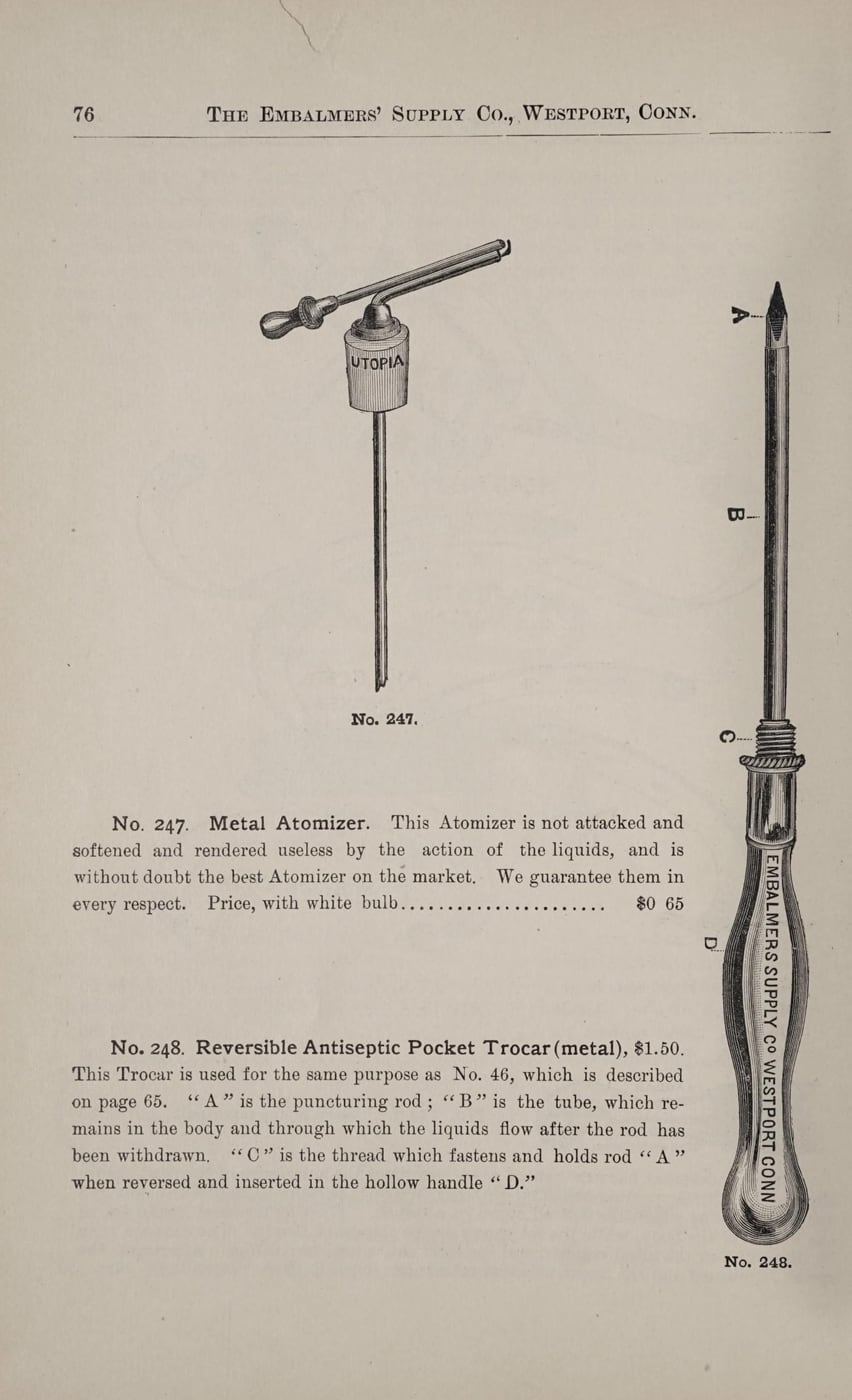
That reversibility — withdraw, then deliver, through one hollow tube — is the entire engineering idea of the instrument, and it is why period supply catalogs sold the trocar and the aspirator as a matched pair. Neither is much use without the other.
1.5 The name, and a surgical instrument repurposed
The word trocar did not begin in the undertaker’s shop. It comes from the French trocart — usually derived from trois-quarts (“three-quarters”) or trois carres (“three sides”), both pointing at the triangular, three-sided point of the original surgical instrument. That surgical trocar is much older than embalming’s use of it: the term appears in a French dictionary of arts and sciences by 1694, and patents for trocars appear early in the nineteenth century. In its medical form it is a two-part device — a pointed inner obturator (a stylet) carried inside a hollow outer cannula — used to puncture a body cavity and then withdraw the stylet, leaving the tube behind to drain fluid. It is, in other words, a drainage-and-venting instrument, and the embalming trade adopted it for exactly the draining task cavity treatment required.
What the trade did was simplify it. The classic embalming hand trocar dispenses with the removable obturator and makes the point part of the shaft — a single fixed-point tube, because the embalmer wants a permanent hollow channel for suction and injection, not a temporary sheath left in place. The lineage — surgical drainage instrument to embalming instrument — is a subject Vol 3 develops properly.
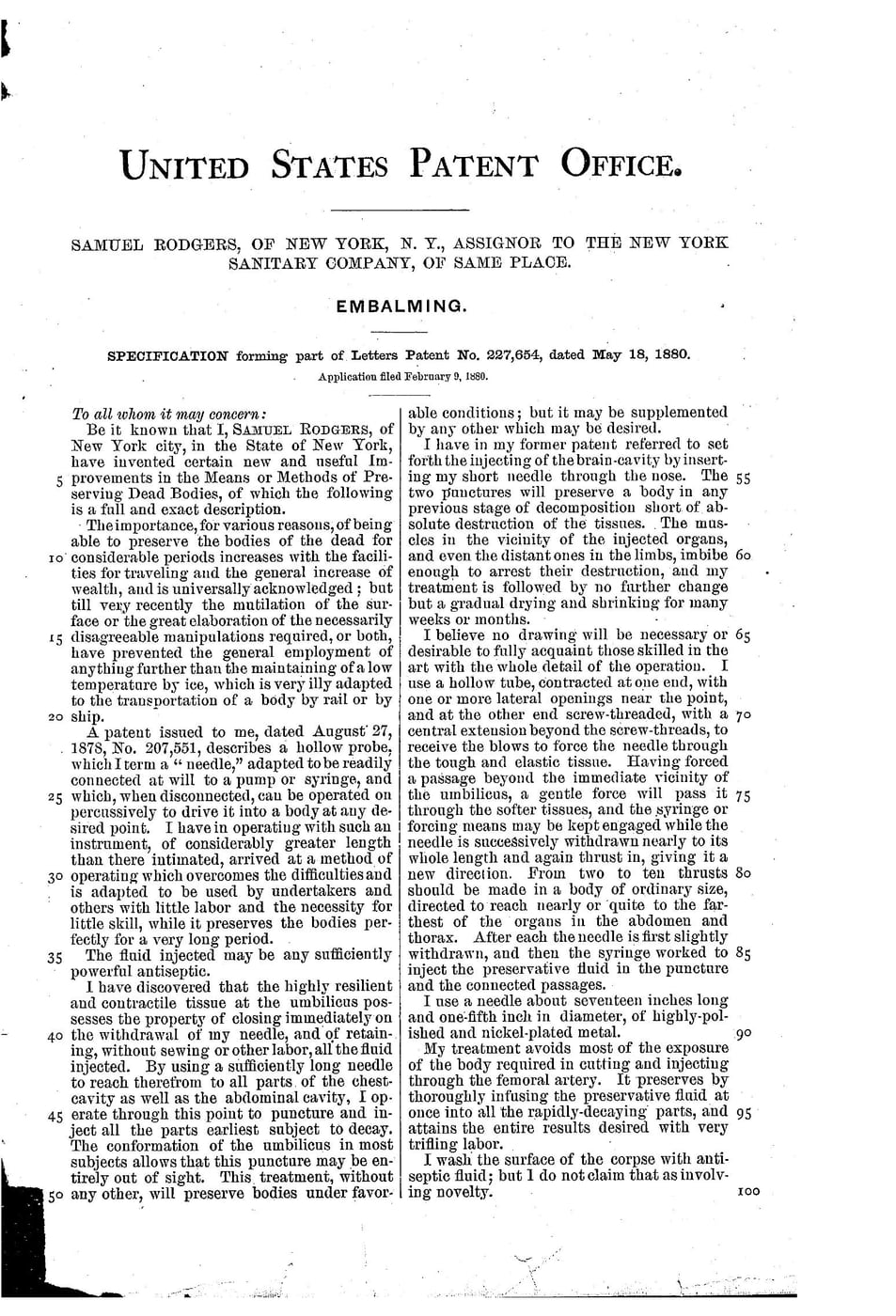
Priority for the embalming trocar is genuinely contested, and this establishing volume flags it rather than settling it. The credit is popularly given to Samuel Rodgers, and the trade often dates it to the mid-1870s or to “1868” or “1878” — but the surviving patent tells a tidier and later story. Rodgers’s United States patent, No. 227,654, titled for the preserving of dead bodies, was filed 9 February 1880 and granted 18 May 1880; it describes introducing preserving fluid “through the navel by means of a long needle” roughly seventeen inches long and a fifth of an inch across, thrust in several directions so the fluid reaches the viscera “without mutilating the body.” The frequently repeated 1868 and 1878 dates are not supported by that document, and should be treated as folklore until a separate, earlier patent is produced. Muddying the credit further, the 1912 text Anatomy and Embalming attributes the enduring pen-point trocar not to Rodgers but to Captain George Billow of Akron, Ohio, a Civil-War veteran and Ohio embalming-board examiner. Both claims can be partly true — a method patented by one man, a point pattern contrived by another — and untangling them is precisely Vol 3’s task.
1.6 Where this volume hands off
You now have the instrument and its reason for existing: a hollow, pointed tube that withdraws and then delivers, doing for the body’s hollow interior what the arterial pump cannot. The obvious next question is the one this volume kept deferring — where the suction comes from. That is Vol 2 — The Water-Jet Aspirator, which follows the water from the tap through a narrowing throat and shows, with a labelled diagram, how fast flow through a constriction drops the pressure enough to pull a vacuum on a side port — the Venturi jet pump that replaced hand, foot, and electric suction in so many shops. From there the dive takes up the contested origins and the makers (Vol 3), how cavity work made embalming into durable, transport-ready preservation (Vol 4), and the collector’s practical business of identifying and displaying these instruments (Vol 5). Readers coming from the Quack Devices wing will notice the contrast in register: where a Violet Ray Wand was a real physical effect dressed up as a cure, the trocar is the opposite — an unglamorous piece of plumbing that does exactly, and only, what its makers claimed.
Sources
- Trocar — Wikipedia — definition and construction (obturator within a cannula, pointed/triangular tip, drainage function); etymology from French trocart / trois-quarts / trois carres; the term in print by 1694 and early-nineteenth-century trocar patents; surgical lineage predating embalming.
- Samuel Rodgers, U.S. Patent No. 227,654 — Google Patents — the primary document: filed 9 February 1880, granted 18 May 1880; the long side-ported needle (~17 in × ⅕ in) introduced “through the navel,” thrust in several directions to reach the viscera “without mutilating the body.” Used to correct the folkloric 1868/1878 dates.
- Nunnamaker & Dhonau, Anatomy and Embalming (1912) — Project Gutenberg — attributes the enduring “pen point trocar” to Captain George Billow of Akron, Ohio; notes that “cavity embalming became the means of preservation, until its limitations were learned”; frames hollow-organ treatment as beyond arterial injection’s reach.
- Elite CME, “History of Embalming and Restorative Arts” (trade CE chapter, PDF) — secondary trade history crediting Samuel Rodgers with the trocar in the mid-1870s/1878 and describing cavity treatment as a two-step aspirate-then-inject process; treated as secondary and cross-checked against the patent above.
- Modern Embalming — William L. Clements Library, University of Michigan — museum framing of arterial vs. cavity work and the professionalisation of the trade.
- Hydro-aspirator overview — My Mortuary Cooler (secondary) — the trocar’s rear hose connecting to a water-powered aspirator; the Venturi mechanism is deferred to and verified in Vol 2.
- Contemporary trade/reference descriptions of embalming trocar dimensions and infant trocars (~12 in, ¼ in bore), trocar points, and the trocar button — used only for the instrument’s physical form; specific adult lengths left to Vol 5’s collecting guidance rather than stated as a single figure here.
Comments (0)