Trocars and Cavity Injection · Volume 4
Preservation You Could Ship
How cavity treatment completed arterial injection, turned embalming into transport-ready durable preservation, and helped drive the undertaker's trade from itinerant craft to licensed profession between the 1870s and 1900.
Contents
4.1 About this volume
The earlier volumes of this dive treated the trocar as an object. Vol 1 — The Instrument and Why Cavity Work Exists established what the instrument physically is and why cavity treatment has to exist alongside arterial injection; Vol 2 — The Water-Jet Aspirator followed the water through the Venturi jet pump that made suction from the household tap; Vol 3 — Origins and Makers sorted the contested credit for the embalming trocar and its surgical ancestry. This volume steps back from the hardware to ask what the hardware did to the trade.
The claim it defends is a specific one. Cavity treatment — emerging in the 1870s and codified in print and patent by 1880 — was not merely a technical refinement of arterial injection. It was the step that turned embalming from a partial, unreliable preservation into something a family, a railroad, and eventually a state licensing board would treat as transport-ready durable preservation: a body that could be shipped hundreds of miles and held for days without distension, leakage, or offense. That reliability is what the trade could finally advertise, and advertising it is bound up with the same professionalisation story the earlier Embalming Machines dives tell — the arc from itinerant “embalming surgeons” to a licensed, school-trained, catalog-supplied profession.
As throughout the sub-project, this is trade and engineering history. It describes apparatus, commerce, and law, never a procedure performed on a body, and every figure shows a catalog plate, a diagram, or an instrument.
4.2 The two branches, and what cavity work completed
The engineering rationale is Vol 1’s in full; the one-sentence version is that arterial injection preserves the vascularised, solid body — the tissues threaded with the vessels doing the delivering — but does not reach the contents and interior spaces of the hollow organs, nor the interstitial spaces between them. Those unreached spaces, packed with the resident bacteria of the gut, are exactly where putrefaction proceeds fastest, and putrefaction makes gas. Gas makes the two failures a family notices: distension, the bloating of trunk and face, and purge, the forcing of fluid back out. A body could be arterially injected to a high standard and still spoil visibly, because the fluid never got where the spoiling was.
Cavity treatment closed that gap by attacking the hollow interior directly — aspirating the accumulated gas and liquid, then delivering a concentrated cavity fluid into the trunk. The point worth making in this volume is chronological: arterial injection came first and alone. Thomas Holmes and the Civil-War embalmers of the 1860s (the subject of the Gravity Injection Systems dive) worked chiefly by arterial injection, and their results, while good enough to make embalming publicly acceptable, were not yet the routine, repeatable preservation the later trade sold. The trocar and systematic cavity work are what made the method whole.
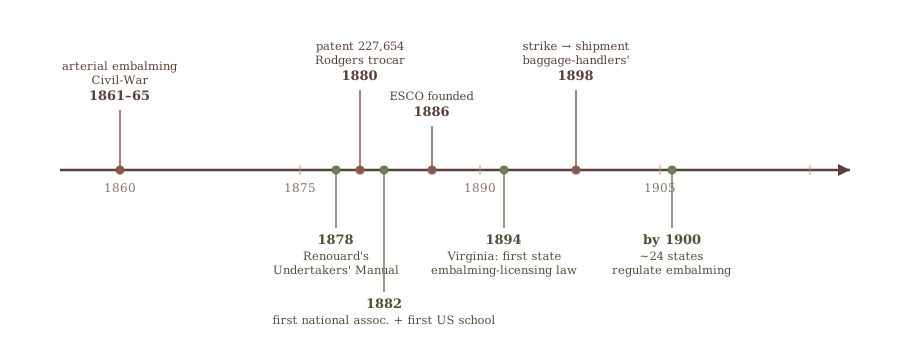
The primary record shows cavity treatment already in practice before the trocar patent settled its instrument. Auguste Renouard’s The Undertakers’ Manual of 1878 — the first embalming textbook published in the United States — describes, alongside arterial work, an abdominal cavity treatment: an antiseptic solution — about four ounces of fluid poured over the intestines, with a further six-to-eight ounces poured “between the interstices of the bowels” — before closing. Samuel Rodgers’s U.S. patent No. 227,654 (granted 18 May 1880), examined in Vol 3, then gave the operation its characteristic instrument: a long side-ported needle driven “through the navel” and thrust in several directions so fluid reached the viscera “without mutilating the body.” Method in the manual, instrument in the patent — and between them, by about 1880, the two-branch process was complete.
4.3 Preservation you could ship
Why did completeness matter so much commercially? Because the nineteenth-century demand for embalming was, above all, a demand for distance. Americans died far from where they wished to be buried — soldiers away at war, migrants who had moved west, city dwellers whose family plots were a rail journey away — and Renouard’s manual opens the case plainly: “It is customary to send back and over long distances the bodies of those that have died far from home.” Renouard himself, working in the trade, is repeatedly credited with arterially embalming bodies before shipment east and south, to the acclaim of the undertakers receiving them.
Distance is a harder test than a local, next-day funeral. A body held a day or two in a cool room, or on ice on a cooling board (the pre-refrigeration practice of the Cooling Boards and Corpse Coolers dive), needed only to be slowed. A body loaded into a warm baggage car for a journey of several days needed to arrive without having bloated, leaked, or announced itself — and that is precisely the failure mode arterial injection alone left open, and that cavity treatment closed. The concentrated cavity fluid, working by direct contact on the most actively decomposing material in the body, is what bought the extra reliability that made rail shipment routine rather than a gamble.
The period preservation claims were correspondingly bold. Renouard reported that a body prepared by his method “has been kept, in a wooden coffin, in a dark and moderately cool place, for the space of nine months without any perceptible change” — a striking figure, offered as evidence that the trade could now promise not just a viewing but genuine keeping. Whether nine months is representative or a best case is exactly the kind of claim the debunking section below revisits; here it stands as a marker of what the completed method let the trade advertise that arterial injection alone had not.
4.4 The 1898 strike: the market makes a rule
The clearest single sign that embalming had become transport-ready preservation is that the transport industry began to require it. Railroads had long been wary of shipping the dead — the odour, the mess, the fear of contagion — and the men who actually handled the freight had the strongest objection of all. In 1898, railway baggage handlers, in the words of the Encyclopedia of Cleveland History, were “tired of having bodies explode,” and through a strike “demanded and got embalmed corpses.” The exploding, of course, was the gas of unchecked cavity putrefaction — the very failure cavity treatment existed to prevent. “Thanks to embalming,” the same account concludes, “the period between death and burial could now be extended.”
The episode is worth dwelling on because it inverts the usual order of regulation. This was not a government mandating a health measure; it was the workforce nearest the problem refusing to move unembalmed bodies, and a shipping industry consequently making embalming a condition of carriage. A preservation good enough that a baggage handler would stake a strike on it is, by definition, a preservation the trade could sell. Cavity work is what pushed embalming across that threshold from “often works” to “reliable enough to be a commercial requirement.” (Accuracy flag: the 1898 date and the “bodies explode” characterisation are consistently reported in reputable secondary funeral-history sources such as the Encyclopedia of Cleveland History, but the underlying primary record of the specific strike and any formal railway embalming requirement was not pinned to a contemporaneous document in this pass; treat the year and the causal framing as well-attested trade lore rather than a verified statute.)
4.5 From craft to profession
Reliable, shippable preservation and a professionalising trade grew together, each feeding the other, across roughly the same two decades. Once embalming could be sold as durable preservation, it needed practitioners who could reliably deliver it, instruments and fluids to standardise it, schools to teach it, associations to represent it, and — finally — licenses to gate it. The instruments and the aspirators of this dive are only one thread in that fabric; the same years wove all of them.
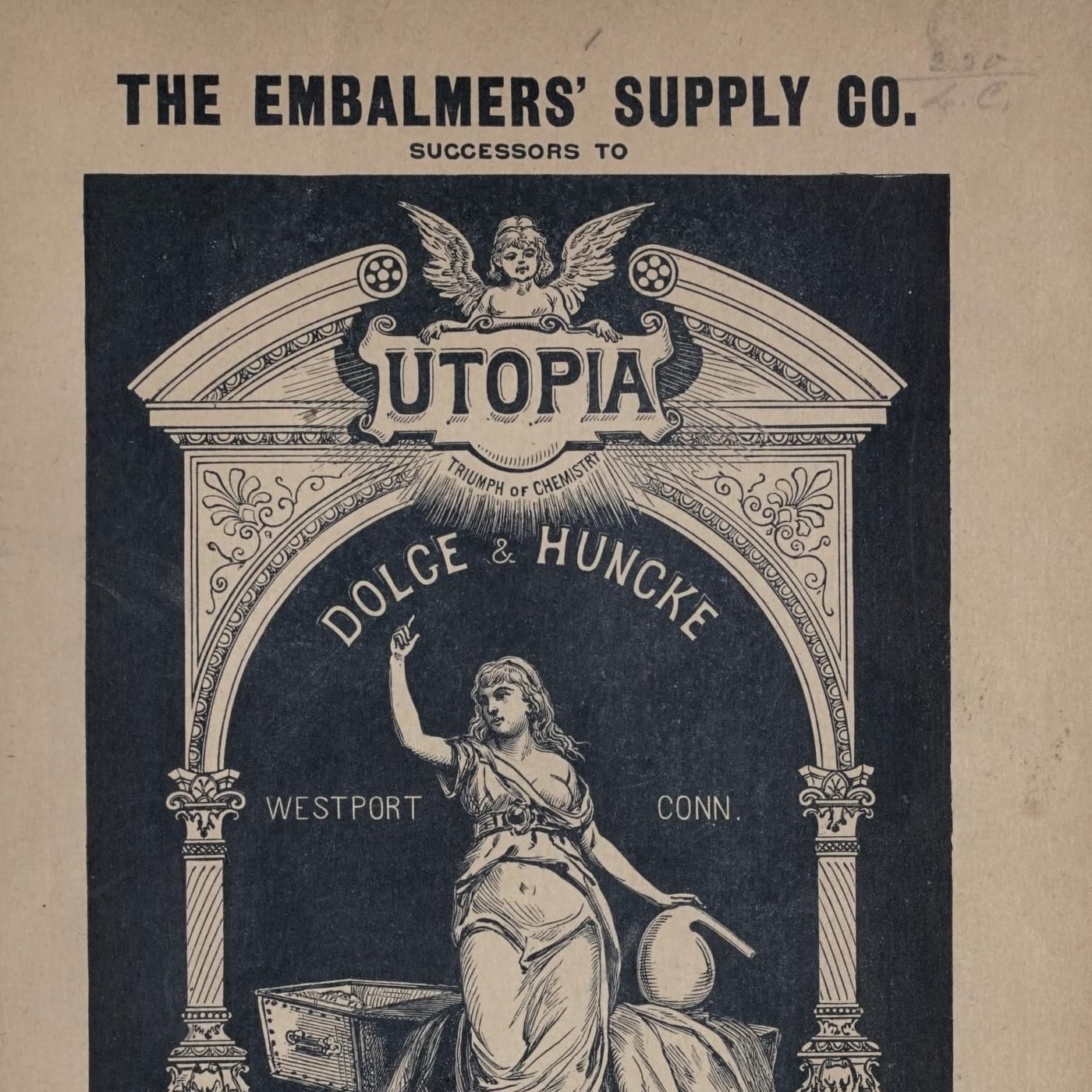
The chronology is tidy. The literature arrived first: Renouard’s Undertakers’ Manual in 1878, the first U.S. embalming textbook, turning a set of trade secrets into a teachable method. Organisation followed: a national funeral-directors’ association was formed in 1882 — its founding traced to a convention in Rochester, New York — giving the trade a collective voice and a set of shared standards. Schooling came the same year: the Cincinnati School of Embalming, commonly cited as the first U.S. embalming school, was founded in 1882 by Joseph Henry Clarke, with Renouard opening a Rochester school shortly after. Manufacture professionalised next: the Embalmers’ Supply Company (ESCO) was founded in 1886 (introducing American-made embalming instruments and accessories from the following year, as the Hand Pump and Bulb Machines dive records), so that trocars, aspirators, and fluids came from a catalog rather than from Germany or the operator’s own bench.
Then the state stepped in. Virginia in 1894 passed the first state embalming-licensing law, establishing a board of embalming and making unlicensed practice a misdemeanour, expressly “to provide for the better protection of life and health, to prevent the spread of contagious disease, and to regulate the practice of embalming and the care and disposition of the dead.” The idea spread fast: by 1900, on the Library of Congress’s account, some twenty-four states had enacted similar statutes regulating licensing, education, and technical preparation. Within a generation, embalming had gone from an itinerant surgeon’s trick to a licensed occupation with a textbook, a professional association, a supply industry, and a state-issued credential — and the trocar was standard-issue in every one of those licensed shops. The professionalisation arc the Gravity, Hand Pump, and Electric dives each trace from their own corner of the apparatus converges here on the same destination.
4.6 What “permanent preservation” actually delivered
The trade’s language ran ahead of its chemistry, and honesty requires drawing the line. Embalming — arterial and cavity together — is retardation of decomposition, not its prevention. It fixes proteins and disinfects tissue enough to suppress the bacterial and enzymatic decay that would otherwise proceed within hours, and cavity treatment extends that suppression to the hollow interior the arterial fluid missed. What it buys is time: enough for a viewing, and enough for a journey. What it does not buy is permanence.
Period claims like Renouard’s “nine months without any perceptible change,” and the later marketing vocabulary of “permanent” or “everlasting” preservation, should be read in that light — as the best-case, best-conditions results (“a dark and moderately cool place”) of a process that everywhere else is fighting a losing battle against time. The modern regulatory verdict is explicit on the point: under the U.S. Federal Trade Commission’s Funeral Rule, a provider “may explain to the family that embalming will temporarily preserve the body,” but is prohibited from claiming that embalming “will preserve the body of a deceased for an indefinite time,” because the FTC’s investigation found such claims untrue. The nineteenth-century trade sold what physics allowed it to sell — a reliable few days to a few weeks, more under ideal storage — and the durable-preservation advertising, then as now, works only if “durable” is read as “long enough,” not “forever.”
This is the through-line to the Quack Devices wing, and the contrast that makes it worth stating. A Violet Ray Wand dressed a trivial physical effect in the language of a cure; the embalming trade did something subtler and more defensible — it took a real and genuinely useful effect and inflated its duration. The trocar and the cavity treatment it performs are honest engineering. It is only the word “permanent” that needs debunking, not the instrument.
4.7 Where this volume hands off
This volume argued that cavity treatment completed arterial injection, made embalming into the transport-ready preservation the railroads came to require, and grew up alongside the schools, associations, supply houses, and licensing laws that turned undertaking into a profession between 1878 and 1900. The final volume, Vol 5 — Collecting Trocars and Aspirators, brings the hardware back to the present as a collector’s subject: how to identify and date a trocar by its point pattern and construction, how to tell a hand instrument from an electric or hydro-aspirator outfit, what a complete cased set contains, and how to display these instruments soberly as trade history — favouring, as the whole dive has, isolated-instrument photographs and diagrams over anything anatomical. Readers who came for the object rather than its social history will find the practical collecting guidance there.
Sources
- Auguste Renouard, The Undertakers’ Manual (1878) — Project Gutenberg — the primary text: the first U.S. embalming textbook; shipping “over long distances the bodies of those that have died far from home”; the abdominal cavity treatment (about four ounces of fluid over the intestines, a further six-to-eight ounces “between the interstices of the bowels”); and the “nine months without any perceptible change” preservation claim, used here as a documented period claim and debunked against the FTC rule.
- Auguste Renouard — Open Library record for The Undertakers’ Manual — confirms authorship, title, and 1878 first-edition dating of the manual.
- Funeral Homes and Funeral Practices — Encyclopedia of Cleveland History, Case Western Reserve University — the 1898 baggage-handlers’ strike (“tired of having bodies explode,” “demanded and got embalmed corpses”); that “the period between death and burial could now be extended”; and a state undertakers’ association (1881) and national association (1882).
- Evolution of American Funerary Customs and Laws — Library of Congress, In Custodia Legis — Virginia’s 1894 first state embalming-licensing law and its stated purpose; that by 1900 some twenty-four states had enacted similar statutes. (Fetch was blocked in this pass; the specific figures were taken from the LoC page as surfaced in search and should be re-confirmed directly by the reviewer.)
- About NFDA — National Funeral Directors Association — the national funeral-directors’ association traced to an 1882 founding in Rochester, New York (note the exact original name varies in secondary accounts).
- The History of Embalming in America — Funeral.com — secondary trade history: Renouard’s 1878 manual, the Cincinnati School of Embalming (1882, Joseph Henry Clarke), embalming’s spread for delayed and distant burial; cross-checked against primary and museum sources above.
- Complying with the Funeral Rule — U.S. Federal Trade Commission and The FTC Funeral Rule — FTC Consumer Advice — the modern legal line: embalming may be described as temporary preservation, and providers are prohibited from claiming it preserves a body “indefinitely.” Used to debunk the “permanent preservation” marketing.
- Nunnamaker & Dhonau, Anatomy and Embalming (1912) — Project Gutenberg — the two-branch rationale that arterial injection does not assure treatment of the hollow organs, carried over from Vol 1; cavity treatment as the complement.
- Samuel Rodgers, U.S. Patent No. 227,654 — Google Patents — the 1880 trocar patent giving cavity work its instrument (“through the navel,” reaching the viscera “without mutilating the body”); dated here to anchor the “by 1880 the method was complete” claim, with the priority dispute deferred to Vol 3.
Comments (0)