Spectro-Chrome and Color Therapy · Volume 5
Collecting and the Color-Therapy Afterlife
What survives of the Spectro-Chrome, how collectors identify and date a projector and its slide set, why the FDA seizure is the object's pedigree, and how chromotherapy persists today as wellness pseudoscience — displayed as history, never used as treatment.
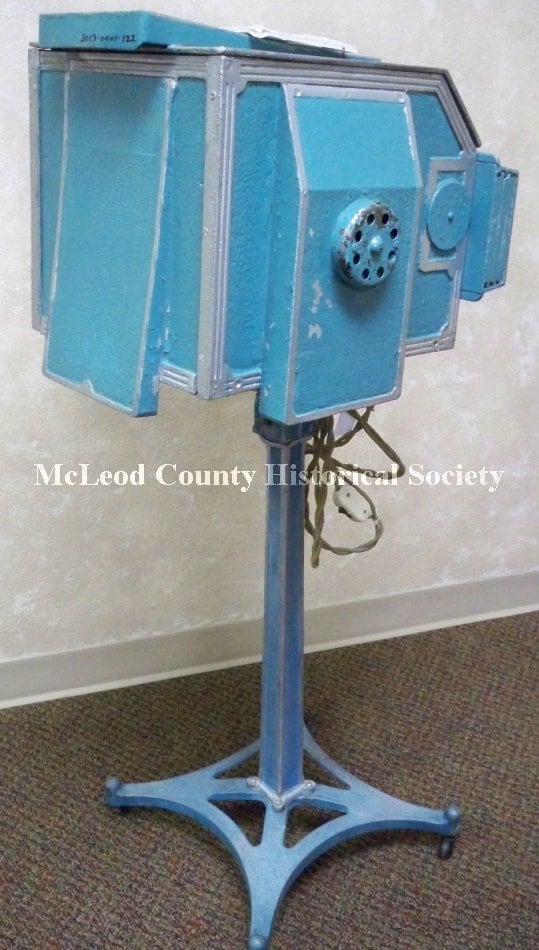
Four volumes have taken the Spectro-Chrome apart: the projector and its coloured slides, the flat physics of filtered light, the man and the chromotherapy tradition he inherited, and the trials that ended production. This closing volume is for the person who now stands in front of a surviving example — in a museum case, at an estate sale, or in an online auction lot described with far more romance than accuracy. It covers what survives, how to read and date it, why its seizure history is the best thing about it, and the uncomfortable fact that the idea outlived the injunction: chromotherapy is alive and selling today. The object is worth keeping and showing. It is not, and never was, worth using.
5.1 About this volume
The Spectro-Chrome is one of the more satisfying objects in the quackery field to collect, for the same reason it was such a clean specimen to analyse: it is almost nothing. A tin lantern, a stand, a high-wattage bulb, and a handful of coloured glass panes. Nothing about the hardware is fragile electronics or perishable chemistry; a projector that has sat in an attic for eighty years is usually intact, if dusty. What makes a given example valuable is not the metalwork — any period sheet-metal lantern is worth little — but the paper and provenance around it: the labelling, the slide set, the enrolment literature, and, at the top of the tree, a documented connection to the federal seizures that pulled these machines off the market.
This volume assumes you have read the rest of the dive and refers back rather than repeating. The physical object and its “attuned color waves” system are laid out in Vol 1; why the coloured light did nothing systemic — the sharp line between it and genuine phototherapy — is Vol 2; Ghadiali and the older tradition are Vol 3; the court cases and the 1958 injunction are Vol 4. Here we catalogue what is left, and follow the idea past the injunction into the present.
5.2 What survives, and where
Spectro-Chromes survive in three overlapping populations: museum holdings, the auction stream, and the living successor organisation.
The flagship museum example is at the Smithsonian’s National Museum of American History, which holds at least two Spectro-Chrome records; the museum states that its projector was transferred to the Smithsonian by the Food and Drug Administration in 1967 — the year after Ghadiali’s death, and out of the same enforcement apparatus that had prosecuted him. That single provenance line is the whole moral of the object: it entered the national collection not as medicine but as evidence.
The Mütter Museum of the College of Physicians of Philadelphia has displayed a Spectro-Chrome, and the College’s Historical Medical Library holds a substantial Spectro-Chrome archive — photographs, correspondence, and miscellaneous items, some of it used as evidence at the 1946 trial. The paper trail there was placed on permanent loan by the FDA in 1982 and formally transferred to the library in 1991, which makes Philadelphia the single richest documentary holding for the whole affair. Other quackery and history-of-medicine collections (for example the science-museum galleries that also hold violet-ray and radionics apparatus) carry comparable colour-therapy objects, and the Dinshah P. Ghadiali papers survive as an archival collection in California, so a researcher can reconstruct the enterprise from originals rather than from hostile summaries alone.
The auction stream is where a private collector meets one. Projectors surface periodically on the general antiques market, described variously as “circa 1930s,” “Spectro-Chrome Metry projector,” and — the tell that a seller has done some homework — “pre-Malaga,” meaning a unit made before the Institute consolidated at Malaga, New Jersey (see Vol 1 and Vol 3). Prices are modest by antique-scientific-instrument standards precisely because the hardware is humble; the premium is entirely for completeness, labelling, and story.
5.3 Reading a projector: identifying and dating
Confronted with a mystery lantern, work from the outside in.
Labels and plates first. A surviving Spectro-Chrome Institute label, transfer, or serial plate — Malaga / Franklin Township, New Jersey — is the single most valuable identifying feature, both because it confirms the maker and because printed labelling was the exact thing the government prosecuted (a labelled unit is a documented one). Earlier units may carry earlier addresses; the geography of the label is itself a dating clue, since Ghadiali’s operation moved before settling at Malaga in the early 1920s.
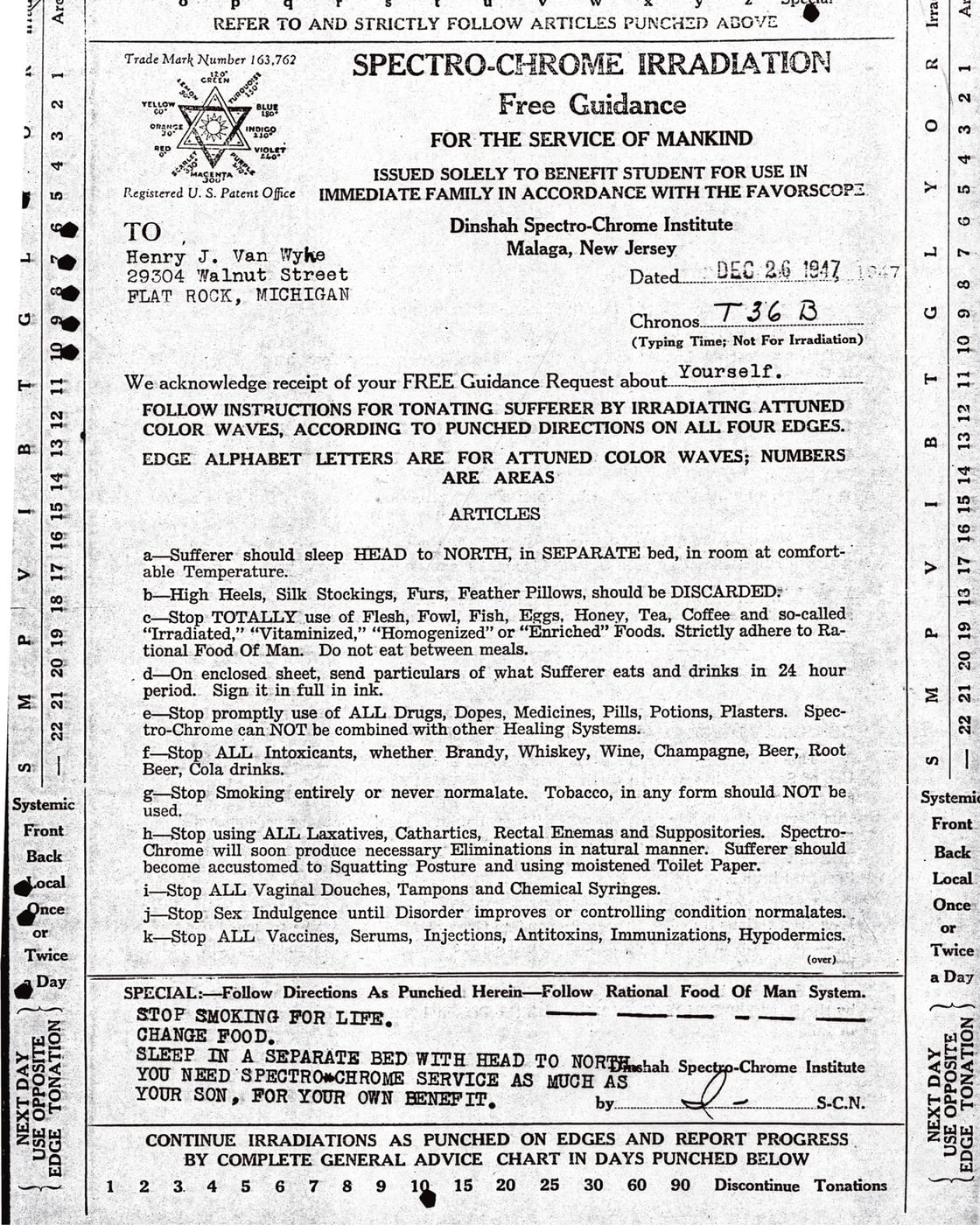
The enrolment literature. These were sold as home appliances bundled with a course of instruction, so a complete example often arrives with printed matter: the Spectro-Chrome Metry Encyclopaedia (1933), course pamphlets, a “colour prescription” or tonation schedule, and membership paperwork tying the buyer to the Institute. That paper both dates the set (by edition and address) and multiplies its value; a projector with its original booklet is a far better artefact than a bare lantern.
The hardware particulars. Absent a plate, the housing style, the stand, the lamp fitting, and the slide carrier place a unit within roughly the 1920s–1940s production window that ended when the courts shut manufacture down (see Vol 4). Do not over-read the metalwork: because the design was trivial and widely imitated — and because home builders and later enthusiasts have reproduced the concept — a lantern alone proves little. Cross-check any seller’s “1920s” claim against the label and literature rather than the tin.
5.4 Condition, completeness, and the slide set
Grade a Spectro-Chrome the way you would grade any cased instrument: the case is common, the contents make the value.
The slide set. The coloured glass slides are the collectable heart, and — as Vol 1 established — the economy of the system is itself a dating and authenticity check: the projector rendered its twelve “attuned color waves” from only about five coloured glass filters, used singly or in pairs. A lot advertised with a fat box of a dozen distinct panes should raise an eyebrow; the genuine set is small. Inspect each pane for cracks, chips, and colour (period glass, not modern theatrical gel), and treat any that are obviously modern replacements as what they are.
The lamp and wiring. These were mains appliances built around an ordinary high-wattage incandescent lamp, so the same caution that governs any pre-war electrical antique applies: century-old cordage and a hot ~1,000-watt-class bulb make powering an untested unit a fire and shock hazard, not a demonstration. Assess the wiring as perished until proven otherwise, and see the display note below — there is no reason to energise one.
The housing and stand. Cosmetic but value-setting: original finish, an intact stand, an un-reproduced slide carrier, and any surviving factory label. A complete unit — lantern, stand, small set of period slides, and original literature — is worth far more than the sum of loose parts, and is the only configuration worth paying a premium for.
5.5 Provenance: the seizure is the pedigree
Here the Spectro-Chrome differs from most collectables, and it is worth being explicit. For an ordinary antique, a brush with the law would be a defect. For this object, the federal case is the pedigree. The Smithsonian’s projector is valuable partly because the FDA transferred it in 1967; the Philadelphia archive matters partly because its contents were trial evidence in 1946. A unit whose paperwork can be tied — by address, by edition, by a named owner — to the era of the misbranding conviction and the 1958 injunction is a documented artefact of one of the most important medical-fraud prosecutions in American history, not merely an old lamp.
So the collector’s discipline is documentary. Photograph every slide and every printed page; record the exact wording and address of any label; note where the unit came from and any chain of ownership. That record is the difference between “an old colour-light box” and a dated, attributed specimen of the enterprise the FDA Notices of Judgment recorded count by count. Do not, however, invent an accession number or a trial link the paperwork does not support — the field is thick enough with inflated stories without collectors adding to them.
5.6 The color-therapy afterlife
The injunction ended the machine. It did not end the idea, and honesty about the object requires saying so plainly.
The most direct survival is institutional. Ghadiali’s son, Darius Dinshah, founded the Dinshah Health Society — a New Jersey non-profit established in 1975 (granted federal tax-exempt status in 1977) — to keep the method in circulation. Its principal vehicle is the manual Let There Be Light, now in its thirteenth edition (2021), which presents Spectro-Chrome as a home practice of shining specific colours on the body, and which the Society sells alongside colour references and materials. The Society’s own literature is careful in the modern regulatory way: it now carries the standard disclaimer that the system is “not intended to diagnose, treat, cure, or prevent any disease,” language that is itself a monument to Vol 4’s history — the exact claims that the courts and the FDA forbade are precisely the ones the successor is now legally obliged to disown. The doctrine persists; the promise has been struck from the label.
The broader survival is commercial, and much larger. “Chromotherapy” is now a fixture of the wellness industry — coloured-LED panels marketed with infrared saunas, “colour therapy” glasses, spa treatments, and chakra-keyed light gadgets — reciting essentially Ghadiali’s premise that particular colours act on particular organs or “energy centres.” The scientific verdict is unchanged from Vol 2: chromotherapy is classed as pseudoscience, with no credible evidence that a low-power coloured LED shone on the skin treats systemic disease, and the specific colour-to-organ mappings have never been demonstrated. The contrast with the genuine, narrow phototherapy the fraud always imitated remains stark — Finsen’s ultraviolet for lupus vulgaris, neonatal blue light for jaundice, and bright-light therapy for seasonal affective disorder (which needs on the order of 10,000 lux of full-spectrum white light, not a dim tinted glow) are real, mechanism-specific, dose-specific treatments. Modern chromotherapy borrows their vocabulary and their credibility while doing what the Spectro-Chrome did: shining coloured light and calling it medicine.
For the collector this afterlife is context, not endorsement. It explains why the object still resonates — the pitch never died — and it sharpens the reason to display the antique as a cautionary artefact: a machine that a court destroyed, whose central error is still being sold.
5.7 Displaying it honestly
Displayed cold, a Spectro-Chrome is an excellent object: the lantern on its stand, the small box of coloured slides open beside it, and — if you have them — the tonation schedule and enrolment booklet laid out as the real payload. The honest label is the one that tells the whole arc in a sentence: a thousand-watt bulb behind coloured glass, sold as a cure for nearly every disease, convicted as a fraud and enjoined out of production, shown here as history. Do not stage it as a working treatment; do not photograph a person “under tonation”; do not repeat a colour-cure claim on a display card except in quotation marks, as Vol 1 does, to catalogue the fraud rather than commit it.
Practically: keep it dry and out of direct sun (to spare the finish, the label, and any paper), leave the plug in the drawer (an untested pre-war mains appliance is a hazard, not a demo — if you want coloured light for a photograph, use a modern safe source, never the antique), and store the original literature flat and archivally, since the paper is the most valuable and most perishable thing in the set. A Spectro-Chrome shown this way does exactly the work this collection wants from it: it makes the mechanism of the fraud legible, and it lets a visitor see how little was inside a very large promise.
5.8 Where this dive ends
This is the last volume of the Spectro-Chrome dive. The object closes the loop the collection keeps returning to: a persuasive-looking medical box a family bought, plugged in, and worked on itself from a booklet — the same commercial category as the violet-ray wand two dives over, and a cousin to the radionics boxes and radioactive tonics elsewhere in Quack Devices. Where a Spectro-Chrome differs is the purity of the specimen: no coil, no isotope, no serum — just filtered light, and an enormous structure of paper claiming it healed. Held cold, dated by its label, and shown for what a court found it to be, the projector is one of the clearest teaching objects in the whole quackery cabinet: proof of how far a system of meaning can be draped over a lamp, and how long the idea can outlive the machine.
Sources
- Quackwatch — “Colorful Nonsense: Dinshah Ghadiali and His Spectro-Chrome Device” — the core skeptical account of the device, the five-filters-make-twelve-colours economy of the slide set, and the outline of the legal history that gives a surviving unit its provenance value.
- Smithsonian National Museum of American History — Spectro-Chrome object records and Spectrochrome — museum-held projectors; the record that the FDA transferred an example to the Smithsonian in 1967, supporting the physical description and the “seizure-as-pedigree” framing.
- College of Physicians of Philadelphia — Mütter Museum / Historical Medical Library Spectro-Chrome collection — the archive of photographs, correspondence, and trial-evidence items placed on FDA permanent loan in 1982 and transferred to the library in 1991; the richest documentary holding for identifying and dating material.
- FDA Notices of Judgment Collection — Dinshah P. Ghadiali / Spectro-Chrome Institute — the primary federal record of the misbranding actions; the authoritative source a collector should tie a labelled unit’s provenance to rather than to seller lore.
- Dinshah Health Society — the living successor organisation founded by Darius Dinshah in 1975 (tax-exempt 1977); publisher of Let There Be Light; carries the modern “not intended to diagnose, treat, cure, or prevent any disease” disclaimer that documents the afterlife of the enjoined claims.
- Let There Be Light: Practical Manual for Spectro-Chrome Therapy, Darius Dinshah, 13th ed. (2021) — the current manual keeping the home-tonation practice in print, evidence that the method persists as a taught system.
- Chromotherapy — Wikipedia — chromotherapy’s classification as pseudoscientific alternative medicine, and its persistence in modern wellness (LED “colour therapy,” sauna panels), against which the Spectro-Chrome’s afterlife is measured.
- Clearlight Saunas — “A Critical Analysis of Chromotherapy and Its Scientific Evolution” — an industry-side acknowledgement that peer-reviewed evidence for consumer chromotherapy is thin, illustrating the modern commercial afterlife and its evidentiary weakness.
- Cabinet Magazine — Christopher Turner, “The Kingpin of Fakers” — narrative history of Ghadiali and the Spectro-Chrome useful for provenance context on surviving objects and the enterprise’s scale.
Comments (0)