Spectro-Chrome and Color Therapy · Volume 2
What It Actually Did: Just Coloured Light
The physics of the Spectro-Chrome — filtered visible light and nothing more — set beside the two narrow, genuine phototherapies it borrowed its credibility from: Finsen's ultraviolet lamp for lupus and modern blue-light treatment of newborn jaundice.

Contents
| Section |
|---|
| About this volume |
| What the machine is, electrically |
| The claim, and why the physics refuses it |
| The genuine phototherapy it parasitised |
| Drawing the line |
| Where this volume hands off |
2.1 About this volume
The previous volume, Vol 1 — The Projector and Its Colours, described the object: a floor-standing sheet-metal lantern holding a large incandescent bulb, a set of coloured glass slides, and a front aperture that threw a cone of tinted light onto an undressed patient. This volume asks the only question that matters about it — what was actually happening — and gives the plain answer the marketing spent thirty years obscuring. A Spectro-Chrome treatment was coloured light falling on skin. That is the entire physical event. There was no penetrating ray, no “attuned wave” reaching the organs, no tuning of the body’s chemical elements. Government experts who examined the device for the 1940s federal prosecution put it flatly: it was “merely an ordinary lamp,” and any recoveries owed to the placebo effect or the natural course of the illness.
But this is not a volume of pure dismissal, because the honest part of the story is the interesting part. Spectro-Chrome did not invent its credibility from nothing. It stood next to two real phototherapies — genuine, Nobel-honoured, still-practised medicine in which shining light on the body does something specific and measurable. Understanding why those two work, and why Spectro-Chrome does not, is the sharpest way to see the fraud. The gap is not “light is useless”; it is the distance between a narrow, mechanistically understood effect and a universal cure invented by analogy to it.
2.2 What the machine is, electrically
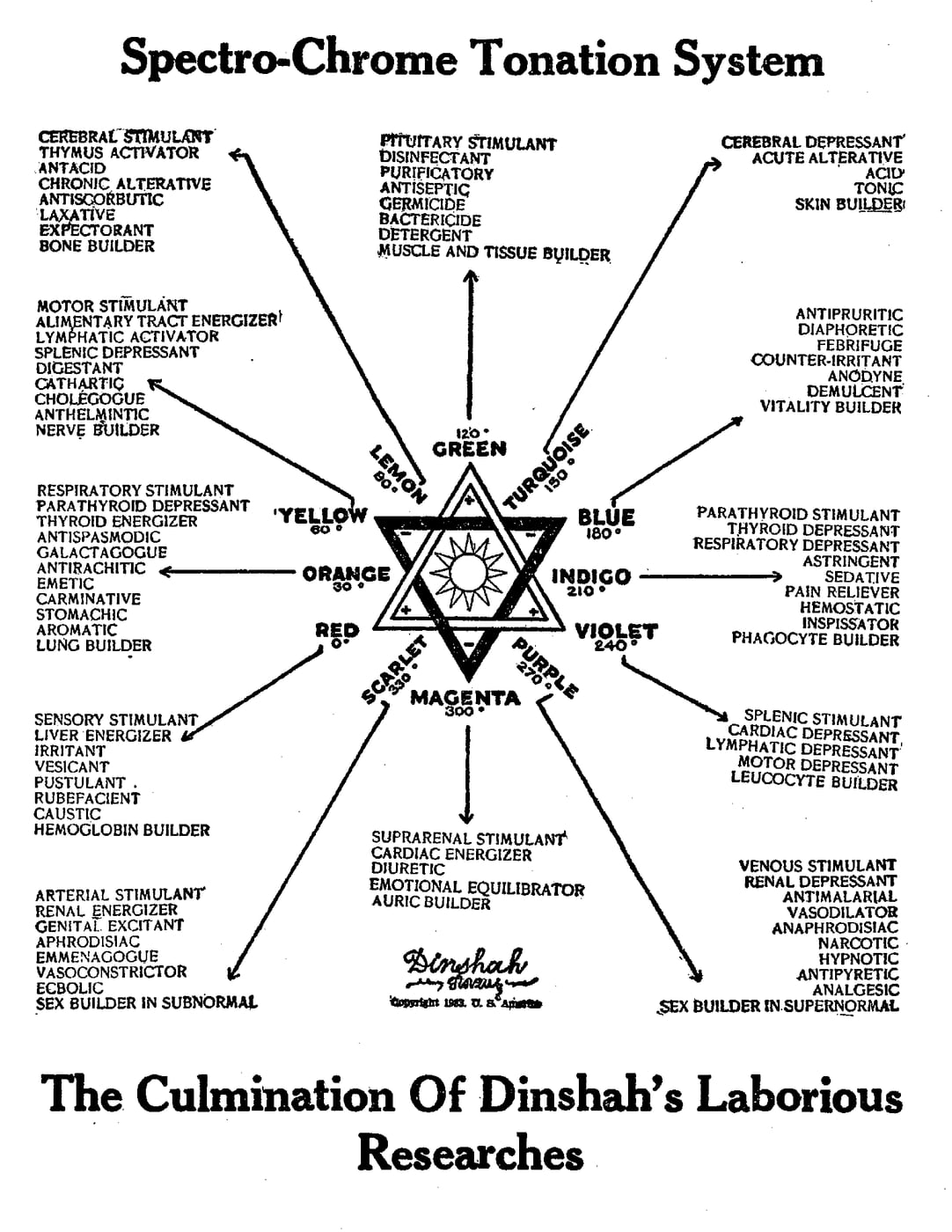
Strip the mysticism and the Spectro-Chrome is trivially simple, simpler than the violet-ray wand it shared a marketplace with. There is no coil, no interrupter, no high-frequency circuit — nothing but a lamp and some glass. Quackwatch’s description of the device examined in court is a metal box containing a 1,000-watt incandescent bulb and an opening fitted with coloured filters that Dinshah called “Attuned Color Wave Slides.” Contemporary accounts note the set comprised five filters, which could be used singly or in overlapping pairs to produce twelve named colours — a detail worth flagging, because the number “twelve” is often reported as twelve separate slides. Twelve was the count of colours in the system; five was the count of pieces of glass. (The colour vocabulary and Dinshah’s element-and-organ mappings are catalogued in Vol 3 — Dinshah Ghadiali and the Chromotherapy Tradition; this volume is about what the light does, not what he named it.)
A coloured filter does exactly one thing: it subtracts. White light from the tungsten filament is a broad mixture of wavelengths; a red slide absorbs most of the greens and blues and passes the reds, a blue slide passes the blues and absorbs the rest, and so on. Nothing is added to the light on the way through — no energy, no “charge,” no vibratory quality. The beam that leaves the aperture is dimmer than the beam that entered, and narrower in its spread of wavelengths, and that is the whole of the transformation. What lands on the patient is a patch of coloured illumination indistinguishable, physically, from the same colour thrown by any stage gel or church window. The bulb is an ordinary incandescent lamp; the glass is ordinary tinted glass; the output is ordinary coloured light.
2.3 The claim, and why the physics refuses it
Dinshah’s stated theory was that every chemical element in the body “exhibits a preponderance” of one of the seven prismatic colours — oxygen answering to blue, hydrogen to red, nitrogen to green, carbon to yellow — and that disease was a colour imbalance to be corrected by bathing the patient in the deficient or excessive hue. Green light was prescribed as a “pituitary stimulant and germicide,” scarlet as a “genital stimulant,” yellow for diabetic coma. Curiously, Dinshah himself did not claim the light penetrated: he wrote that the device acted “not by absorption or penetration, but by a process of Reinforcement or Interference on the Radio Emanations of the Chemical Body, called the Aura.” That is not a physical mechanism at all — it is invented vocabulary standing where a mechanism should be — and it fails for the same reason a penetrating-ray theory would.
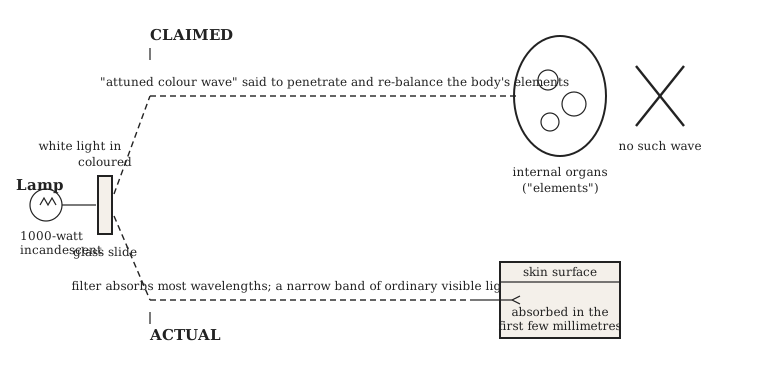
Consider the physics honestly, point by point. First, penetration: visible light barely enters the body. The longer, redder wavelengths reach deepest, but even those are absorbed and scattered within the first few millimetres of skin; blue and green penetrate less still. No visible colour reaches the pituitary, the pancreas, or the gonads to “stimulate” them — the light is gone, turned to a trace of warmth, before it is a centimetre in. Second, element tuning: the notion that a carbon atom or a nitrogen atom in living tissue can be “reinforced” by shining its “corresponding” colour on the skin has no basis in chemistry. Atoms in molecules do absorb specific wavelengths, but the absorption bands of the body’s bulk elements bear no relation to Dinshah’s colour chart, and absorbing a photon does not “balance” or heal an element — it simply deposits a little energy, usually as heat. Third, the aura: there is no “Radio Emanation of the Chemical Body” for the light to reinforce or interfere with; it is a phrase, not a phenomenon. The colours were assigned to organs and elements by aesthetic and numerological analogy — seven colours, seven planets, seven of everything — not by any measured effect. Strip the language away and a Spectro-Chrome session delivers a dim, tinted glow to the skin surface and stops there.
2.4 The genuine phototherapy it parasitised
Here is where fairness matters, because “light does nothing to the body” would itself be a false claim. Two real, respectable phototherapies flank Spectro-Chrome, and Dinshah’s marketing leaned on both. People found his theory plausible, the McGill Office for Science and Society notes, precisely because light genuinely does some medical things — the sun makes vitamin D in skin, plants live on light, and, tellingly, premature infants really are treated with coloured light. The trick of the fraud was to point at these true facts and imply that his lamp was the same kind of thing.
The first genuine case is Niels Ryberg Finsen (1860–1904), the Danish physician who founded modern medical phototherapy and won the 1903 Nobel Prize in Physiology or Medicine “for his contribution to the treatment of diseases, especially lupus vulgaris, with concentrated light radiation.” Lupus vulgaris is cutaneous tuberculosis — a disfiguring skin infection by the tubercle bacillus — and from 1895 Finsen treated it with concentrated, filtered ultraviolet light from carbon-arc lamps (the “Finsen light”), using quartz lenses rather than ordinary glass so the UV would pass, and filtering out the heat to avoid burning. It worked because ultraviolet is genuinely bactericidal and because the disease sits in the skin, exactly where the light can reach. The Finsen Institute in Copenhagen treated over 1,200 lupus patients with roughly half cured, and some forty Finsen institutes opened across Europe and America before antibiotics eventually superseded the method. Note every feature that Spectro-Chrome lacked: a specific pathogen, a specific waveband (ultraviolet, not the visible colours Dinshah used), a surface target the light could actually reach, and a measured mechanism.
The second genuine case came after Spectro-Chrome and is now in every hospital nursery: blue-light phototherapy for newborn jaundice. In 1958 R. J. Cremer (Richard John Cremer) and colleagues, at Rochford General Hospital in Essex, published in The Lancet the observation — sparked by a ward sister, Jean Ward, who noticed jaundiced babies improved in sunlight — that visible blue light lowered the level of bilirubin, the pigment whose build-up yellows a newborn’s skin and, at high levels, can cause brain injury. This one uses visible light, close to the colours Spectro-Chrome threw, so it is the most important comparison to make carefully. It works by a precisely understood photochemistry: blue light in a narrow band around 420–480 nanometres is absorbed by bilirubin molecules sitting in the capillaries of a newborn’s thin, translucent skin, and the absorbed photons reshape the molecule — converting the fat-soluble native form into water-soluble photoisomers (and the structural isomer lumirubin) that the baby can excrete in bile and urine without the liver processing that the newborn cannot yet manage. It is real, it is visible light, and it saves lives — and it still bears no resemblance to Spectro-Chrome.
2.5 Drawing the line
Put the three side by side and the line is not blurry at all. Finsen’s lamp and the jaundice lights each do one specific thing to one specific target by one specific mechanism: UV kills the tuberculosis bacillus in the skin; blue light photochemically converts bilirubin in the skin’s capillaries into an excretable form. Both act at the surface, where light can reach. Both were established by measurement and controlled comparison, not by analogy. Neither claims to cure anything else — you cannot treat a broken bone or a failing kidney with a jaundice lamp, and nobody suggests you can.
Spectro-Chrome inverted every one of those features. It offered one apparatus for essentially every disease, promising drug-free, surgery-free cure by “balancing” colour throughout the whole body — the opposite of a narrow, targeted effect. It aimed visible light at internal organs it could not reach, by a mechanism (“attuned colour waves,” “auric reinforcement”) that does not exist. And it was validated by testimonial, timetable, and a mystical colour-element chart, never by controlled test — a failure that Vol 4 — The Trials and the Reckoning shows collapsing under courtroom scrutiny, where several of the “cured” patients paraded as evidence had in fact died or remained disabled. The tell of quackery in this whole family of devices — the same tell as the violet-ray wand’s gas-discharge glow sold as ultraviolet therapy, or the diathermy overreach in the sober Electrotherapy Devices → High Frequency Currents dive — is the leap from a real, bounded physical effect to a universal cure. Spectro-Chrome made that leap in its purest form: it took a genuine truth (light can be medicine, narrowly) and inflated it into a total falsehood (this coloured light cures everything).
None of this makes the object less interesting; it makes it more so. A Spectro-Chrome is a near-perfect fossil of a specific kind of error — reasoning by resemblance. Coloured light looks powerful; medicine does use light; therefore, the argument ran, this coloured light must heal. The machine is the argument made in sheet metal and tinted glass, and its emptiness is exactly what a museum case should teach.
2.6 Where this volume hands off
You now have the physics: filtered visible light, absorbed at the skin, doing nothing systemic — set against the two narrow phototherapies whose real success the device borrowed and betrayed. The next question is human. Who built this, what tradition of colour-mysticism did he draw on, and how did a Bombay-born polymath come to project rainbows at naked patients in rural New Jersey? That is Vol 3 — Dinshah Ghadiali and the Chromotherapy Tradition, which traces the line back through Edwin Babbitt’s 1878 Principles of Light and Color and the 1870s blue-glass craze. The courtroom undoing — the 1931 New York trial, the 1940s federal conviction, and the 1958 injunction — is Vol 4 — The Trials and the Reckoning; and the surviving apparatus, and colour therapy’s stubborn afterlife, are Vol 5 — Collecting and the Color-Therapy Afterlife.
Sources
- Quackwatch — “Colorful Nonsense: Dinshah Ghadiali and His Spectro-Chrome Device” — the device as a metal box with a 1,000-watt incandescent bulb and five “Attuned Color Wave” filters producing twelve colours; the “not by absorption or penetration… Reinforcement or Interference on the Radio Emanations… the Aura” theory; colour prescriptions (green as pituitary stimulant/germicide, scarlet as genital stimulant, yellow for diabetic coma); expert testimony that it was “merely an ordinary lamp” with recoveries due to placebo or natural course.
- McGill Office for Science and Society — “Colourful conman” — Dinshah’s element-to-colour scheme (oxygen–blue, hydrogen–red, nitrogen–green, carbon–yellow) and disease-as-colour-imbalance theory; why it seemed plausible (vitamin D, plants, and genuine infant blue-light therapy); the debunking that the device was an ordinary lamp.
- The Nobel Prize in Physiology or Medicine 1903 — Niels Ryberg Finsen — the award “for his contribution to the treatment of diseases, especially lupus vulgaris, with concentrated light radiation.”
- Niels Ryberg Finsen — Wikipedia and Britannica — carbon-arc “Finsen light” using ultraviolet against lupus vulgaris (cutaneous tuberculosis) from 1895; quartz/crystal lenses to pass UV and filter heat; the Copenhagen Finsen Institute, ~1,251 lupus patients with about half cured, spread of Finsen institutes, and supersession by antibiotics.
- Nature, Journal of Perinatology — “Sixty years of phototherapy for neonatal jaundice” — Cremer, Perryman & Richards (Rochford General Hospital, 1958, The Lancet), Sister Jean Ward’s sunlight observation, and the establishment of blue-light phototherapy.
- MDPI/PMC — “Bilirubin Photoisomers in Neonatal Jaundice” — the ~420–480 nm blue band, photoisomerization of native Z,Z-bilirubin into water-soluble configurational isomers and structural lumirubin excretable without hepatic conjugation (McDonagh, 1985).
- FDA Notices of Judgment Collection (Ghadiali / Spectro-Chrome Institute) — the federal enforcement record underlying the “ordinary lamp / false-claims” finding (detailed in Vol 4).
Comments (0)