Spectro-Chrome and Color Therapy · Volume 1
The Projector and Its Colours
What a Spectro-Chrome actually is — a thousand-watt lamp behind coloured glass — and the 'attuned color waves' system of twelve colours, element-organ mappings, and timed 'tonations' that Dinshah Ghadiali built around it.
Contents
| Section |
|---|
| About this volume |
| The projector on its stand |
| The twelve attuned color waves |
| Tonation: the oriented, timed schedule |
| Sold as “a Spectro-Chrome in every home” |
| Where this volume hands off |
1.1 About this volume
Strip away the encyclopaedias, the diplomas, and the decades of court transcripts, and the Spectro-Chrome is one of the plainest objects in this whole collection. It is a lamp in a box, shining through coloured glass. A patient — undressed, because the “waves” were said to need bare skin — lay in a darkened room while a cone of red, or green, or blue light fell across the body for an hour. That was the entire treatment. There were no drugs, no electrodes, no injections, nothing to swallow. Its inventor, Dinshah P. Ghadiali, advertised exactly that emptiness as a virtue, in a slogan he repeated for forty years: No Diagnosis, No Drugs, No Manipulation, No Surgery.
This is the establishing volume of a five-part deep dive, and its job is narrow: to describe the object and the system built around it — the projector, its set of coloured slides, and the elaborate scheme of “attuned color waves,” element-and-organ mappings, and timed sessions that turned a slide projector into a claimed cure for nearly every disease. It deliberately stops short of the two arguments that follow. The physics — the flat fact that this was filtered visible light and only that, set carefully against the genuine, narrow phototherapy it imitated — is the whole subject of Vol 2 — What It Actually Did. The man himself, and the long chromotherapy tradition he inherited from Edwin Babbitt and the blue-glass fad, belongs to Vol 3 — Dinshah Ghadiali and the Chromotherapy Tradition. The trials and the regulatory reckoning are Vol 4 — The Trials and the Reckoning; collecting and the modern afterlife are Vol 5.
One caution belongs at the front. Everything below describes what the device was said to do, in the vocabulary its maker used, because you cannot catalogue the object without cataloguing its claims — the claims were engineered into the hardware. None of it is medical advice, and none of it worked. Where this volume names a colour as a “liver energizer” or a “genital excitant,” it is quoting a fraud, not reporting a fact.
1.2 The projector on its stand
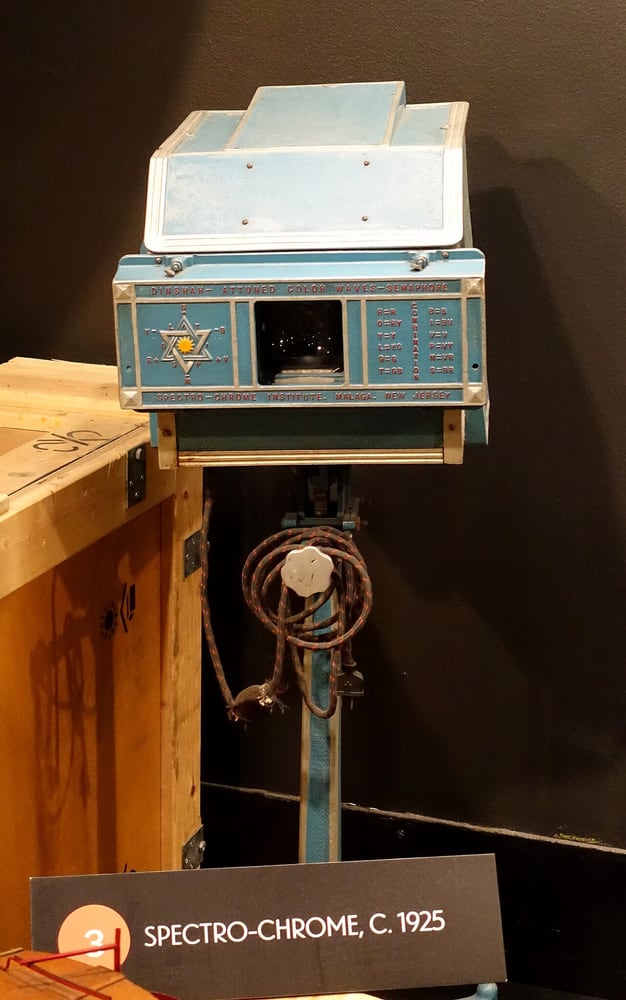
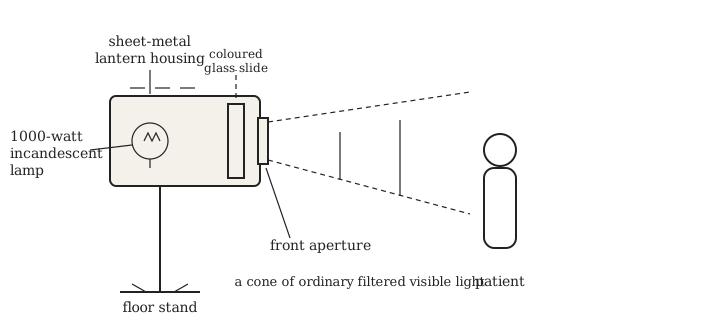
The apparatus itself is unglamorous, and that is part of what makes it such a clean specimen. Surviving examples — including the one held by the Smithsonian’s National Museum of American History — amount to a sheet-metal lantern housing mounted on a floor stand, with a high-wattage incandescent bulb inside and a slot at the front into which a coloured glass slide is dropped. Popular and skeptical accounts alike settle on a 1,000-watt incandescent lamp as the light source — a genuinely bright, genuinely hot ordinary bulb of the interwar era, the same technology that lit a stage or a shop window.
The optics were minimal. Light from the lamp passed through a coloured glass slide held in a carrier at the front of the housing and left through an aperture as a diverging cone of coloured light, aimed at the reclining patient a few feet away. There was no focusing to speak of, no shutter mechanism of any subtlety, and nothing between lamp and skin but a pane of tinted glass and open air. Later and home-grade versions were smaller tabletop boxes rather than the full standing “lantern,” but the principle never changed across the product’s life: hot filament, coloured pane, bare skin.
It is worth pausing on that simplicity, because the elaborate part of the Spectro-Chrome was never the hardware. A competent tinsmith could have built the housing; the bulb came off a shelf. What Ghadiali sold, and what he defended through two decades of litigation, was the system of meaning draped over the box — the doctrine that each colour was an “attuned color wave” carrying a specific therapeutic potency, delivered to a specific organ, on a specific schedule. The value, in other words, lived entirely in the instruction booklet, not in the machine. That is the classic structure of the paper-and-lamp fraud, and the rest of this volume is really a tour of the paperwork.
1.3 The twelve attuned color waves
Ghadiali’s scheme organised colour into twelve hues arranged as a wheel, which he called the “attuned color waves”: red, orange, yellow, lemon, green, turquoise, blue, indigo, violet, purple, magenta, and scarlet. Descriptions of the physical slide set are consistent on a telling economy — the projector shipped with only about five coloured glass filters, which were used singly or in pairs to render the full set of twelve. That detail is worth holding onto: the “twelve waves” were partly a bookkeeping of glass combinations, dressed as a spectrum of distinct healing energies.
The colours were tied to matter through a piece of pseudo-chemistry. Ghadiali taught that the four elements making up the great bulk of the body — oxygen, hydrogen, nitrogen, and carbon — corresponded respectively to blue, red, green, and yellow, and that shining the matching colour could reinforce or damp the body’s supposed elemental balance. Colour, in his phrase, represented “chemical potencies in higher octaves of vibration.” This is the load-bearing category error of the whole enterprise, and Vol 2 dismantles it properly; here it is enough to note that the mapping was asserted, never demonstrated, and bears no relation to how oxygen or carbon behave in tissue.
From that root, each colour acquired a roster of specific medical powers, listed in his literature with the confident vocabulary of a pharmacopoeia. In his own descriptions, green was a “pituitary stimulant,” a germicide, and a muscle-tissue builder; yellow a digestant and nerve builder; red a “liver energizer” and haemoglobin builder; blue a “vitality builder”; lemon a bone builder; indigo a haemostatic; turquoise a tonic; orange an emetic; scarlet a “genital excitant”; magenta a “suprarenal stimulant”; violet a cardiac depressant; and purple an anti-malarial. A practitioner reading a complaint off the body would look up the indicated colour — or a paired sequence of colours — and set the corresponding slide. The precision of the lists was the point: it made a slide projector read like a formulary, and it let a lay operator feel they were prescribing rather than merely switching on a lamp.
1.4 Tonation: the oriented, timed schedule
A session was called a “tonation,” and the ritual around it did more persuasive work than the light itself. The patient was to be positioned with the head pointing north, so that — in Ghadiali’s account — the body’s own field aligned with the earth’s magnetic field. The room was darkened, the skin bared to the beam, and the coloured light played on the body for a set period, commonly on the order of an hour per colour.
The timing was not casual. Ghadiali built an elaborate schedule around when a colour should be given, keyed to the time of day and to what he described as the prevailing “atmospheric colour,” with sessions apportioned across the day and, in the fuller expositions, tied to lunar and calendrical cycles — a scheduling apparatus that read as astrological in flavour. He supplied ancillary gadgets to support the ritual: “Spirometer Rods” used to compare the pressure of breath from each nostril, taken as a sign of which side or system was out of balance, and special thermometers said to distinguish acute from chronic conditions and thus to indicate treatment timing. None of these instruments measured anything therapeutically meaningful, but each added a layer of measured-seeming procedure between the patient and the plain fact of a coloured bulb.
Crucially, Ghadiali insisted the effect was not one of penetration or absorption. In his own framing the colour acted on the body “not by absorption or penetration, but by a process of Reinforcement or Interference” with the body’s supposed emanations — a formulation that conveniently sidestepped the awkward question of how visible light shone on the skin could reach an internal organ at all. He claimed the method could address essentially “any disease or condition,” with the memorable exception of a broken bone, which he conceded needed setting. The oriented posture, the timed and “atmospherically” scheduled tonations, the breath-measuring rods, and the promise of a universal, drug-free cure together made the darkened treatment room feel like a clinic. Vol 2 takes the whole edifice apart; this volume simply lays out its parts.
1.5 Sold as “a Spectro-Chrome in every home”
The Spectro-Chrome was not primarily a doctor’s instrument — it was pitched as a household one, sold with the enrolment of the buyer into Ghadiali’s Spectro-Chrome Institute, which from the early 1920s operated out of Malaga, in Franklin Township, New Jersey, just outside Vineland. Buyers paid a substantial sum for the projector and, with it, received the instruction to become their own colour therapist at home, guided by Ghadiali’s course literature and his sprawling Spectro-Chrome Metry Encyclopaedia (1933). The aspiration was explicit and often quoted in his promotion: a Spectro-Chrome in every home, restoring the body’s “colour balance” without a physician.
That home-appliance framing put the Spectro-Chrome in the same commercial category as the violet-ray wand two dives over — a persuasive-looking medical box a family bought, plugged in, and operated on itself from a booklet — and it is the reason the object turns up today in general history-of-medicine and quackery collections rather than only in professional medical holdings. It also set up the legal collision that Vols 4 tells in full. A device sold across state lines, with printed labelling promising cures it could not deliver, was precisely what the emerging federal food-and-drug law was built to reach; the “in every home” ambition was, in the end, the exposure that the government prosecuted.
For the collector and the historian, the takeaway of this establishing volume is the mismatch at the object’s core. The hardware is trivial — a lamp, a housing, a stand, and five panes of coloured glass. The system is baroque — twelve named waves, four element mappings, a dozen organ potencies, a compass-oriented posture, an astrologically flavoured timetable, and breath-measuring rods. Every ounce of the device’s claimed power lived in that second layer, and none of it was in the light. Holding a surviving Spectro-Chrome is holding the physical anchor for an enormous structure of paper — which is exactly why the remaining volumes are needed to weigh it.
1.6 Where this volume hands off
You now have the object and its system: the thousand-watt lamp and its coloured slides, the twelve attuned waves and their element-and-organ table, the oriented and timed tonation, and the home-appliance business that carried it across the country. The question the marketing worked hardest to keep you from asking is the one the next volume answers directly: what was actually happening when the coloured light fell on the skin. That is Vol 2 — What It Actually Did: Just Coloured Light, which makes the flat correction that this was filtered visible light and nothing more — no penetrating “attuned waves,” no element-tuning — and draws the sharp line between Spectro-Chrome’s universal claims and the genuine, narrow phototherapy (Finsen’s ultraviolet lamp, modern neonatal blue-light) that it imitated. From there the dive turns to Ghadiali and the older chromotherapy tradition (Vol 3), the trials and the reckoning (Vol 4), and collecting and the colour-therapy afterlife (Vol 5).
Sources
- Quackwatch — “Colorful Nonsense: Dinshah Ghadiali and His Spectro-Chrome Device” — the core skeptical account: the 1,000-watt lamp, five filters used singly or in pairs to make twelve colours, the oxygen/hydrogen/nitrogen/carbon → blue/red/green/yellow element mapping, “tonation,” the head-north posture, Spirometer Rods and thermometers, “Reinforcement or Interference” (not absorption/penetration), the “any disease except broken bones” claim, and the outline of the legal cases.
- McGill Office for Science and Society — “Colourful conman” — corroborates the box-with-a-bulb-and-coloured-filters design, the element-colour associations, and colour “properties” such as green as a pituitary stimulant/germicide and scarlet as a genital stimulant; summarises the 1931 acquittal and the 1945-era misbranding conviction with fine and five-year probation.
- Weird NJ — “Spectro-Chrome Therapy: Technicolor Cures or Kaleidoscopic Quackery?” — the Malaga / Franklin Township, NJ location of the Spectro-Chrome Institute; the 1,000-watt bulb and “five filters … twelve different colours” description; the “No Diagnosis, No Drugs … No Surgery” slogan; the 1931 Buffalo grand-larceny acquittal, the federal misbranding conviction, and the 1958 permanent injunction.
- Smithsonian National Museum of American History — “Spectrochrome” object record — a museum-held Spectro-Chrome projector, supporting the physical description (lamp housing, coloured slides) and providing the lead-figure provenance.
- FDA Notices of Judgment Collection — Dinshah P. Ghadiali / Dinshah Spectro-Chrome Institute — the primary federal record of the misbranding actions against the device and institute (twelve counts, District of New Jersey); the authoritative source for the trial outcomes examined in Vol 4.
- Wikipedia — “Dinshah P. Ghadiali” and Public Domain Review — Edwin D. Babbitt’s Principles of Light and Color (1878) — leads for the 1933 Spectro-Chrome Metry Encyclopaedia, the “chemical potencies in higher octaves of vibration” framing, the FDA-facilitated 1958 injunction against the Visible Spectrum Research Institute, and the older chromotherapy tradition (Babbitt, Pleasonton) developed in Vol 3.
Comments (0)