Spectro-Chrome and Color Therapy · Volume 4
The Trials and the Reckoning
How the law caught up with the Spectro-Chrome — organized medicine's opposition, the 1931 Buffalo grand-larceny acquittal, the 1945–47 federal misbranding conviction that fined Ghadiali and his Institute about $20,000 and outlawed the device, its affirmance on appeal, and the 1958 injunction that finally shut the successor institute.
Contents
4.1 About this volume
The three volumes before this one established what the Spectro-Chrome was and why it could not work. It was a high-wattage lamp behind coloured glass, shone on bare skin (Vol 1 — The Projector and Its Colours); the “attuned color waves” were nothing but filtered visible light, incapable of the systemic cures claimed for them (Vol 2 — What It Actually Did); and its inventor, Dinshah P. Ghadiali, sat at the end of a long chromotherapy tradition running back through Edwin Babbitt and the blue-glass fad (Vol 3 — Dinshah Ghadiali and the Chromotherapy Tradition). This volume is about the reckoning — the roughly thirty-year contest in which organized medicine, and then the federal government, took Ghadiali’s business apart in court.
It is a legal history, and legal history rewards precision, so a discipline runs through it. Where a date, dollar figure, or verdict could be pinned to a court reporter or to the FDA’s own published record it is cited as such; where a claim could only be traced to secondary or promotional accounts it is flagged in the prose. The single most important primary source is the FDA Notices of Judgment Collection at the U.S. National Library of Medicine, which preserves the government’s contemporaneous paper trail against the Spectro-Chrome. Nothing here is medical advice. It is the story of how a coloured lamp stopped being sold as medicine.
4.2 Organized medicine draws first blood
Long before any court took an interest, the American Medical Association did. The AMA’s Bureau of Investigation — the body that maintained the association’s running “Nostrums and Quackery” indictments of fraudulent healing apparatus — labelled Ghadiali, in language repeated across the secondary literature, “a fraud and a charlatan,” and published refutations of his colour-therapy claims. Its expert view was the same one Vol 2 defends on the physics: the Spectro-Chrome was, in the phrase government witnesses would later use in court, “an ordinary lamp,” and whatever benefit patients reported was attributable to the placebo effect or to the natural course of illness rather than to any property of coloured light.
But a professional society’s condemnation carried no force of law, and Ghadiali was unusually skilled at turning it to his advantage. He recast the AMA’s opposition as persecution — the self-interested medical establishment ganging up on a drug-free, surgery-free humanitarian — a posture that played well to an audience already suspicious of doctors and drugs. That framing is worth noting because it recurs across this whole field: the violet-ray and radionics promoters used it too. Organized medicine could denounce the device in print, but denunciation without a statute behind it left the Spectro-Chrome on sale. Ending the trade required the criticism to acquire teeth, and that took two separate acts of government a decade apart.
4.3 1931: the Buffalo acquittal
The first courtroom test went Ghadiali’s way, and he never let anyone forget it. In 1931 he was arrested in Buffalo, New York, and charged with second-degree grand larceny after a purchaser — described in the accounts as a former student or customer — complained that the Spectro-Chrome had failed to deliver the results promised for it. The case was tried in the New York Supreme Court (in New York’s naming, that is the trial-level court, not an appellate one).
Ghadiali mounted a defence built almost entirely of satisfied patients, and its centrepiece was a genuinely credentialed physician. Dr. Kate W. Baldwin, a senior surgeon associated with the Woman’s Hospital of Philadelphia, testified that she had used the Spectro-Chrome to treat an astonishing roster of serious conditions — glaucoma, tuberculosis, cancer, syphilis, gastric ulcers, and severe burns among them. Government experts countered that the device was merely an ordinary lamp and that any recoveries were placebo or spontaneous. The prosecution’s problem, however, was not the physics but the charge. Grand larceny required proving an intent to defraud, and a defendant who plainly believed his own doctrine — and who could parade physicians and cured-feeling patients to say so — was very hard to convict of theft. The jury acquitted him.
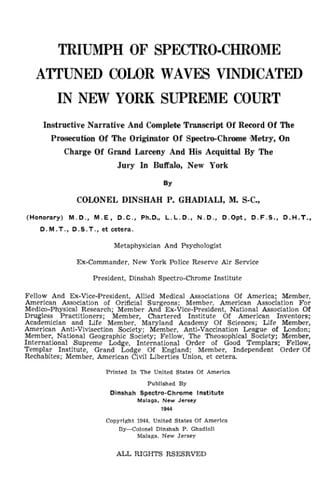
Ghadiali treated the verdict as vindication of the science itself and published the trial transcript under the triumphant title Triumph of Spectro-Chrome: Attuned Color Waves Vindicated in New York Supreme Court (issued by the Dinshah Spectro-Chrome Institute; the surviving edition is dated 1944). It was a category error he exploited for the rest of his career: an acquittal on a fraud charge, which turned on his state of mind, is not a finding that coloured light cures cancer. But it bought him another fifteen years of business, and it is the reason the government’s second attempt was framed on entirely different ground.
4.4 The law grows teeth: the 1938 FDCA
The 1931 case had foundered on the near-impossibility of proving criminal intent. The tool that finally worked did not require it. The Federal Food, Drug, and Cosmetic Act of 1938 extended federal jurisdiction, for the first time, to medical devices, making it a crime to introduce into interstate commerce any device that was misbranded — that is, whose labelling made therapeutic claims it could not support. (The same statute is the hinge of the violet-ray story in the sibling Violet Ray Wands dive; the 1906 Pure Food and Drug Act it replaced had reached foods and drugs but not apparatus at all.)
The distinction is the whole reason the second prosecution succeeded where the first failed. Misbranding is a labelling offence, not a fraud offence. The government did not have to prove that Ghadiali knew his claims were false, or that he intended to cheat anyone; it had only to prove that his device travelled across state lines carrying claims — printed in his literature and built into his whole “any disease except a broken bone” system — that the device could not deliver. Ghadiali’s sincerity, so useful to him in Buffalo, was now beside the point. A device sold nationwide from Malaga, New Jersey, with printed labelling promising cures it could not produce was precisely the object the 1938 Act was written to reach.
4.5 1945–47: the federal reckoning
The federal case moved through the courts in the mid-1940s. The government seized Ghadiali’s books and lamps, and he was indicted in the District of New Jersey on twelve counts of introducing a misbranded device into interstate commerce in violation of the 1938 Act. He appeared to answer the charges in October 1946, pleaded not guilty, and was tried and convicted by a jury — the College of Physicians of Philadelphia finding aid dates the trial to November 1946, with the guilty verdict returning against him by 1947.
This time the evidence ran the other way from Buffalo. The prosecution built its case around the human wreckage the claims had left. Contemporary accounts of the trial describe a patient who suffered a seizure on the witness stand; a paralysed patient who had been advertised as cured but could not walk; a diabetic who died after being directed to use yellow light rather than seek medical care; and — the detail that most cleanly inverted the 1931 defence — the celebrated burn patient from the earlier trial, who, far from being a triumphant cure, had in fact died of her injuries. Where Buffalo had been a parade of the satisfied, the federal trial was a parade of the harmed.
The sentence was substantial. Taken together the fines totalled about $20,000: the Dinshah Spectro-Chrome Institute was fined $12,000, and Ghadiali personally $8,000. He was sentenced to one year’s imprisonment on each of the first three counts, though execution of that prison term was suspended, and he was placed on five years’ probation; sentencing on the remaining counts was suspended. The government kept his seized books and lamps. In practical terms the conviction did what the 1938 Act was built to do: it made it a federal crime to ship the Spectro-Chrome as a cure, and so it outlawed the device’s manufacture and interstate sale as a therapeutic instrument — not by banning a lamp, but by criminalising the promises attached to it. (Accuracy note: the ~$20,000 total is the sum of the $12,000 institutional and $8,000 personal fines recorded in the FDA Notice of Judgment; secondary sources that cite “a heavy fine and five years’ probation” without a figure are summarising the same sentence.)
A biographical note keeps the man in proportion. This was not Ghadiali’s first federal conviction: in 1925 he had been convicted under the Mann Act for transporting a young female employee across state lines “for immoral purposes,” and served time in prison. That earlier case had nothing to do with colour therapy, but it establishes that the 1940s prosecution fell on a defendant already known to the federal courts.
4.6 Affirmed on appeal, and Notice of Judgment 2389
Ghadiali appealed, and lost cleanly. The United States Court of Appeals for the Third Circuit heard United States v. Ghadiali and affirmed the conviction on 9 February 1948, in an opinion reported at 165 F.2d 957. The Supreme Court of the United States subsequently denied his petition for certiorari, exhausting his appeals and leaving the misbranding conviction standing as settled law.
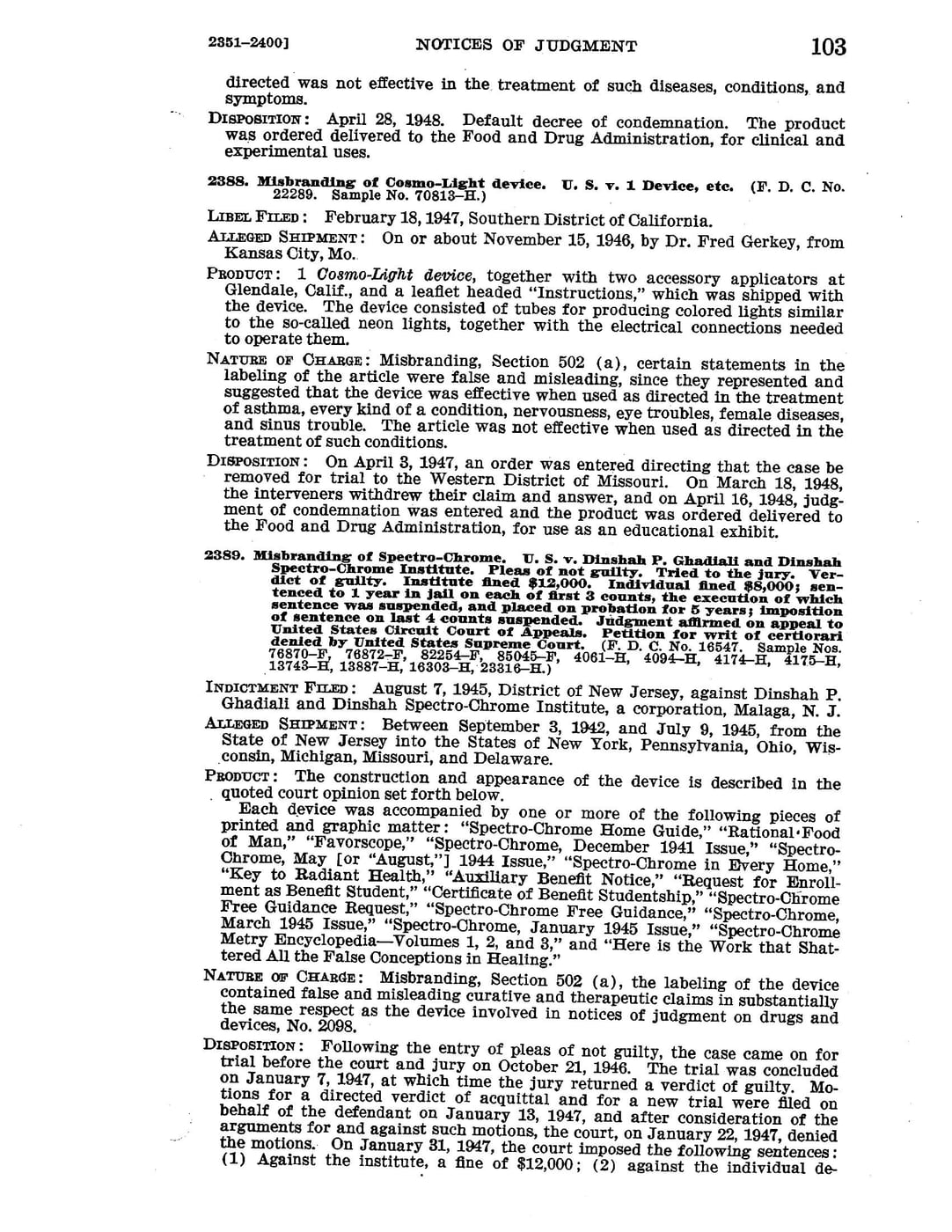
The whole proceeding is preserved in the government’s own contemporaneous record as FDA Notice of Judgment No. 2389, “Misbranding of Spectro-Chrome,” published in the Notices of Judgment series in April 1949. That document is the load-bearing citation for this volume, and it is worth understanding what it is. The Notices of Judgment were the FDA’s routinely published summaries of concluded enforcement actions — a running gazette of seizures, condemnations, and criminal convictions under the food-and-drug laws. Notice 2389 records the defendants (Ghadiali and the Malaga institute), the twelve-count misbranding charge, the not-guilty pleas, the jury’s guilty verdict, the split $12,000/$8,000 fines, the suspended prison term and five-year probation, the affirmance on appeal, and the denial of certiorari — in a few sober paragraphs. It is the reason the outcomes in this volume can be stated as fact rather than as folklore, and it is where any reader wanting the primary record should start. (The Notices of Judgment Collection is fully digitised and searchable at fdanj.nlm.nih.gov under Ghadiali’s and the institute’s names.)
4.7 1958: the injunction and the New Jersey remnant
The 1947 conviction ended the Spectro-Chrome as a nationally advertised cure, but it did not quite end Ghadiali. He was, by every account, incorrigible. Reportedly the very day his probation expired, he reorganised the business as the Visible Spectrum Research Institute and resumed selling lamps — now shipped with a label solemnly disclaiming any “curative or therapeutic value.” The disclaimer fooled no one; his surrounding literature made plain that it was a device to evade the misbranding statute rather than an honest retreat from the claims.
So the government returned a final time. In 1958 the FDA obtained a permanent injunction against the Visible Spectrum Research Institute prohibiting the shipment of Spectro-Chromes across state lines — a civil remedy that, unlike a one-off criminal fine, gave the courts standing authority to shut down any future interstate trade at a stroke. It was the definitive end of the Spectro-Chrome as an article of interstate commerce.
What survived was small and local. An injunction against interstate shipment left Ghadiali free to sell within New Jersey, and he reportedly continued doing so from Malaga until his death in 1966, at the age of ninety-two. His descendants carried the organisation forward in a diminished, wellness-tradition form — a thread Vol 5 picks up. But as a commercial medical device, the Spectro-Chrome was finished: driven out of the national market not in a single dramatic ban but in three graded steps — an AMA denunciation with no teeth, a fraud acquittal that turned on intent, a misbranding conviction that did not need it, and finally an injunction that closed the door for good.
4.8 Where this volume hands off
This volume traced the arc from criticism to conviction to injunction — the AMA’s early opposition, the 1931 Buffalo acquittal on a fraud charge, the decisive 1945–47 federal misbranding case with its $20,000 in fines and its affirmance at 165 F.2d 957, and the 1958 injunction that ended interstate sale. The regulatory story is now complete. What remains is the object’s long afterlife: how the Spectro-Chrome survives as a collector’s item and a museum specimen, how the Dinshah organisation persisted as a health society, and how “colour therapy” quietly re-entered modern wellness marketing shorn of the courtroom history that ought to accompany it. That is Vol 5 — Collecting and the Color-Therapy Afterlife, which returns the device to the present and asks what, if anything, colour light legitimately does — set carefully, as always, against the universal claims that a federal jury rejected.
Sources
- Quackwatch — “Colorful Nonsense: Dinshah Ghadiali and His Spectro-Chrome Device” — the core skeptical account: the AMA’s “fraud and charlatan” characterisation, the 1925 Mann Act conviction, the 1931 grand-larceny acquittal and Dr. Kate Baldwin’s testimony, the “ordinary lamp” expert finding, the 1940s misbranding conviction with heavy fine and five-year probation, the day-after-probation founding of the Visible Spectrum Research Institute, and the 1958 injunction and New-Jersey-only sales until his 1966 death.
- FDA Notices of Judgment Collection — Dinshah P. Ghadiali and Dinshah Spectro-Chrome Institute (Notice of Judgment No. 2389, “Misbranding of Spectro-Chrome,” April 1949) — the primary federal record: twelve misbranding counts in the District of New Jersey, not-guilty pleas, jury guilty verdict, the $12,000 institutional and $8,000 personal fines, one year’s imprisonment on each of the first three counts (execution suspended) plus five years’ probation, affirmance on appeal, and denial of certiorari.
- United States v. Ghadiali, 165 F.2d 957 (3d Cir. 1948) — the appellate decision affirming the conviction on 9 February 1948, confirming the twelve-count Federal Food, Drug, and Cosmetic Act misbranding indictment.
- McGill Office for Science and Society — “Colourful conman” — corroborates the AMA opposition, the 1931 acquittal on inability to prove intent to defraud, and the 1945-era misbranding conviction (heavy fine, seizure of books and lamps, five-year probation).
- Weird NJ — “Spectro-Chrome Therapy: Technicolor Cures or Kaleidoscopic Quackery?” — the Malaga, New Jersey institute; the Buffalo grand-larceny acquittal; the federal misbranding conviction; and the 1958 permanent injunction framing.
- HathiTrust catalog record — Ghadiali, Triumph of Spectro-Chrome: Attuned Color Waves Vindicated in New York Supreme Court (Dinshah Spectro-Chrome Institute) — Ghadiali’s own published transcript of the 1931 Buffalo grand-larceny trial, confirming the charge, the jury acquittal, and how he promoted it as scientific “vindication.”
- Federal Food, Drug, and Cosmetic Act (1938) — the statute that first extended FDA authority to misbranded devices, the legal basis distinguishing the 1947 misbranding conviction from the failed 1931 fraud charge.
- Wikipedia — “Dinshah P. Ghadiali” — secondary lead confirming the 1958 FDA-facilitated permanent injunction against the Visible Spectrum Research Institute and the continuation of the organisation after his 1966 death.
Comments (0)