Spectro-Chrome and Color Therapy · Volume 3
Dinshah Ghadiali and the Chromotherapy Tradition
The man behind the Spectro-Chrome — his self-invented credentials, his institute at Malaga, New Jersey, and the older colour-cure lineage he inherited from Augustus Pleasonton's blue-glass craze and Edwin Babbitt's Principles of Light and Color.
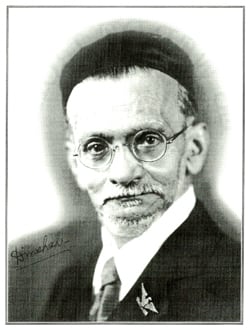
Where Vol 1 — The Projector and Its Colours described the object and Vol 2 — What It Actually Did established the physics, this volume is about the people. A lamp behind coloured glass could not, by itself, become a national health movement; a person had to make it one, and Dinshah Ghadiali spent forty years doing exactly that. But he did not invent the idea he sold. Colour-cure was already a two-generation-old American enthusiasm when he arrived, with its own founding general and its own textbook. This volume traces that lineage backward — Ghadiali, then his forerunners Edwin Babbitt and Augustus Pleasonton — and treats the tradition as what it was: a persistent, recurring fantasy that the visible spectrum is a pharmacy.
3.1 About this volume
It is tempting to treat Ghadiali as a lone crank who dreamed up coloured light in a New Jersey attic. He was not. By the time he demonstrated his projector around 1920, Americans had already lived through one full blue-light mania in the 1870s and had a fat, respectable-looking chromotherapy treatise on library shelves. Ghadiali’s genuine originality was organisational and rhetorical — he systematised the old idea into a numbered “science,” wrapped it in an encyclopaedia and a mail-order institute, and defended it in court for decades — but the core claim that a colour carries a specific healing potency was inherited, not invented.
This volume therefore does double duty. It gives the biography of the man, verified against the archival and legal record rather than his own extravagant autobiography, and it sketches the two predecessors the dive brief names. It deliberately holds back the courtroom detail of the Spectro-Chrome prosecutions — the 1931 larceny acquittal, the 1940s federal misbranding case, the 1958 injunction — because those are the spine of Vol 4 — The Trials and the Reckoning. What belongs here is the man’s own earlier legal disaster, which was personal rather than medical, and the shape of the tradition he stood at the end of.
3.2 Pleasonton and the blue-glass craze
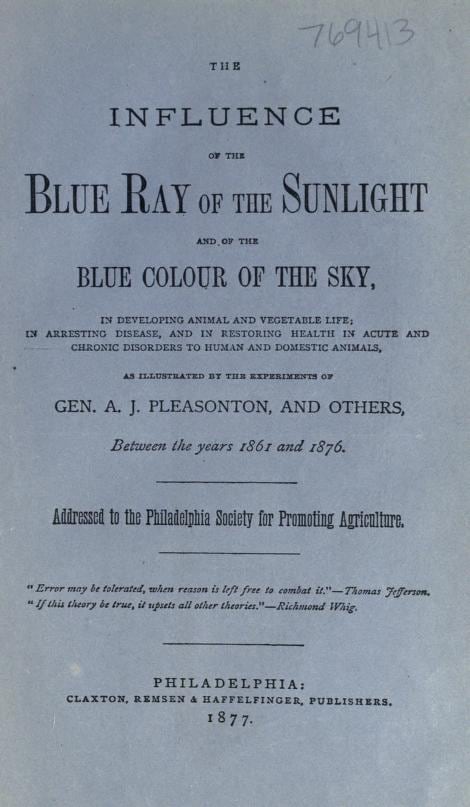
The American colour-cure begins not with a doctor but with a soldier. Augustus James Pleasonton (1808–1894), a Philadelphia lawyer and Pennsylvania militia general, became convinced through amateur greenhouse experiments that sunlight filtered through blue glass stimulated the growth of plants and animals and could arrest disease in humans. In 1876 (some editions and citations give 1877) he published his case as The Influence of the Blue Ray of the Sunlight and of the Blue Colour of the Sky — a book printed, notoriously, in blue ink on blue-tinged pages, addressed to the Philadelphia Society for Promoting Agriculture and summarising experiments he dated between 1861 and 1876.
The effect on the public was immediate and faintly ridiculous. The mid-1870s “blue-glass craze” saw people glazing panes of blue glass into their windows, spectacles, and even infant incubators, and sitting under them for their health; blue panes reportedly sold by the wagonload. It burned out within a couple of years, as fads do, but it left a residue that mattered: the notion, now planted in popular culture, that a particular colour of light was not merely decorative but physiologically active — that the spectrum could be dosed. Pleasonton’s book is frequently credited as the seed of modern pseudoscientific chromotherapy, and while that is a tidy origin story worth treating cautiously, the line of influence from his blue windows to Ghadiali’s blue slide is real enough to draw.
3.3 Babbitt: chromotherapy gets a textbook
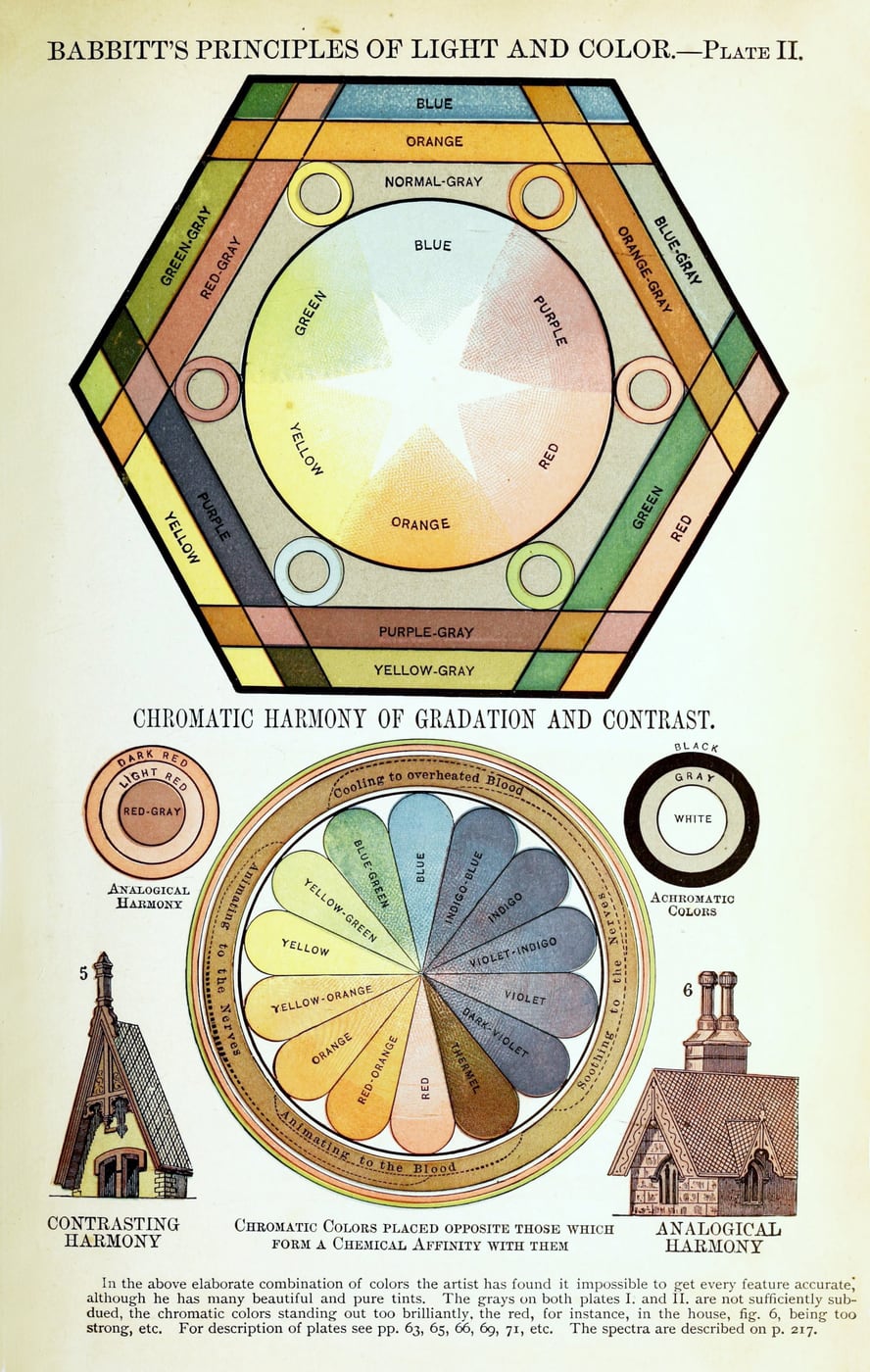
What Pleasonton started as a farming enthusiasm, Edwin Dwight Babbitt (1828–1905) turned into a system. Babbitt — born in Hampden, New York, a schoolteacher and businessman who came to medicine and “magnetic healing” in middle age — published The Principles of Light and Color in 1878, a heavy illustrated volume with coloured plates that set out an entire cosmology of “fine forces,” chromo-chemistry, and chromo-therapeutics. It reads as the first attempt to give colour-healing the architecture of a science: laws, diagrams, a spectrum mapped to bodily action, and apparatus.
That apparatus is the direct ancestor of the Spectro-Chrome. Babbitt described and sold a Chromo Lens — a hollow, double-convex glass lens some five and a half inches across, filled with coloured water, held near the body to “concentrate the rays of light into a brilliant focus” — along with colour-tinted lamp shades, a patented sun-and-vapour bath he called a “solar thermolume” (patented in 1889), and “potentised” colour-charged water for patients to drink. Strip the vocabulary and Babbitt is already doing what Ghadiali would do four decades later: passing light through coloured glass onto (or into) a patient and assigning each colour a medical office. In 1883 he institutionalised it, founding what became the College of Fine Forces in New York to grant credentials in chromotherapy and magnetic therapy — a template of the doctrine-plus-diploma-mill that Ghadiali’s institute would follow almost exactly.
The historical point is that when Ghadiali claimed a healing colour system, an educated American reader in 1920 did not hear a novelty. They heard an updated, electrified version of a doctrine that already had a book, a college, and a lineage — which is precisely what made it saleable.
3.4 The making of Dinshah Ghadiali
Dinshah Pestanji Framji Ghadiali was born in Bombay in 1873 and died in the United States in 1966. Almost everything about his early life comes from his own telling, and his own telling should be handled with tongs: he claimed to have started school at two and a half, to have become an assistant to a mathematics or physics professor at eleven, and to have begun medical study at fourteen before abandoning it. What is better attested is that he had genuine technical facility — he worked with electricity, early automobiles, and telecommunications, and ran commercial ventures in India — which matters, because it lent his later pseudo-science a veneer of real competence that a pure fantasist could not have managed.
His stated conversion narrative is a set piece of the tradition: he said he cured a young woman “dying of colitis” by shining indigo light on her (and dosing her with milk under blue light), with recovery in three days, and that this launched his life’s work. Whether or not any such episode occurred, he opened an Electro-Medical Hall in Surat, India, to develop the treatments, and he emigrated to the United States in 1911, arriving with the theory already formed. He first surfaced in American public life not as a healer but on the fringes of Indian-nationalist and Theosophical circles, and he became a naturalised citizen — a status later entangled in the wave of denaturalisation actions against Indian immigrants that followed the Supreme Court’s Thind decision, one more strand of litigation in a life full of it.
The credentials are their own tell. Ghadiali festooned his name with degrees — M.D., Ph.D., LL.D., D.C., M.E., and more — that were variously honorary, purchased, or self-conferred through the kind of unaccredited institution Babbitt’s College of Fine Forces had pioneered. This is not incidental colour; the manufacture of authority was the business. The projector was cheap and simple, as Vols 1 and 2 show; what a buyer was really purchasing was the assurance of a heavily lettered “Doctor” that the coloured light was a science.
3.5 Malaga: the Spectro-Chrome Institute
Ghadiali gave his first public Spectro-Chrome demonstration around 1920, and by the early 1920s had established the Spectro-Chrome Institute at Malaga, in Franklin Township, New Jersey — a rural crossroads outside Vineland that became the movement’s headquarters, factory, and campus. From Malaga he sold the projectors, enrolled buyers as students of “Spectro-Chrome Metry,” issued their instruction, and published the doctrine, culminating in his sprawling Spectro-Chrome Metry Encyclopaedia of 1933. Buyers did not simply purchase a lamp; they were inducted into a correspondence course and a membership, paying a substantial fee and pledging to follow the system — the structure that let Ghadiali argue, in court, that he was educating members rather than selling a medical device to the public.
Malaga was also a family enterprise, and it outlived its founder. After the federal prosecutions closed the original institute, Ghadiali’s son Darius Dinshah carried the doctrine forward through the Dinshah Health Society and the still-circulating booklet Let There Be Light, keeping the “colour balance” idea alive as a non-commercial teaching after the device itself was outlawed. That afterlife — how a suppressed 1930s fraud became a durable strand of alternative-health folklore — is the closing subject of Vol 5 — Collecting and the Color-Therapy Afterlife. What matters here is that Malaga was never just a workshop; it was the institutional body that made one man’s coloured-light theory into a membership, a curriculum, and a cause worth defending to the Supreme Court’s doorstep.
3.6 The Mann Act conviction and the man’s other troubles
Long before the Food and Drug Administration reached him, Ghadiali fell hard — and the fall was personal, not medical. While on a 1925 Spectro-Chrome lecture tour in Portland, Oregon, he was arrested and prosecuted under the Mann Act (the White Slave Traffic Act) for transporting a young woman — an employee — across state lines for immoral purposes, the relationship having spanned New Jersey and Oregon. He was convicted, sentenced to five years’ imprisonment and a $5,000 fine, and served roughly seventeen months in the federal penitentiary at Atlanta before being released by President Coolidge; he later obtained a full pardon from President Franklin Roosevelt. His appeal was rejected by the Ninth Circuit Court of Appeals in 1927 (Ghadiali v. United States, 17 F.2d 236).
Two things are worth drawing out. First, this conviction is frequently blurred, in loose retellings, into the Spectro-Chrome case — but they are distinct events a full generation apart, one a morals prosecution in Oregon in the 1920s and the other a food-and-drug prosecution in New Jersey in the 1940s. Second, the Mann Act term is very likely the source of the widespread claim that Ghadiali was “imprisoned for Spectro-Chrome.” He was not. As Vol 4 documents from the FDA Notices of Judgment, the later federal misbranding conviction brought fines totalling about $20,000 — $12,000 against the Dinshah Spectro-Chrome Institute and $8,000 against Ghadiali personally — plus five years’ probation, with the accompanying one-year jail terms suspended — a heavy penalty, but not incarceration. The myth worth correcting here is not the dollar figure (the ~$20,000 total is accurate as the sum of the institutional and personal fines) but the claim of served imprisonment: the prison terms attached to the Spectro-Chrome conviction were suspended, so repeating “fine and imprisonment” for that case conflates it with the earlier Mann Act term. The honest record is that Ghadiali went to prison once, in the 1920s, over a Mann Act charge that had nothing to do with coloured light.
That he emerged from a federal penitentiary, was pardoned, and returned to Malaga to run the institute for another two decades is itself a measure of the man’s resilience and of how thin the regulatory net still was. The device’s real reckoning was decades away, and it is the whole of Vol 4 — The Trials and the Reckoning.
3.7 Where this volume hands off
You now have the human spine of the story: a two-generation American colour-cure tradition — Pleasonton’s blue windows of the 1870s, Babbitt’s 1878 textbook and its Chromo Lens and college — that Ghadiali inherited, electrified, and organised into a national institute at Malaga, defended behind a wall of self-awarded doctorates and survived even a Mann Act imprisonment to keep running. The question the biography raises is the one the courts finally answered: what happens when a man sells a cure-all lamp across state lines under a food-and-drug law built precisely to stop him. That is Vol 4 — The Trials and the Reckoning — the 1931 grand-larceny acquittal, the 1940s federal misbranding conviction, and the 1958 permanent injunction against the successor Visible Spectrum Research Institute — with the collecting and cultural afterlife following in Vol 5. The tradition here also rhymes with the other cure-all electric appliances of the age; readers may recognise the doctrine-plus-diploma pattern from the makers in the Violet Ray Wands dive.
Sources
- Quackwatch — “Colorful Nonsense: Dinshah Ghadiali and His Spectro-Chrome Device” — Ghadiali’s 1873 Bombay birth and 1966 death, his string of self-styled credentials, the Electro-Medical Hall, the indigo-light colitis origin story, the institute at Malaga, and the outline of his legal history.
- McGill Office for Science and Society — “Colourful conman” — the prodigy-childhood claims, the abandoned medical study, immigration to America in 1911, and the summary of the 1931 acquittal and 1940s misbranding conviction with fines and five-year probation.
- Wikipedia — “Dinshah P. Ghadiali” — the 1933 Spectro-Chrome Metry Encyclopaedia, the “chemical potencies in higher octaves of vibration” framing, Pleasonton and Babbitt named as predecessors, the 1958 injunction against the Visible Spectrum Research Institute, and the son Darius Dinshah / Dinshah Health Society afterlife.
- Ghadiali v. United States, 17 F.2d 236 (9th Cir. 1927) — the primary appellate record of the 1925 Mann Act conviction arising from the Portland lecture tour, establishing the charge, the interstate facts, and the affirmed conviction.
- Dinshah Ghadiali — Theosophy Wiki — corroborates the Mann Act sentence (five years and $5,000), the ~17-month term at Atlanta, the Coolidge release and later Roosevelt pardon, and Ghadiali’s Theosophical/Indian-nationalist milieu; used cautiously as a secondary summary.
- FDA Notices of Judgment Collection — Dinshah P. Ghadiali and Dinshah Spectro-Chrome Institute (District of New Jersey) — the federal misbranding conviction on twelve counts, the $12,000 institutional and $8,000 personal fines (about $20,000 total), the suspended one-year jail terms, and five-year probation (the authoritative correction to the claim of served imprisonment); the case detail is developed in Vol 4.
- The Public Domain Review — “Blue-Sky Thinking: The Influence of the Blue Ray of the Sunlight (1877)” and Wikipedia — “Augustus Pleasonton” — Pleasonton’s dates (1808–1894), his Philadelphia militia rank, the 1876 blue-ray book, and the 1870s blue-glass craze it triggered.
- BRMI — “Edwin Dwight Babbitt” and The Public Domain Review — Edwin D. Babbitt’s Principles of Light and Color (1878) — Babbitt’s dates (1828–1905), the 1878 treatise, the Chromo Lens and 1889-patented sun-and-vapour “thermolume,” and the 1883 College of Fine Forces as the doctrine-and-diploma model Ghadiali later mirrored.
Comments (0)