Radionics and Abrams Boxes · Volume 5
The Afterlife and Collecting
How radionics outlived Albert Abrams through Ruth Drown and George De la Warr into a still-marketed 'black box' cottage industry, what survives on the collector market, and how to identify and display an Oscilloclast, Dynamizer, or Drown instrument honestly — as an artifact of fraud, never a working diagnostic device.
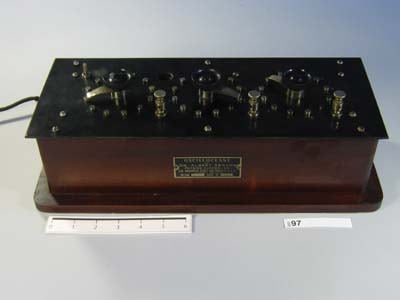
The other volumes of this dive dismantled the machine. This one follows it forward. Albert Abrams died in January 1924, nine months before the Scientific American committee that was investigating him published its verdict — and yet the “Electronic Reactions of Abrams” did not die with him. It shed his name, absorbed a new one — radionics — and passed to a lineage of successors who kept the sealed box in business for another forty years and, in diminished form, keep it in business today. This closing volume traces that afterlife through its two most important heirs, Ruth Drown and George De la Warr, then turns to the practical question a reader of this collection actually faces: you are holding, or about to buy, an Abrams-lineage black box. What is it, how do you tell a real one from a reproduction, and how do you put it on a shelf honestly — as a documented artifact of fraud, and never as a device that does anything.
5.1 About this volume
This is the fifth and last volume of the dive. It assumes you have read the rest: the object and its mystique are established in Vol 1 — The Black Box; Abrams himself and the birth of ERA in Vol 2 — Albert Abrams and the Birth of ERA; the meaningless internals — “ordinary radio parts meaninglessly wired together” — in Vol 3 — What Was Actually Inside; and the Scientific American investigation, the AMA sting, and the reckoning in Vol 4 — The Sting and the Reckoning. The story resumes here, after the reckoning failed to finish the job.
The through-line of the whole dive holds to the end: state the claim, then the physics, then the outcome. The claim was diagnosis and cure at a distance from a dried blood spot; the physics was nothing — no vibratory rates, no signal, a dead circuit; the outcome, told across Vols 4 and 5, was decades of enforcement that killed the founder’s brand but never the idea. Collecting one of these instruments is collecting that history. The discipline this volume insists on is that you collect it as history.
5.2 The lineage after Abrams: Drown and De la Warr
Two successors carried radionics past Abrams, one on each side of the Atlantic, and each made the fraud his or her own.
5.2.1 Ruth Drown (United States)
Ruth B. Drown was a Los Angeles chiropractor who built her own line of black boxes in the 1930s and ran them out of a Hollywood laboratory. Where Abrams had percussed the abdomen of a healthy “reagent,” Drown replaced the tapping with a rubber pad the operator stroked with the fingertips: a sticky drag under the finger — the ideomotor “stick” — signaled a “tuned” reaction. Her instruments carried banks of dials numbered 0–10, footplates, and a micro-ammeter, and home treatment units were sold for around $588 (per the Quackwatch account of the case). Her most theatrical claim was “radio-vision” photography — she said her machine could photograph the diseased internal organs of a patient anywhere on earth from a spot of blood. Expert witnesses at trial called the resulting plates meaningless, one likening them to Rorschach inkblots; University of Chicago researchers reproduced identical images simply by briefly exposing photographic plates to light.
Drown was prosecuted by the FDA in 1951 for introducing a misbranded device into interstate commerce. A federal jury convicted her; a government witness, the urologist Dr. Elmer Belt, testified the device was “perfectly useless… I couldn’t even use it to amuse the children.” She was fined $1,000, stopped shipping across state lines, and otherwise carried on in California. The end came later: on 23 May 1963 a California Department of Public Health investigator, Jackie Metcalf, brought Drown’s associates blood samples she said were her sick children’s — the samples were turkey, sheep, and pig blood — and paid $50 apiece for confident diagnoses. Grand-theft charges followed; in court Dr. Moses Greenfield dismantled a Drown instrument on the stand and showed it to be, in essence, “a length of wire linking together two pieces of dissimilar metal,” and the judge compared the underlying theory to “voodoo or witchcraft.” Ruth Drown died in 1965 while awaiting trial. Her equipment was seized and destroyed — which is exactly why surviving genuine Drown instruments are scarce.
5.2.2 George De la Warr (United Kingdom)
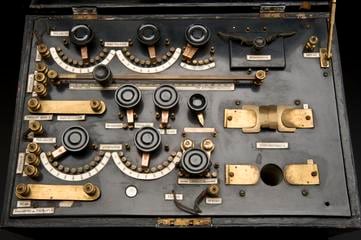
George Walter De la Warr (1904–1969) was an English civil engineer who left conventional engineering in the early 1950s to build radionic boxes at Delawarr Laboratories in Oxford. His instruments — explicitly descended from Abrams and Drown — used Drown’s finger-stroked rubber pad rather than Abrams’ abdominal percussion, and his laboratory’s product line ballooned into a catalogue of “detectors”: a diagnostic instrument, a “vibrograph,” a “psychoplot,” and above all a radionic camera he claimed could photograph disease, and even a person’s thought, at a distance.
The pivotal legal moment was the 1960 High Court case in London. A former customer, Catherine Phillips, sued De la Warr, alleging his diagnostic instrument was worthless and had damaged her health. After roughly ten days the judge found for De la Warr — but pointedly declined to endorse the box, the ruling turning on De la Warr’s apparent sincere belief rather than on the device working; De la Warr’s own defence was that the apparatus “operated above the physical plane” and served merely as a focus for thought. It is a revealing verdict: even in victory, the box was not held to do anything. Delawarr Laboratories continued until 1987; the radionic camera later passed to the California researcher Marcel Vogel and vanished after his death in 1991. The date detail worth flagging: some references give De la Warr’s birth year as 1905 rather than 1904, and his forename spelling and his laboratory’s (“De la Warr” the man, “Delawarr” the firm) are inconsistently rendered across sources.
5.3 Radionics today
Unlike violet-ray wands, which were driven out of manufacture, radionics never fully stopped — because it had already retreated to a defence that no seizure could touch. Once De la Warr told a court his box “operated above the physical plane,” radionics reclassified itself from medical instrument to psychic focusing aid, and in that guise it survives as a small alternative-therapy cottage industry. There is a Radionic Association in the United Kingdom offering practitioner training, and radionic “instruments” — often now just a box of dials and a stick-pad, or software — are still sold and used, frequently rebranded toward agriculture (“agricultural radionics”) or dowsing to sidestep medical-device law. In the United States the tradition was carried into the postwar decades by Abrams’ Electronic Medical Foundation under Fred J. Hart — ordered by a federal court in 1954 to stop distributing the devices, after which Hart founded the National Health Federation health-freedom lobby — and later by the U.S. Psychotronics Association.
The verdict of science is unchanged and unambiguous. The claimed “vibratory rates” have no physical basis; the diagnostic reaction is the operator’s own ideomotor movement, the same unconscious muscle action that drives a Ouija planchette or a dowsing rod. The U.S. Food and Drug Administration recognises no legitimate medical use for radionic devices, and systematic reviews have found radionics no more effective than placebo — it is, in the plain classification of the literature, pseudoscience. A collector should carry that forward as the governing fact: the modern survival of radionics is a fact about marketing and belief, not about the device having ever been re-validated. Nothing has changed inside the box since Vol 3.
5.4 What survives: identifying an Abrams-lineage instrument
Genuine period instruments do surface — Abrams’ firms alone are said to have placed on the order of 5,000 devices with roughly 3,000 practitioners — but the field is muddied by two things: contract secrecy that discouraged photography and documentation at the time, and destruction orders (as in the Drown case) that thinned the survivors. What you are likely to meet:
- Abrams devices. The Oscilloclast (the treatment box) and the Dynamizer (the diagnostic box), plus later relatives — the Radioclast, Autoclast, and Pathoclast made by licensees and imitators. Expect a wooden or metal cabinet, an engraved panel of rheostats and numbered dials, terminals for the blood-specimen electrode and the “reagent” connection, and often a maker’s plate tying it to Abrams’ San Francisco operation or a licensee. The contract that forbade opening the box means an unmolested, sealed original is itself a documentary object; conversely, an already-opened one lets you show the empty theatre inside (see Vol 3).
- Drown devices. Bench and portable units with 0–10 dial banks, footplates, a micro-ammeter, and the characteristic rubber detecting pad. Genuinely scarce because California destroyed seized examples.
- De la Warr / Delawarr devices. Oxford-made instruments and cameras, dial-and-pad boxes, some quite elaborately built.
Authentication rests on the ordinary museum disciplines rather than any electrical test — because there is nothing to test. Read the maker’s plate and the panel engraving; match the model name against the documented Abrams/Drown/Delawarr product lines; weigh the provenance — a lease contract, a practitioner’s letterhead, an FDA or court exhibit tag, or an old museum accession is worth more than the metal. Be sceptical of round numbers and dramatic dollar figures attached to auction lots: this field inflates its own history, and a seller’s story is not provenance. Do not fabricate or trust an unverified accession number. And note the honest gap in the record: because these boxes were deliberately hidden from view in their own day, confident attribution of an unmarked box is often impossible — say so rather than guess.
5.5 Displaying it honestly
This is the volume’s core instruction, and it is a matter of ethics as much as taste. A radionics box is a beautiful object — cabinetry, engraving, a wall of Bakelite dials — and that beauty was the fraud’s whole delivery mechanism. Display it in a way that cannot be mistaken for endorsement.
- Label it as fraud. The caption is not decoration; it is the point. State plainly that the device did nothing, that the “diagnosis” was ideomotor suggestion, that the internals were meaningless wiring, and that its makers were prosecuted. A radionics box shown without that context is the advertisement working one more time.
- Never operate it, and never imply it can be operated. There is no “working” state to restore. Do not wire a blood spot, do not stroke the pad “to show how it worked” as if it worked; if you demonstrate the ritual at all, demonstrate it as the ideomotor illusion it is. (These are also old mains-adjacent appliances with perished wiring where powered at all — but the deeper reason not to power it is that there is nothing to power.)
- Show the inside if you ethically can. An opened Oscilloclast beside its own dead circuit — the “box full of wires, lights and buzzers” the AMA found — is the single most honest display in this collection: claim on the panel, nothing behind it.
- Keep the paper. The lease contract, the “vibratory rate” charts, the radio-vision plates, the trial exhibits and Notices of Judgment — this documentary material is what converts a mysterious cabinet into a dated, attributed artifact of the golden age of medical fraud, and it is where the real historical value sits.
Displayed that way, an Abrams box earns its place exactly as the violet-ray wand does at the end of its own dive: not as a curio that “might have done something,” but as a precise specimen of how a persuasive object, a confident operator, and an unfalsifiable claim can outlive every court that rules against them.
5.6 Where this volume hands off
This closes the Radionics and Abrams Boxes dive. The black box does not stand alone in this collection: its sealed-cabinet-and-dials theatre is the diagnostic cousin of the therapeutic theatre in the Violet Ray Wands dive, and it shares its “invisible healing energy from a beautiful appliance” logic with the Electropathic Belts, Spectro-Chrome and Color Therapy, and Radioactive Cures dives elsewhere in Quack Devices. And it sits pointedly opposite the Electrotherapy Devices sub-project, where genuine (if limited) medical electricity is treated soberly as apparatus — the line radionics pretended not to cross. From here the collection continues, each dive ending, as this one has, on the object a collector holds and how to read it honestly.
Sources
- Radionics and Albert Abrams, M.D. — Quackwatch — the ERA/Oscilloclast scheme, ~5,000 devices and ~3,000 practitioners, the Scientific American/AMA investigation, absurd fraudulent diagnoses, and the successor lineage (Drown, De la Warr, Fred J. Hart’s 1954 cease order and the U.S. Psychotronics Association).
- The Incredible Drown Case — Quackwatch — Ruth Drown’s instruments (dials, footpads, micro-ammeter, rubber pad), $588 home units, “radio-vision” photography debunked, the 1951 federal misbranding conviction and $1,000 fine, Dr. Elmer Belt’s testimony, the 23 May 1963 Metcalf sting with turkey/sheep/pig blood, Dr. Moses Greenfield’s in-court teardown, and her death in 1965 awaiting trial.
- Albert Abrams — Wikipedia — lease terms (equipment leased ~$200 plus ~$5/month; courses ~$200), the contract forbidding opening the box, Abrams’ death on 13 January 1924 of pneumonia, and the Scientific American verdict.
- George de la Warr — Wikipedia — De la Warr (1904–1969), Delawarr Laboratories Oxford (closed 1987), the radionic camera and its descent from Abrams/Drown, the 1960 High Court case brought by Catherine Phillips, the “above the physical plane”/focus-for-thought defence, and the camera’s later passage to Marcel Vogel.
- Radionics — Wikipedia — the modern status of radionics, the stick-pad/ideomotor diagnostic method, the FDA’s non-recognition of any legitimate medical use, and systematic reviews finding it no better than placebo (pseudoscience).
- Oscilloclast — National Museum of American History (Smithsonian) — a surviving Abrams Oscilloclast in a national medical-history collection, supporting the lead figure and the “identify by maker’s plate and provenance” guidance (record consulted via catalogue listing; direct fetch was access-restricted at time of writing).
Comments (0)