Radionics and Abrams Boxes · Volume 1
The Black Box
What an ERA/radionics device is: the leased, hermetically sealed box a practitioner was contractually forbidden to open, the dried blood-spot input, and the dial-and-electrode front panel that diagnosed disease 'by radio.'
Contents
| Section |
|---|
| About this volume |
| The object on the table |
| The sealed lease |
| The ritual: a blood spot and a tapped belly |
| A whole family of black boxes |
| Why this object matters |
| Where this volume hands off |
1.1 About this volume
Most of the frauds in this collection at least do something. A violet-ray wand really lights up and crackles; a radium tonic really emits radiation. The radionics box is the purest specimen of the opposite kind of quackery: an object engineered to do nothing at all, and to hide that nothing behind a locked lid, a signed contract, and an elaborate diagnostic ritual performed on someone else’s body. It is the archetype the trade later named “black box quackery,” and the Smithsonian and Science Museum Group both keep specimens precisely because the box is a landmark in the history of medical deception.
This is the establishing volume of a five-part deep dive. Its job is narrow: to describe the object and the practice it enabled — what an “Electronic Reactions of Abrams” (ERA) instrument physically was, the leased and sealed box a practitioner was forbidden to open, the dried blood-spot that went into it, and the panel of dials and electrode leads on its face. It deliberately holds back the two most dramatic threads. The man who invented it — Albert Abrams, and how a respectable San Francisco physician came to sell diagnosis “by radio” — is Vol 2 — Albert Abrams and the Birth of ERA. What was actually inside the boxes when investigators finally pried them open is Vol 3 — What Was Actually Inside, and the stings, the Scientific American committee, and the courtroom reckonings are Vol 4 — The Sting and the Reckoning. Collecting and the strange afterlife of radionics are Vol 5 — The Afterlife and Collecting. This volume simply puts the object on the table and describes it honestly.
One clarification belongs at the front, because the vocabulary is deliberately misleading. Words like “electronic,” “vibratory rate,” and “radio” were chosen in the 1910s and 1920s to borrow the glamour of genuine new physics. There was no radio in these boxes in any working sense — no transmitter, no meaningful signal, no measurable “rate.” Where this volume repeats a marketing term, it is naming the claim, not endorsing it; the physical reality is the subject of Vol 3, and the answer, briefly, is that the boxes were inert.
1.2 The object on the table
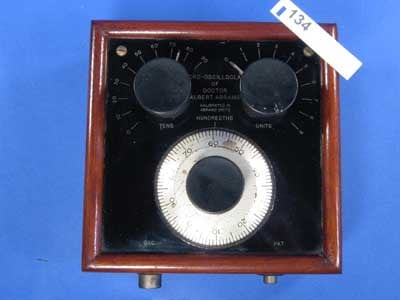
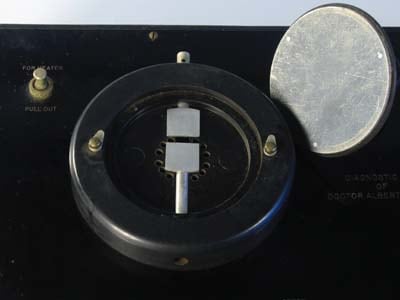
Strip away the mystique and an Abrams instrument is a portable box, roughly the size and weight of a period table-radio or a large medical-battery case — stained wood or moulded Bakelite, a carrying handle, and a hinged or screwed-down lid. What sells it as a scientific instrument is the front panel. Surviving examples in museum and private collections show a face crowded with numbered dials, rheostats (variable resistors with pointer knobs), push-buttons, and brass terminal posts to which insulated wire leads clip. The general impression — knobs, a scale, a meter, terminals — is exactly the impression an early radio set gave, and that resemblance was the point.
Abrams built more than one kind of box, and the family is worth naming because the names recur across every museum catalog and auction listing. The Dynamizer (sometimes rendered “Dynomizer”) was the diagnostic instrument — the one a dried blood spot was wired into. The Oscilloclast was the treatment instrument, meant to broadcast a curative “vibratory rate” back at the disease; a licensed variant and later imitations circulated under names like Radioclast. Abrams also marketed a Reflexophone and other differently-badged boxes, but the diagnosis/treatment pair is the heart of the system. The Oscilloclast is the one Quackwatch singles out as “the prototype of what has become known as ‘black box’ quackery.”
Some radionics literature quotes very precise-sounding specifications — for instance, that the Oscilloclast offered eleven push-button treatment frequencies clustered around 43 megacycles. Those figures come from within the radionics tradition rather than from an independent engineering measurement, and Vol 3 shows why any such “frequency” was meaningless in a box that generated no coherent signal. Treat the numbers as period marketing, not as verified specifications.
1.3 The sealed lease
The single most telling feature of the object is not on its front panel — it is in the paperwork. An Abrams box was not sold; it was leased, and the lease came with a clause that is the whole confidence trick in miniature: the practitioner agreed never to open the instrument.
The commonly cited terms, reported in the AMA’s contemporary write-ups and repeated by Quackwatch, were a deposit of $200 or $250 — the higher figure for the version wired for direct current, the lower for alternating current — followed by a monthly payment of about $5. Before a practitioner could lease a box at all, they typically first paid roughly $200 for a course of instruction in the “Electronic Reactions of Abrams,” after which the instrument was loaned to them under the franchise agreement. By 1921 there were said to be around 3,500 practitioners operating under this scheme across the United States — a genuinely large installed base for a device that did nothing.
Abrams justified the no-opening clause with a plausible-sounding excuse: the instrument was calibrated so delicately that opening it would ruin the adjustment. The real function of the clause was the opposite of protective. A sealed box that no lessee dared open could never be examined — not by a curious practitioner, not by a rival, not by a patient’s skeptical relative. The seal converted the device’s greatest vulnerability (that its insides were meaningless) into an apparent virtue (that its insides were too precious and precise to disturb). This is the defining move of black-box quackery, and every imitator copied it. What was actually behind the seal is Vol 3’s reveal; what happened when investigators finally broke it is Vol 4’s.
1.4 The ritual: a blood spot and a tapped belly
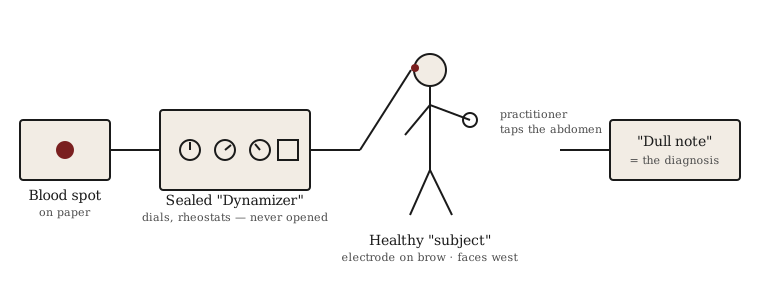
The object only makes sense alongside the practice it enabled, because the box did no diagnosing on its own. The input was minimal and famously convenient: a spot of the patient’s dried blood on a piece of paper, mailed in — a patient never had to be present, or even in the same state. Abrams claimed a specimen of handwriting or a signature would serve just as well, which is already a tell: whatever the box was reading, it was not blood chemistry.
The blood spot was clipped into the Dynamizer’s circuit. But the “reading” was taken not from any dial on the box — it was taken from a person. A healthy assistant, the “subject,” stood wired to the instrument with an electrode against the forehead, stripped to the waist and, in Abrams’ protocol, facing west in dim light (a stipulation with no physical rationale that nonetheless lent the procedure a ceremonial gravity). The practitioner then percussed — tapped — the subject’s bare abdomen with a finger, listening for a change in the note. A supposed area of dullness appearing over the belly was read off as the diagnosis: this dull zone meant cancer, that one syphilis, another tuberculosis.
Physiologically, this is percussion — a real clinical technique for mapping organs by the pitch of the tap — detached from any real signal and driven instead by the tapper’s own unconscious expectation. It is a textbook ideomotor effect: the practitioner, primed by the patient’s letter and their own guesswork, produces the “dull note” they expect to find, exactly as a Ouija planchette is nudged by hands that believe they are still. The box in the corner supplied authority and theater; the diagnosis came from the operator’s mind. Vols 3 and 4 develop the mechanism and the proof; here it is enough to see that the ritual, not the hardware, did the work.
Once a Dynamizer had “diagnosed,” the matching Oscilloclast supplied the cure: the operator dialed in the disease’s supposed “vibratory rate” and let the box broadcast the corrective frequency, often for scheduled sessions over weeks. The treatment box was the revenue engine — a leased instrument generating monthly fees and per-session charges — and it is why radionics was a business and not merely a parlor trick.
1.5 A whole family of black boxes
Abrams died in 1924, but the object outlived him and multiplied. The sealed diagnostic-and-treatment box became a template that other practitioners rebadged and re-marketed for decades, and a museum shelf of radionics instruments is really a shelf of variations on his front panel.
The most prominent American successor was Ruth B. Drown, a Los Angeles chiropractor who built compact radionics boxes she called Radio Therapeutic Instruments and added a striking new claim: “radio-vision,” in which her apparatus supposedly produced photographic plates showing a patient’s diseased organs at a distance, from nothing but a blood spot. The images were, in reality, artifacts of ordinary photographic fogging and development, but as objects the Drown instruments and their “radio-vision” plates are landmark pieces of the genre. Drown was prosecuted; a federal jury in Los Angeles found her guilty in September 1951 in a case brought over the mislabeling of her instruments — a date and outcome Vol 4 examines against the court record.
Across the Atlantic, the British engineer George De la Warr and his laboratories in Oxford produced the best-known UK boxes, including a much-publicized radionic “camera.” De la Warr’s story ended not in a criminal conviction but in a civil suit in the High Court in London in 1960, brought by a dissatisfied customer, Catherine Phillips, who said the instrument had ruined her health; after a long hearing the judge — while regarding the apparatus itself as bogus — found for De la Warr because there was no fraudulent intent, De la Warr having conceded that the box worked only “above the physical plane,” and awarded no costs, the plaintiff being on legal aid. It is a genuinely tangled outcome, and Vol 4 treats it carefully rather than as a clean “quack loses in court” story. For this volume the point is simpler: the black box was a durable, transnational object, and Drown’s and De la Warr’s instruments belong on the same catalog shelf as Abrams’ Dynamizer.
1.6 Why this object matters
The radionics box is a near-perfect teaching specimen because its persuasion lived almost entirely in design and staging rather than in any real effect. It looked like a radio in an age intoxicated by radio. It carried a scientific-sounding vocabulary — “electronic,” “vibratory rate,” “oscilloclast” — at the exact moment those words were entering ordinary speech. It was leased, not sold, which read as the practice of a serious instrument-maker protecting delicate equipment. And it was sealed, which turned the impossibility of inspecting it into a badge of precision. Every one of those features is a deliberate trust-building choice, and not one of them required the box to function.
It also mattered because of what it enabled downstream. A convenient mailed blood-spot meant a practitioner could “diagnose” thousands of distant patients and prescribe a leased-box “cure” for each — cancer, syphilis, tuberculosis, even a patient’s religion or a dead poet’s ailments, all read from a smear of dried blood or a signature. The gap between that sweeping promise and the inert reality inside the case is the entire subject of this dive, and it is why an object that did nothing deserves five volumes.
1.7 Where this volume hands off
You now have the object in hand — the leased, sealed, dial-faced box; the blood-spot input; the percussion ritual; and the family of imitators from Drown to De la Warr. The next question is the human one the marketing worked hardest to dress up: how did a credentialed, once-respected San Francisco physician come to build and franchise it? That is Vol 2 — Albert Abrams and the Birth of ERA. From there the dive breaks the seal to show what was actually inside the boxes, lays out the stings and the reckoning — the Scientific American committee, the red-ink and animal-blood tests, and the courtrooms — and closes on the afterlife and collecting of an object that refused to die. The genuine high-frequency electrotherapy whose vocabulary Abrams borrowed is treated soberly in the Electrotherapy Devices sub-project (see High Frequency Currents); the radionics box is what happens when that borrowed language is wired to nothing and locked in a case.
Sources
- Radionics and Albert Abrams, M.D. — Quackwatch — the Oscilloclast as the prototype of “black box” quackery; diagnosis from a drop of blood or a personal object; the Scientific American investigation (“ten months and $30,000”); Abrams’ death of pneumonia in January 1924; Drown and De la Warr named as imitators.
- Albert Abrams — Wikipedia — device names (Dynamizer for diagnosis, Oscilloclast and Radioclast for treatment); leasing at roughly $200 with a ~$5 monthly charge and a contract that the box “would never be opened”; diagnosis from dried blood on paper mailed in; ~3,500 ERA practitioners by 1921; born Dec 1863, died Jan 1924 of pneumonia.
- Oscillocast object record — Smithsonian National Museum of American History — a museum-held Abrams treatment box; provenance and framing of the object as a landmark of black-box quackery (used for the front-panel figure and object description).
- Albert Abrams — Science Museum Group Collection — museum holdings of Abrams/radionics apparatus (e.g. a “Dynamopath”) and the description of a box that claimed to read frequencies from a blood or hair sample and transmit “healing vibrations” back; corroborates the sealed diagnostic-and-treatment format.
- Albert Abrams, the Dynamizer, and the birth of the modern medical scam — IFLScience — the percussion-of-a-healthy-assistant’s-abdomen ritual, the subject facing west, and the diseases the boxes “diagnosed”; the leasing/treatment business model (context deferred to Vol 4).
- Ruth B. Drown — Wikipedia and The Incredible Drown Case — Quackwatch — Drown as a Los Angeles chiropractor; her Radio Therapeutic Instrument and “radio-vision” photography; guilty verdict in federal court in September 1951 for mislabeling; the later animal-blood (sheep/turkey/pig) sting; her death in 1965.
- George de la Warr — Wikipedia — the De la Warr laboratories’ radionic instruments and “camera”; the June 1960 High Court civil suit brought by Catherine Phillips, the judgment for De la Warr without a finding that the box worked, and no award of costs.
Comments (0)