Radionics and Abrams Boxes · Volume 2
Albert Abrams and the Birth of ERA
How a genuinely credentialed San Francisco physician turned a theory of diseased 'vibrations' into a leased black box that 3,500 practitioners paid to keep sealed.
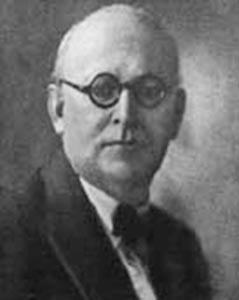
2.1 About this volume
Vol 1 — The Black Box introduced the object: a sealed cabinet of dials that claimed to diagnose and treat any disease from a spot of dried blood. This volume tells the human story behind it — because radionics is, unusually for this field, a fraud with a single, well-documented author. Albert Abrams was not a fairground pitchman. He was a Heidelberg-trained physician who had held respectable teaching posts and officer’s chairs in California medical societies before he built the machine that made him rich and, eventually, notorious.
That respectability is the point. It is what let a physically impossible idea travel: a credentialed neurologist, vouched for by a famous muckraking novelist, licensing his invention to thousands of practitioners on terms that forbade them from ever looking inside. What follows is who Abrams was, how his “Electronic Reactions of Abrams” (ERA) came to be, and — the load-bearing part — the leasing business model that turned a theory into an income. What was actually inside the boxes, and the physics of why it could not work, belong to Vol 3 — What Was Actually Inside; the Scientific American investigation, the AMA sting, and the courtroom aftermath are the subject of Vol 4 — The Sting and the Reckoning.
2.2 The man before the box
Albert Abrams was born in San Francisco on 8 December 1863 and died there of broncho-pneumonia on 13 January 1924, aged 60 (Wikipedia). His early credentials were real, and it matters that they were. Wikipedia records a medical degree from the Medical College of the Pacific in 1881 and a doctorate from the University of Heidelberg, where the university’s own archive reportedly shows he passed the examination for the M.D. on 21 November 1882 with the grade cum laude (Wikipedia). (⟨verify — the Heidelberg degree is a long-standing point of dispute. Some skeptical accounts claim he never earned it or bought it; others cite the Heidelberg archive confirming a legitimate 1882 pass. Because his date of birth would put him at only 18, the timeline is genuinely odd and the safest statement is that he held a Heidelberg M.D. whose exact circumstances are contested.⟩)
Whatever the truth of the paperwork, Abrams’ subsequent standing was not in doubt. He taught at Cooper Medical College in San Francisco — later absorbed into the medical school of Stanford University — across some fourteen years, rising from Demonstrator of Pathology (1885–1889) to Professor of Pathology (1894–1898); he served as vice-president of the California State Medical Society (1889) and president of the San Francisco Medico-Chirurgical Society (1893) (Wikipedia). He was a prolific author. His 1910s book Spondylotherapy promoted a system of diagnosis and treatment by percussion and manipulation along the spine — a bridge between orthodox neurology and the manual-therapy fringe, and the seed from which ERA would grow (Quackwatch). By the 1910s Abrams was, in the words the era used, one of the best-known physicians on the Pacific Coast. That reputation was the capital he later spent.
2.3 From the spine to the electron: the birth of ERA
Abrams’ bridge from respectable neurology to radionics ran through the fashionable physics of his day. The electron had been identified in 1897; “vibration,” “energy,” and “radio” were the glamour words of the 1910s and 1920s. Abrams fused them into a doctrine he set out in his 1916 book, generally cited as New Concepts in Diagnosis and Treatment, founding the Electronic Reactions of Abrams (Quackwatch; The Healthy Planet, on Sinclair’s account).
The claim, stripped to its core, was that every disease has its own characteristic “vibratory rate” — an electronic signature — and that a diseased tissue radiates that signature the way a transmitter radiates a wavelength. If disease was a frequency, Abrams reasoned, then it could be detected at a distance and, better still, cancelled by broadcasting a “beat” against it. Crucially, he held that the signal travelled with the patient’s own matter: a drop of the patient’s blood dried on a scrap of blotting paper — or, in the strongest version of the claim, a sample of the patient’s handwriting — carried the disease’s vibratory rate and could stand in for the patient entirely (Quackwatch; IFLScience). The Science Museum Group summarises the finished doctrine plainly: Abrams “believed that all life forms have their own electro-magnetic fields,” and that if these were disrupted, disease resulted; each organ supposedly had “its own resonance or vibration” (Science Museum Group).
None of this has a physical basis — dried blood does not broadcast a “disease frequency,” and no such frequencies exist — but as a sales proposition it was near-perfect. It required the patient’s presence only long enough to draw a drop of blood, after which the diagnosis could be sold by mail, from anywhere, forever.
2.4 How a “diagnosis” was performed
The diagnostic ritual is worth describing here because it explains why the whole system needed a human operator, not just a machine — the mechanics of the box itself are dissected in Vol 3. Abrams’ diagnostic instrument was the Dynamizer (the dive brief’s “Dynomizer”; the spelling used across museum and skeptical sources is Dynamizer). The patient’s dried blood spot was placed in the Dynamizer, which was wired through a series of rheostats to an electrode pressed against the forehead of a healthy “reagent” — a stripped-to-the-waist assistant who stood facing west, in dim light (Wikipedia).
The operator then percussed (thumped) the reagent’s abdomen and listened for areas of “dullness.” The location and size of the dull note supposedly revealed the disease and its seat in the absent patient, while a “vibratory rate” rheostat was turned until the reaction appeared, yielding a number said to name the specific ailment. This is a direct descendant of the spinal percussion of Spondylotherapy, now pointed at a proxy body. Modern readers will recognise the mechanism at once: the “dullness” is not in the reagent but in the operator’s own expectation, transmitted through tiny, unconscious variations in how hard he taps — the ideomotor effect, the same phenomenon that moves a Ouija planchette. The blood, the wires, the westward orientation, and the rheostat dial are stagecraft around a cold reading. That diagnosis — of cancer, tuberculosis, syphilis, even a patient’s religion — could then be mailed out for a fee, and the matching “cure” prescribed.
2.5 The lease: a business model, not a sale
The single most important fact about radionics as a business is that Abrams never sold his machines. He leased them, and the lease is what makes ERA a case study rather than a curiosity.
A practitioner who wanted to offer ERA had first to take Abrams’ course of instruction, then lease the treatment instrument — the Oscilloclast — on standard terms. The figures most consistently reported are a deposit of about $200 down and a rental of $5 a month, available only to those who had trained with Abrams (nolindan.com, Lindan Collection; Wikipedia). (⟨verify — the dive brief’s ”~$200–$250 deposit plus a monthly fee” is broadly confirmed at ~$200 down / $5 per month, but exact figures vary between sources and between the diagnostic Dynamizer and the treating Oscilloclast; treat the numbers as representative rather than fixed.⟩)
Every lease carried the clause that defines the genre: the lessee had to sign a contract promising never to open the apparatus. Abrams’ stated reason was that opening the box would disturb its “delicate adjustment.” The real reason, as later investigators would prove, was that the seal was the product’s only genuine feature — it kept practitioners, patients, and rivals from discovering that the interior was a meaningless jumble of wires, resistors, and a buzzing motor (nolindan.com; IFLScience). A device that is leased rather than sold, that can only be obtained after paying for a course, and that is contractually forbidden from being examined, is a machine whose entire commercial design is to remain a mystery. The sealed box was not a side effect of the fraud; it was the fraud’s business model.
2.6 How ERA spread
The leasing model made ERA a franchise, and it grew like one. By 1921 there were a reported 3,500 practitioners operating ERA equipment — a figure repeated by Quackwatch (which cites an estimate of around 3,000, “most of them chiropractors”) and by numerous period accounts (Quackwatch; Wikipedia). Abrams also chartered an organisation — later the Electronic Medical Foundation — to license and defend the method, and marketed on the order of several thousand devices over the system’s life (Quackwatch).
Two things fuelled the spread. The first was the recurring revenue the model handed to lessees: contemporary accounts claimed an ERA practitioner could earn $1,000 to $2,000 a week diagnosing and treating a stream of patients, many of them by mail from a mere blood spot (whonamedit.com; period press). Whatever the true averages, the promise of that income sold courses and leases as effectively as the devices sold treatments.
The second was a spectacular piece of unpaid publicity. In 1922 the muckraking novelist Upton Sinclair — famous for The Jungle — investigated Abrams and, instead of debunking him, published a credulous and enthusiastic profile, “The House of Wonder,” in Pearson’s Magazine (The Healthy Planet; Prevention & Healing). Sinclair called Abrams’ work possibly “the greatest discovery” of the age. A respected reformer’s endorsement, in a national magazine, gave ERA a credibility no advertisement could buy — and it is precisely the endorsement that prompted the American Medical Association and Scientific American to mount the investigations told in Vol 4.
2.7 The money, the fame, and the coming reckoning
By the early 1920s Abrams was, by common report, a millionaire — his estate at his death in 1924 is variously described as running into seven figures, though precise valuations differ between accounts (The Healthy Planet; period obituaries). (⟨verify — a specific estate figure, often quoted around $2 million, appears in secondary and hobby sources but I could not confirm it against a primary or archival record; state only that he died wealthy.⟩) The AMA had by then dubbed him “the dean of gadget quacks,” and the collision between his fame and organised medicine was already under way.
It ended, for Abrams personally, abruptly. He died of pneumonia in January 1924 — before the Scientific American committee published the final instalment of its verdict, and before he could be brought to court (Wikipedia; Quackwatch). His death did not kill radionics. The leasing network he had built outlived him, the Electronic Medical Foundation carried the method on for decades, and imitators — the chiropractor Ruth Drown in the United States and George De la Warr in Britain — extended the sealed-box idea into “radio-vision” photography and their own leased instruments. Their stories, and the trials that finally caught up with the whole field, are told in Vol 4 — The Sting and the Reckoning and Vol 5 — The Afterlife and Collecting.
2.8 Where this volume hands off
We have met the author and the business. The theory of “vibratory rates,” the westward-facing reagent, and the sealed lease are the scaffolding; the next volume dismantles the object itself. Vol 3 — What Was Actually Inside opens the Dynamizer and Oscilloclast to show the ordinary, non-functional components the no-open clause was written to hide, and sets out plainly why nothing in the circuit could detect or treat anything. Readers interested in how Abrams’ spinal-percussion background connects to the wider world of hands-on electrotherapy will also find the sober, legitimate lineage in the High Frequency Currents dive within Electrotherapy Devices — the real medicine whose vocabulary radionics borrowed.
Sources
- Albert Abrams — Wikipedia — supported the 1863 birth / 1924 death dates, the Medical College of the Pacific (1881) and Heidelberg (1882, cum laude) degrees, the Cooper Medical College and medical-society posts, the Dynamizer diagnosis procedure (reagent facing west, forehead electrode, abdominal percussion), the ~$200 / $5-a-month lease with the no-open contract, and the ~3,500-practitioner figure by 1921.
- Radionics and Albert Abrams, M.D. — Quackwatch — supported the ERA/radionics framing, Spondylotherapy as the precursor, the Oscilloclast as “the prototype of black-box quackery,” the ~3,000-practitioner (mostly chiropractor) estimate, the Electronic Medical Foundation, and the $30,000 / ten-month AMA–Scientific American investigation (developed in Vol 4).
- Albert Abrams — Science Museum Group Collection — supported the “electro-magnetic fields / organ resonance” statement of the doctrine and the museum’s holding of Abrams-related electromedical apparatus (Dynamopath).
- The Oscilloclast of Dr. Albert Abrams — Lindan Collection — supported the lease-not-sale model, the $200-down / $5-a-month terms restricted to Abrams graduates, and the contractual bar on opening the apparatus.
- Albert Abrams, the Dynamizer, and the birth of the modern medical scam — IFLScience — supported the blood-spot / handwriting specimen claim and the “wires, lights and buzzers” description of the sealed interior.
- The House of Wonder by a Quack: Upton Sinclair on Abrams — The Healthy Planet — supported the 1916 New Concepts founding of ERA, Sinclair’s 1922 Pearson’s Magazine profile “The House of Wonder,” and Abrams’ wealth at death.
- Albert Abrams — whonamedit.com — supported the claimed $1,000–$2,000 weekly practitioner income and the early respectable-reputation framing.
- Cross-reference (named in prose, not linked): the High Frequency Currents dive in Electrotherapy Devices — the legitimate electrotherapy lineage whose vocabulary ERA borrowed.
Comments (0)