Radionics and Abrams Boxes · Volume 3
What Was Actually Inside
The reality behind the sealed black box — an ideomotor 'percussion' diagnosis, a bench of inert wiring that broadcast nothing, and 'vibratory rates' with no physical basis, set against the signal path the machine was sold as having.
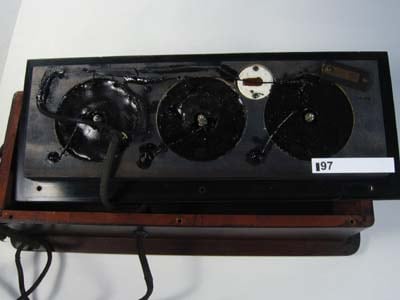
Vol 1 — The Black Box introduced the sealed leased instrument as an object, and Vol 2 — Albert Abrams and the Birth of ERA followed the man and how his “Electronic Reactions of Abrams” became a movement. This volume opens the box. It sets out, plainly, three things: how the “diagnosis” was actually produced, what the wiring inside really was, and why the “vibratory rates” the whole system rested on correspond to nothing in physics. The lease contract forbade opening the box precisely because there was nothing inside worth protecting from a competitor — only a mechanism worth hiding from a physicist.
3.1 About this volume
The persuasive power of radionics lived in a gap. On one side was an elaborate, technical-sounding account of how the machine worked — blood specimen, tuned circuit, “vibratory rate,” a diagnosis and a therapeutic broadcast. On the other side was the physical reality of the apparatus and the procedure, which had nothing to do with that account. Bridging the gap was theatre: dials, a hum, a darkened room, and a practitioner’s confident manner. This volume treats the two sides separately and then lays them against each other, because the single most useful thing a museum visitor can carry away from an Abrams box is the ability to hold both pictures in mind at once — the story the leaflet told, and the dead bench of parts that told no story at all.
Throughout, the aim is to explain a defunct fraud as history, not to instruct anyone in a procedure. Nothing here is a usable method. The point is the opposite: to show that there was no method, only a very old psychological effect dressed in mahogany and Bakelite.
3.2 The percussion “diagnosis”
Abrams did not, in practice, “read” a disease off a meter. The core diagnostic ritual descended from his earlier work in “spondylotherapy” and rested entirely on percussion of a living human abdomen — a genuine clinical technique (tapping the body wall and listening to the note) turned to a purpose it cannot serve.
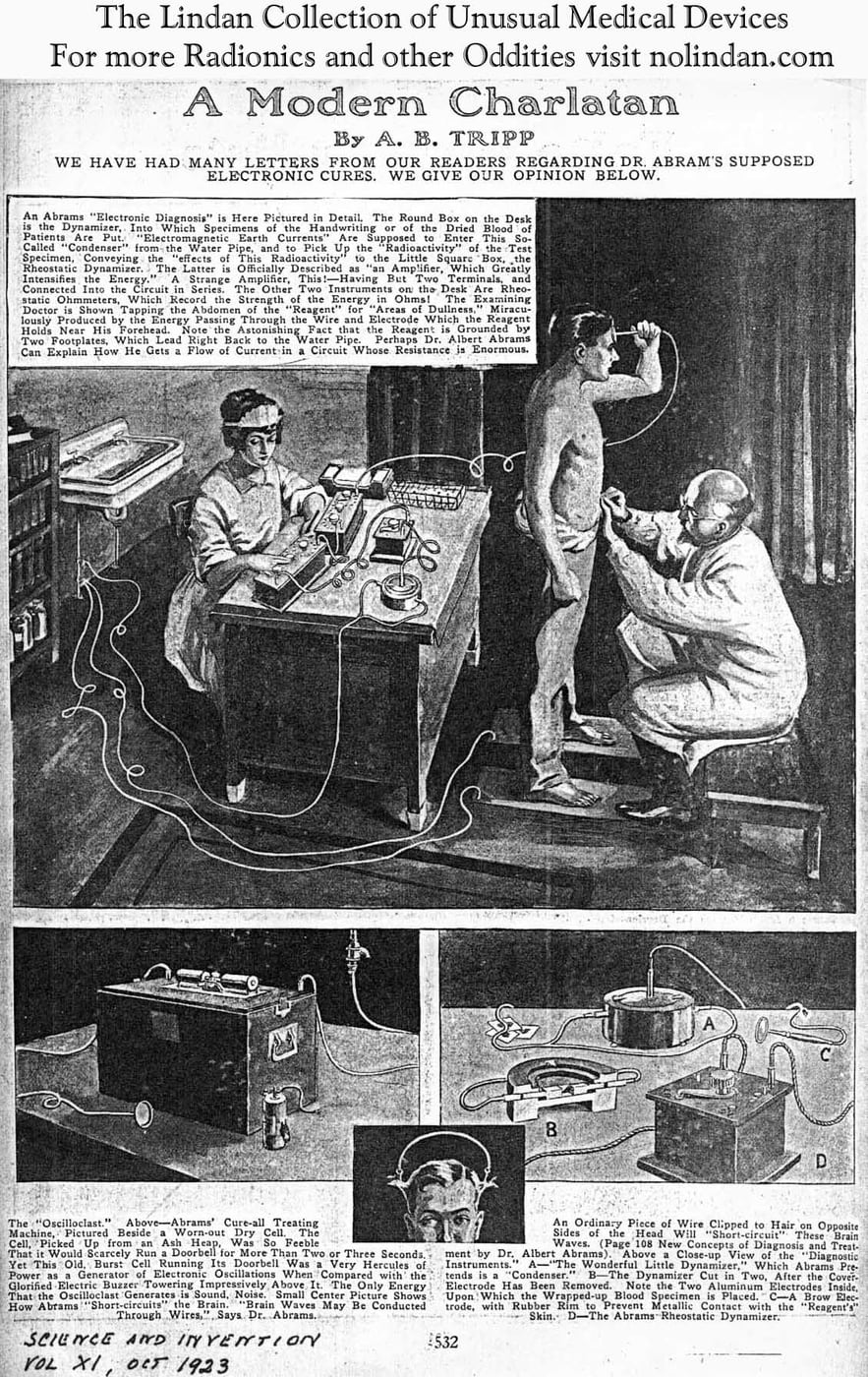
In the classic set-up, described in the American Medical Association’s own investigations, a healthy assistant — Abrams called this person the “reagent” — stood stripped to the waist and barefoot, facing west, in dim light, sometimes wired to the specimen and grounding plates. The operator then percussed the reagent’s abdomen, thumping the back of one hand with a finger of the other, and listened for “areas of dullness” in the note. A dried drop of the patient’s blood (or a scrap of their handwriting) sat in the circuit as the supposed source of the “vibrations.” Different diseases were said to produce dull notes over different regions of the reagent’s belly; the operator read the disease off the map of dull spots.
The real mechanism here is well understood and has a name: the ideomotor effect — the same unconscious, self-generated muscle movement that drives a Ouija planchette, a dowsing rod, and “facilitated communication.” An operator who expects a particular result produces, without any awareness of doing so, the very finding that confirms it: a fractionally harder tap here, a slightly different listening posture there, an ear primed to hear “dull.” The abdominal note becomes a screen onto which the operator projects the answer already in mind. Because the subject being percussed was a healthy third party and not the patient at all, nothing about their body could carry information about a stranger’s disease. The procedure was, structurally, a cold reading with a physiological prop. The blood spot’s only function was to license the performance; the box’s only function was to make it look like engineering.
3.3 Vibratory rates with no physical basis
The number that supposedly made this objective was the “vibratory rate.” Abrams introduced a rheostat — a variable resistor — into the “patient–experimenter” circuit, and taught that each disease had its own characteristic setting, expressed in ohms. In his scheme a cancer specimen “tuned” at around 50 ohms and a syphilis specimen at about 55 ohms; his kit included a “vibratory rate rheostat” and a “measuring rheostat” for reading off the “ohmage” of a sample. Adjust the dial until the reagent’s abdomen went dull at the expected spot, note the resistance, and you had a “rate.”
This is where the physics fails completely, and it fails in two independent ways. First, a resistance value in ohms is not a frequency. An ohm measures opposition to current flow; a frequency (in hertz) measures cycles per second. They are different physical quantities in different units, and no disease, tissue, or blood drop possesses a “characteristic ohmage” that identifies it. Wikipedia’s summary of the modern assessment puts the linguistic sleight of hand precisely: Abrams “used ‘frequency’ not in its standard meaning, but to describe an imputed energy type, which does not correspond to any property of energy in the scientific sense.” Second, even granting the vocabulary, a dried spot of blood does not emit a disease-specific radio signal, and no receiver — then or now — can tune a carcinoma. There is no radiating source, no channel, and no detectable quantity to measure. The “rate” was whatever setting the operator’s ideomotor response happened to land on, retroactively dignified with a unit.
It is worth being fair about why this was persuasive in 1920. Radio was new and genuinely marvellous; invisible waves really did carry voices across oceans, and X-rays really did photograph bones through flesh. In that atmosphere, “your body has electronic reactions, and disease shifts them, and my instrument reads the shift” sounded less like nonsense than like next year’s science. The tragedy is that the surface plausibility was doing all the work; behind it there was no there.
3.4 Inside the box: the inert circuit
The lease terms sharpen the point. A practitioner could obtain an Oscilloclast only on a signed contract promising never to open the sealed instrument — a first payment commonly given as $200 or $250 (depending on whether it was wired for alternating or direct current) and a monthly rental of about $5. Abrams justified the seal by saying that opening the box would disturb its “delicate adjustment.” The real service the clause performed was to keep the instrument away from anyone qualified to examine it. (The commercial machinery behind those leases — the practitioner network, the “college,” the numbers — belongs to Vol 4 — The Sting and the Reckoning.)
When boxes were nonetheless opened — by curious owners, by heirs, and above all by the Scientific American investigating committee of 1923–1924 — what emerged was not a suppressed invention but an anticlimax. Descriptions converge on “simple wiring, a few resistors, a small motor that only made a humming noise, and nothing that could in any way perform a diagnosis or ‘broadcast’ or even produce radio waves.” There was no oscillator capable of the claimed radio emission, no detector capable of the claimed reception, and no coherent signal path connecting input to output. The components were real electrical parts; they simply were not wired to do the advertised job, or indeed any job. The hum — a small motor or buzzer — supplied the one thing the performance genuinely needed: a plausible mechanical noise to stand in for “operation.”
The committee’s verdict on the internals became one of the most quoted lines in the history of medical fraud. On inspecting the wiring, the Nobel laureate physicist Robert Millikan is reported to have said the boxes were “the kind of device that a ten-year-old boy would build to fool an eight-year-old.” The physical claim — that the box housed a diagnostic radio — collapsed the moment a competent engineer looked inside. That the boxes could not be opened under the lease was therefore not incidental to the fraud; it was the fraud’s load-bearing wall.
Surviving examples in public collections make the anticlimax visible today. The Smithsonian’s National Museum of American History holds an Oscilloclast in its medical-sciences collection, and the Science Museum Group in the United Kingdom holds Abrams-lineage radionics apparatus (including a later “Dynamopath” of the same family), so a modern viewer can see for themselves the gap between the imposing cabinet and the trivial contents.
3.5 Claimed versus actual signal path
The two circuits can be drawn side by side. The top row is the machine as marketed; the bottom row is what actually happened at the bench.
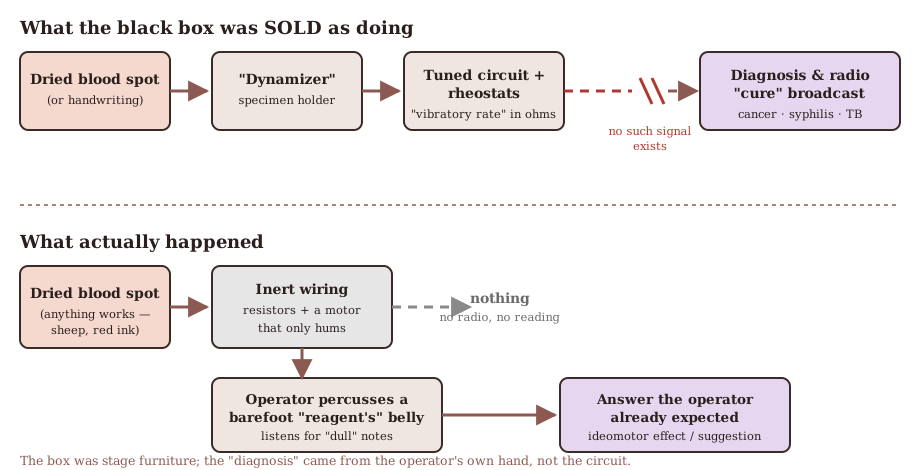
In the claimed path, a dried blood spot (or handwriting sample) is placed in a “Dynamizer,” its “vibratory rate” is tuned and read in ohms on a bank of rheostats, and the machine both diagnoses the disease and broadcasts a therapeutic counter-vibration. Every arrow but one is a plausible piece of engineering vocabulary. The single arrow that cannot be drawn is the one between the tuned circuit and the result: there is no signal there to carry the information, so the chain is broken, and the diagnosis has no physical route by which to arrive.
In the actual path, the blood spot feeds wiring that goes nowhere — resistors, a coil or two, a humming motor, all inert with respect to the advertised function. The “reading” enters the story from a completely different door: the operator percusses the barefoot reagent, listens for “dull” notes, and, through the ideomotor effect, produces the finding he already expected. The output is real in the sense that a diagnosis was written down and a fee collected; it is false in the sense that it came from the operator’s own hand and expectations, not from any measurement. This is why the sting samples described in Vol 4 worked so devastatingly: because the box measured nothing, it could just as confidently “diagnose” cancer in sheep’s blood, in a rooster’s, or in a smear of red ink as in a sick person’s — the answer never depended on the specimen at all.
3.6 Where this volume hands off
Knowing that the box was inert and the diagnosis ideomotor is what makes the debunking story land. Vol 4 — The Sting and the Reckoning tells how the Scientific American committee and the AMA proved exactly this in public — the animal-blood and red-ink specimens returned with confident diagnoses, the ten-month investigation, Abrams’ death in 1924 before the verdict was complete, and the later reckonings for imitators Ruth Drown (convicted in a 1951 US federal misbranding case) and George De la Warr (whose “camera” survived a 1960 London civil suit on the extraordinary ground that it worked “above the physical plane”). Vol 5 — The Afterlife and Collecting then follows the dead circuit into the present, where these boxes are prized museum and private objects — and where the same ideomotor machinery still surfaces under new names.
The porous boundary with legitimate medicine is worth restating one last time. Real percussion is a sound diagnostic skill; real high-frequency electrotherapy (covered in this collection’s Electrotherapy Devices → High Frequency Currents dive) has genuine, narrow uses. Radionics borrowed the vocabulary and the props of both and hollowed them out. The lesson of opening the box is that impressive apparatus is not evidence of anything; only a traceable, testable signal path is — and here there was none.
Sources
- Radionics and Albert Abrams, M.D. — Quackwatch — the Scientific American investment of “some ten months and $30,000,” the conclusion that “the so-called Electronic Reactions of Abrams do not exist … at least objectively,” Abrams’ death from pneumonia in January 1924 before the report was complete, and Drown and De la Warr as imitators.
- Albert Abrams — Wikipedia — what was found inside the opened boxes (“simple wiring, a few resistors, a small motor that only made a humming noise …”), the red-ink labels “confounding” the instruments, the blood-spot/handwriting diagnostic claim, and death date of 13 January 1924.
- Radionics — Wikipedia — the ideomotor mechanics of tapping the abdomen for “areas of dullness,” and the key correction that Abrams “used ‘frequency’ … to describe an imputed energy type, which does not correspond to any property of energy in the scientific sense.”
- Albert Abrams and the Medical Fraud Debunked Using Red Ink and Sheep’s Blood — IFLScience — the dim-lit, west-facing procedure, the abdomen “played like a set of drums,” and the sheep/chicken/red-ink diagnoses of “hereditary syphilis” offered a $250 cure.
- The King of Quacks: Albert Abrams, M.D. — Skeptical Inquirer (Center for Inquiry, PDF) — the “reagent” standing barefoot on grounding plates, the weighted-thimble percussion, and the assignment of ohm values (≈50 ohms for cancer, ≈55 for syphilis) via the “vibratory rate” and “measuring” rheostats.
- Dr. Albert Abrams ~ The Oscilloclast (johnwhook.tripod.com) — the lease terms: first payment of $200 or $250 (AC vs DC) plus a $5 monthly rental, on a signed contract never to open the hermetically sealed box; used cautiously, cross-checked against the AMA/Quackwatch record.
- Robert Millikan’s “ten-year-old boy … to fool an eight-year-old” verdict — reported via the Scientific American 1923–24 committee (summarised at Quackwatch and secondary histories) — the physicist’s assessment of the internal wiring; attributed and flagged as widely-quoted rather than primary-verified here.
- Oscilloclast — National Museum of American History (Smithsonian) object record — a surviving Abrams treatment box in a US national collection, supporting the figure and the “inert cabinet” point.
- Albert Abrams — Science Museum Group Collection — Abrams-lineage radionics apparatus (incl. a “Dynamopath”) held in a UK national collection.
Comments (0)