Radionics and Abrams Boxes · Volume 4
The Sting and the Reckoning
How Scientific American, the AMA, and a healthy guinea pig named 'Miss Bell' took the Abrams black box apart — the red-ink diagnosis, the wiring 'a ten-year-old built to fool an eight-year-old,' Abrams' death in 1924, and the long courtroom afterlife of Ruth Drown and George De la Warr.
Contents
4.1 About this volume
The volumes around this one describe the object and its inventor: the sealed “black box” leased to practitioners and read from a spot of dried blood (Vol 1 — The Black Box); the San Francisco physician Albert Abrams (1863–1924) who built the doctrine of the “Electronic Reactions of Abrams,” or ERA (Vol 2 — Albert Abrams and the Birth of ERA); and what the wiring inside those boxes actually was (Vol 3 — What Was Actually Inside). This volume is about the reckoning — the roughly two-year effort by which a scientific magazine, a physicist, and the American Medical Association dismantled the claim, and the courtroom coda that ran on into the 1960s through Abrams’ most famous imitators.
The whole scheme rested on one unfalsifiable-looking ritual: a drop of the patient’s blood placed in the circuit, an operator percussing a healthy assistant’s abdomen, and “dull” versus “resonant” notes read off as disease. The debunkers’ strategy was elegantly simple. If the box could not tell human blood from animal blood, could not tell blood from red ink, and contained nothing that could carry a signal, then the ritual read only the operator’s own expectations. Every test below is a variation on that single move. As always in this field the numbers and quotations are treated with suspicion: where a figure or a line of dialogue rests only on secondary retelling it is marked reported or commonly cited, and the thinnest links are gathered again in the accuracy flags. Nothing here is medical advice; it is the history of how a fraud was proven to be one.
4.2 The men who tested the box
The decisive public investigation was run by Scientific American. From late 1923 the magazine convened a committee to examine ERA under controlled conditions, and the effort was substantial — Quackwatch, drawing on the contemporary record, describes an inquiry running “some ten months” and costing about $30,000, an enormous sum for a magazine in 1924. The committee did not test Abrams personally so much as his method: it worked with a senior, cooperating ERA practitioner (identified in later accounts only as “Doctor X”) and put sealed vials of known material to him.
The results were unambiguous. Given six vials of known pathogens the practitioner “got the contents of all six vials completely wrong,” and when the labels were made less conspicuous and the vials re-presented, he got them wrong again — the readings tracked nothing in the tubes. The committee’s published verdict, appearing across a series of installments and concluding in September 1924, was blunt: the Electronic Reactions of Abrams “do not exist… at least objectively. They are merely products of the Abrams’ practitioner’s mind.” The magazine’s summary headline for the finding was that electronic medicine in general had been “Found Utterly Worthless.” (Accuracy note: the ten-month duration and $30,000 figure are as reported by Quackwatch summarizing the period coverage; the “Doctor X” framing and the six-vial protocol are consistently retold but the exact installment dates should be confirmed against the original 1924 Scientific American run before any line is quoted as verbatim.)
4.3 The AMA sting: Miss Bell, a sheep, and a bottle of red ink
Running alongside the magazine’s committee, the American Medical Association’s Bureau of Investigation attacked from the other direction — not by testing a cooperating operator but by feeding the network false patients and cataloguing what came back. These stings produced the images the story is still told with.
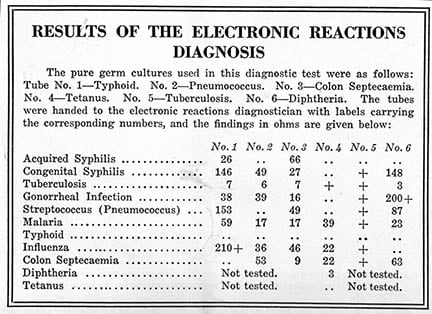
The most quoted is the “Miss Bell” ruse. Investigators submitted a blood sample said to belong to a woman named Miss Bell; the specimen was actually drawn from a healthy male guinea pig. It came back diagnosed — as commonly retold — with cancer, an infection of the left frontal sinus, and a streptococcic infection of the left fallopian tube, a structure the male donor conspicuously lacked. In a companion test a rooster (a Plymouth Rock, in one account) yielded a reading of malaria, diabetes, cancer, and syphilis. Animal blood, in short, was diagnosed as freely and confidently as any human’s.
Two further demonstrations became emblematic. Sheep’s blood submitted to an ERA practitioner was diagnosed with hereditary syphilis — “which a helpful practitioner offered to cure for $250,” the AMA reported — and, in the most damning flourish, a sample of ordinary red ink was said to have been read out as a disease and met with the same offer of a tuned “cure.” The pattern was the point: the box could not distinguish a sick woman from a healthy guinea pig, a rooster, a sheep, or a bottle of ink, because it was not reading the specimen at all. Later government sampling produced the same absurdities — blood from a man who had lost his right leg returned “arthritis in the right foot and ankle.” (Accuracy note: the specific ailments attributed to “Miss Bell” and the red-ink episode are drawn from AMA-derived secondary accounts and popular retellings; they are consistent across sources but the underlying AMA Bureau of Investigation documents are the primary record and were not read line-by-line in this pass. The $250 cure fee recurs across accounts and matches the era’s lease economics.)
4.4 Opening the box
The physics half of the debunking was the simplest of all: someone finally opened a sealed unit. The lease that came with an Oscilloclast or Dynamizer forbade exactly this — practitioners signed a contract undertaking that the device would never be opened, on pain of forfeiting their deposit (Vol 2 gives the lease economics: commonly cited as roughly a $200 diagnostic course, an initial deposit on the order of $200, and about $5 a month). The seal was the trick’s guarantor. Break it and there was nothing to protect.
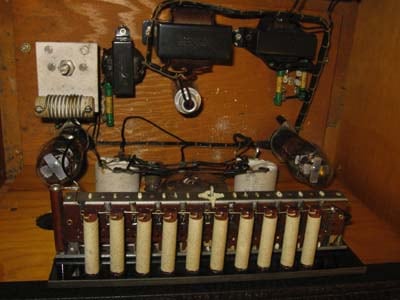
When investigators did break it, the interior was a disappointment by design. It held ordinary, cheap components — resistors, an ohmmeter or rheostat, wiring, a small motor that “only made a humming noise” — assembled in no configuration that could generate, tune, or receive the “vibratory rates” the marketing described. The line that has outlived every other detail of the affair is the physicist’s: examining an Oscilloclast, the reviewer judged that it “might have been thrown together by a ten-year-old boy who knows a little about electricity to mystify an eight-year-old who knows nothing about it.” The man who actually built the boxes reportedly told investigators that Abrams paid him about $30 per unit and that the arrangement of the wires inside did not matter. (Accuracy flag: the “ten-year-old… eight-year-old” appraisal is widely attributed to the Nobel physicist Robert A. Millikan in connection with the Scientific American inquiry; the attribution and exact wording vary between retellings and should be confirmed against the 1924 report before crediting Millikan by name. The $30-per-box builder anecdote is likewise a period story repeated in secondary sources.)
For the full internal inventory and the electrical reason each part was inert — why a rheostat and a buzzer cannot read a “disease frequency” from dried blood — see Vol 3 — What Was Actually Inside. The point that belongs here is narrative rather than technical: the seal was the whole apparatus of persuasion, and it survived precisely as long as no one was allowed to look.
4.5 Abrams’ death, 1924
Abrams did not live to read the verdict. He died in San Francisco on 13 January 1924 of broncho-pneumonia, aged 60 — nine months before Scientific American completed and published its condemnation that September. He died wealthy, having built the largest device-quackery enterprise in the country on lease fees and lecture courses, and the timing spared him the trial that his method, not his person, was about to lose in print.
His death did not end ERA; it distributed it. The leased boxes stayed in the field, the practitioner societies persisted, and the doctrine simply detached from its founder and drifted — under the newer, cannier name radionics — into other hands. Vol 5 — The Afterlife and Collecting follows that drift through the rest of the century. Two of the hands it fell into ended up in court.
4.6 The heir: Ruth Drown and the 1951 trial
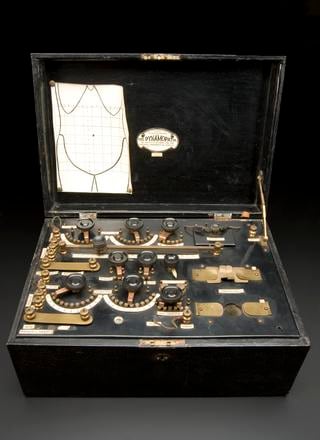
The most important American successor was Ruth Beymer Drown (1891–1965), a Los Angeles chiropractor who refined the black box into her own line of instruments — the Drown Radio Therapeutic Instrument (a cabinet fronted with nine tuning dials), the Homo-Vibra Ray, and above all Drown Radio-Vision, which claimed to produce photographs of a patient’s internal organs from a spot of dried blood, at any distance. Where Abrams had promised diagnosis by radio, Drown promised diagnosis and imaging by radio, from a blood spot on a blotter.
Her claims were tested and failed badly. In late 1949 investigators at the University of Chicago gave her blood samples from three patients; her readings, as recorded in The Medical Messiahs, were “spectacular failures” — a case of tuberculosis of one lung reported as widely metastatic breast cancer, a hypertensive patient credited with both a uterus and a prostate, a healthy young male physician given a poor cancer prognosis.
The federal reckoning came two years later. Charged by the FDA with introducing a misbranded device into interstate commerce under the Food, Drug, and Cosmetic Act, Drown was tried in U.S. District Court in Los Angeles; the government argued the Radio Therapeutic Instrument was “absolutely and totally worthless,” and on 24 September 1951, after about seven hours, the jury found her guilty. She was fined $1,000. Notably, the court did not allow her Radio-Vision photographs into evidence. The conviction ended her interstate shipments but not her practice; she carried on in California until a later grand-theft prosecution overtook her, and she died on 13 March 1965, before that second trial concluded. (Accuracy note: the 24 September 1951 verdict date, the misbranding charge, and the $1,000 fine are consistently reported across Quackwatch’s Medical Messiahs and Wikipedia; the University of Chicago test is recounted in Medical Messiahs and should be read there for the exact wording.)
4.7 The Englishman: George De la Warr and the 1960 case
Radionics also crossed the Atlantic. George De la Warr (1904–1969), working from Oxford, marketed a Delawarr Diagnostic Instrument and a radionics “camera” said to photograph disease from a blood spot — a British sibling of Drown’s Radio-Vision.
His courtroom moment came not as a prosecution but as a civil suit. In 1960, in the High Court in London, a dissatisfied customer, Mrs. Catherine Phillips, sued De la Warr, alleging that the diagnostic instrument could not do what was claimed for it and that she had been injured relying on it. After ten days, the judge found for De la Warr — he was not held liable — but the victory was hollow: De la Warr had retreated at trial to the position that his box treated only “pre-physical” conditions and worked “above the physical plane,” serving merely as a “focus for thought,” and accounts of the judgment stress the judge’s evident skepticism about the apparatus itself. Because Phillips was on legal aid and unable to pay, De la Warr was not awarded costs. It is best read not as a vindication of radionics but as a plaintiff who could not meet the burden of proving fraud against a defendant who had, in effect, disclaimed that his box did anything physical at all. (Accuracy flag: sources agree De la Warr won the 1960 case and was denied costs, but they diverge on the judge’s characterization of the device — some say he declined to rule on whether it worked, others that he called it bogus. The claimant’s surname is spelled both “Philips” and “Phillips.” Treat the verdict as firm and the judge’s exact remarks as unconfirmed pending the law report.)
The two cases bookend the reckoning. Abrams’ method was destroyed in the scientific and popular press in 1924; his American heir was convicted under food-and-drug law in 1951; his British heir survived a civil suit in 1960 only by conceding his box did nothing measurable. In none of the three did the claim itself ever survive contact with a controlled test.
4.8 Where this volume hands off
This volume closed the case against the black box — the Scientific American committee, the AMA’s animal-blood and red-ink stings, the opened box “a ten-year-old built to fool an eight-year-old,” Abrams’ death, and the courtroom coda of Drown (1951) and De la Warr (1960). The reckoning did not, however, kill radionics. The final volume, Vol 5 — The Afterlife and Collecting, follows the doctrine’s survival past every debunking — into modern “radionics” and dowsing subcultures, into the collectors’ market for surviving Oscilloclasts and Drown cabinets, and into the sober questions of how to identify, date, and display one of these boxes as an artifact of medical fraud rather than a working instrument. For the parallel regulatory arc that ended a different electrical cure-all under the same 1938 Food, Drug, and Cosmetic Act, see the Violet Ray Wands dive; for the one quack family that was genuinely dangerous rather than merely worthless, see Radioactive Cures.
Sources
- Radionics and Albert Abrams, M.D. — Quackwatch/NCAHF; the Scientific American committee’s ten-month, ~$30,000 inquiry and its “do not exist… products of the practitioner’s mind” verdict, Abrams’ death in January 1924 nine months before publication, and the absurd government blood-sample diagnoses.
- Albert Abrams — Wikipedia; Abrams’ dates (Dec 8 1863 – Jan 13 1924, broncho-pneumonia), the Dynamizer/Oscilloclast, the lease terms ($200 course, ~$200 deposit, $5/month, contract never to open the box), the “Doctor X” six-vial test, the Plymouth Rock rooster diagnosis, and the September 1924 “Found Utterly Worthless” conclusion.
- Albert Abrams, the Dynamizer, and the Birth of the Modern Medical Scam — IFLScience; the sheep’s-blood “hereditary syphilis” diagnosis and $250 cure offer, the red-ink demonstration, and Abrams’ 1924 death as the debunking spread.
- What the American Medical Association Thinks of the Electronic Reactions of Abrams — contemporary AMA-derived record (via PMC); background to the Bureau of Investigation’s stings, including the healthy-guinea-pig “Miss Bell” ruse.
- The Medical Messiahs, Chapter 11 — James Harvey Young via Quackwatch; Ruth Drown’s devices, the 1949 University of Chicago “spectacular failures,” and her 1951 federal misbranding conviction (guilty verdict 24 September 1951, $1,000 fine, Radio-Vision photographs barred from evidence).
- Ruth B. Drown — Wikipedia; Drown’s full name and dates (1891–1965), the Radio Therapeutic Instrument / Homo-Vibra Ray / Radio-Vision devices, the misbranding charge, and the later grand-theft case left unfinished at her 1965 death.
- George de la Warr — Wikipedia; De la Warr’s dates (1904–1969), the Delawarr Diagnostic Instrument and radionics “camera,” and the 1960 High Court suit by Catherine Phillips — ten days of argument, verdict for De la Warr, no costs awarded, his “pre-physical / above the physical plane” defense.
- Oscilloclast / Electronic Reactions of Abrams apparatus and Smithsonian National Museum of American History — museum object records for surviving Abrams and Drown instruments used for the figure captions above (institution and object described; no accession numbers asserted that were not independently verified).
Comments (0)