Radioactive Cures · Volume 5
Collecting Safely and Displaying
Why surviving Radithor bottles, Revigator crocks, and Radiendocrinators are still radioactive a century on, what museum surveys of them actually read, and how collectors and institutions handle, display, and dispose of them — documented and cautionary, never instructional.
The four volumes before this one treated the radium cures as history: the bottles and crocks and gold cases (Vol 1 — The Bottles, Crocks, and Cases), the physics of why ionising radiation is not vitality (Vol 2 — The Physics and the Harm), the makers who sold it (Vol 3 — The Makers and the Radium Boom), and the reckoning that ended the fad after Eben Byers’ jaw came off (Vol 4 — The Reckoning). This closing volume is different in one important respect: unlike the violet-ray wand, the electropathic belt, or the Abrams box — all of which are merely old — a surviving radium tonic or appliance is still doing the one thing it was sold to do. It is still radioactive. This volume is about that fact and what responsible people do about it.
Everything here is documented and cautionary. It records what museums have measured and how they and collectors manage these objects. It is not, and must not be read as, instructions to acquire, open, handle, drink, wear, or reproduce any of them.
5.1 About this volume
The radioactive cures are the one family in the whole Quack Devices collection where the collector-safety section is not a formality. A violet-ray wand is an unsafe appliance — its hazard is mains voltage and perished insulation, and unplugged it is inert. A radium crock has no plug to pull. Its hazard is intrinsic to the material, it cannot be switched off, and it will outlast the collector, the collector’s grandchildren, and the museum. That single distinction governs this volume.
The aim is to be honest about a real hazard without either sensationalising it or handing anyone a manual. Museums that specialise in exactly these objects — chiefly the Oak Ridge Associated Universities (ORAU) Museum of Radiation and Radioactivity, whose collection of “Radioactive Quack Cures” is the authoritative catalogue for this field — have measured them, written them up, and in several cases physically neutralised them for display. Their published readings and practices are the backbone of what follows.
5.2 Why the objects are still dangerous
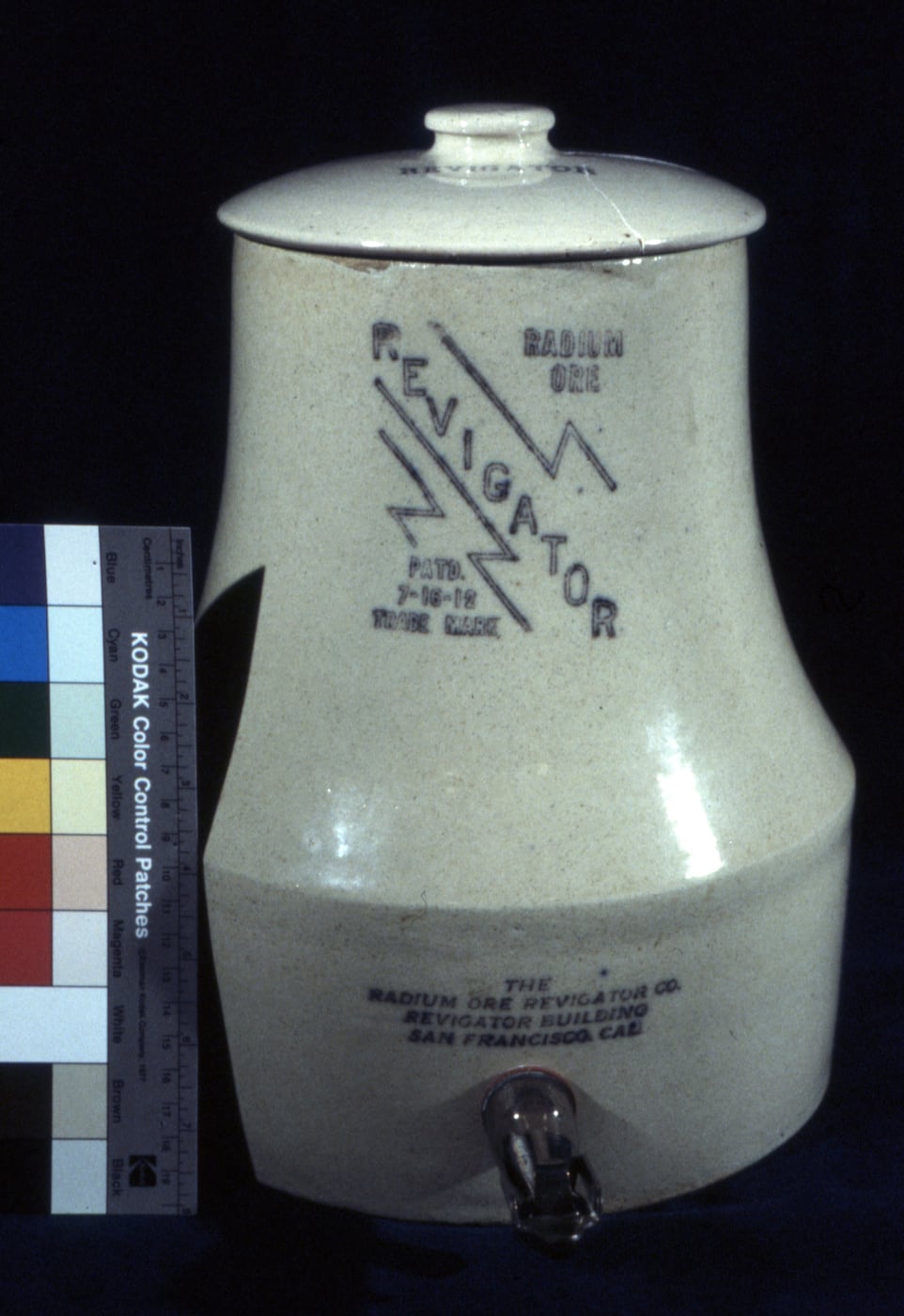
The reason is a single number: the half-life of radium-226 is about 1,600 years. Radithor was certified to contain radium; the Revigator’s liner was radium-bearing carnotite ore; the Radiendocrinator’s active element was radium soaked into blotter cards. In roughly a century since manufacture, a 1,600-year half-life has decayed away only about four percent of that radium. For all practical purposes, a surviving radium cure is as radioactive today as the day it was sold. Time has not helped, and on any human scale it will not.
Three distinct hazards follow, and they matter in different ways:
- External dose. Radium and its decay daughters emit penetrating gamma rays as well as alpha and beta particles. Standing near a piece, or holding it, delivers a measurable external dose — small from a single bottle at arm’s length, but real, and cumulative for anyone who handles a collection routinely.
- Radon gas. Radium decays to radon-222, a radioactive gas that seeps out of the material and accumulates in a closed container or an unventilated room. This is why the Revigator “worked” as advertised to make water radioactive — and why a sealed cabinet of radium antiques is its own small radon problem. As Vol 2 explains, radon and its short-lived daughters are the inhalation hazard.
- Contamination and ingestion. This is the worst case and the one the history turns on. Radium is chemically a bone-seeker, mimicking calcium; ingested, it lodges in the skeleton and irradiates it for life (the mechanism that killed Byers and the Radium Girls). A broken bottle, a cracked crock, or a leaking case turns a contained external hazard into loose radioactive material that can be inhaled or swallowed. The ORAU museum’s own Radiendocrinator “leaked, resulting in mild contamination inside the case” — an intact-looking object that was quietly shedding activity.
The one-line version, which every source in this field converges on: the danger is not the object glowing on a shelf so much as the object opened, broken, ground up, or drunk. Integrity is everything.
5.3 What surveys of surviving pieces show
The value of the museum record is that these are not estimates — they are meter readings on the actual surviving objects. A few anchor figures, all from published museum and laboratory surveys:
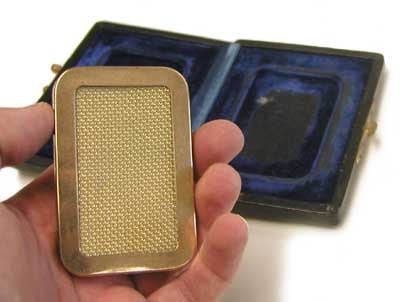
The Radiendocrinator. Before ORAU removed its source, the appliance read approximately 200 mR/hr on contact to a beta-gamma Geiger-Müller detector. That is a substantial contact reading for an object designed to be worn against the endocrine glands or, in Bailey’s marketing, the scrotum, for hours at a time. The seven radium-soaked cards inside a two-by-three-inch gold-plated case were, in dose terms, exactly as advertised — which was the tragedy.
The Revigator. A documented survey of one surviving stoneware Revigator read about 5.2 mR/hr inside the jar and roughly 1–2 mR/hr on the outside surface (a single-specimen reading from collector and museum records, not from the NIST work below). More striking is what a 2010 NIST study found when it filled vintage crocks and let them stand: radon in the water reached 50,000 to 200,000 picocuries per litre, against an EPA proposed drinking-water limit on the order of 300 pCi/L. The same study underscored a second, non-radioactive hazard — the ore liner leached arsenic, lead, uranium, and vanadium into the water at multiples of EPA limits. The Revigator was poisonous by two independent mechanisms at once.
Radithor and the human record. Each half-ounce Radithor bottle was certified to about 2 microcuries of radium (roughly 1 µCi each of radium-226 and radium-228); because of the 1,600-year half-life, a surviving sealed bottle still assays as a radium source today. The most quoted measurement in the whole subject is not of a bottle but of a body: when Eben Byers was exhumed in 1965, thirty-three years after death and despite a lead-lined coffin, his remains were still reported at around 225,000 becquerels of activity — a commonly cited figure that Vol 4 distinguishes from the separate ~1,000 µCi (≈37 MBq) lifetime-intake estimate credited to Robley Evans. Radium keeps its own time.
5.4 How museums and collectors handle them
The published practice of the institutions that hold these objects is consistent, and it can be described plainly as history without becoming a how-to.
Survey first. The object is characterised with a Geiger-Müller or scintillation instrument before anything else — contact reading, reading at distance, and a wipe or contamination check to establish whether it is a sealed external source or a leaking, contaminating one. The Radiendocrinator’s “mild contamination inside the case” is exactly the finding that check exists to catch.
Keep it intact and sealed. The universal rule, stated by the EPA for radioactive antiques generally, is do not take them apart — an item in good condition poses little risk, and it is breakage that creates the real hazard. No opening bottles, no prising open cases, no emptying crocks, no scraping liners. The EPA’s parallel warning against using radioactive antique ceramics or Vaseline glass for food or drink applies with obvious force to a vessel actually built to make water radioactive: a Revigator is a display object, never a container for anything anyone will consume.
Manage the three classic variables. Radiation protection reduces to time, distance, and shielding, plus ventilation for the radon. In practice that means minimal handling, storing pieces away from where people sit for hours (not the bedside, not a desk), and not sealing a radium collection into an airtight cabinet where radon can build. Some collectors keep pieces in ventilated or vented display space for that reason.
Neutralise when the reading demands it. The strongest documented step is ORAU’s own with the Radiendocrinator: because it was “sufficiently radioactive,” the museum removed the radium source entirely before public display, so that “nothing above background is detectable now.” That is the museum world’s answer to a genuinely hot, genuinely leaking object — de-source it, and show the empty case as the artefact. It is specialist work, done by health-physics staff under licence, and it is noted here as institutional practice, not as anything a private owner should attempt.
The thread through all of it: the object is safe to the public precisely to the degree that it is left sealed, kept at a distance, and not treated as a working device.
5.5 The law and the problem of disposal
Here the radioactive cures diverge sharply from every other object in this collection: they are the only ones that are, in the regulator’s language, actual radioactive material.
The regulatory picture in the United States is genuinely awkward, and worth stating carefully. The Nuclear Regulatory Commission generally does not license private collectors to possess small radioactive antiques — old radium items largely predate and sit outside the routine licensing net. But radium tonics and appliances are what the rules call “discrete sources of radium-226,” and for those there is, in the NRC’s and Health Physics Society’s own framing, no straightforward, low-cost route to disposal. A radium bottle or crock cannot lawfully go in household trash and cannot go down a drain; the owner bears the disposal cost, and that cost can be significant.
The documented first step, in the guidance of the EPA, the NRC, and state programmes alike, is the same: contact your state’s radiation-control (radiological health) programme. In an NRC “agreement state” that programme administers the rules directly; elsewhere it refers the matter onward, but state and federal rules align. Broken or leaking pieces are treated as the priority — the EPA’s blunt instruction for damaged radioactive antiques is to dispose of them, through those official channels, not to keep a contaminating object in a drawer. The NRC’s Radium Historical Items Catalog and its radium-226 FAQ exist precisely because this category — old, dispersed, legally messy radium — is a recognised orphan-source problem.
The practical upshot for a collector is sobering and belongs in any honest account: acquiring one of these is easy and cheap; getting rid of one lawfully and safely is neither. That asymmetry is itself a reason for caution before the object comes through the door.
5.6 Displaying, honestly
Displayed responsibly — surveyed, intact, kept at a distance, ventilated, and clearly not in food-contact use — a Radithor bottle, a Revigator, or a Radiendocrinator case is among the most eloquent objects a medical-history collection can hold. Each is a small monument to a lethal category error: the belief, sold as science, that because radiation carries energy it must carry health.
The display should tell that truth, not the marketing’s. A good label states what the object contains, that it remains radioactive, and — where the object is a famous killer, as Radithor is — what it did to the people who trusted it. The temptation to reproduce the period “vitality” copy uncritically should be resisted; the honest caption is the one that names the harm. This is the same discipline the whole Antique Medical Equipment collection applies to the Violet Ray Wands, Electropathic Belts, and Radionics and Abrams Boxes dives — but here the stakes are literal, because the exhibit is still emitting.
5.7 Where this volume hands off
This is the last volume of the Radioactive Cures dive, and in a sense the last word the collection can offer on this family, because the objects will still be here long after everything written about them. The arc closes where it began — on the bottle, the crock, and the gold case of Vol 1 — but now understood fully: as genuinely radioactive artefacts of a fraud that was, uniquely in this collection, sometimes fatal, and whose surviving specimens demand real care rather than the mere reverence an old machine earns.
From here the collection turns to the other quack families, whose hazards are historical rather than physical: the coloured-light cure of Spectro-Chrome and Color Therapy, the sealed-box theatre of Radionics and Abrams Boxes, and the mechanised cures of Mechanical and Vibratory Cures. None of them is still dangerous. That the radium cures are is the whole point of this dive, and the reason its safety volume is not a footnote but the conclusion.
Sources
- Radioactive Quack Cures — ORAU Museum of Radiation and Radioactivity — the authoritative object catalogue: Radithor (half-ounce bottles, ~2 µCi radium), the Revigator ($29.50, 1929), and the Radiendocrinator (14-carat gold, $150), with the museum’s descriptions and framing.
- The Radiendocrinator (ca. 1924–1929) — ORAU Museum of Radiation and Radioactivity — the ~200 mR/hr on-contact beta-gamma reading before de-sourcing; the seven radium-soaked blotter cards in a 2”×3” gold-plated case; the leak and “mild contamination inside the case”; the $1,000-to-$150 price; and the museum’s removal of the source for display.
- Radithor — Wikipedia — Bailey / Bailey Radium Laboratories, East Orange NJ; ~1 µCi each of radium-226 and radium-228 per 15 mL bottle; 400,000 bottles sold 1925–1930; Byers’ ~1,400 bottles, lead-lined coffin, 1965 exhumation, remains at ~225,000 Bq (used cautiously, cross-checked against ORAU for the object figures).
- Radium ore Revigator — Wikipedia and What Were They Drinking? Researchers Investigate Radioactive Crock Pots — NIST — the carnotite liner and, from the NIST study specifically, radon in the water at 50,000–200,000 pCi/L against an EPA ~300 pCi/L benchmark plus the arsenic, lead, uranium, and vanadium leaching. The ~5.2 mR/hr interior / 1–2 mR/hr exterior figures are a documented survey of an individual surviving crock (collector and museum specimen records), not a NIST result.
- Radioactivity in Antiques — US EPA (RadTown) — the “do not take them apart,” “little risk in good condition,” “dispose of broken items,” and “contact your state or local radiation control program” guidance; and the no-food-or-drink caution for radioactive antique ceramics/glass.
- Frequently Asked Questions (FAQs) Regarding Radium-226 — NRC and Disposal of historical artifacts containing radium-226 — Health Physics Society, Ask the Experts — that radium tonics/appliances are “discrete sources of radium,” that there is no simple low-cost disposal route, that the owner bears the cost, and that the first step is the state radiological-protection programme (which may refer to the NRC in agreement states).
- Radium Historical Items Catalog, Final Report (M. A. Buchholz, 2008) — NRC (ML100840118) — the federal catalogue of radium consumer and medical items behind the “orphan discrete-source” disposal problem.
- Radium Part I: Opening Pandora’s Box — NRC “History 101” and Radium-226 — Wikipedia — the ~1,600-year half-life establishing that surviving radium cures remain, for practical purposes, undiminished in activity a century on.
Comments (0)