Radioactive Cures · Volume 4
The Reckoning
How one wealthy man's jaw, roughly 1,400 bottles of radium water, a lead-lined coffin, and a still-radioactive corpse exhumed in 1965 ended the radium-tonic fad — and how the dial-painting Radium Girls, a separate and larger tragedy, first proved what swallowed radium does to bone.
Contents
4.1 About this volume
The three volumes before this one describe a family of objects and the industry that made them: the bottles, crocks, and cased appliances themselves (Vol 1 — The Bottles, Crocks, and Cases); the genuine, dangerous physics of ingested and worn radioactivity (Vol 2 — The Physics and the Harm); and the promoters who rode the radium boom (Vol 3 — The Makers and the Radium Boom). This volume is about how it ended — not in a laboratory, but at a deathbed, a graveside, and a Federal Trade Commission hearing that a dying man was too ruined to attend.
The radium-cure fad did not collapse because the public suddenly understood radioactive decay. It collapsed because a rich, famous, well-liked American swallowed a genuinely radioactive product for years and died of it in a way too grotesque to ignore. His name was Eben Byers, and the timeline below is the spine of this volume.
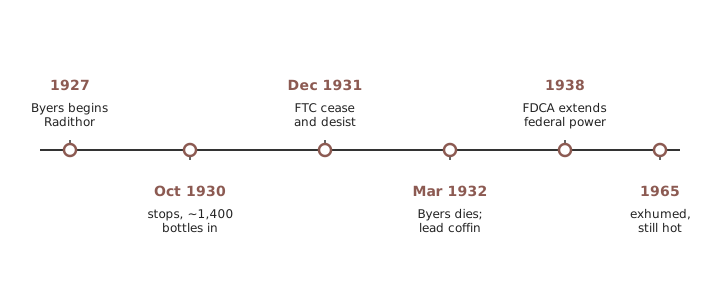
A discipline note, because this case is retold constantly and the retellings drift. Where a figure or quotation can be pinned to a museum or a government record it is cited as such; where the sources themselves disagree — and on the exact bottle count and the exhumed radioactivity they do — the disagreement is stated rather than smoothed over. Nothing here is medical advice. It is the history of the single deadliest object in this entire collection.
4.2 The man: Eben M. Byers
Ebenezer McBurney Byers (April 12, 1880 – March 31, 1932) was exactly the kind of customer a luxury quack most wants: wealthy, athletic, sociable, and conspicuous. He was chairman of the Girard Iron Company, a Pittsburgh steel-and-iron fortune founded by his father, and a nationally known amateur golfer who won the 1906 U.S. Amateur championship. When a man like that endorses a tonic by visibly thriving on it, he is worth more than any advertisement.
The origin of his illness is a small, almost farcical injury. In 1927, returning by train from the Harvard–Yale football game, Byers fell — accounts describe a tumble from a railway sleeping berth — and hurt his arm. The persistent pain would not resolve, and a Pittsburgh physician, Dr. C. C. Moyar, recommended a fashionable “radioactive” tonic then being marketed to the affluent: Radithor. It is a detail worth holding onto: Byers did not stumble into a drugstore nostrum. He was prescribed radium water by a doctor, which is exactly how the expensive tier of this fraud reached its victims.
4.3 Roughly 1,400 bottles
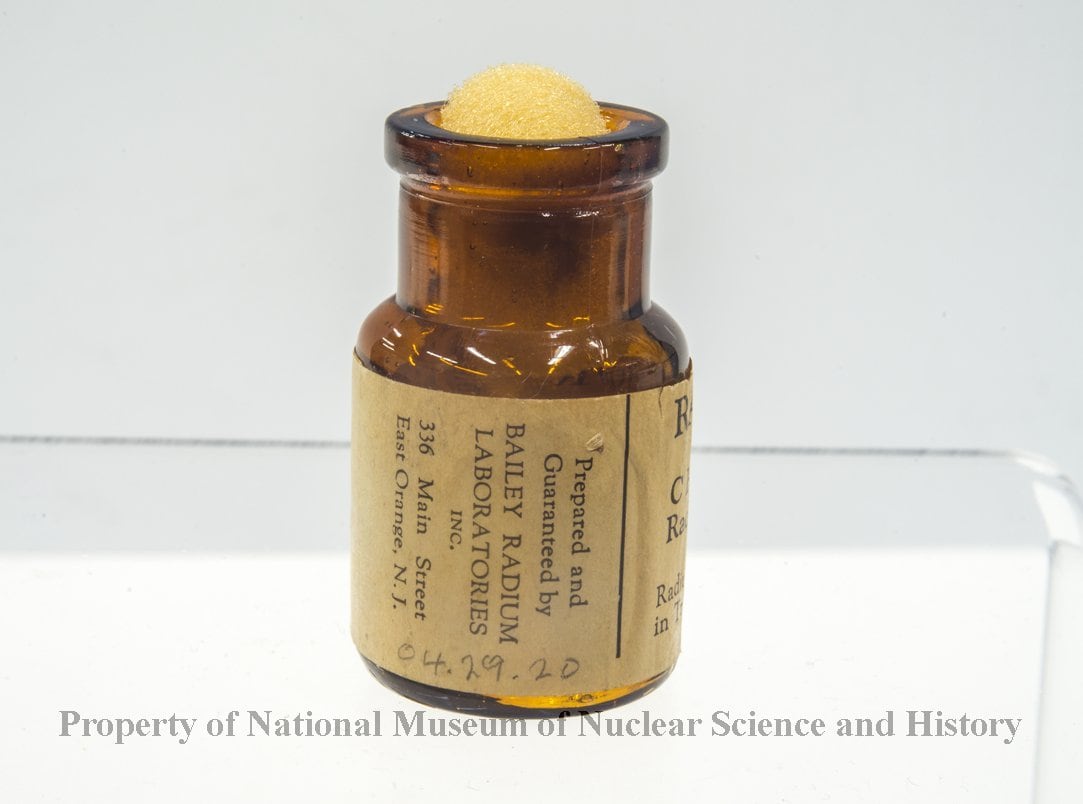
Radithor was the product of Bailey Radium Laboratories at 336 Main Street, East Orange, New Jersey, run by William J. A. Bailey — a Harvard dropout who styled himself “Dr. Bailey” on the strength of a doctorate he never held, and who had prior brushes with the law over an automobile-financing scheme and over fraudulent “impotence cures” (his full career is treated in Vol 3 — The Makers and the Radium Boom). Radithor was not a diluted gesture at radioactivity. According to the ORAU Museum of Radiation and Radioactivity, each ½-ounce bottle was certified to contain at least one microcurie each of radium-226 and radium-228 dissolved in water — real, potent, alpha-emitting radium, sold with a printed guarantee that it was “harmless in every respect.” That guarantee is the crux of the whole tragedy: it was a lie about the danger wrapped around the truth about the contents.
Byers liked how it made him feel. He reported a “toned-up feeling,” and by his own account drank on the order of three bottles a day for about two years, beginning in late 1927 and stopping around October 1930 when the pleasant effect faded and, more ominously, his teeth began to fall out. The cumulative figure most often quoted — and the one this collection uses — is roughly 1,400 bottles.
A word on that number, because it is repeated with false precision. Some sources say “1,400 bottles,” others “1,400 doses”; since a Radithor bottle was a single dose, the distinction largely dissolves, but the total is an estimate reconstructed after the fact, not an inventory. Treat “about 1,400” as the well-attested order of magnitude rather than a counted tally. What is not in doubt is the scale of the business around him: ORAU and Wikipedia both put Bailey’s sales at roughly 400,000 bottles between 1925 and 1930, at about $1 a bottle — Byers was one heavy user inside a mass market.
4.4 The jaw, and the deposition that could not be taken in Washington
By 1931 Byers was disintegrating. Radium is a “bone-seeker”: chemically it behaves like calcium, so the body files it into the skeleton, where its alpha particles bombard bone and marrow at point-blank range for the rest of the victim’s life (the mechanism is detailed in Vol 2 — The Physics and the Harm). The result is anemia, spontaneous fractures, necrosis of the jaw, and osteosarcoma. In Byers it produced abscesses, headaches, catastrophic weight loss, and the destruction of his jaw.
The most-quoted description of his condition comes from the Federal Trade Commission, which in 1931 opened a case against Bailey’s advertising claims and needed Byers’s testimony. He was far too sick to travel to Washington, so the FTC sent a lawyer to take his statement at his Long Island home. That attorney’s report is the sentence every account of this case reaches for. As preserved by the ORAU museum and other records, the investigator wrote that Byers’s “whole upper jaw, excepting two front teeth, and most of his lower jaw had been removed,” and that “all the remaining bone tissue of his body was slowly disintegrating, and holes were actually forming in his skull.” He was, by then, lucid, articulate, and physically wrecked — able to condemn the product with his own testimony even as it killed him.
Byers died on March 31, 1932, of what was recorded as radium poisoning, the immediate cancer centered on his ruined jaw. He was 51.
4.5 The lead coffin and the 1965 exhumation
Byers was buried in Allegheny Cemetery in Pittsburgh in a lead-lined coffin — a precaution that reflected, correctly, that the radioactivity was in his bones and would not politely fade with death. Radium-226 has a half-life of about 1,600 years; the man was gone, but the isotope in him had barely begun to decay.
In 1965, with the consent of the family and in the interest of the science of radium dosimetry, the body was exhumed. The study is associated with Robley D. Evans, the MIT physicist who had spent decades building the human radium-burden database that would eventually set the first occupational limits. Byers’s remains were still measurably, seriously radioactive more than thirty years after death. Here the sources diverge on the exact number, and honesty requires flagging it: one widely repeated figure (via the Radithor Wikipedia article) puts the activity of the exhumed remains at about 225,000 becquerels, while the exhumation study is more often cited for an estimate of Byers’s total lifetime radium intake on the order of 1,000 microcuries. These describe different quantities — a residual measurement versus a reconstructed cumulative dose — and should not be blurred together. What both establish beyond dispute is the durable point: the product was so genuinely radioactive that its most famous victim set off instruments a third of a century after he was buried in lead.
4.6 “The Radium Water Worked Fine Until His Jaw Came Off”
The line that fixed this case in popular memory is a headline, and its provenance matters. It comes from a Wall Street Journal feature by reporter Ron Winslow, published August 1, 1990 — nearly sixty years after Byers’s death — under the title “The Radium Water Worked Fine Until His Jaw Came Off.” It is frequently misremembered as a 1932 newspaper obituary; it is in fact a modern retrospective, and it is worth crediting Winslow rather than an anonymous 1930s desk, both for accuracy and because the phrase’s dark wit has done as much as any museum to keep the cautionary tale alive.
The contemporary press of 1932 needed no such flourish. Byers’s death was front-page news precisely because he was rich and celebrated, and it did to the radium-tonic trade what no scientific paper had managed: it made the danger legible to ordinary buyers. Radithor’s certified-genuine radium, which had been the whole selling point, was suddenly the whole horror. Sales of radium tonics collapsed; the fashionable clientele evaporated; and the industry that Vol 3 — The Makers and the Radium Boom describes began its retreat into embarrassment and, eventually, into museum vitrines. Bailey himself — who kept insisting to the end that radium was harmless — died in 1949 of bladder cancer; when his own body was examined in the 1960s as part of the same radium studies, it too was found to be heavily contaminated.
4.7 The parallel tragedy: the Radium Girls
Byers is the emblem of the radium fad’s collapse, but he is not the reason science understood what radium did to bone. That knowledge was written first, and at far greater human cost, in the jaws of working women — and the two stories must be connected but never conflated.
The Radium Girls were dial painters who, from roughly 1917 onward, applied glow-in-the-dark radium paint (branded “Undark”) to watch and instrument dials at the United States Radium Corporation in Orange, New Jersey, the Radium Dial Company in Ottawa, Illinois, and a plant in Waterbury, Connecticut. To keep a fine point on their brushes they were taught to shape the bristles with their lips — the “lip, dip, paint” routine — swallowing a little radium with every stroke, all day, for years. They developed the same “radium jaw” necrosis, anemia, and bone sarcomas that would later kill Byers.
Crucially for this volume, the medical documentation of the dial painters came first. The Newark medical examiner Harrison Martland and colleagues had, by the mid-1920s, characterized radium necrosis in these workers as a distinct, radiation-caused disease — which is precisely why physicians in 1931–1932 could recognize what was destroying Byers. Five Orange dial painters — Grace Fryer, Edna Hussman, Katherine Schaub, Quinta McDonald, and Albina Larice — sued United States Radium and settled in the autumn of 1928 (widely reported as about $10,000 each plus a $600 annual annuity and medical costs); in Illinois, Catherine Wolfe Donohue and her co-workers won a landmark award before the state Industrial Commission in 1938.
The distinction to hold firmly: the Radium Girls suffered occupational exposure — poisoned by their jobs, without consent or knowledge, and central to the birth of U.S. workplace-safety and radiation-protection law. The Radithor victims suffered consumer exposure — poisoned by a product they paid a premium to swallow, believing a printed guarantee of safety. Same isotope, same bone-seeking chemistry, same “radium jaw”; entirely different route in, and entirely different lessons for the law. The dial painters proved the mechanism; Byers, prominent and voluntary, proved it to the buying public.
4.8 The regulatory reckoning
The legal aftermath is genuinely instructive about how weak U.S. consumer protection then was. The FTC’s order of December 19, 1931 directed Bailey Radium Laboratories to cease and desist from representing that Radithor had therapeutic value and from claiming it was harmless. That was an advertising remedy, not a seizure — and it landed only after Byers was already dying. The Food and Drug Administration of the era, as ORAU notes, issued warnings but lacked the statutory authority to ban such a product outright.
That gap is what the death helped close. The public revulsion following Byers fed the long push for stronger law that culminated in the Federal Food, Drug, and Cosmetic Act of 1938, which for the first time gave the FDA meaningful authority over drugs’ safety (and, in the same era, extended federal reach over medical devices — the mechanism traced in the Violet Ray Wands dive’s regulatory volume). Radium tonics did not need a dramatic prohibition in the end; the market had already recoiled, and the surviving statutory teeth ensured nothing quite like Radithor could be sold openly again. The reckoning, in other words, was three-part: a death that made the danger undeniable, a toothless 1931 order that showed how little power regulators then had, and a 1938 statute that made sure the next Bailey would meet a law with force.
4.9 Where this volume hands off
This volume closed the historical arc — from a golfer’s sore arm to a lead coffin still ticking on a Geiger counter in 1965. The final volume, Vol 5 — Collecting Safely and Displaying, returns these objects to the present, where the central fact of this dive becomes a hands-on one: surviving Radithor bottles, Revigator crocks, and Radiendocrinators are still radioactive, and the museums that hold them survey and handle them accordingly. Read Vol 5 before you buy, open, or shelve anything from this family — it is the only deep dive in this entire collection where the antique can still hurt you.
Sources
- Radithor (ca. 1928) — ORAU Museum of Radiation and Radioactivity; the radium-226/228 content (≥1 µCi each), ~400,000 bottles sold 1925–1930 at ~$1, Bailey Radium Laboratories at 336 Main Street East Orange NJ, the FTC investigator’s jaw-and-skull description, and the December 19, 1931 cease-and-desist order.
- Eben Byers — Wikipedia; Byers’s dates (1880–1932), the Girard Iron Company chairmanship, the 1906 U.S. Amateur title, the 1927 train injury and Dr. Moyar’s prescription, ~1,400 doses stopped October 1930, death March 31, 1932, burial in a lead-lined coffin at Allegheny Cemetery, the 1965 Robley Evans exhumation and ~1,000 µCi intake estimate, and the Ron Winslow WSJ headline (August 1, 1990).
- Radithor — Wikipedia; corroborates the isotope content and sales figures, William Bailey’s background, the FDA’s lack of ban authority, and the ~225,000 Bq figure cited for the exhumed remains (flagged in-text as distinct from the intake estimate).
- Radium Girls — Wikipedia; the dial-painting companies (US Radium/Orange NJ, Radium Dial/Ottawa IL, Waterbury CT), the “lip, dip, paint” method and Undark paint, radium-jaw necrosis, the five-plaintiff 1928 settlement (~$10,000 + $600/yr annuity), and Catherine Wolfe Donohue’s 1938 Illinois award.
- Radioactive quackery — Wikipedia; framing of Radithor within the broader radium-tonic trade and its collapse after Byers.
- Radium cures: the health fad of the early 20th century — History.com; secondary framing of the radium-tonic fad and the impact of the Byers case on public opinion (used for context, not for specific figures).
Comments (0)