Radioactive Cures · Volume 1
The Bottles, Crocks, and Cases
The radium tonics, water crocks, gold-plated pads, toothpaste, and cosmetics that put genuine radioactivity in the American medicine cabinet — what they were, how they were sold, and why they are the one deadly family in this collection.
Contents
1.1 About this volume
Most of the objects in this collection are frauds that could not hurt you. A violet-ray wand tingled and smelled of ozone and did nothing; an electropathic belt passed a current too feeble to matter; an Abrams “black box” contained wiring that meant nothing at all. The radioactive cures are different, and the difference is the whole reason to handle them carefully. These products worked exactly as advertised at the level of physics — they really were radioactive — and that is precisely what made them dangerous. This is the one family in the collection that killed people, and the establishing job of this volume is to lay out the objects themselves before the later volumes explain why they were lethal.
So this volume is a catalog. It describes the things: the little cobalt-blue Radithor bottles with their printed guarantees; the glazed stoneware Revigator water crock with its brass spigot and its instruction to “drink freely”; the gold-plated Radiendocrinator worn against the body; the tubes of radioactive toothpaste and the jars of radium face cream. It describes what each one was, what it claimed, and how it reached the buyer — the drugstore counter, the mail-order coupon, the physician’s endorsement. It deliberately stops short of the two hardest questions. The physics of radioactive decay and the biological reality of what radium does to a living skeleton are the subject of Vol 2 — The Physics and the Harm. The men who built the industry and the boom that carried it are Vol 3 — The Makers and the Radium Boom; the death of Eben Byers and the regulatory collapse are Vol 4 — The Reckoning; and how a collector today handles a surviving bottle without contaminating a household is Vol 5 — Collecting Safely and Displaying.
A warning belongs at the front, in plain words. Nothing in this dive is a recipe. Surviving examples of these objects are still radioactive, sometimes strongly, and nothing described here is usable, reproducible, or safe to imitate. This is documented history, presented so it is understood — and never repeated.
1.2 Radithor: radium in a bottle
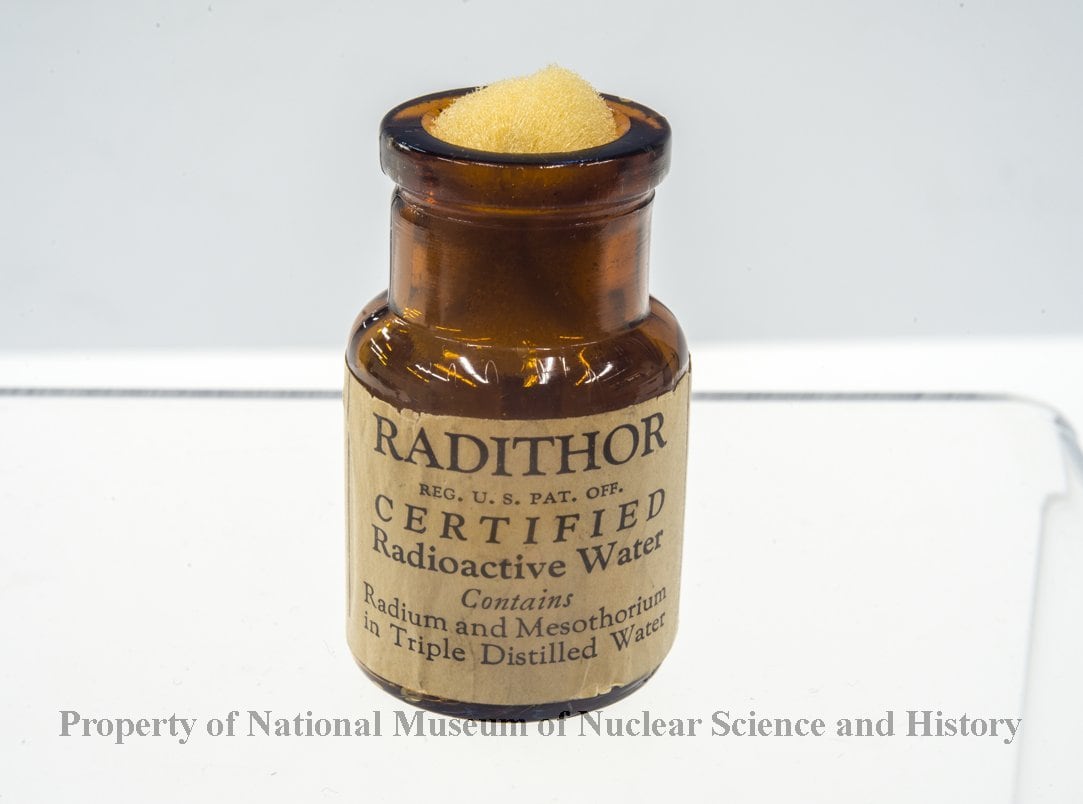
The purest specimen of the whole fad is Radithor, and it is worth starting there because it is so simple: a half-ounce (about 15 mL) bottle of triple-distilled water into which real radium had been dissolved. It was made by Bailey Radium Laboratories of East Orange, New Jersey, the company of William J. A. Bailey — a Harvard dropout with no medical degree who nonetheless styled himself “Doctor.” Each bottle carried a printed guarantee that it contained at least one microcurie each of radium-226 and radium-228, the two principal radium isotopes; Bailey publicly offered $1,000 to anyone who could show a bottle held less than the certified amount. That guarantee was the product’s whole selling point, and, grimly, it was honest. The radium was really there.
According to the Oak Ridge museum’s record, Radithor sold for about $1 a bottle — an enormous markup, since the profit margin ran to roughly 400 percent — and Bailey’s laboratory distributed on the order of 400,000 bottles, most of them between about 1925 and 1930. The dose was to drink the contents, one bottle at a time, as a general “tonic.” Bailey’s literature promised it would restore lost energy and sexual vigor and cure a long roster of “endocrine” and degenerative complaints; a printed claim that “Radithor is harmless in every respect” sat on the same page as the guarantee of its radium content, a juxtaposition that reads today as an epitaph. The reality — that radium is chemically a calcium mimic that lodges in bone and irradiates it from within — is Vol 2’s to explain, and the fate of the man who drank an estimated 1,400 bottles, Pittsburgh socialite Eben Byers, is the centerpiece of Vol 4. Here it is enough to note that a museum survey meter held to a surviving Radithor bottle still reads a few microroentgens per hour above background at a foot, rising sharply on contact.
1.3 The Revigator and the water crocks
Radithor was a bottled dose. The Revigator was a household appliance, and it sold in far greater numbers because it promised to make the radioactive water for you, night after night, for free. It was a roughly two-to-four-gallon glazed stoneware water crock with a wooden lid and a brass spigot near the base — the sort of thing that would sit on a kitchen counter — except that its inner wall was a porous lining containing uranium/radium ore (the mineral carnotite). The idea, printed right on the jar, was to fill it every night and let the water stand in contact with the ore; radon gas emanating from the radium would dissolve into the water overnight. The user then drank it through the day. The Revigator’s own instructions told the buyer to “fill jar every night” and “drink freely… when thirsty and upon arising and retiring, average six or more glasses daily.”
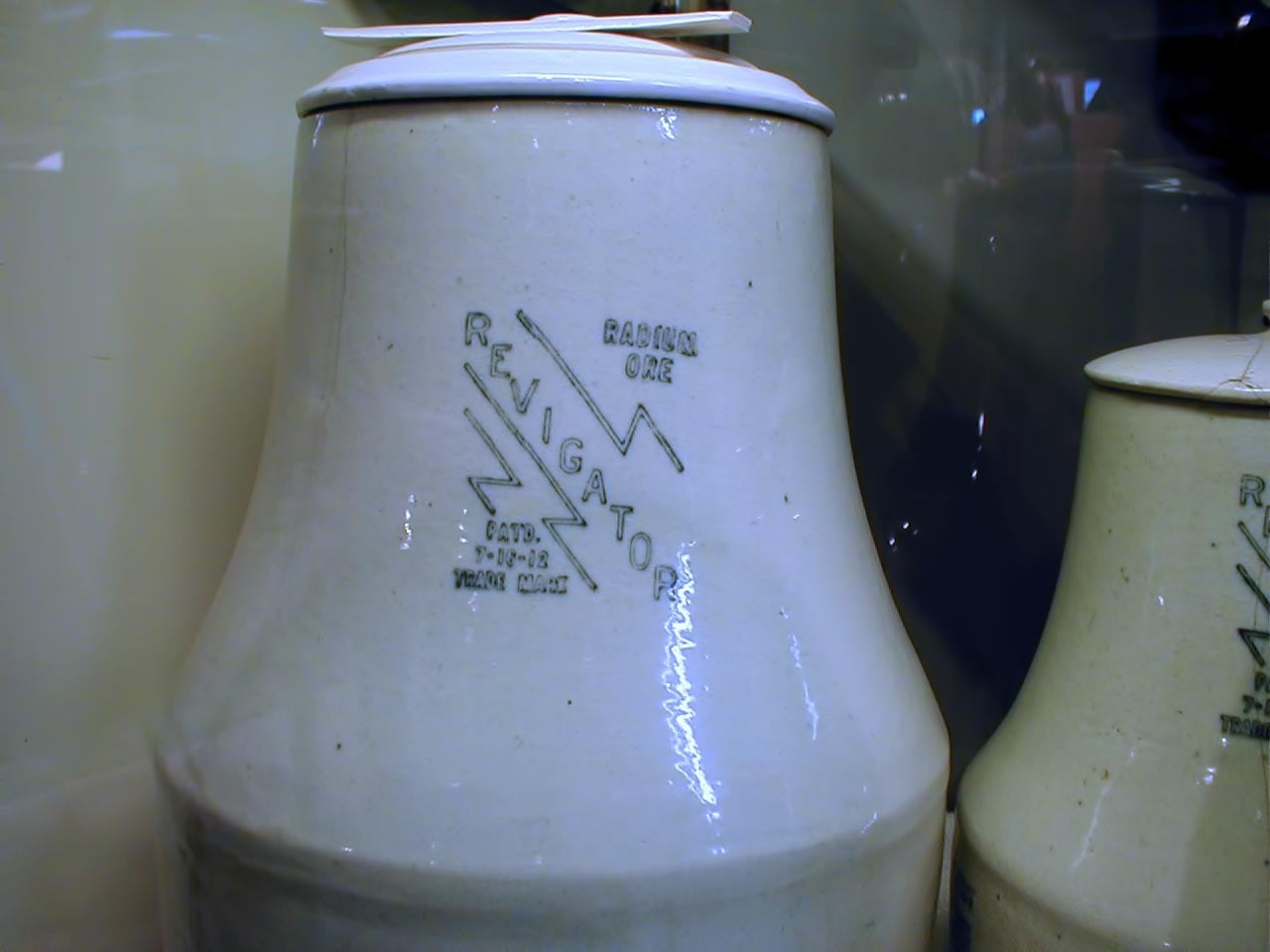
The device was patented in 1912 by R. W. Thomas, then a stock salesman in Arizona; commercial manufacture came later, through the Radium Ore Revigator Company of San Francisco (Thomas sold his interest on to the Dow-Herriman Pump & Machinery Company in 1924), which moved hundreds of thousands of the crocks between roughly 1924 and 1930. Contemporary museum records put the retail price around $29.50 in the late 1920s — a meaningful sum then, but a one-time purchase for a lifetime of “radioactive” water. A cheaper alternative for the thrifty buyer was the Thomas Cone, a smaller radioactive ceramic cone or “emanator” one dropped into an ordinary vessel of water to the same end; a whole minor market of radon “emanators” worked on this principle, and under an American Medical Association standard of the era such a device was only supposed to earn approval if it generated more than 2 microcuries of radon per liter over 24 hours.
The bitter twist, confirmed by modern analysis (including a 2010 National Institute of Standards and Technology study of surviving crocks), is that the Revigator delivered on its radioactive promise — water left in one for a week reached radon levels of hundreds to over a thousand picocuries per liter, far above any modern drinking-water limit — while also leaching arsenic, lead, and uranium out of the ore into the water. It was a health hazard twice over. The physics of why the “radon tonic” idea was a category error belongs to Vol 2; the object here is simply a pretty stoneware crock that quietly poisoned its owner’s drinking water.
1.4 The Radiendocrinator and things you wore
If Radithor was the thing you drank, the Radiendocrinator was the thing you wore, and Bailey created the company behind it. Marketed through American Endocrine Laboratories in New York (active from the early 1920s through about 1930, with a Manhattan attorney, Ward Leathers, eventually listed as proprietor after Bailey left to run the Radithor business), the Radiendocrinator was a small, luxurious object: several radium-soaked paper strips, each about the size of a playing card, sealed under clear plastic behind fine gold-wire screens, the whole assembly gold-plated and nestled in a velvet-lined, embossed leatherette case. By the Oak Ridge museum’s record it launched at about $1,000 and was later cut to $150 — the lowest documented price for the gold-plated model, and still a striking sum for what was, physically, a wafer of irradiated blotting paper in a jewel case. Both figures come from the museum’s documentation, which is why casual accounts quote such a wide range.
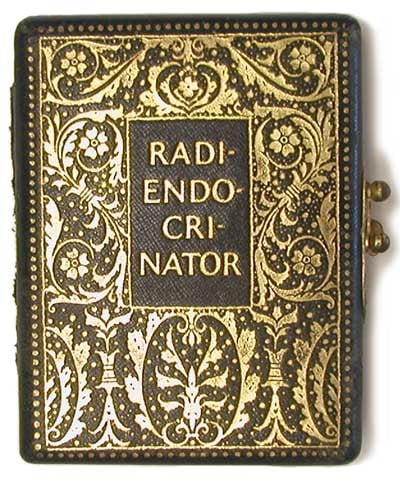
The user was directed to wear it against the body over the endocrine glands — held in place with an adjustable harness, and, in the notorious male version, positioned under the scrotum overnight — on the theory that radium’s “energy” would stimulate the glands and thereby restore vitality, potency, and youth. Bailey’s promotional literature attached the device to a sweeping list of glandular and degenerative conditions. The object’s danger is not hypothetical or historical only: the Radiendocrinator held in the Oak Ridge museum collection was radioactive enough that the curator had to remove the radium source before it could be safely put on public display — a fact that says more about the product than any period advertisement could.
1.5 Toothpaste, cosmetics, and the everyday shelf
Radium did not stay in the tonic aisle. As the fad matured it migrated onto ordinary shelves, so that a household could be radioactive without ever knowing it had bought into a health craze.
The best-known example is Doramad, a German radioactive toothpaste made by Auergesellschaft of Berlin and sold from the 1920s into the mid-1940s. Its radioactivity came not from radium but from thorium, extracted from monazite sand — Auergesellschaft’s main business was thorium gas-mantles, and the toothpaste was essentially a way to sell a byproduct into the radioactivity fad. The tube’s German marketing promised that its radioactive rays “increase the defenses of teeth and gums,” charging the toothpaste with the same borrowed glamour of atomic energy.
Cosmetics followed the same logic. The French line Tho-Radia, launched in Paris in 1932, sold face cream, powder, toothpaste, and soap under the imprimatur of a “Dr. Alfred Curie” — a figurehead whose surname did the advertising’s heavy lifting, trading on Marie and Pierre Curie without any real connection to them. A 1932 laboratory certificate for Tho-Radia cream recorded genuine radioactive content (a small quantity of radium bromide, alongside thorium), and the brand’s famous poster of a woman’s face lit from below became the visual shorthand for “radiant” beauty. France restricted radioactive ingredients from 1937, after which Tho-Radia quietly reformulated but kept the name and the glow-from-below imagery well into the 1950s. Around this same shelf sat radium suppositories, radium-labeled tablets and “Radio-active” pastilles, radium hair tonics, and even radium-branded contraceptive jellies — a long tail of products in which the word “radium,” and sometimes the element itself, was sold as a synonym for potency and life.
1.6 “Drink freely, wear it”: the marketplace
What ties these objects together is not a single maker or a single dose but a marketplace and a mood. In the two decades after the Curies isolated radium in 1898, radium was the most glamorous substance on earth: vanishingly rare, absurdly expensive, faintly glowing, and — crucially — genuinely used by real physicians in real hospitals to shrink real tumors. That last fact is what made the quackery so plausible. If a carefully aimed radium source could destroy a cancer, the intuitive (and wrong) leap was that a little radium, taken gently and continuously, must invigorate healthy tissue. The tonics, crocks, and pads sold that leap.
The channels were everything the era offered. Radithor was pushed through physicians, who received a commission on the bottles they prescribed, lending the product a veneer of medical authority. The Revigator was sold by mail order and door-to-door as a durable household good, the way one might buy a stove. The Radiendocrinator was marketed as a discreet luxury, its price and gold case signaling exclusivity. Toothpaste and cosmetics rode the ordinary drugstore and department-store counter. And across all of them ran a single grammar of persuasion — the pseudo-scientific “guarantee” of microcurie content, the borrowed prestige of a famous name, the promise of restored “vitality” and sexual vigor, and the reassuring instruction to use the product freely and continuously, since more radioactivity could only mean more life. The catalog of who profited from that grammar, and how big the boom really got, is Vol 3 — The Makers and the Radium Boom.
1.7 Where this volume hands off
You now have the objects in hand: a bottle, a crock, a gold pad, a tube, a jar — the physical furniture of a health fad that, uniquely in this collection, delivered exactly the radioactivity it advertised. The next and most important question is the one every one of these products depended on the public not asking clearly: what does drinking or wearing radioactivity actually do to a body? That is Vol 2 — The Physics and the Harm, which explains radioactive decay in plain terms, why radium behaves like calcium and seeks the bones, and why “energy equals vitality” was a fatal category error — while carefully distinguishing all of it from the legitimate radiation medicine of the same era. From there the dive turns to the makers and the boom (Vol 3), the reckoning that followed Eben Byers’s death (Vol 4), and the sober practicalities of collecting and displaying these still-radioactive artifacts safely (Vol 5).
Sources
- ORAU Museum of Radiation and Radioactivity — Radioactive Quack Cures (collection index) — overview of the product families; Revigator price (~$29.50, ca. 1929), San Francisco maker, patent 1912; Radiendocrinator ($150, gold-plated, worn over endocrine glands); emanator/AMA 2-µCi-per-liter standard; Doramad and cosmetics present in collection.
- ORAU Museum — Radithor (ca. 1928) — half-ounce bottle “guaranteed to contain at least 1 microcurie each of Ra-226 and Ra-228”; Bailey’s $1,000 challenge; ~$1/bottle with ~400% margin; >400,000 bottles; museum survey readings (~2 µR/hr at one foot, ~35 µR/hr on contact); “harmless in every respect” claim.
- ORAU Museum — The Radiendocrinator (ca. 1924–1929) — radium-soaked paper strips under gold-wire screens in a gold-plated holder and velvet-lined leatherette case; launched ~$1,000, later cut to $150; company founded by William Bailey, American Endocrine Laboratories, NYC (ca. 1923–1930, Ward Leathers later proprietor); source had to be removed before museum display.
- Wikipedia — Radithor — Bailey Radium Laboratories, East Orange NJ; 400,000 bottles 1925–1930; Eben Byers drank ~1,400 bottles from 1927, died 1932, jaw removed, lead-lined coffin, remains still radioactive (225,000 Bq) when exhumed 1965; the 1990 Wall Street Journal headline.
- Wikipedia — Radium ore Revigator — R. W. Thomas patent 1912; Radium Ore Revigator Company of San Francisco; carnotite/uranium-ore lining; “fill jar every night… drink freely” instructions; hundreds of thousands sold 1924–1930; radon and leached arsenic/lead/uranium in the water.
- NIST — “What Were They Drinking? Researchers Investigate Radioactive Crock Pots” (2010) — modern measurement of surviving Revigators: high radon (hundreds to >1,000 pCi/L) plus toxic arsenic, lead, and uranium leaching into the stored water.
- Wikipedia — Doramad Radioactive Toothpaste — Auergesellschaft, Berlin; thorium from monazite sand; a byproduct of the firm’s gas-mantle business; marketed as strengthening the “defenses” of teeth and gums; produced 1920s–1945.
- Wikipedia — Tho-Radia — French radioactive cosmetics launched Paris 1932; radium bromide and thorium; “Dr. Alfred Curie” figurehead; 1932 lab certificate of radium content; radioactive ingredients restricted in France from 1937.
- Smithsonian National Museum of American History — Radium Ore Revigator (object record) — museum specimen of the water crock for the figure caption.
- ORAU Museum — Radioactive Curative Devices and Spas — framing of the wider fad, the borrowed prestige of medical radium therapy, and the range of tonics, emanators, and appliances.
Comments (0)