Radioactive Cures · Volume 2
The Physics and the Harm
What radioactive decay actually is, why radium hunts the skeleton like calcium, and why 'energy equals vitality' was a lethal category error.
2.1 About this volume
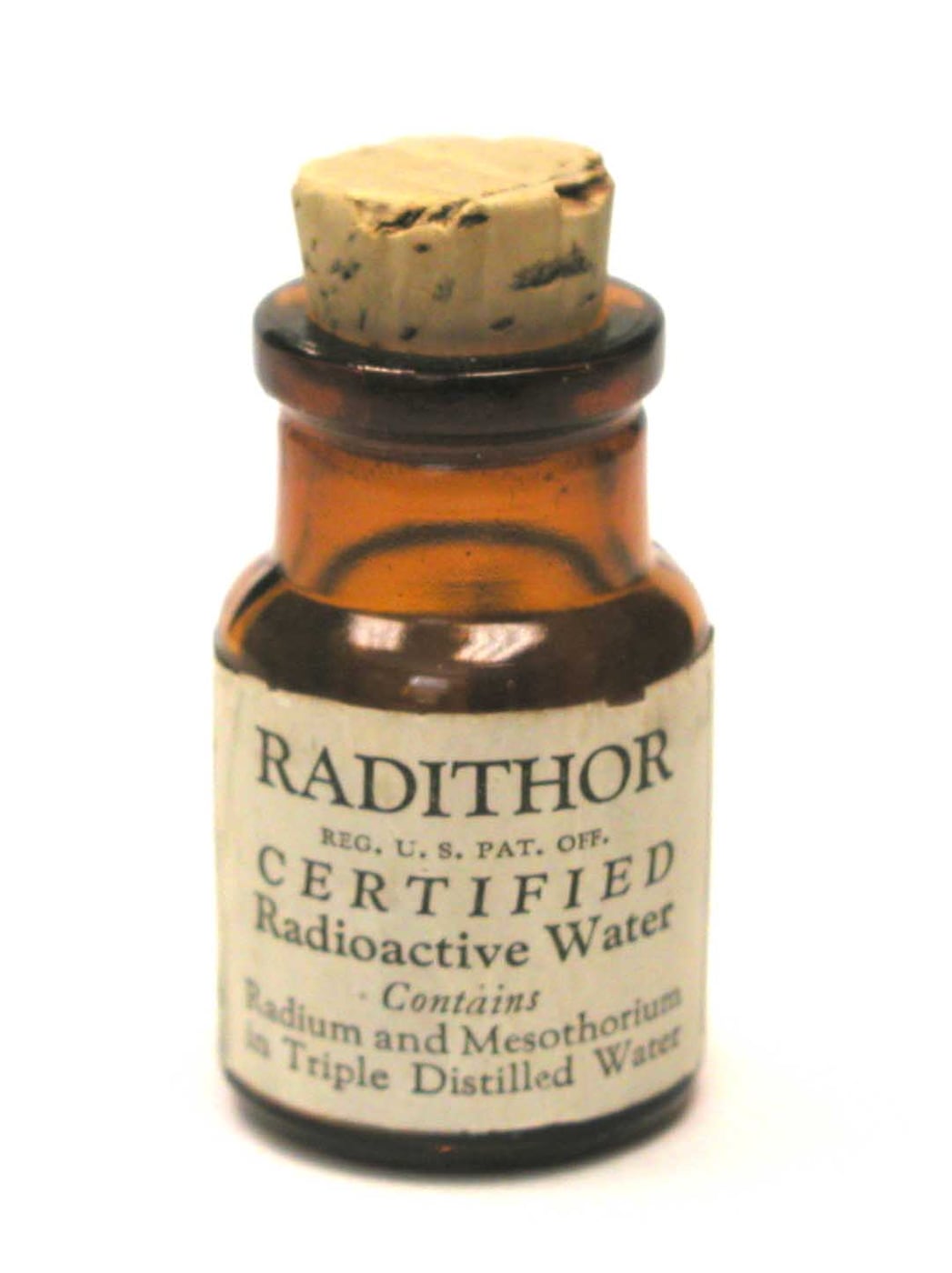
Vol 1 — The Bottles, Crocks, and Cases laid out the objects: Radithor’s little amber bottles, the Revigator’s stoneware crock, the gold-cased Radiendocrinator, and the emanators and tablets that promised health from a dose of radioactivity. The subject here is the one thing all of them had in common and the one thing their sellers got catastrophically wrong. Unlike the Violet Ray Wands dive elsewhere in this collection, whose spark was mostly harmless theatre, these products worked exactly as advertised in the narrow sense that they really were radioactive. That is precisely why they were dangerous.
The discipline of this volume is to make the hazard explicit and to keep it strictly historical. Nothing here is a recipe, a dose, or a method; every product named is described as a documented public-health disaster, not a thing to reproduce. The argument runs in three moves that this whole dive repeats: state what radioactivity is, show what it does inside a living body, and then explain why the era mistook “delivers energy” for “restores life.” The full regulatory reckoning — the trials, the FDA, the fall of the fad — belongs to Vol 4 — The Reckoning; here we build the physics and physiology that reckoning was built on.
2.2 Radioactive decay in plain terms
An atom of a radioactive element is unstable: its nucleus will, at some unpredictable moment, throw off part of itself and become a different, lighter atom. That event is radioactive decay, and the fragment it throws is radiation. Radium’s most important product, alpha radiation, is a fast, heavy particle — two protons and two neutrons, a helium nucleus — hurled out of the nucleus. Beta radiation is a fast electron. Both are forms of ionising radiation, meaning they carry enough energy to knock electrons off the molecules they pass through, breaking chemical bonds along the way (U.S. EPA, radionuclides).
Each unstable isotope decays at its own fixed rate, described by its half-life — the time for half of any quantity to decay. The relevant numbers are wildly spread. Radium-226 has a half-life of about 1,600 years; its immediate product, the gas radon-222, has a half-life of just 3.8 days; and their parent, uranium-238, a staggering 4.5 billion years (NIST, radium-226 decay chain). One decay produces another unstable atom, which decays in turn, forming a decay chain that steps down through a series of daughters until it reaches a stable one — for the uranium series, ordinary lead-206.
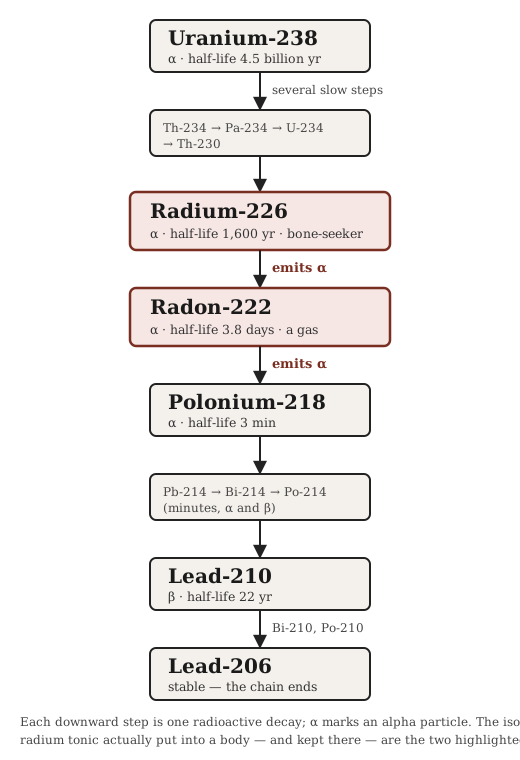
The crucial, counter-intuitive fact for a modern reader is that a radium tonic did not deliver a single burst and stop. A radium atom lodged in the body sits at the top of that cascade and keeps working — for a human lifetime and far beyond — emitting alpha particles itself, generating radon, and seeding every downstream daughter, each of which adds its own radiation. The “energy” the advertisements sold was the energy of that unstoppable, self-renewing bombardment. (Radithor, unusually, carried a second isotope, radium-228, drawn from the separate thorium-232 series, a beta emitter with a half-life near six years — so a Radithor drinker was fed two independent decay chains at once.)
2.3 Radium the bone-seeker
Here is the mechanism that turned a “tonic” into a slow poison. Radium sits directly below calcium, barium, and strontium in the same column of the periodic table, and the body cannot tell it apart from calcium. Swallowed radium is therefore absorbed and routed exactly as dietary calcium is — into the mineral of the skeleton, where it is laid down in bone and teeth and then retained for years to decades (National Research Council, Health Risks of Radon and Other Internally Deposited Alpha-Emitters; EPA). This is what “bone-seeker” means: the poison concentrates itself in the one tissue you cannot flush, right against the bone marrow that makes blood.
Once fixed in bone, each radium atom fires alpha particles into the surrounding tissue at point-blank range. Alpha particles are almost harmless outside the body — a sheet of paper or the dead outer skin stops them — but inside, embedded in bone, they are the most destructive form of radiation there is, dumping all their energy into a few cells’ width of living tissue. Over years the accumulated local dose is enormous; studies of the radium dial painters estimated microscopic bone doses ranging into the tens of thousands of rads (NRC bookshelf). The biological results are a grim, consistent list: destruction of bone (osteonecrosis, the “radium jaw” seen where the poison concentrated in the jawbone), suppression of the marrow leading to anemia, and, after a latency that could run decades, bone cancer — osteosarcoma. Among the studied dial-worker population roughly one in sixty developed a radiation-induced bone sarcoma, a cancer vanishingly rare in the general public (NRC bookshelf; ORAU, “Radium Girls”).
None of this was reversible and none of it was felt at the time of dosing. The tonic produced no sensation of harm — arguably the most dangerous property a poison can have — while quietly stocking the skeleton with a permanent alpha-particle source.
2.4 Radon: the gas you drank and breathed
The Revigator crock and the various “emanators” worked on a different but equally real principle. Their walls or inserts contained radium-bearing ore; as the radium decayed, it produced radon-222, a heavy, invisible, chemically inert radioactive gas that dissolved into the water standing overnight in the jar (ORAU, “Radioactive Quack Cures”). The American Medical Association even ran an approval scheme in this period, listing “emanators” that could raise water above a set radon activity — a striking measure of how thoroughly the mainstream had, for a time, accepted the premise (ORAU).
Radon’s harm is delivered by the same alpha mechanism, relocated. Drunk or inhaled, radon and its short-lived solid daughters (polonium-218 and beyond) deposit in tissue and irradiate it from within; inhaled radon is today a well-established cause of lung cancer and is, after smoking, a leading contributor to it. The Revigator’s own instruction to “drink freely… six or more glasses daily” was, in physical terms, a prescription for a daily internal alpha dose. That its crock is far less notorious than Radithor is largely an accident of chemistry: radon’s short half-life meant much of the activity was gone within days, and dissolved radon is exhaled rather than permanently bound like skeletal radium — so the emanators, though genuinely hazardous, rarely produced the spectacular fatalities that bottled radium did.
2.5 Why “energy equals vitality” was a category error
The entire fad rested on a single seductive syllogism. Radioactivity was new, invisible, and demonstrably powerful — it fogged photographic plates, it glowed, it warmed. Life, too, was understood as a matter of “energy” and “vital force.” Therefore, the reasoning went, a source of concentrated energy taken into the body must top up its vitality. The Radiendocrinator’s own literature promised the reactivation of the endocrine glands and the restoration of youthful vigour; radium tonics promised potency and rejuvenation “from the inside.” It felt like plugging the body into a power source.
The error is a confusion of two utterly different meanings of “energy.” Biological vitality is not a quantity of raw energy poured into tissue; it is the exquisitely ordered chemistry of intact molecules — enzymes, membranes, and above all DNA — doing their work. Ionising radiation delivers energy in the only way it can: by breaking those molecules, smashing bonds and shredding DNA at random. It is the biochemical opposite of a tonic. Adding radioactive energy to a living cell is not like charging a battery; it is like taking a hammer to the machinery. The sensation of stimulation some users reported was almost certainly suggestion and the general excitement of a fashionable cure, exactly as with the violet-ray wand — but underneath the placebo, real damage was accumulating with every dose. “Energy” the physicist could measure had been silently swapped for “vitality” the advertiser could sell, and the two had nothing to do with one another.
2.6 The line to legitimate radiation medicine
It matters to say clearly that radiation is not magic and not uniformly evil — because the quacks borrowed their credibility from a genuine medicine that was maturing at the very same time. By the 1900s–1920s, physicians were using radium and X-rays deliberately against cancer: sealed radium needles and tubes placed in or beside a tumour (brachytherapy), and external beams aimed at malignant tissue. That practice was, and remains, real medicine.
The difference is total, and it is worth stating as a set of contrasts. Legitimate radiation therapy uses a measured dose, targeted at diseased tissue and shielded away from healthy tissue, delivered by trained hands, for a specific pathology — and it exploits the one thing radiation genuinely does: it kills cells, which is useful only when the cells you are killing are cancer. The quack products did the reverse on every count: an unmeasured dose, swallowed or worn so that it spread through the whole healthy body, self-administered, for no disease at all but as a general “tonic,” on the false premise that the radiation would nourish rather than destroy. Same underlying physics; opposite intent, dose, target, and result. The tonic sellers were not doing a crude version of cancer therapy — they were doing its exact inversion, spreading a cell-killing agent evenly through people who were, until they drank it, well.
2.7 What the harm actually looked like
The physics stops being abstract in the person of Eben Byers, a wealthy Pittsburgh industrialist and amateur golf champion who from 1927 drank Radithor by the case on his doctor’s advice — by later reckoning something on the order of 1,400 bottles (Radithor, Wikipedia; ORAU). The radium did precisely what its chemistry dictates: it built up in his skeleton and irradiated it from within. By the early 1930s his bones were disintegrating; much of his upper and lower jaw was surgically removed, holes opened in his skull, and he died in 1932. He was buried in a lead-lined coffin, and when his body was exhumed for study in 1965 it was still measurably radioactive — reported at around 225,000 becquerels, roughly fifty times the natural radioactivity of an ordinary body (Radithor, Wikipedia). The retrospective Wall Street Journal headline most often quoted about the affair — “The Radium Water Worked Fine Until His Jaw Came Off” — is genuinely from the Journal, but it dates from a 1990 feature by Ron Winslow, not from a 1932 front page, a detail worth getting right since the phrase is so often mis-dated (leads via Eben Byers, Wikipedia).
Byers is often mentioned in the same breath as the Radium Girls, and the mechanism was identical — radium lodged in bone, alpha particles, necrosis, sarcoma — but the two must not be conflated. The dial painters were workers poisoned occupationally, ingesting radium from luminous paint as they pointed their brushes with their lips; their story is one of industrial negligence and a landmark fight for workers’ compensation, and it belongs to a different history than the consumer fraud told here. What the two share is the clinical picture: they are the empirical proof, written in human bone, of everything the earlier sections describe. The regulatory consequences that followed — for the makers, and for American drug law — are the subject of Vol 4 — The Reckoning.
2.8 Where this volume hands off
With the hazard established, the story returns to people and commerce. Vol 3 — The Makers and the Radium Boom profiles William J. A. Bailey and the entrepreneurs who built an industry on the physics debunked here, and the boom-era culture that bought it. Vol 4 — The Reckoning carries Byers, the FDA and FTC, and the collapse of the fad. Vol 5 — Collecting Safely and Displaying is where this volume’s physics becomes a practical warning: because radium-226 has a 1,600-year half-life, every surviving Radithor bottle, Revigator crock, and Radiendocrinator is still radioactive today, and Vol 5 covers how a collector documents and displays such an object without handling it as if it were inert. The chain that Byers’s remains still register did not switch off — and neither did the ones sitting in these museum cases.
Sources
- ORAU Museum of Radiation and Radioactivity — “Radioactive Quack Cures” — supported the Radithor per-bottle activity (~2 µCi radium), the Revigator (R. W. Thomas, patented 1912, $29.50 in 1929, “drink freely… six or more glasses daily”), the $150 gold-cased Radiendocrinator worn over the scrotum, the AMA emanator-approval scheme, and the radon-water mechanism.
- ORAU — “Radium Girls: The health scandal of radium dial painters” — supported the occupational-poisoning parallel, lip-pointing ingestion, and the necrosis/sarcoma outcomes distinct from the consumer fraud.
- National Research Council, Health Risks of Radon and Other Internally Deposited Alpha-Emitters (BEIR IV), NCBI Bookshelf — supported radium’s chemical similarity to calcium, deposition and long retention in bone, the alpha-particle bone-dose figures, and the anemia/osteonecrosis/osteosarcoma spectrum.
- U.S. EPA — Radionuclide Basics: Radium — supported the definition of ionising alpha/beta radiation, radium’s decay to radon, and its behaviour as a calcium-analogue bone-seeker.
- NIST — Radium-226 decay chain — supported the half-lives (Ra-226 ≈ 1,600 yr, Rn-222 ≈ 3.8 days, U-238 ≈ 4.5 billion yr) and the chain of daughters to stable lead-206 drawn in the figure.
- Radithor — Wikipedia (leads) — supported the radium-226 + radium-228 content (~1 µCi each), Bailey Radium Laboratories of East Orange NJ, the Byers ~1,400-bottle figure, 1932 death, lead-lined coffin, and the 1965 exhumation reading (~225,000 Bq).
- Eben Byers — Wikipedia (leads) — used to date and attribute the “Radium Water Worked Fine…” Wall Street Journal headline to a 1990 retrospective (Ron Winslow), correcting its frequent mis-dating to 1932.
Comments (0)