Radioactive Cures · Volume 3
The Makers and the Radium Boom
The salesmen who turned a lethal element into a consumer product — William J. A. Bailey and his Radithor and Radiendocrinator, R. W. Thomas and the Revigator crock, and the wider fad economy that put radium in tonics, toothpaste, and face cream.
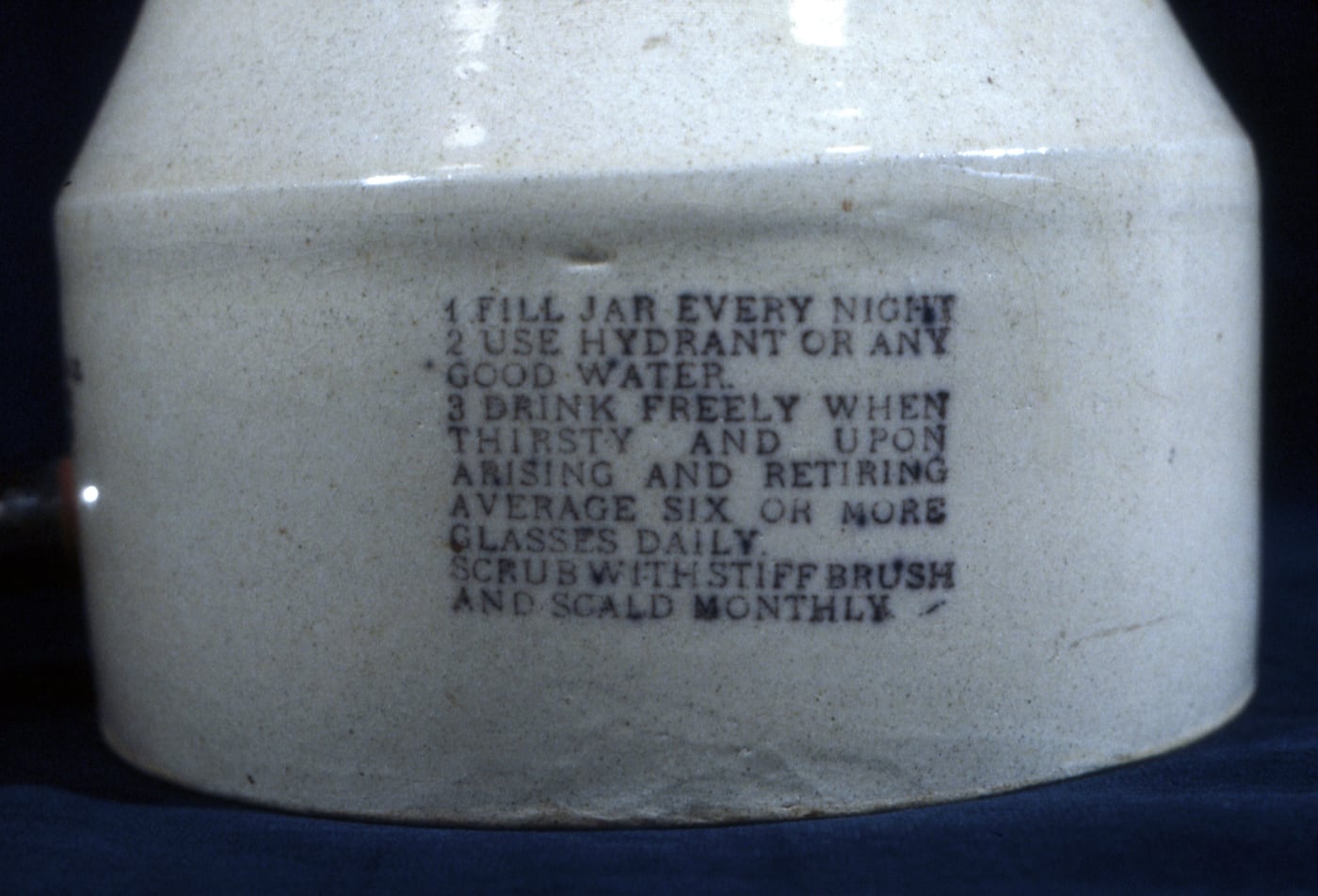
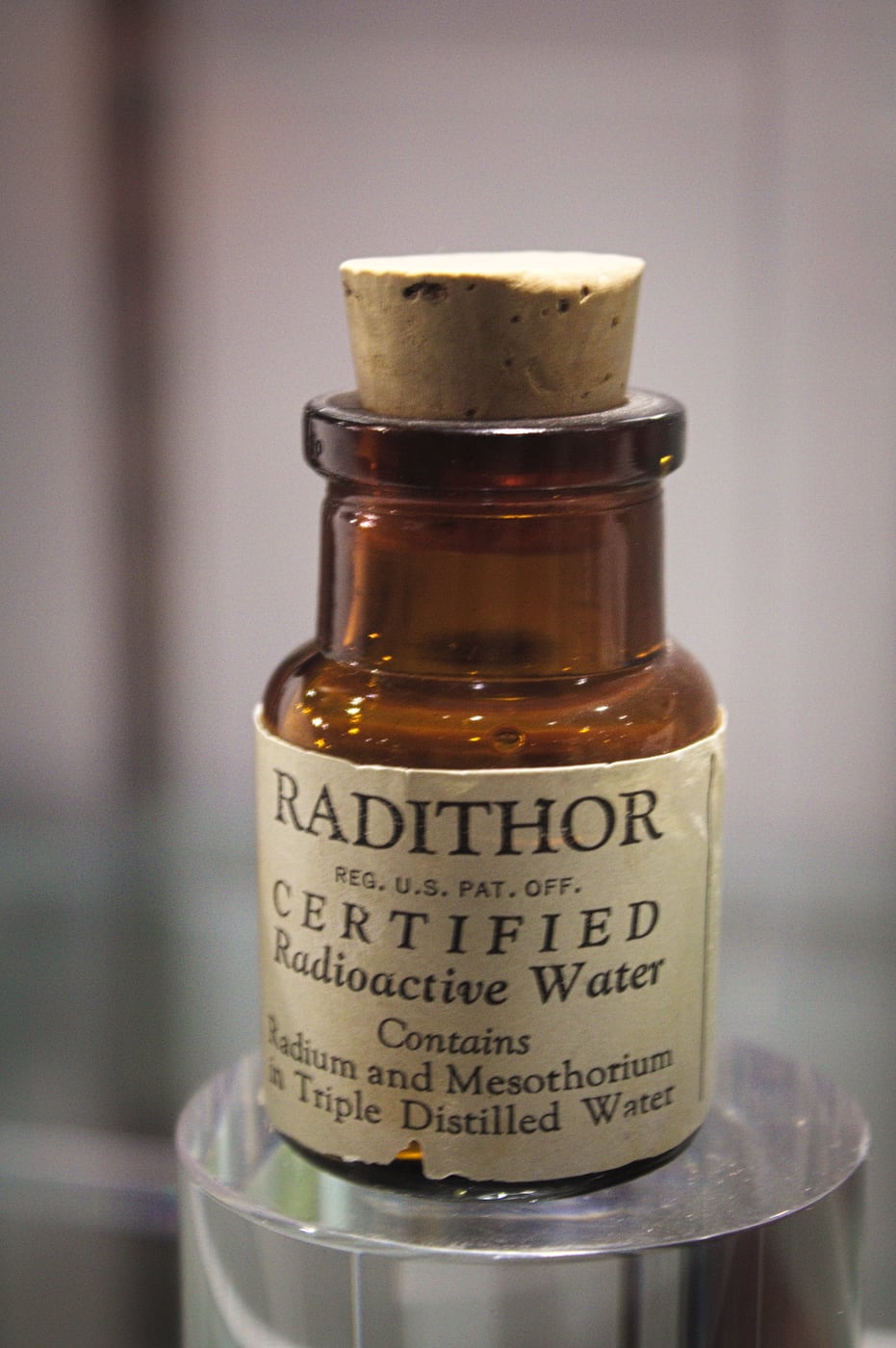
Where Vol 1 — The Bottles, Crocks, and Cases introduced these objects and Vol 2 — The Physics and the Harm explained why drinking radium destroys bone rather than restoring vitality, this volume is about the people and firms who built the trade — and the peculiar economy that let a genuinely lethal element be sold across a drugstore counter. The reckoning that ended it is reserved for Vol 4 — The Reckoning.
3.1 About this volume
The radium fad was a real, briefly enormous consumer industry that ran from roughly the end of the First World War to the early 1930s. Unlike the violet-ray trade of its neighbouring dive (see Quack Devices → Violet Ray Wands), which sold a harmless glowing gadget, the radium trade sold genuine ionising radioactivity as a health-giving ingredient — in water, in worn appliances, in creams and pastes. Because radium was one of the most expensive substances on Earth (period prices ran to roughly $100,000 per gram), the honest products were costly and the dishonest ones simply omitted the radium and kept the word.
This volume treats the two best-documented American operators as anchors — William J. A. Bailey, whose Radithor and Radiendocrinator sit at the fatal, high-end pole of the trade, and R. W. Thomas, whose Revigator crock brought radioactive water into ordinary homes at a mid-range price — and then surveys the surrounding fad economy of cosmetics and sundries. Throughout, where a figure is inflated, contested, or thinly sourced, this volume says so rather than repeat it. The underlying physics and the specific injuries are covered in Vol 2; the Byers death, the trials, and the regulatory endgame are covered in Vol 4.
3.2 William J. A. Bailey: the salesman who called himself doctor
William John Aloysius Bailey (May 25, 1884 – May 17, 1949) was born in Boston, attended Boston Latin School, and was admitted to Harvard — from which, by the museum record, he departed after about three semesters without a degree. He nonetheless styled himself “Dr. Bailey” and, at various points, claimed a doctorate in medicine from the University of Vienna, a credential he never held. He was, in the plainest terms, a patent-medicine promoter and salesman, not a physician or a chemist.
Bailey’s radium career predated Radithor. He is documented running Associated Radium Chemists, Inc. by about 1922, and over the decade he marketed a shifting catalogue of radioactive nostrums — among them “Thorone” tablets advertised, absurdly, as “250 times more radioactive than radium.” What distinguished Bailey from the ordinary snake-oil vendor is that his products frequently did contain what they claimed. That is precisely why they were dangerous. He genuinely dissolved certified radium salts into his tonic and genuinely sealed radium into his worn appliance, then wrapped both in the language of endocrinology and “stimulation.” The category error at the heart of the whole trade — treating radioactive energy as if it were biological vitality — is dissected in Vol 2; Bailey’s genius was commercial, not scientific.
His own end is the darkest footnote to his advertising. Bailey died of bladder cancer in 1949; when his body was exhumed roughly two decades later during a study of radium victims, it was found to be, in the researchers’ description, ravaged by radiation — the salesman having evidently sampled his own merchandise.
3.3 Radithor: the flagship
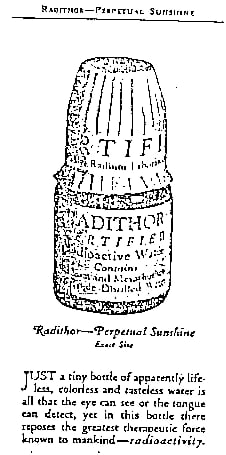
Radithor was Bailey’s commercial masterpiece and the product by which the whole fad is now remembered. It was manufactured by Bailey Radium Laboratories of East Orange, New Jersey, and sold in small half-ounce (about 15 mL) bottles of distilled water, each certified to contain at least one microcurie each of radium-226 and radium-228 — roughly two microcuries of radium activity in a mouthful of water, taken daily. Marketing copy billed it as “A Cure for the Living Dead” and “Perpetual Sunshine,” and promised relief for impotence, “endocrine” weakness, and, by the fuller advertising, well over a hundred other complaints.
The commercial figures are well attested by the ORAU museum record and by Wikipedia’s sourcing: over 400,000 bottles were sold between 1925 and 1930, at a price of about $1 per bottle, on an estimated profit margin near 400%. A “minimum course of treatment” of several months’ daily dosing meant the dollar-a-bottle price compounded quickly for a committed customer — which is exactly how the Pittsburgh industrialist Eben Byers came to drink an estimated 1,400 bottles, a story told in full in Vol 4.
Two guarantees on the packaging capture Bailey’s confidence. He offered $1,000 to anyone who could prove a bottle contained less radium than stated — a dare he could safely make, because the radium was real. And he guaranteed that “Radithor is harmless in every respect.” That second promise was catastrophically false, and its falsity — written on the label of a product that killed at least one prominent man — became a central exhibit when regulators finally moved.
3.4 The Radiendocrinator: gold-plated radium for the glands
At the luxury pole of Bailey’s line sat the Radiendocrinator, a small worn appliance rather than a drink. It was a gold-plated plaque roughly 2 by 3 inches, containing (in the surviving museum example) seven radium-soaked paper cards the size of playing cards, faced with two gold-wire screens and clear covering, and shipped in a dark-blue embossed leatherette case lined with velvet — an object deliberately styled to look precious. The buyer was instructed to wear it over the endocrine glands; a man was to strap it beneath the scrotum overnight, “like any athletic strap,” to irradiate the gonads directly. The claimed benefit was restored endocrine function and, through it, general rejuvenation and sexual potency.
The device is closely associated with Bailey, though the museum paper trail attributes its sale to a related New York entity — American Endocrine Laboratories (with a Manhattan attorney, Ward Leathers, eventually listed as proprietor) — active roughly 1924–1930. The price is one of the fad’s most quoted figures, and the museum record resolves the wide spread seen in secondary accounts: it launched at about $1,000 — a sum that, at a time when a new Model T Ford sold for under $300, represented several months’ wages for many buyers — and was later cut to $150, described as the lowest it ever sold for. Both figures are correct; they are simply the two ends of its price history, which is why casual sources disagree.
The surviving specimen tells the physical truth the advertising hid. Before its source was removed for safe storage, the museum measured roughly 200 milliroentgens per hour at contact — a serious dose rate against the skin and glands — and the case interior was found to have been contaminated by leakage from the radium papers over the decades. A collector encountering one today is handling a genuinely hot object; that hazard is the subject of Vol 5 — Collecting Safely and Displaying.
3.5 R. W. Thomas and the Revigator
If Bailey served the wealthy and the desperate, Ralph W. Thomas (born December 10, 1873, in Kansas) served the middle of the market. Thomas was a stock salesman working in Arizona — not a scientist — who filed the patent behind the Revigator, a radioactive water crock, in 1912 (the patent was granted that year, though commercial manufacture came a decade later). The premise was to let ordinary tap water sit overnight in a jar whose inner wall was lined with carnotite, a uranium-and-radium-bearing ore, so that the water absorbed radon gas and became, in the advertising, “revitalized.”
The object itself was a glazed earthenware crock about a foot tall, with a lid and a bottom spigot, sold with the memorable instruction to “fill it every night” and then drink freely — “six or more glasses daily.” By the museum record Thomas’s jars appeared commercially around 1921, and demand outran him: in late 1924 he sold the operation to the Dow-Herriman Pump & Machinery Company, which rebranded it as the Radium Ore Revigator Company, headquartered in San Francisco with branch offices nationwide. Thomas was largely pushed out within a year or two.
On the numbers, the ORAU museum states that Revigator sales reached several hundred thousand units — a striking record given the price. That price is well documented at $29.50 in 1929 for the standard crock, a substantial sum for a household water jar, which the company justified by casting the crock as a permanent health appliance rather than a consumable. After leaving the Revigator business Thomas went on, around 1928, to market the cheaper Thomas Radioactive Cone — a radium-bearing cone meant to be dropped into an existing water container to irradiate it — which his widow Charlotte continued selling into the 1930s despite federal seizures and a 1936 FTC order to stop the medical claims. The regulatory thread is picked up in Vol 4.
3.6 The wider radium-fad economy
Bailey and Thomas were only the best-documented operators in a broad consumer market. By the late 1920s “radium” had become a general-purpose marketing word applied, the History channel’s radium-fad feature notes, to everything from mouthwash to chocolate bars — beer, butter, cigarettes, cigars, suppositories, and “radium” bread all appeared, and a large fraction of them contained no radium at all, the word alone being the selling point.
Where radioactivity was genuinely present, it clustered in a few categories. Cosmetics were prominent: the English Radior line — face creams, powder, rouge, hair tonic, and soap — was sold through American stores from about 1918, “guaranteed to retain their Radio activity for at least 20 years,” and the later French Tho-Radia cosmetic line (radium- and thorium-dosed creams and powders) carried the fashion into the 1930s. Doramad, a German radioactive toothpaste, promised the radiant health of an irradiated smile. There were radon “emanators” and dispensers meant to charge drinking water at home, radium suppositories, and “Radio X”–style tablets, alongside the tonics and crocks already described.
Two things made this economy possible. First, the science was young and the danger genuinely under-appreciated: radium had been isolated by the Curies only in 1898, its industrial and medical uses were real (radium was a legitimate cancer therapy in expert hands), and the long-latency internal hazard was not widely understood by the public. Second, regulation had almost no reach: the 1906 Pure Food and Drug Act policed labelling more than safety, radioactive tonics were not classed as drugs requiring proof of safety, and a product that honestly stated its radium content — as Radithor did — was largely beyond the law’s grip until the framework changed. That failure, and the deaths and scandals that forced the change, are the whole subject of Vol 4.
3.7 Where this volume hands off
With the makers and their business models in hand, the story turns to consequences: Vol 4 — The Reckoning covers the death of Eben Byers, the Wall Street Journal headline that fixed the scandal in memory, the distinction from the Radium Girls dial-painters, and the regulatory tightening that ended the trade. The practical follow-through — how to recognise, survey, handle, and display a bottle, crock, or Radiendocrinator that is still radioactive a century later — is the subject of Vol 5 — Collecting Safely and Displaying.
Sources
- Radithor (ca. 1928) — ORAU Museum of Radiation and Radioactivity — Radithor at $1 per bottle, ~1 µCi each of Ra-226 and Ra-228, over 400,000 bottles (1925–1930), the ~400% margin, the $1,000 radium guarantee and “harmless in every respect” claim, and Bailey’s fake Harvard/Vienna credentials.
- The Radiendocrinator (ca. 1924–1929) — ORAU Museum of Radiation and Radioactivity — construction (gold-plated, seven radium paper cards, velvet-lined case), the American Endocrine Laboratories sale, the $1,000→$150 price history, ~200 mR/hr at contact, and the “athletic strap” wear instruction.
- R. W. Thomas, the Revigator and the Thomas Cone — ORAU Museum of Radiation and Radioactivity — Ralph W. Thomas’s biography (Arizona stock salesman), the jar’s commercial appearance ~1921, the late-1924 sale to Dow-Herriman / Radium Ore Revigator Company, and the later Thomas Radioactive Cone and its FTC action.
- Radioactive Quack Cures — ORAU Museum of Radiation and Radioactivity — the Revigator’s carnotite lining, spigot, $29.50 (1929) price, “fill every night / six or more glasses daily” instructions, several-hundred-thousand sales, and San Francisco headquarters with national branch offices.
- Radithor — Wikipedia — corroborates the 400,000-bottle 1925–1930 figure, the half-ounce bottle and radium isotope content, the “Cure for the Living Dead” branding, and Bailey as Harvard dropout and non-physician.
- William J. A. Bailey — Wikipedia — Bailey’s dates (1884–1949), Associated Radium Chemists, the Thorone tablets, his death from bladder cancer, and the radiation-ravaged exhumation.
- Radium ore Revigator — Wikipedia — the 1912 patent by R. W. Thomas, the carnotite-lined earthenware crock design, and the radon-absorption premise.
- Radium Ore Revigator — Smithsonian National Museum of American History (object 1802670) — a museum-held Revigator crock, used for the figure caption.
- Radium: The Deadly Health Fad of the Early 1900s — HISTORY — the wider fad economy (radium in products “from mouthwash to chocolate bars,” many with no actual radium), the Radior cosmetics line from 1918, the Radiendocrinator’s endocrine claims, and framing of Bailey and Byers.
Comments (0)