Mechanical and Vibratory Cures · Volume 5
Collecting and the Physiotherapy Legacy
Where the surviving Zander machines, Pulsocons, and electric vibrators can be seen, how a collector identifies and dates one, why the widely-repeated 'hysteria vibrator' story is a contested myth, and how this apparatus became genuine physiotherapy and gym equipment.
This is the last volume of the dive, and — like every volume in this collection — it ends on the object a person can actually stand in front of, own, or hold. The earlier volumes described the machines (Vol 1 — The Machines), separated their real, limited effects from the cure-all claims (Vol 2 — What They Actually Did), told the story of Zander, Kellogg, Macaura, and their institutions (Vol 3 — The People and the Institutions), and worked through the contested history and the reckoning (Vol 4 — The Contested History and the Reckoning). Here we do three things: locate the surviving hardware, show how a collector reads and dates it, and trace the one genuinely important legacy in this field — the line that runs from a Zander gymnasium to modern physiotherapy and the gym down the road. Along the way it confronts, head-on, the single most misreported claim in the whole subject.
5.1 About this volume
Mechanical and vibratory cures survive very unevenly. The small objects — hand-crank Pulsocons in their chrome cases, electric vibrators with their fan of applicator heads — turn up constantly and cheaply at auction and estate sales, because they were made in enormous numbers for the home. The large objects — Zander’s cam-and-lever machines and Kellogg’s vibrating apparatus — barely survive at all, because they were heavy institutional furniture that was scrapped when the spa or sanatorium modernised. A handful of collections rescued them. This volume treats both scales, and it keeps the discipline of the whole dive: the small effects were real, the cure-all claims were not, and the boundary between physiotherapy and quackery ran right through this hardware.
5.2 The surviving machines and where to see them
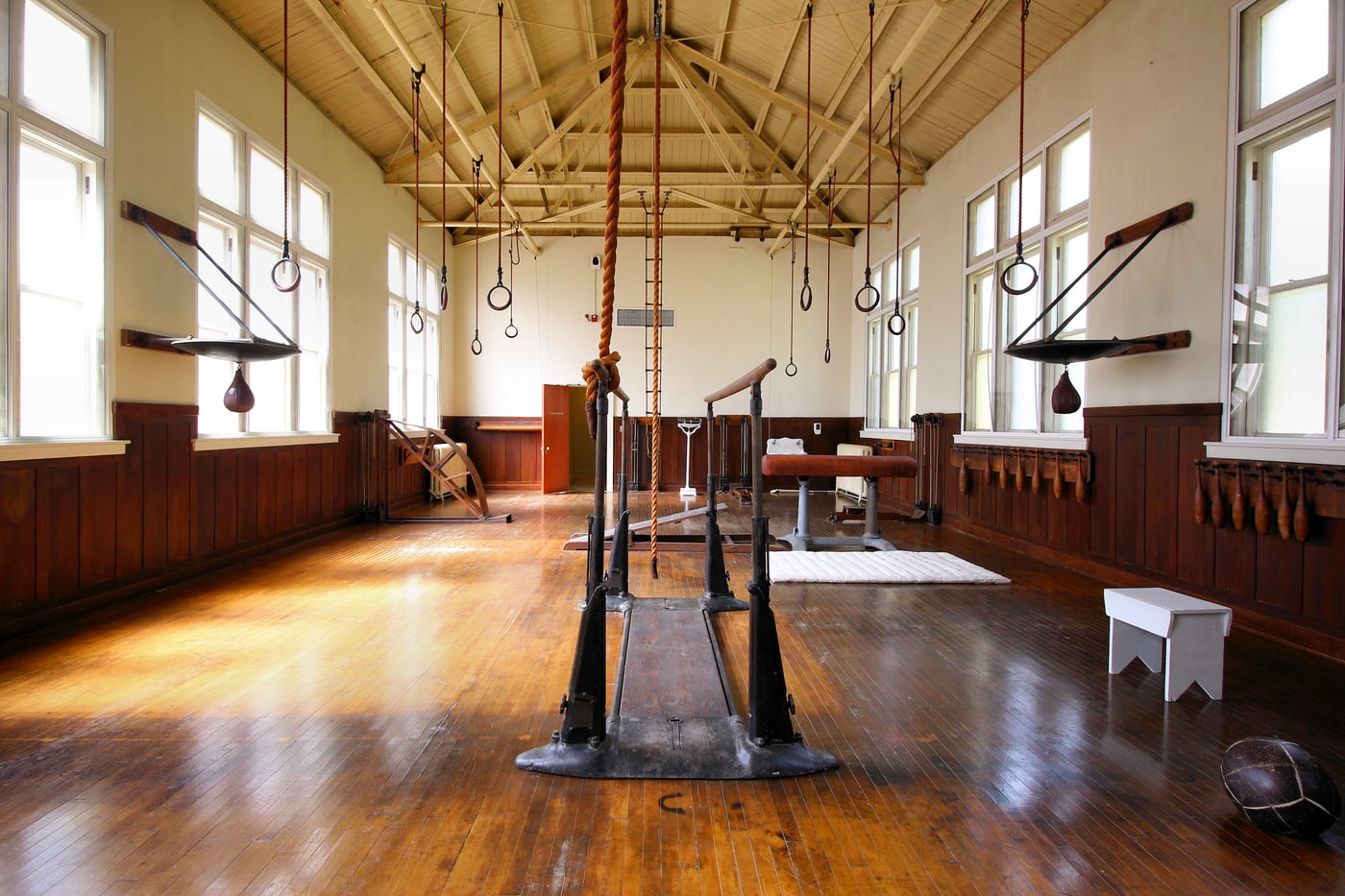
The best place in the United States to stand among Zander machines is the Fordyce Bathhouse at Hot Springs National Park, Arkansas. The Park Service describes the Fordyce exercise-room collection as “the largest known to exist in the U.S. today.” Its provenance is unusually well documented for this field: the displayed machines were not the bathhouse’s own originals (those were removed “long ago, perhaps in 1944”) but a set originally installed at The Homestead resort in Hot Springs, Virginia, where in 1911 a Dr. Kurt Linert of Vienna set up 36 Zander machines; the survivors were donated to the national park in December 2000. The Fordyce itself had ordered four machines from the Kny-Scheerer Company of New York (three in December 1914, a fourth in January 1915) — a universal vibratory apparatus, a “mechanical horse,” and combination machines for the upper extremities — a good snapshot of a single spa’s mechanotherapy suite.
For the sanitarium side, the Dr. J. H. Kellogg Discovery Center in Battle Creek, Michigan, displays a Kellogg vibrating chair and an “oscillo-manipulator” of his invention; the center is credited with rescuing a number of Battle Creek machines in the 1980s. Kellogg’s devices were built by the Battle Creek Sanitarium Equipment Company (established 1890), so surviving examples occasionally carry that maker’s name — a useful attribution anchor.
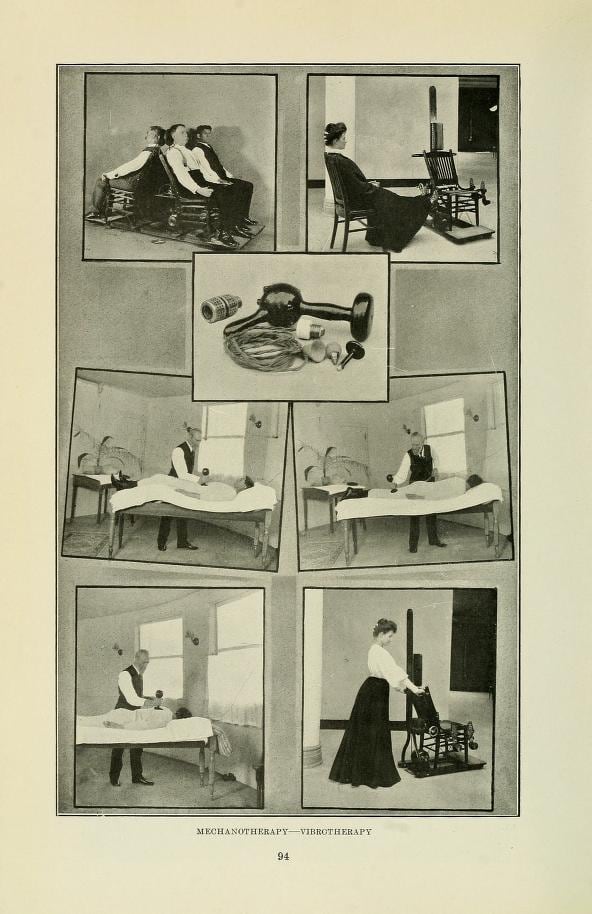
The hand vibrators are far more widely held. Dr. Macaura’s Pulsocon / “Blood Circulator” is in numerous medical collections — the Science Museum Group, the Old Operating Theatre Museum (London), the University of Manchester’s Museum of Medicine and Health, and the Smithsonian’s National Museum of American History, among others — precisely because it survives so well and photographs so vividly in its fitted case. Zander apparatus and mechanotherapy documentation also sit in the Smithsonian Libraries, which holds Alfred Levertin’s illustrated 1892 volume Dr. G. Zander’s medico-mechanische Gymnastik, the catalogue that pictures the machine types.
5.3 Identifying and dating a vibrator or Zander machine
For the small objects, the collector’s method mirrors the one used across this collection. Read the maker, the patent date, and the power source first.
A Pulsocon is a hand-crank device: a chrome-plated case enclosing a simple gear-and-cam mechanism, a side crank, and a socket for interchangeable applicator heads. Gerald Macaura patented it in the USA in 1902 (“Movement Cure Apparatus”) and in Britain in 1904 (patent 13932), and production ran from around 1911 well into the interwar period. Its marketing claimed it could deliver several thousand vibrations per minute — sources cite figures around 5,000 to 6,000, best treated as advertising rather than measurement. A crank, not a cord, dates the mechanism to the earlier, pre-electrified branch of the family; the box, the applicator set, and any surviving instruction booklet with its list of “cured” complaints are what a collector values.
An electric vibrator dates itself by its cord and motor. Hamilton Beach is generally credited with an early consumer electric vibrator around 1902, with the well-known Type “D” following about 1912; between roughly 1905 and 1920 more than sixty vibrator patents issued in the United States, and there were dozens of manufacturers (about 34 in 1909). These are among the earliest home appliances to be electrified — commonly ranked the fifth domestic device to get a motor, after the sewing machine, fan, kettle, and toaster. So an electric vibrator with a fabric-covered two-wire cord, a heavy field-coil motor, and a nickel or bakelite body is a genuine 1900s–1920s domestic-electrical artefact, and — exactly as with the violet-ray wands of that era (see the Violet Ray Wands dive) — it should be treated as an unsafe antique mains appliance: displayed cold, not plugged in. The perished insulation, ungrounded cord, and un-serviced motor make powering one a real electrical hazard, and it heals nothing regardless.
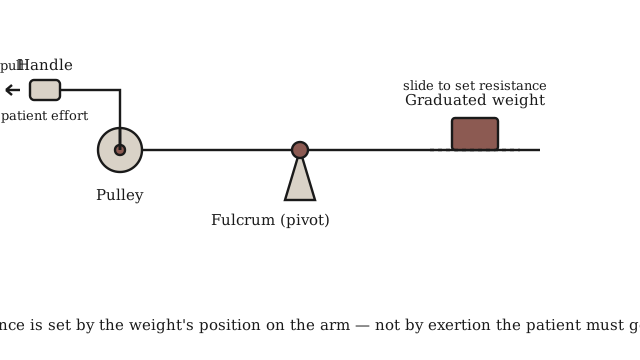
Zander machines are institutional ironmongery, so provenance and the maker’s cast or plate matter more than any manual. A genuine Zander carries the graduated weight-and-lever or cam mechanism its catalogue illustrates; reproduction is essentially impossible to confuse with the real thing, but attribution to a particular institution (Homestead, Fordyce, a named European Zander Institute) is what turns a heavy curiosity into a documented object.
5.4 The contested myth: the “hysteria vibrator” story
No claim in this entire collection is repeated more confidently, or stands on weaker evidence, than the story that Victorian and Edwardian physicians routinely used vibrators to bring women diagnosed with “hysteria” to orgasm — described as “paroxysm” — as a standard medical treatment. It is retold as settled fact in popular articles, a stage play, and a feature film. It should not be stated as fact, and this volume does not.
The claim originates with Rachel Maines, whose 1998/1999 book The Technology of Orgasm: “Hysteria,” the Vibrator, and Women’s Sexual Satisfaction argued that vibrators were invented as a labour-saving device for physicians performing “pelvic massage” to orgasm. In 2018, historians Hallie Lieberman and Eric Schatzberg published “A Failure of Academic Quality Control: The Technology of Orgasm” (Journal of Positive Sexuality), in which they went back through every primary source Maines cited in support of that core claim and reported that none of them actually says physicians used vibrators to induce orgasm in patients. Their conclusion is blunt: the thesis was not supported by its own footnotes, and its uncritical acceptance is a cautionary tale about how a striking idea can become “common knowledge” in the humanities without ever being verified. Notably, Lieberman — herself a historian of sex toys — has publicly walked the popular version back.
The honest position, then, is this. Electromechanical and hand-crank vibrators genuinely existed, were genuinely sold as medical devices for a sweeping list of complaints (this is well documented, and is the subject of Vol 2), and “hysteria” was genuinely a common diagnosis of the period. What is not established is the specific, titillating bridge between them — the routine physician-administered-orgasm story. Present it, as the sources require, as a contested myth: cite Maines (1998) as its origin, cite Lieberman and Schatzberg (2018) as the serious challenge, and decline to assert it. A collector who owns one of these devices owns a real artefact of medical over-marketing — not a prop from the confidently-told story.
5.5 The genuine legacy: physiotherapy and the gym
Set against that debunking, the mechanical branch also carries the one large, genuine legacy in the Quack Devices wing — and it is worth stating as plainly as the debunking. Zander’s mechanotherapy was a real forerunner of modern physiotherapy and of the machine-based gym. His insight was sound: by putting the resistance in a graduated weight-and-lever or cam system rather than in a free weight or a therapist’s hands, he made controlled, repeatable, progressively-loaded exercise available to people who could not do calisthenics — the injured, the deformed, the convalescent, the sedentary office worker who (as the Smithsonian frames it) was a new phenomenon of late-19th-century industrial life. He won a gold medal for the machines at the 1876 Centennial Exhibition in Philadelphia, and by the 1890s Zander Institutes had spread internationally.
Anyone who has used a selectorised weight-stack machine, an adjustable resistance cam, or a rehabilitation exercise device has used Zander’s idea. The direct line to the modern gym is real, and museums make the point explicitly — the Smithsonian’s own piece frames Zander as a Victorian ancestor of the Bowflex. Likewise, the sound core of Kellogg’s Battle Creek programme — supervised exercise, hydrotherapy, and what would now be called physical therapy — persisted and was legitimate, even as the “biologic living,” “auto-intoxication,” and vibrating-away-of-organic-disease claims around it were not. The real, limited effects — improved circulation, muscular stimulation, mobilisation, comfort — were always there. The quackery was only ever the cure-all overclaim stacked on top of them.
5.6 Framing the boundary object honestly
This dive was always the porous one, and the collector’s final task is to hold both truths at once without collapsing them. A Zander machine is not a fraud; it is an ancestor of the physiotherapy clinic, and it should be labelled and displayed as such. A Pulsocon or a New-Life electric vibrator is not simply a joke; it is a real early appliance that did produce a real vibratory-massage sensation — and it was also sold, dishonestly, as a cure for tuberculosis, deafness, paralysis, and cancer. The correct caption for these objects states the mechanism, states the modest genuine effect, and states the false claim, in that order — the same discipline the Violet Ray Wands dive applies to a device that glows but does not heal.
Where this dive differs from its siblings is that the debunking cuts in two directions. It debunks the cure-all marketing, and it also debunks a pop-historical myth that has grown up around the objects themselves. A collector who can explain to a visitor both that the vibrator did not cure asthma and that the famous “doctors used it for orgasms” story is unproven has understood the object better than most of the books written about it.
5.7 Where this dive hands off
This is the last volume of the Mechanical and Vibratory Cures dive, and the last of the Quack Devices wing’s electrical-and-mechanical group. From here the collection’s threads reconnect: the genuine, physician-administered side of medical electricity and mechanics — real faradic and high-frequency therapy, real diathermy — lives in the Electrotherapy Devices sub-project, where the same coils and currents are treated as legitimate apparatus rather than cure-alls. And the discipline this volume closes on — mechanism, then modest real effect, then false claim, then honest label — is the one every dive in this collection ends on, standing in front of the object a person actually holds.
Sources
- The Therapy Machines of Dr. Gustav Zander — Hot Springs National Park (NPS) — the Fordyce Bathhouse collection as the largest surviving in the U.S.; the Homestead/Kurt Linert 1911 installation of 36 machines; the December 2000 donation; the 1914–15 Fordyce machine order; the weight-and-lever/leverage mechanism.
- These Victorian-Era Exercise Machines Look Surprisingly Familiar — Smithsonian Magazine — Zander born Stockholm 1835; the Therapeutic Zander Institute; the 1876 Centennial gold medal; international spread by the 1890s; the physiotherapy/gym (Bowflex) legacy framing; the Smithsonian Libraries’ 1892 Levertin catalogue.
- John Harvey Kellogg — Wikipedia — the vibrating chair (~20–60 shakes/second, for circulation and the bowels); mechanical massage devices; the Battle Creek Sanitarium Equipment Company (1890); the vibrating chair and oscillo-manipulator on display at the Dr. J. H. Kellogg Discovery Center, and the 1980s rescue of the machines.
- Pulsocon — Wikipedia and Dr. Macura’s Blood Circulator — National Museum of American History — Gerald Macaura; 1902 US “Movement Cure Apparatus” patent and 1904 UK patent 13932; the hand-crank gear-and-cam mechanism and several-thousand-vibrations-per-minute claim; the 1914 Paris fraud conviction and that he was not a doctor; museum holdings.
- Doctor Gerald Macaura’s Blood Circulator — The Old Operating Theatre Museum — the sweeping cure-all claims (from rheumatism and constipation to cancer, TB, deafness, and paralysis) and Macaura’s biography and legal troubles.
- A Failure of Academic Quality Control: The Technology of Orgasm — Lieberman & Schatzberg (2018), Journal of Positive Sexuality (via Georgia Tech) — the finding that none of Rachel Maines’ cited primary sources support the claim that physicians used vibrators to induce orgasm in “hysteria” patients; the “cautionary tale” framing. Paired with Rachel Maines, The Technology of Orgasm (1998/99), for the disputed thesis.
- Vibrators had a long history as medical quackery before feminists rebranded them as sex toys — Hallie Lieberman, The Conversation — the documented medical-quackery marketing of vibrators, by one of the historians who challenged the orgasm-therapy myth.
- 1902 Hamilton Beach Vibrator (Retrorambling) and Selling Sex Toys: Marketing and the Meaning of Vibrators in Early Twentieth-Century America — Enterprise & Society (Cambridge) — the electric vibrator as an early home appliance (Hamilton Beach c. 1902, Type “D” c. 1912); dozens of makers and 60-plus patents 1905–1920; the “New-Life” and its cure-everything instruction guide.
Comments (0)