Mechanical and Vibratory Cures · Volume 4
The Contested History and the Reckoning
The single most careful chapter in this dive: the famous 'Victorian doctors used vibrators to treat hysteria' story presented as a contested myth — Maines (1998) versus Lieberman & Schatzberg (2018), citing both sides — and then the real reckoning, in which cure-all vibration faded into legitimate physiotherapy while the fraud met the courts and the regulators.
Contents
4.1 About this volume
This is the volume that decides whether the whole dive can be trusted. The mechanical-and-vibratory family sits on the most porous boundary in the collection: Gustav Zander’s resistance machines were a genuine forerunner of modern physiotherapy and the gym (Vol 1 — The Machines), and passive exercise and vibration produce real, limited effects — circulation, muscle stimulation, comfort (Vol 2 — What They Actually Did). The quackery is the overclaim layered on top. And attached to this family is one of the most repeated “facts” in all of medical history — that Victorian physicians routinely masturbated their female “hysteria” patients to orgasm, first by hand and then with the newly invented electric vibrator.
That story is contested. It comes from a single 1998 book; a 2018 peer-reviewed paper checked its sources and could not find the practice in any of them. This volume’s most important job is to present that dispute honestly — to lay out both sides and state plainly that the claim is not established fact — and then to tell the real reckoning, in which cure-all vibration quietly matured into legitimate physiotherapy while the outright fraud, like the Pulsocon, met the courts. Nothing here is medical advice; it is the history of where a real therapy ends and a story begins.
4.2 Two ledgers: the real effect and the cure-all overclaim
Keep two ledgers side by side, because the honesty of the field depends on not merging them.
On the real side: mechanotherapy and vibration do measurable, modest things. Resisted and passive movement on a Zander machine loads and mobilises muscles and joints; local vibration and mechanical massage transiently increase surface blood flow, loosen tissue, and feel good. These are the genuine seeds of physical therapy, rehabilitation, and sports training. Zander (1835–1920), a Swedish physician and one of the originators of mechanotherapy, built his system of weight-, lever-, and cam-driven apparatus for exactly this, and it franchised to spas and sanatoria worldwide (the number of institutes is discussed in Vol 3 — The People and the Institutions). John Harvey Kellogg’s Battle Creek Sanitarium likewise ran real hydrotherapy, graded exercise, and mechanical massage that would be recognisable to a modern physiotherapist.
On the overclaim side: the same devices were sold as cures for organic and systemic disease they could not touch — constipation and “auto-intoxication,” obesity, deafness, impotence, “nerve force” and “vital vigor,” even the vague promise of mechanised rejuvenation. Vibration cannot cure deafness or dissolve a disease; a machine that mimics a masseur’s hands is not a treatment for an organ. The through-line of the whole dive, stated once and not re-derived here, is that the effect is superficial and local, and the marketing pretended it was systemic and curative. That gap is where the quackery lives — and it is exactly the gap the vibrator-and-hysteria story exploits, because it dresses a titillating claim in the borrowed authority of medicine.
4.3 The contested myth: doctors, hysteria, and the vibrator
The claim, in its popular form, runs like this. From antiquity to the 1920s, Western physicians treated “hysteria” — a catch-all female complaint — by massaging the patient’s genitals to orgasm, an event they euphemistically called a “hysterical paroxysm” and did not regard as sexual. The task was tedious, so when the electromechanical vibrator was invented in the 1880s, doctors adopted it to reach the “paroxysm” faster, making the vibrator, in this telling, a medical instrument before it was a household one.
This narrative has a single scholarly origin: Rachel P. Maines, The Technology of Orgasm: “Hysteria,” the Vibrator, and Women’s Sexual Satisfaction (Johns Hopkins University Press, 1998). The book won the American Historical Association’s Herbert Feis Award and became genuinely influential — it inspired Sarah Ruhl’s 2009 play In the Next Room (or the vibrator play) and the 2011 film Hysteria, and its central claim spread into countless articles, museum labels, and popular histories as settled fact.
It is not settled fact. In 2018, historians Hallie Lieberman and Eric Schatzberg (Georgia Institute of Technology) published “A Failure of Academic Quality Control: The Technology of Orgasm” in the Journal of Positive Sexuality (vol. 4, no. 2, pp. 24–47). They went back to Maines’s own footnotes and checked the primary sources one by one. Their conclusion, quoted precisely: “we could find no evidence that physicians ever used electromechanical vibrators to induce orgasms in female patients as a medical treatment.” They argued that Maines’s cited sources do not actually support her central claim, and that the book’s nineteen-year run as accepted history “points to a fundamental failure of academic quality control” — the claim was so appealing that few checked it.
The correct way to state the matter, and the way this dive states it: the “doctors used vibrators to bring hysteria patients to orgasm” story is a contested and largely discredited hypothesis, not a documented medical practice. It should never be repeated as fact.
4.4 What the sources actually show
The refutation is specific, which is what makes it strong. Lieberman and Schatzberg found not merely an absence of evidence but positive evidence pointing the other way.
Take the founding figure of the popular version, the British physician Joseph Mortimer Granville, routinely credited as inventing the “medical vibrator” in the early 1880s and cast in the film Hysteria as using it to service female patients. Granville’s own writing does the opposite. He used his percussion device (the “percuteur” or percussor) chiefly on men, to treat pain, nerve conditions, and deafness, and he explicitly warned against using it on women or for hysteria, distrusting the hysterical patient’s suggestibility. The only sexual application he discussed was percussion of the perineum in men for impotence — not clitoral or vaginal stimulation of women at all. The single most cited “inventor of the hysteria vibrator” was, on the record, opposed to the use the myth assigns him.
More broadly, Lieberman and Schatzberg noted that where vibrators and mechanical devices were used on women in gynaecology, contemporary sources describe penetrative or abdominal application for a range of complaints, not clitoral massage aimed at orgasm, and that manual “massage to paroxysm” was never described in the medical literature as a standard, routine treatment for hysteria. In short: the euphemism-decoded, everybody-knew-what-they-were-doing picture is a modern reconstruction, not something the Victorian doctors left in their own words.

It is only fair to give Maines the last word on her own thesis. Pressed after the 2018 critique, she did not defend it as proven. In an interview she said: “I never claimed to have evidence that this was really the case. What I said was that this was an interesting hypothesis, and as [Lieberman] points out — correctly, I think — people fell all over it.” That is a remarkable and honest concession: the author herself now frames the famous claim as a hypothesis the culture inflated into certainty. This dive follows her lead and Lieberman & Schatzberg’s evidence, and treats it as exactly that.
4.5 Why the myth spread
The interesting historical question is no longer “did it happen” but “why was it believed.” Several forces aligned. The claim was too good to check: it was funny, faintly scandalous, flattering to modern condescension toward “repressed Victorians,” and it handed feminist and popular writers a vivid parable about medicine, euphemism, and women’s sexuality. It carried the prestige of a university press and a major history prize. And it was amplified by a play and a film that dramatised it as fact, so that by the 2010s the story circulated far beyond the book — in newspapers, on museum captions, and in the sales copy of modern novelty vibrators trading on the “originally a Victorian medical device” origin story. The lesson Lieberman and Schatzberg draw is a general one for this whole collection: a claim’s popularity is no evidence of its truth, and the more delightful an origin story, the harder it deserves to be checked. That discipline is the reason this dive exists.
4.6 The reckoning: from cure-all to physiotherapy — and the courts
Set the myth aside and the real regulatory reckoning is quieter and, in its way, more instructive. Mechanical and vibratory therapy did not end in a single dramatic prohibition. It split. The honest, limited core was absorbed into legitimate medicine — physical therapy, rehabilitation, orthopaedics, and, downstream of Zander’s machines, the entire modern exercise-equipment industry (Vol 5 — Collecting and the Physiotherapy Legacy traces that inheritance). The cure-all overclaim, stripped of that respectable core, withered as the science and the law caught up.
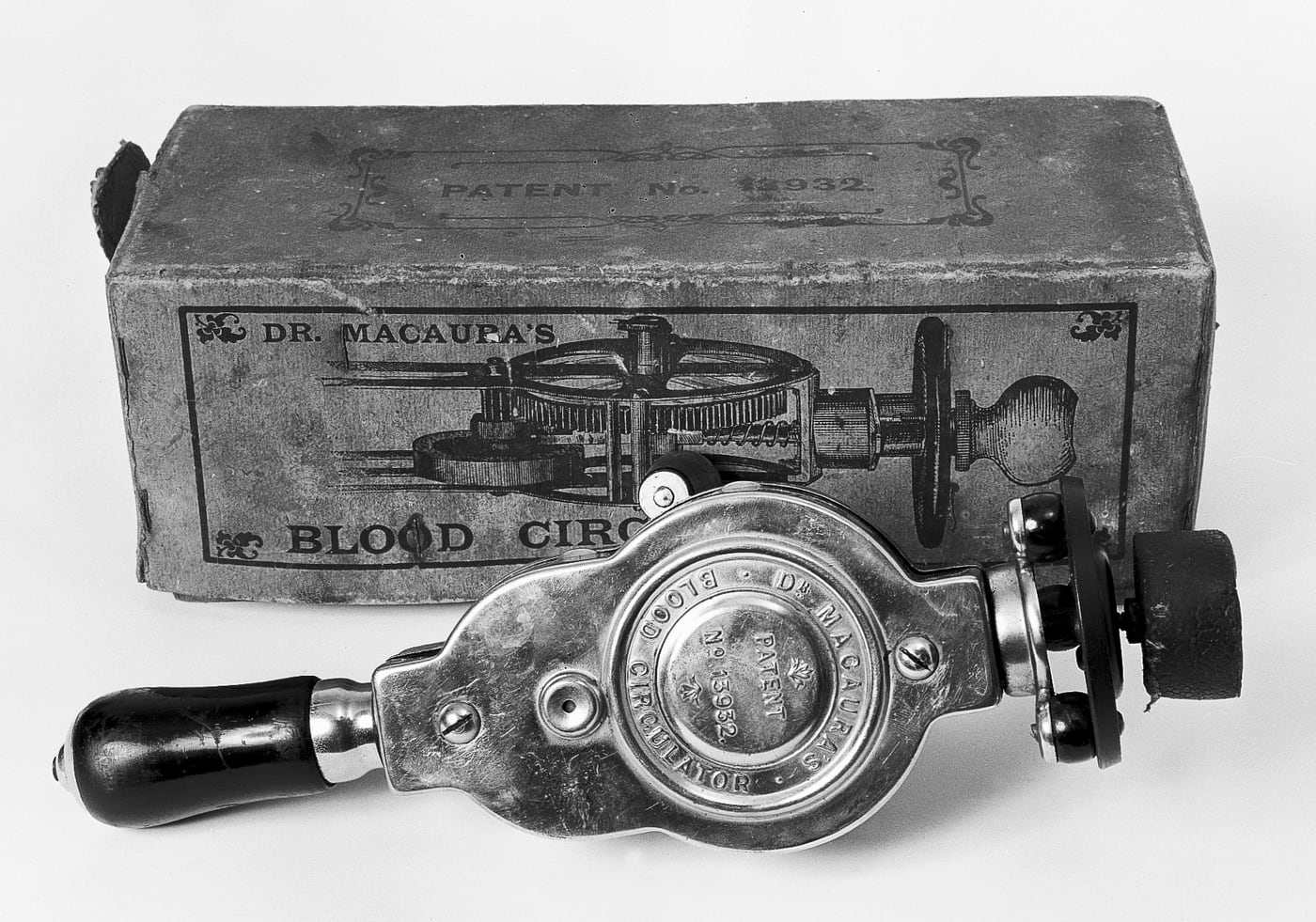
The clearest legal collision belongs to the medical vibrator as a cure-all. Dr Gerald Macaura — who marketed the hand-crank “Pulsocon” blood circulator (see Vol 1), reportedly capable of thousands of vibrations per minute and sold as a remedy for a long list of diseases from rheumatism to deafness — was convicted of fraud in Paris in 1914 and sentenced to prison, the court rejecting the curative claims for the device; contemporary and museum accounts add that Macaura was not the physician he styled himself. That is a concrete, court-tested verdict against vibratory cure-all marketing. Enforcement in the United States is harder to pin to a single celebrated case: the general framework that made such advertising actionable arrived with the 1938 Federal Food, Drug, and Cosmetic Act (extending federal authority to medical devices) and the same year’s Wheeler-Lea Act (giving the Federal Trade Commission clear authority over deceptive advertising) — the same statutory turning point that ended the violet-ray trade (see the Violet Ray Wands dive in this collection). (Accuracy flag: the brief asks for specific FTC/FDA action against vibrator “cure” advertising; I confirmed the 1938 statutory framework and the 1914 French Macaura conviction, but did not locate a single named, dated U.S. FTC or FDA enforcement case against an electric-vibrator manufacturer in this pass — the U.S. story is better described as the general post-1938 attrition of medical claims than as one landmark suit. This should be verified before any specific American case is asserted.)
The deeper reckoning was scientific, not just legal. As physiology matured, the extravagant claims — that vibration cured organic disease, dissolved fat, or restored “nerve force” — simply lost their audience among physicians, and the devices were re-labelled honestly: for massage, relaxation, and local muscle stimulation. The object survived by shedding its promises, exactly as the violet-ray wand did.
4.7 Battle Creek: a mixed ledger
The Battle Creek Sanitarium is the perfect closing illustration of the porous boundary, because it refuses to be filed cleanly as either medicine or quackery. Under John Harvey Kellogg it delivered a great deal of sound practice — hydrotherapy, graded therapeutic exercise, dietetics, and mechanical massage that Kellogg explicitly placed under “physiotherapy,” recommended for anemia, debility, and muscular or nervous weakness. Kellogg was a real surgeon who patented genuine mechanical movement and massage apparatus in the 1900s, manufactured by the Sanitarium’s own equipment company.
And in the same building, the same man promoted pseudoscience: the doctrine of “biologic living,” an obsession with intestinal “auto-intoxication,” and mechanical contrivances like a vibrating chair said to shake the bowels into health. The vibrating platforms, mechanical horses, and slapping and kneading machines were partly real physiotherapy and partly theatre for a cure-all philosophy. Battle Creek is the whole dive in one institution: legitimate mechanised therapy and grandiose overclaim under one roof, which is precisely why the collection treats this family with a scalpel rather than a hammer.
4.8 Where this volume hands off
This volume did the dive’s most important work: it refused to state the famous vibrator-and-hysteria story as fact, laid out Maines (1998) against Lieberman & Schatzberg (2018) with the author’s own hypothesis-not-evidence concession, and separated the real regulatory reckoning — Macaura’s 1914 fraud conviction, the 1938 FDCA/Wheeler-Lea framework, and the quiet absorption of honest mechanotherapy into medicine — from the myth that grew up beside it. The final volume, Vol 5 — Collecting and the Physiotherapy Legacy, follows the legitimate core forward: how Zander’s institutes and Kellogg’s gymnasium seeded modern physical therapy and the exercise-machine industry, and how a collector identifies, dates, and displays a surviving Zander machine, a Pulsocon, or a Battle Creek device as the historical hardware it is.
Sources
- A Failure of Academic Quality Control: The Technology of Orgasm — Lieberman & Schatzberg, Journal of Positive Sexuality 4(2): 24–47 (2018) — the primary refutation: checked Maines’s cited sources and found none support the claim that physicians used vibrators to bring hysteria patients to orgasm; the “fundamental failure of academic quality control” framing; the finding on Granville and on penetrative use.
- Rachel Maines — Wikipedia — the thesis of The Technology of Orgasm (1998), its Herbert Feis Award, the Lieberman & Schatzberg citation (vol. 4, no. 2, pp. 24–47), and Maines’s 2018 “I never claimed to have evidence… an interesting hypothesis” concession.
- The Technology of Orgasm — Johns Hopkins University Press — the publisher’s statement of Maines’s claim (massage/vibrator treatment of hysteria from Hippocrates to the 1920s), the source of the contested thesis.
- Hysteria Was Not Treated With Vibrators — Marginal Revolution and The Great Vibrator Myth — Today I Found Out — secondary syntheses of the debunking; Granville used his device mainly on men (pain, deafness) and warned against using it on women/for hysteria, his only sexual mention being the male perineum for impotence; the play In the Next Room (2009) and film Hysteria (2011) as amplifiers of the myth.
- Gustav Zander — Wikipedia — Zander (1835–1920), Swedish physician and originator of mechanotherapy; weights/levers/springs resistance machines; the 1876 Centennial gold medal; institute expansion (the “146” figure — see Vol 3 for the numbers caveat).
- The Therapy Machines of Dr. Gustav Zander — NPS, Hot Springs National Park — the machines as variable-resistance physical therapy (F-1 universal vibratory, F-2 mechanical horse, etc.); the Homestead/Fordyce Bathhouse installations; several dozen models each targeting specific muscles or mimicking a massage technique.
- Dr. Gustav Zander’s Victorian-Era Exercise Machines — Smithsonian Magazine — Zander’s system as a genuine forerunner of the modern exercise-machine industry; muscle-power, then steam, then electric drive.
- John Harvey Kellogg — Wikipedia — Battle Creek’s mechanotherapy and “physiotherapy” (mechanical massage for anemia/debility/nervous weakness), the vibrating chair, patented mechanical movement and massage apparatus, the Sanitarium Equipment Company, and the pseudoscientific “biologic living”/auto-intoxication doctrine.
- Pulsocon — Wikipedia and Doctor Gerald Macaura’s Blood Circulator — Old Operating Theatre Museum, London and Dr. Macaura’s Blood Circulator — Smithsonian National Museum of American History — the hand-crank Pulsocon vibrator, its cure-all marketing, and Macaura’s 1914 Paris fraud conviction and imprisonment.
- Federal Food, Drug, and Cosmetic Act (1938) — FDA — the 1938 statutory turning point extending FDA authority to medical devices (with the Wheeler-Lea Act covering advertising), the framework that made cure-all device claims actionable.
Comments (0)