Mechanical and Vibratory Cures · Volume 1
The Machines
Zander's hall of cam-and-lever therapy apparatus, the hand-crank and electric medical vibrator, and Battle Creek's shaking chairs and platforms — the objects, and how they were used and sold.
Contents
| Section |
|---|
| About this volume |
| Zander’s hall of machines |
| The medical vibrator: hand-crank and electric |
| Battle Creek’s vibrating apparatus |
| How the machines were sold |
| Where this volume hands off |
| Sources |
1.1 About this volume
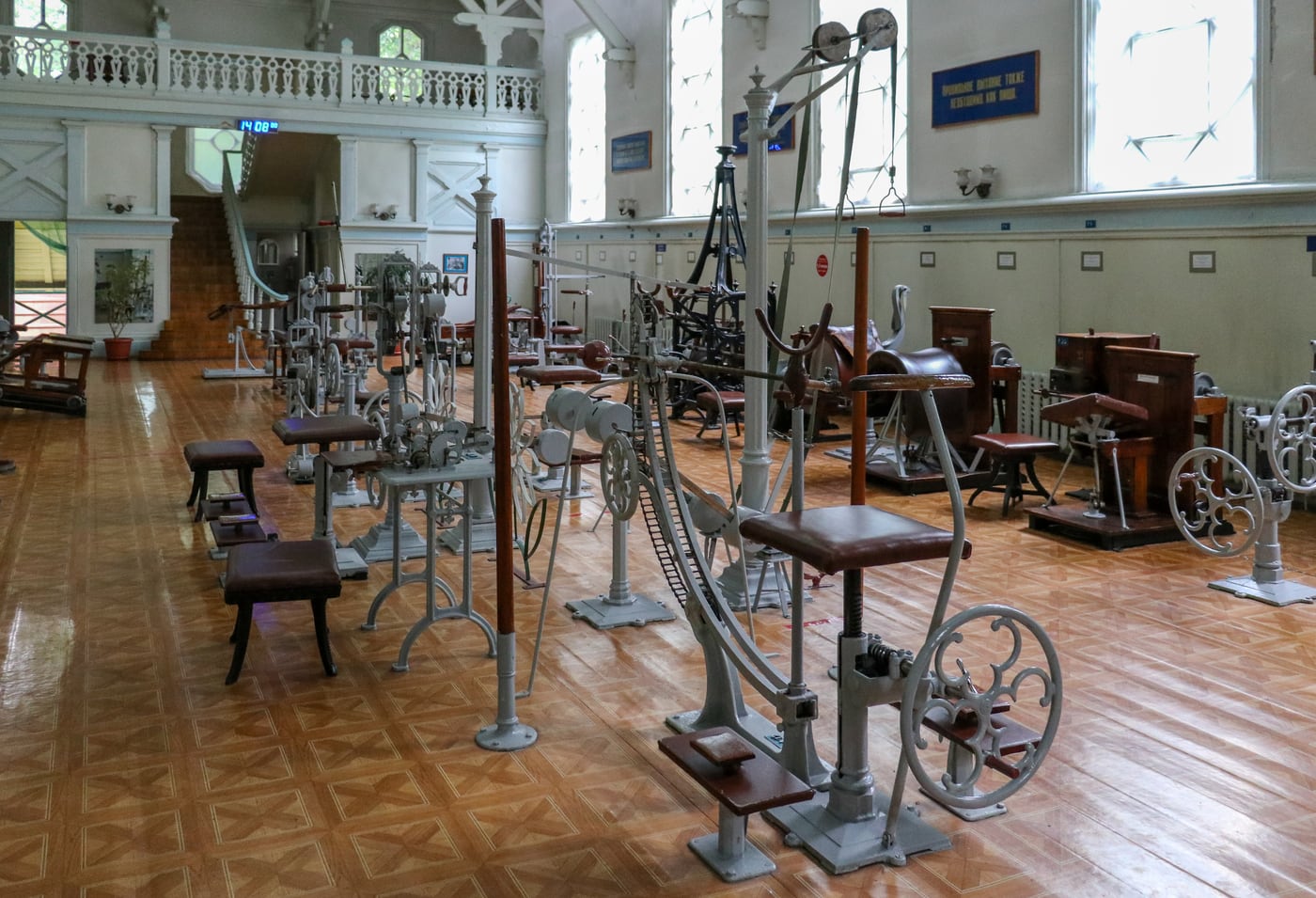
Walk into a Zander Institute around 1900 and it looks less like a clinic than a strange gymnasium: rows of oak-and-iron apparatus, each with a seat, a lever, and a sliding weight, and at each one a well-dressed patient pushing, riding, or being kneaded by a machine. Down the hall a chair shakes so hard it blurs. On a side table sits a chrome cylinder with a hand crank; turn it and a padded head buzzes against the skin. This is the mechanised end of the health trade — the family of objects this five-volume dive is about.
It is also the dive’s most honest boundary. Unlike a radionics box or a radium tonic, much of this apparatus did something real. Resisted and passive exercise, massage, and mechanical vibration produce genuine, if limited, physiological effects, and Gustav Zander’s system is a legitimate forerunner of modern physiotherapy and the resistance-training machine. The quackery is not in the hardware but in the claims stacked on top of it — that a shaking chair cured constipation and “auto-intoxication,” that a buzzing crank cured deafness and cancer, that passive exercise was a shortcut to health. This volume’s job is narrow: to describe the machines and the marketplace they lived in. The careful separation of real effect from cure-all overclaim is the whole of Vol 2 — What They Actually Did, and the people and institutions behind them are Vol 3 — The People and the Institutions.
One caution belongs at the very front, because it is the single most repeated “fact” about this subject and it is contested. The popular story — that Victorian doctors routinely used vibrators to bring female “hysteria” patients to orgasm — comes from a single 1998 book, Rachel Maines’ The Technology of Orgasm, and was seriously challenged in 2018 by historians Hallie Lieberman and Eric Schatzberg, who re-examined Maines’ own cited sources and found that none of them actually support the claim. This volume treats that story strictly as a contested myth, not a fact; the full reckoning is reserved for Vol 4 — The Contested History and the Reckoning.
1.2 Zander’s hall of machines
Jonas Gustav Wilhelm Zander (1835–1920), a Swedish physician, built the first and most systematic version of mechanised therapy. Starting from experiments in the 1850s and 1860s, he set out to solve a practical problem in the older “Swedish gymnastics” (medical gymnastics) tradition: manual resisted exercise required a trained attendant whose strength and stamina set the dose, and who could not deliver it precisely or tirelessly. Zander’s answer was to replace the attendant with a machine.
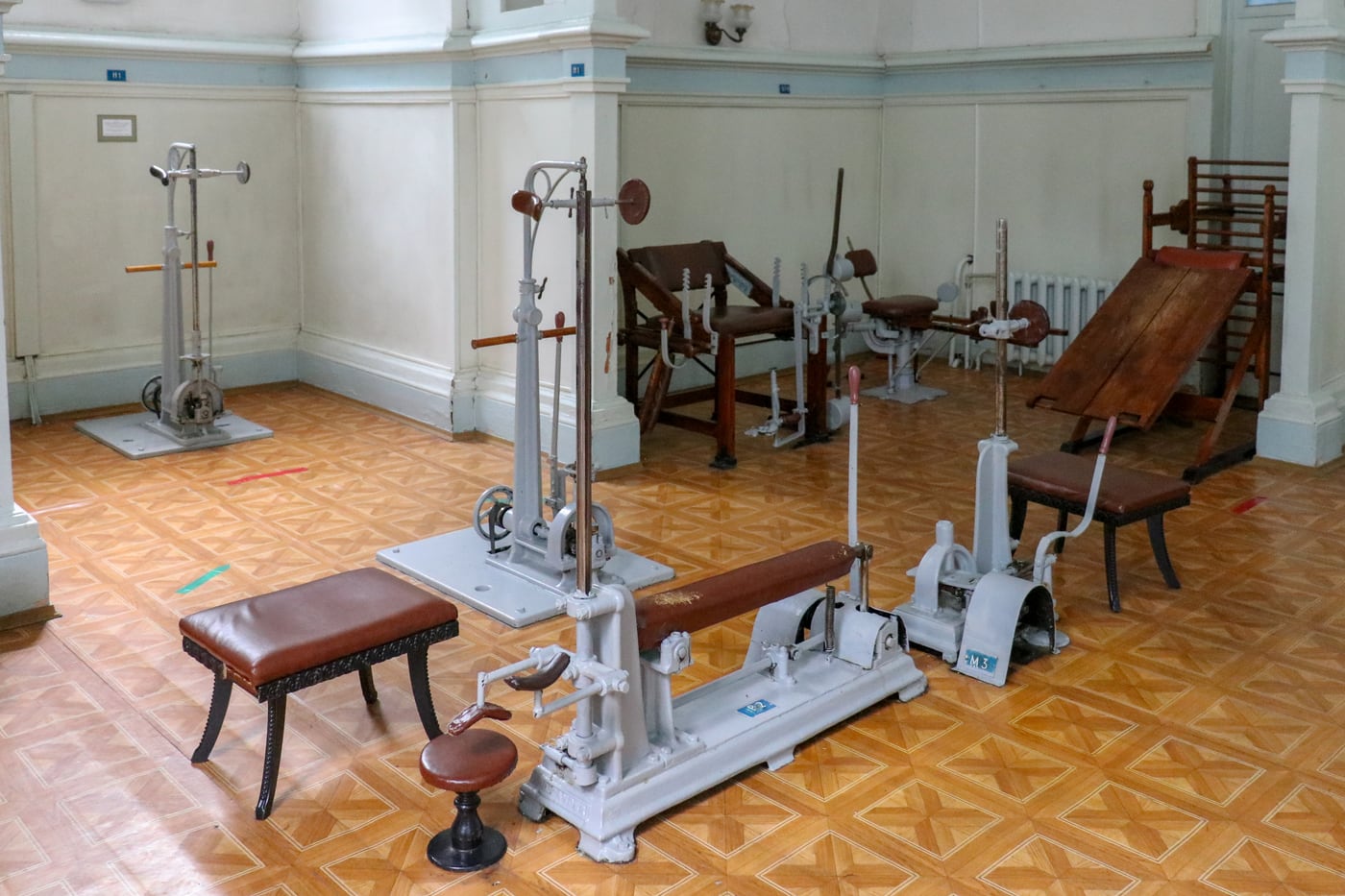
His apparatus used weights, levers, and cams to supply resistance and motion. On a resistance machine, the patient worked against a weight sliding along a graduated lever arm — in effect an adjustable extension of the muscle group in use — so the “dose” could be dialed up in measured steps and a second weight set to compensate for the patient’s own body. Other machines in the set did the moving for the patient: cam-and-eccentric drives produced passive flexion, kneading, percussion, and vibration for people too weak, injured, or deformed to exercise themselves. The Stockholm institute’s catalogue ran to roughly two dozen and more distinct devices — commonly cited as 27 or more — including a stationary velocipede (an early exercise bike), spinal-correction frames for scoliosis, abdominal and arm “kneading” machines, a chest-percussion apparatus, and a mechanical riding-horse whose gait was meant to reproduce the supposed benefits of horseback exercise.
Zander’s system won a gold medal at the 1876 Centennial Exhibition in Philadelphia, and from there the “medico-mechanical” institute franchised across Europe and into American health spas, serving an affluent clientele. (Wikipedia’s oft-repeated figure of institutes in “146 countries” by 1906 is almost certainly a garbling — likely 146 institutes — and is flagged rather than repeated as fact here.) In the United States the machines clustered at resort spas: Dr. Kurt Linert installed thirty-six Zander machines at The Homestead in Virginia in 1911, and the Fordyce Bathhouse at Hot Springs, Arkansas ordered four machines in 1914–1915 — an F-1 universal vibratory, an F-2 mechanical horse, an A-1 upper-extremity apparatus, and a B-1 combination unit. The surviving Hot Springs collection, now cared for by the National Park Service, is described as the largest known assembly of Zander apparatus in the country.
1.3 The medical vibrator: hand-crank and electric
The second object family is the medical vibrator — and it is the one most burdened with myth, so it must be handled precisely. As a machine it is simple: a motor or a hand crank driving an eccentric or cam that shakes a padded applicator head at high frequency. The marketing wrapped that plain mechanism in a vast list of cures.
The hand-crank archetype is the Pulsocon, sold as “Dr. Macaura’s Blood Circulator.” “Dr.” Gerald Macaura — the name was an alias, and he was not in fact a qualified physician — patented a “blood circulator” in the United States around 1902 and again in the United Kingdom around 1904, and from 1911 had it manufactured by the British Appliance Manufactural Co. Ltd. of Leeds. (One museum source gives an 1869 patent date, which conflicts with every other account and is almost certainly an error.) The device is a gear-and-cam mechanism in a chrome-plated case with a side crank; turning the crank drove the head at a claimed several thousand vibrations per minute — sources cite figures up to roughly 5,000 to 6,000. Held against the body, it produced a strong buzzing massage. Macaura claimed it cured a sweeping list of conditions — infantile paralysis, deafness, cancer, tuberculosis, rheumatism, constipation, asthma, anxiety, and “women’s complaints” among them. He demonstrated it at the Royal Albert Hall in 1911, was prosecuted for fraud in France, and in 1914 was sentenced to three years’ imprisonment — during which, by widely repeated account, sales of the Pulsocon continued briskly.
The electric version arrived in the American home almost simultaneously. Hamilton Beach of Racine, Wisconsin began selling electric vibrators around 1902; a much-repeated claim holds that the electric vibrator was among the very first household appliances to be electrified, after the fan, kettle, toaster, and sewing machine (a tidy “fifth appliance” story worth treating as folklore rather than settled fact). Hamilton Beach’s Type D was patented in 1912, and its “New-Life” vibrator shipped with a roughly 300-page instruction book, Health and How to Get It, that promised relief from an enormous span of complaints. Competing brands such as Star sold near-identical machines. Period advertising set the tone: a 1910 New York Tribune notice declared that “Vibration Banishes Disease As the Sun Banishes Mist.” These were sold openly and respectably, in Needlecraft, Woman’s Home Companion, Modern Priscilla, and the Sears, Roebuck catalogue, as general household health appliances.
Here is where the contested myth must be stated plainly and set aside. It is often asserted that these vibrators were designed or routinely used by physicians to induce orgasm in women diagnosed with “hysteria.” That claim traces to Maines (1998) and was directly challenged by Lieberman and Schatzberg (2018), who found no supporting evidence in Maines’ own citations. This volume therefore describes the vibrator as what the record actually shows it to be — a mass-market massage-and-”circulation” appliance sold with cure-all claims — and defers the historiographical argument to Vol 4.
1.4 Battle Creek’s vibrating apparatus
The third object family belongs to John Harvey Kellogg and the Battle Creek Sanitarium in Michigan, where from the 1890s onward mechanised therapy was built into a whole regime of “biologic living.” Kellogg’s program mixed genuinely sound elements — exercise, diet, hydrotherapy, physical therapy — with pseudoscientific theory, and his hardware sat squarely in the middle of that mix.
The signature object is the vibrating chair: a stout wooden chair mechanically shaken — by various accounts roughly twenty to sixty times a second (no primary spec survives) — hard enough to be genuinely uncomfortable, on the theory that the shaking stimulated intestinal peristalsis and relieved constipation and “auto-intoxication” (the era’s notion that stagnant bowel contents poisoned the body). As the century turned, Kellogg developed steam- and motor-powered vibrating chairs, bars, and platforms, and an oscillo-manipulator — examples survive at the Dr. J. H. Kellogg Discovery Center in Battle Creek. Around these stood a fleet of mechanical-massage devices: multi-person foot vibrators, a mechanical slapping massager, and a kneading apparatus advertised in 1909 at around $150. Kellogg promoted mechanical massage — a branch of the mechanotherapy Zander had systematised — for anemia, general debility, and muscular or nervous weakness. The Sanitarium’s clientele included the wealthy and famous, and its apparatus lent the whole vibratory-therapy enterprise a veneer of medical seriousness that the drugstore vibrator borrowed freely.
1.5 How the machines were sold
For all their mechanical variety, these objects shared one selling proposition: health without effort. Passive and assisted exercise, delivered by a machine, was pitched as a shortcut to the vigor of physical culture without the sweat — and vibration was pitched as a way to “stimulate circulation” and “nerve force” into any organ you aimed it at.
The sales channels sorted by class of buyer. Zander apparatus was capital equipment: heavy, expensive, and installed by franchise at spas, sanatoria, and resort bathhouses, where it signalled scientific modernity to a paying, affluent clientele. Battle Creek’s machines were part of an in-patient regime, sold as an experience rather than a product, and reinforced by Kellogg’s prolific health writing. The vibrator, by contrast, was a genuine mass-market consumer good — hand-crank models sold by the tens of thousands in Britain, electric models sold across the drugstore counter and by mail order from Sears and the women’s magazines, each bundled with a fat book of conditions it claimed to relieve. The common thread was a promise pitched just past what the mechanism could deliver: a real massage, a real bit of exercise, sold as a cure for organic disease.
That gap between honest mechanical effect and dishonest medical claim is the whole subject of the next volume.
1.6 Where this volume hands off
You now have the objects in view: Zander’s graduated hall of cam-and-lever machines, the hand-crank Pulsocon and the electric Hamilton Beach and Star vibrators, and Battle Creek’s shaking chairs, bars, and platforms — and the very different marketplaces that sold each. The pressing question is the one the advertising worked hardest to blur: of everything these machines promised, what did they actually do? That is Vol 2 — What They Actually Did, which separates the real, limited effects of resisted exercise, massage, and vibration from the cure-all overclaims. From there the dive turns to the people and institutions behind the hardware (Vol 3), the contested history — including the Maines “hysteria vibrator” thesis and the fading of the cure-all claims under FTC/FDA pressure — and the reckoning (Vol 4), and finally to collecting these machines and tracing their honest legacy in modern physiotherapy and gym equipment (Vol 5). The porous border with legitimate medical electricity — the vibrator sits next door to the high-frequency and faradic apparatus of the Electrotherapy Devices sub-project — is cross-referenced there rather than duplicated here.
Sources
- The Therapy Machines of Dr. Gustav Zander — National Park Service, Hot Springs National Park — weight-and-lever resistance mechanism; the Fordyce Bathhouse’s four machines (F-1 universal vibratory, F-2 mechanical horse, A-1, B-1) ordered 1914–15; Dr. Kurt Linert’s thirty-six machines at The Homestead in 1911; the largest surviving U.S. collection.
- Gustav Zander and His Victorian-Era Exercise Machines — Smithsonian Magazine — mechanotherapy concept; 1876 Centennial gold medal; global spread by 1892; the 1892 catalogue’s device list (velocipede, spinal-correction, kneading, percussion, riding machines); machines as forerunners of modern resistance equipment.
- Gustav Zander — Wikipedia — full name and dates (1835–1920); Zander Therapeutical Institute, Stockholm; 1876 gold medal; the “146” institutes figure (treated cautiously here); Nautilus/variable-resistance legacy.
- Doctor Gerald Macaura’s Blood Circulator — The Old Operating Theatre Museum — gear-and-cam mechanism in a chrome case; hand crank; up to ~6,000 vibrations/min; cure-all claim list; “Macaura” an alias and not a real doctor; tens of thousands sold; 1914 French fraud conviction and three-year sentence.
- Pulsocon — Wikipedia — U.S. patent ~1902, U.K. patent ~1904; British Appliance Manufactural Co. Ltd., Leeds, from 1911; ~5,000 vibrations/min; 1911 Royal Albert Hall demonstration; Paris prosecution and 1914 conviction.
- 1902 Hamilton Beach Vibrator — Retrorambling and Medical Vibrators — Embryo Project Encyclopedia (Arizona State University) — Hamilton Beach selling electric vibrators from ~1902; Type D (1912); “New-Life” vibrator with the ~300-page Health and How to Get It; 1910 “Vibration Banishes Disease” advertising; sale via women’s magazines and Sears.
- Battle Creek Vibratory Chair — Museum of Quackery and Dr. John Kellogg’s Wellness Ideas — HISTORY — the vibrating chair shaken by various accounts ~20–60 times/second to stimulate peristalsis; steam-/motor-powered chairs, bars, and platforms; the oscillo-manipulator; foot vibrators, mechanical slapper, and a kneading device advertised at ~$150 in 1909; mechanotherapy for anemia and debility.
- A Failure of Academic Quality Control: The Technology of Orgasm — Lieberman & Schatzberg (2018), Journal of Positive Sexuality 4(2) — the 2018 challenge to Rachel Maines’ The Technology of Orgasm (1998): a source-by-source finding that Maines’ own citations do not support the claim that physicians used vibrators to induce orgasm in “hysteria” patients — the basis for treating that story as a contested myth here.
Comments (0)