Mechanical and Vibratory Cures · Volume 3
The People and the Institutions
Gustav Zander's machine gymnasium, the medical-vibrator men, John Harvey Kellogg's Battle Creek, and Bernarr Macfadden's physical culture — the figures who built mechanised therapy, and the contested myth that grew up around the vibrator.
Contents
3.1 About this volume
The machines in this dive were not born in a vacuum. Behind every vibrating chair and lever-and-weight apparatus stood a person with a system, a clinic, and a sales pitch — and the people are what make this corner of medical history so genuinely hard to judge. Some were serious clinicians whose work fed straight into modern physiotherapy. Some were showmen selling passive exercise as a shortcut to health. Most were both at once. This volume introduces the four figures who matter most — Gustav Zander, the medical-vibrator promoters, John Harvey Kellogg, and Bernarr Macfadden — and treats the “is-it-really-quackery” boundary as the honest question it is.
It also confronts the single most repeated story in the whole field: the claim that Victorian doctors routinely used vibrators to bring “hysteria” patients to orgasm. That story is a contested academic myth, and this volume sets out both sides plainly rather than repeating it as fact. The machines themselves are catalogued in Vol 1 — The Machines; the honest accounting of real effects versus cure-all claims is Vol 2 — What They Actually Did; the fuller reckoning and regulation are Vol 4 — The Contested History and the Reckoning; and the collecting and physiotherapy legacy are Vol 5.
3.2 Gustav Zander and the machine gymnasium
Jonas Gustav Wilhelm Zander (1835–1920) was a Swedish physician, not a huckster, and the room full of machines he invented is the legitimate spine of this dive. Working out of the Swedish “movement cure” tradition of Pehr Henrik Ling, Zander’s insight was practical: the therapeutic massage and resisted exercise that a skilled attendant delivered by hand could be reproduced by machines, freeing the therapist and standardising the dose. He experimented through the 1850s, qualified in medicine in the mid-1860s, and built out a full Medico-Mechanical Institute in Stockholm around an initial suite of roughly two dozen apparatuses — later expanded well beyond that — each targeting a specific movement, muscle group, or massage technique.
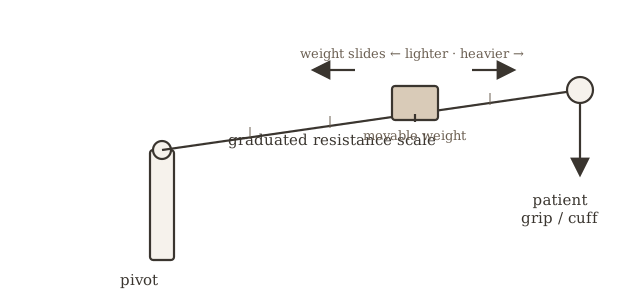
The engineering is the honest, non-quack heart of the story. A Zander machine used weights, levers, and cams to deliver graded, repeatable resistance. On a resistance apparatus, a weight slid along a graduated lever arm: move it toward the far end and the moment arm — and the effort the patient must supply — increased; move it toward the pivot and the load dropped. Other machines were driven the opposite way, by a motor or hand-crank, to deliver passive motion and mechanical massage to a limb that could not move itself.
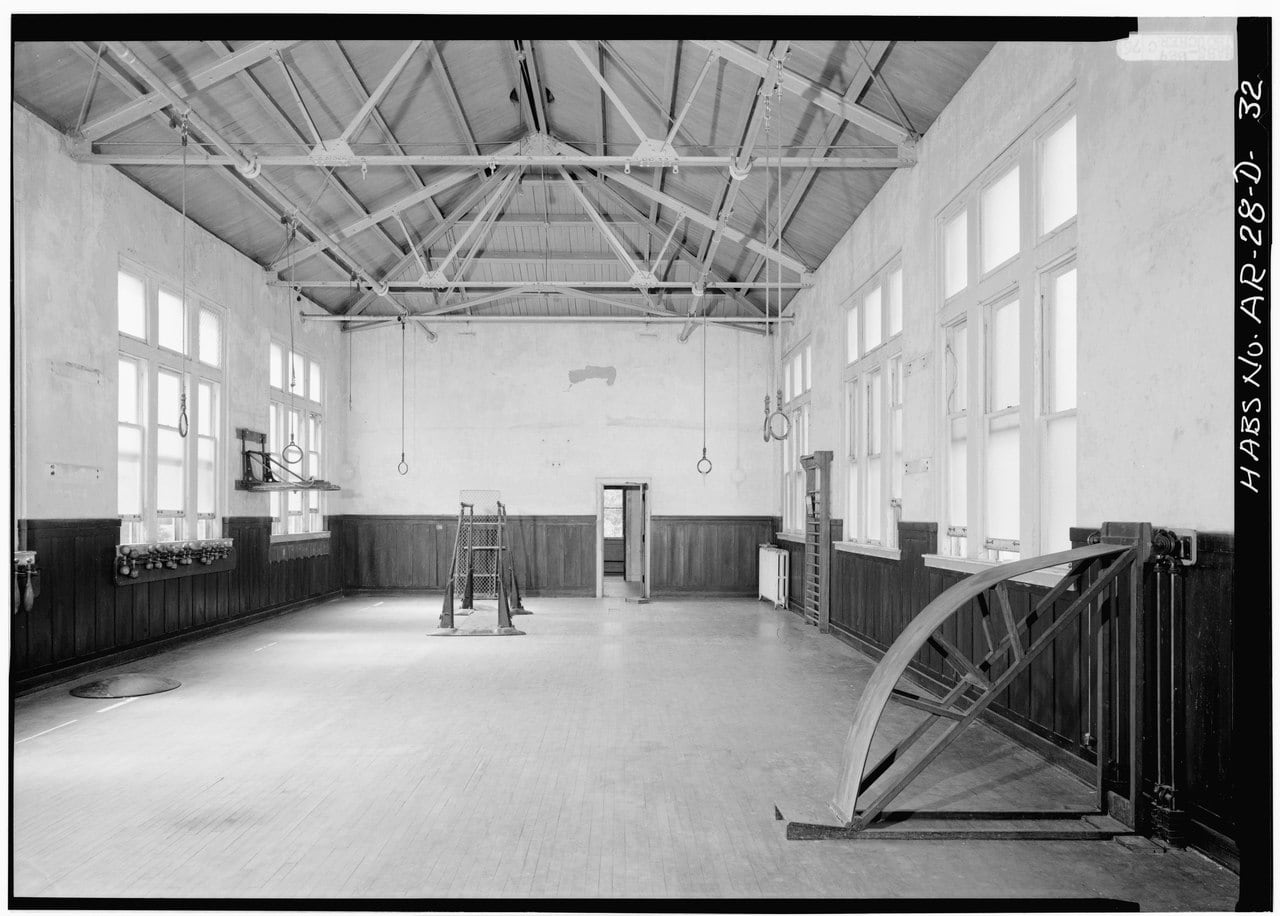
Zander’s apparatus won a gold medal at the 1876 Centennial Exhibition in Philadelphia, and after his illustrated treatise appeared (the German edition Dr. G. Zander’s medico-mechanische Gymnastik, 1892) the system spread worldwide as a franchised model: licensed “Zander Institutes” opened at spas, sanatoria, and even aboard ocean liners. Figures for the peak spread are widely quoted as roughly 146 institutes by about 1906 — a number to treat with care, since it is repeated across popular sources (Wikipedia renders it, garbled, as “146 countries,” which is impossible for 1906) and I could not confirm it against a primary census. What is well documented is the American footprint: the Homestead resort in Hot Springs, Virginia installed thirty-six Zander machines in 1911, and the Fordyce Bathhouse in Hot Springs, Arkansas ordered apparatus from the Kny-Scheerer Company around 1914–1915. That Arkansas equipment survives in Hot Springs National Park, today the largest known Zander collection in the country; the Smithsonian’s libraries hold Zander’s own lavishly illustrated catalogue.
Where does Zander sit on the quackery line? Firmly on the legitimate side, with a caveat. His machines really did deliver graded resistance and passive mobilisation — a direct ancestor of both clinical physiotherapy and the modern gym (Nautilus’s Arthur Jones reinvented the same variable-resistance idea in the 1970s). The overclaim was not Zander’s engineering but the marketing that surrounded mechanotherapy generally: the notion that machine exercise could cure organic disease, constipation, or “nervous” complaints rather than simply strengthen and mobilise. Vol 2 draws that line in detail.
3.3 The medical-vibrator men
If Zander mechanised the gymnasium, others mechanised the massage — and here the marketing ran well ahead of the medicine. The archetype is Dr Gerald Macaura and his “Pulsocon” Blood Circulator, a hand-cranked vibrator of the 1900s–1910s. Turning the crank drove a vibrating head said to reach thousands of pulsations a minute (period claims cite figures up to 5,000 per minute), and the accompanying literature promised relief from rheumatism, constipation, paralysis, asthma, deafness, and heart disease — a classic cure-all list.
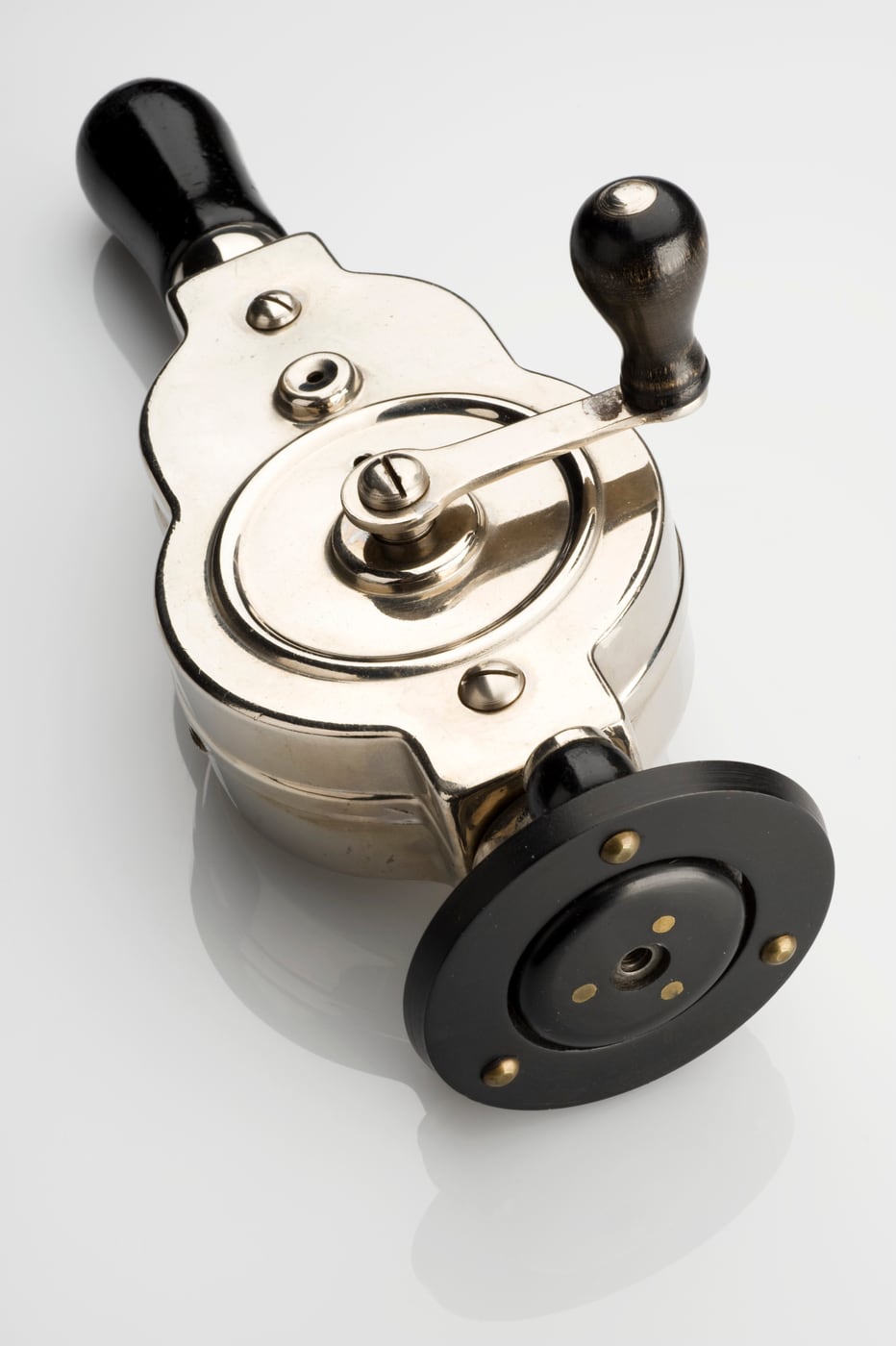
Macaura himself is the cautionary figure. He held no recognised medical qualification, and in 1914 a French court in Paris convicted him of fraud over the Pulsocon’s curative claims, sentencing him to a prison term (reported as up to three years, of which he reportedly served about one). The device’s commercial life outran its disgraced inventor: Pulsocons and their imitators continued to appear in medical and mail-order catalogues into the 1950s. On the electric side, mains vibrators from makers such as Hamilton Beach (whose early models date to around 1902) and the “Star” line brought the same massage-and-circulation pitch into the home — and, crucially, into a regulatory gap: the 1906 Pure Food and Drugs Act did not cover such appliances, so vibrators became, in the historian Hallie Lieberman’s phrase, a kind of “new patent medicine,” advertised with cure-all language after that language had been curbed for bottled nostrums.
The real effects were modest and genuine — local warmth, comfort, a transient bump in surface blood flow, the pleasant loosening of a mechanical massage. The quackery was the leap from “soothing” to “cures organic disease.” Vol 2 covers the physiology; the enforcement that eventually caught up with the claims is Vol 4’s subject.
3.4 The contested vibrator myth
This is the most important accuracy call in the entire dive, so it gets its own section. The widely circulated story goes like this: Victorian and Edwardian physicians, so the claim runs, routinely used electromechanical vibrators to bring female patients diagnosed with “hysteria” to orgasm — a “paroxysm” — as a standard, respectable medical treatment, and the vibrator was invented to spare doctors the labour of doing it by hand.
That narrative comes almost entirely from one book: Rachel P. Maines, The Technology of Orgasm: “Hysteria,” the Vibrator, and Women’s Sexual Satisfaction (Johns Hopkins University Press, 1998). It was enormously influential — spawning a Broadway play (In the Next Room, or the Vibrator Play), the feature film Hysteria (2011), and countless articles that now repeat the tale as settled fact.
It is not settled. In 2018, historians Hallie Lieberman and Eric Schatzberg published “A Failure of Academic Quality Control: The Technology of Orgasm” in the Journal of Positive Sexuality. They went back through the primary sources Maines cited in support of her central claim and reported that none of them actually documents a physician using a vibrator to induce orgasm in a female patient. Maines’ own book, they noted, had at times hedged the thesis as a hypothesis — yet it entered the culture as established history. The critique stops just short of alleging fabrication, and it has been widely accepted; a number of scholars have since said they stopped teaching the claim.
The responsible position, and the one this reference takes, is therefore explicit: the “doctors used vibrators to treat hysteria by inducing orgasm” story is a contested claim, not a documented fact. Vibrators were real, they were sold with wildly overblown health claims, and “hysteria” was a real (and now-discarded) diagnosis — but the specific orgasm-therapy narrative rests on evidence its own critics say does not hold up. We cite Maines (1998) as the source of the thesis and Lieberman & Schatzberg (2018) as the rebuttal, and we state neither as proven. Vol 4 returns to how this myth spread and why it stuck.
3.5 John Harvey Kellogg and Battle Creek
No institution better embodies the quackery boundary than the Battle Creek Sanitarium under Dr John Harvey Kellogg (1852–1943). A Seventh-day Adventist physician with genuine surgical training, Kellogg took charge of the Adventist health institute at Battle Creek, Michigan in 1876, renamed it a “Sanitarium,” and built it into a world-famous wellness resort where presidents, industrialists, and celebrities came for his regimen of “biologic living.”
Much of what Kellogg prescribed was sound and even ahead of its time: vegetarian diet, exercise, fresh air, sunlight, abundant water, and abstinence from alcohol and tobacco. His hydrotherapy and physical-therapy departments were serious operations, and the Sanitarium bristled with mechanical apparatus in the Zander mould — motor- and steam-driven vibrating chairs, bars, and platforms, mechanical massagers, and the famous vibrating chair (built around 1900) that shook the sitter dozens of times a second. Kellogg promoted therapeutic massage in books and in his magazine Good Health, and this exercise-and-hydrotherapy core is a legitimate ancestor of physical medicine.
The pseudoscience sat right beside it. Kellogg was gripped by the theory of “auto-intoxication” — the idea that stagnant matter in the colon poisoned the body and caused a huge range of disease — and against it he deployed relentless bowel regimens, yoghurt enemas, and the vibrating apparatus aimed at “stimulating” the intestines. Auto-intoxication as he understood it is not supported by modern science, and some of his enthusiasms (his opposition to “self-abuse,” his involvement in the era’s eugenics movement) have aged very badly. Battle Creek is thus the dive’s cleanest case study: sound hydrotherapy and physical training braided together with genuine pseudoscience, marketed as a single seamless system.
3.6 Bernarr Macfadden and physical culture
The last figure pushed mechanised health out of the clinic and into mass media. Bernarr Macfadden (1868–1955) was the impresario of American “physical culture” — bodybuilding, diet, exercise, fasting, and fresh air preached with evangelical zeal. He founded Physical Culture magazine in 1899, built a publishing empire (True Story and more) on the profits, and opened a chain of “healthatoriums” and a Physical Culture Training School that sold his regimen of exercise apparatus, fasting, and drugless “natural” cure.
Macfadden’s genuine contribution was popularising exercise and physical fitness for ordinary people at a time when the medical establishment paid it little mind. But he tipped hard into quackery: he championed fasting as a cure for serious disease, condemned white bread as the “staff of death,” opposed vaccination and much of scientific medicine, and was repeatedly denounced by the organised profession — the AMA’s Morris Fishbein grouped him with “border-line cultists.” He was prosecuted on obscenity charges over his frank health publications, and, ideologically consistent to the end, died in 1955 after refusing conventional treatment for a treatable illness. Macfadden shows where the mechanised-health impulse goes when it curdles into a total anti-medical worldview — the far end of the spectrum from Zander’s sober lever machines.
3.7 Where this volume hands off
You now have the people: Zander the engineer of legitimate mechanotherapy; the vibrator promoters who wrapped a mild massage in cure-all claims; Kellogg braiding real hydrotherapy with the auto-intoxication myth; and Macfadden carrying physical culture into anti-medical zealotry. The next question is what happened when these claims met scrutiny and regulation, and how the contested vibrator myth took hold — that is Vol 4 — The Contested History and the Reckoning. The apparatus itself is inventoried in Vol 1, the real-versus-overclaim physiology in Vol 2, and the collecting and lasting physiotherapy legacy in Vol 5. Readers tracing the parallel electrical strand — where high-frequency current met the same porous quackery boundary — will find it in the Electrotherapy Devices dive’s treatment of High Frequency Currents and in this collection’s Violet Ray Wands.
Sources
- Gustav Zander — Wikipedia — lead facts: 1835–1920 Swedish physician and orthopedist, origins of mechanotherapy, 1876 Centennial gold medal, 1892 treatise, global spread of institutes (the “146” figure — rendered here as “countries,” which is treated cautiously in the text).
- The Therapy Machines of Dr. Gustav Zander — Hot Springs National Park (NPS) — weights-and-levers operation, licensing in mid-1860s, Stockholm institute, London/New York institutes; the Homestead’s 36 machines (1911) and Fordyce’s Kny-Scheerer order (1914–15); largest surviving US collection.
- Dr. Gustav Zander’s Victorian-Era Exercise Machines — Smithsonian Magazine — mechanotherapy in the early 1860s, state-supported Stockholm institute, 1892 book and worldwide institutes, spa clientele, forerunner of modern fitness equipment.
- Zander Mechanotherapy — Gust Hamel, The Hospital (1916), via PubMed Central — contemporary account of the Zander system (metadata/period framing; full numeric claims not extracted here).
- John Harvey Kellogg — Wikipedia — 1852–1943, directorship of Battle Creek from 1876, “biologic living,” vibrating chair and vibrotherapy, hydrotherapy, and the auto-intoxication/intestinal-flora beliefs now lacking scientific support.
- Dr. John Kellogg’s Wellness Ideas — HISTORY and Machines That Exercise for You — Collectors Weekly — Battle Creek’s steam/motor vibrating chairs, bars and platforms improving on Zander’s designs; the ~1900 vibrating chair aimed at the bowels.
- Dr. Macura’s [Macaura’s] Blood Circulator — National Museum of American History (Smithsonian) and Doctor Gerald Macaura’s Blood Circulator — Old Operating Theatre Museum — the hand-crank Pulsocon, its cure-all claims, up to ~5,000 pulsations/min, Macaura’s lack of qualification and 1914 Paris fraud conviction, and catalogue survival into the 1950s.
- Selling Sex Toys: Marketing and the Meaning of Vibrators in Early Twentieth-Century America — Hallie Lieberman, Enterprise & Society (Cambridge) — Hamilton Beach and other electric vibrators, the 1906-law regulatory gap, and vibrators marketed as “new patent medicines.”
- A Failure of Academic Quality Control: The Technology of Orgasm — Lieberman & Schatzberg, Journal of Positive Sexuality (2018) — the 2018 rebuttal finding that Maines’ cited sources do not document physicians using vibrators to induce orgasm; basis for treating the hysteria-vibrator thesis as a contested myth. (Maines’ original thesis: The Technology of Orgasm, Johns Hopkins UP, 1998.)
- Bernarr Macfadden — Wikipedia — 1868–1955, Physical Culture magazine (1899), healthatoriums and training school, fasting-as-cure and anti-medical stance, obscenity prosecutions, Fishbein’s “border-line cultist” charge, and his 1955 death after refusing treatment.
Comments (0)