Mechanical and Vibratory Cures · Volume 2
What They Actually Did: Real Effects, Cure-All Claims
The honest boundary of mechanised therapy — where passive exercise and vibration do real but limited work, where the cure-all marketing became quackery, and why the famous 'hysteria vibrator' story is a contested myth, not a fact.
2.1 About this volume
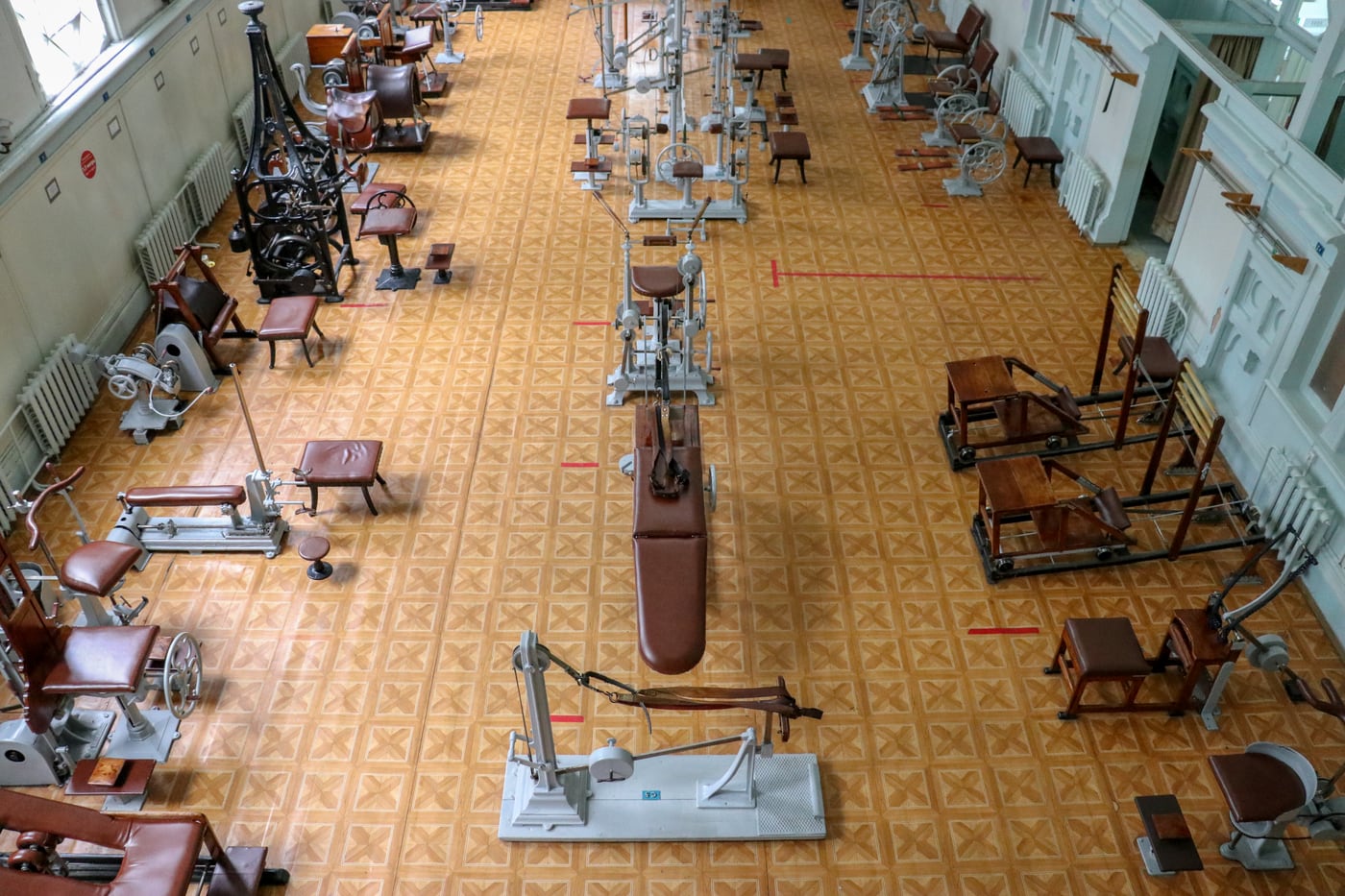
Vol 1 — The Machines laid out the hardware: Zander’s gymnasium of weighted levers, Battle Creek’s motorised chairs and platforms, and the hand-crank and electric vibrators that reached the home. This volume asks the harder question the whole dive is built around — what did any of it actually do? — and it answers honestly, because unlike a violet-ray wand or a radionics box, a mechanical-therapy machine is not pure fraud. It sits on a genuinely porous boundary, with real physiotherapy on one side and cure-all marketing on the other, and the job here is to draw that line cleanly rather than dismiss the whole field or excuse it.
The rule for the volume is simple. Passive and assisted mechanical exercise and vibration produce real but limited effects — they move joints, stimulate muscle, nudge circulation, and feel good. That much is defensible medicine, and Zander’s system in particular is a legitimate ancestor of modern physiotherapy and gym equipment. The quackery is not the machine; it is the overclaim — the leap from “this improves circulation and comfort” to “this cures constipation, obesity, deafness, impotence, and organic disease.” Keep those two statements apart and the whole confusing field snaps into focus.
2.2 The honest core: real but limited effects
Start with what is true. Move a stiff limb through its range, contract a muscle against resistance, or apply mechanical vibration to tissue, and measurable things happen. Muscle contraction increases local blood flow; passive movement helps maintain range of motion and prevents the wasting (atrophy) that follows immobility; rhythmic mechanical stimulation is a mild, pleasant counter-irritant that can ease the perception of aches and tension. None of this is mysterious, and none of it is fraudulent — it is the same physiology that underwrites physiotherapy, remedial gymnastics, and therapeutic massage to this day.
The honest boundaries are just as important. These effects are local, modest, and transient. Vibrating the abdomen does not empty the bowel of “poisons”; shaking the scalp does not regrow hair; a motor-driven belt slapping the waist does not dissolve fat in any meaningful quantity, and passive machine-work burns far less energy than the exertion it was often sold to replace. The genuine, narrow benefits — circulation, mobility, muscle tone, comfort — are precisely the ones the marketing then inflated into a cure for everything. Everything in this volume flows from that gap between a real small effect and an advertised universal one.
2.3 Zander: a genuine forerunner of physiotherapy
Jonas Gustav Wilhelm Zander (born 29 March 1835 in Stockholm; died 17 June 1920) was a licensed Swedish physician — he qualified in 1864 — and one of the originators of what he called mechanotherapy, or medico-mechanical gymnastics (Wikipedia; Smithsonian Magazine). Building on the Swedish “medical gymnastics” tradition of Pehr Henrik Ling, Zander’s insight was to let machines supply the resistance a therapist’s hands would otherwise provide, so that treatment could be standardised, graded precisely, and given to many patients at once. Beginning in the 1860s he assembled an institute of several dozen distinct apparatus — commonly cited as more than two dozen machines — each targeting a specific movement or muscle group ⟨verify exact count and the “from 1857” seed: sources place the working institute in the 1860s⟩.
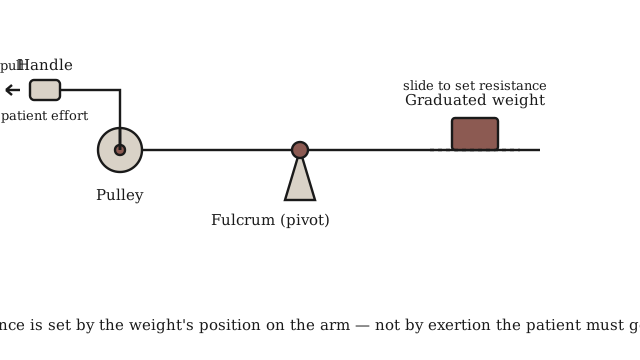
The engineering was elegant and genuinely clever. Most machines used a weight-and-lever system for variable resistance: a graduated weight rides on a pivoting lever arm, and sliding the weight toward the far end increases the load while moving it toward the user lessens it, so a single machine can be dialled from convalescent-gentle to athletic-hard without swapping weights (NPS Hot Springs). A second class of machine was motor- or crank-driven for passive movement — for patients with paralysis or extreme weakness, the machine moved the limb for them, “to keep the affected muscles from atrophying,” and other cam-driven units delivered mechanical massage and vibration.
Zander’s system spread on genuine merit. He won a gold medal at the 1876 Centennial Exhibition in Philadelphia, published Dr. G. Zander’s medico-mechanische Gymnastik in 1892, and franchised Zander Institutes to spas and sanatoria across Europe and North America (Smithsonian Magazine). (Wikipedia’s claim that “by 1906 he had established Institutes in 146 countries” is almost certainly garbled — there were nowhere near 146 countries — and should be read as “in many cities/countries,” not taken literally ⟨verify⟩.) In the United States the best-surviving installation is at the Fordyce Bathhouse in Hot Springs National Park, Arkansas — the largest known Zander collection in the country — while The Homestead resort in Virginia installed 36 machines in 1911 (NPS Hot Springs). Judged as physiotherapy and progressive-resistance exercise, Zander’s apparatus was sound; the quackery crept in only when spa brochures promised those same machines would cure systemic disease.
2.4 Battle Creek: Kellogg’s vibrating chairs and “vibrotherapy”
If Zander is the legitimate end of the spectrum, John Harvey Kellogg and the Battle Creek Sanitarium (Michigan) are its most instructive middle — a place that mixed real physical medicine with confident pseudoscience under one roof. Kellogg ran the “San” as a temple of what he called “biologic living,” and from 1890 an in-house equipment company manufactured his mechanical therapies (Wikipedia). His best-known device is a vibrating chair, shaken by various accounts roughly twenty to sixty times a second (no primary spec survives), sold as a way to “stimulate” the organs of the lower abdomen; the sanitarium floor also held two- and four-person foot vibrators, a mechanical slapping-massage device, and a kneading apparatus advertised in 1909 at $150.
Some of what Battle Creek offered was legitimate: supervised exercise, hydrotherapy, diet, rest, and mechanical physiotherapy of the Zander kind all have real, if modest, value. Kellogg even developed an electrotherapy exercise bed whose painless sinusoidal current produced muscle contractions he claimed gave the effect of “a brisk four-mile walk” — an overstatement wrapped around a genuine phenomenon. But the framework around it was pseudoscientific. Kellogg was a fervent believer in “autointoxication” — the idea that most disease flows from toxins produced by the “wrong” bacteria in a constipated colon — and his vibrating chairs, mechanical exercisers, yoghurt, and notorious enema regimes were all marshalled against that imaginary poisoning (Wikipedia). The vibration was real; the “shaking the poisons loose” rationale was not. Battle Creek is the cleanest single illustration of this dive’s thesis: sound physical therapy and unfounded cure-all theory, sold together and hard to tell apart from the brochure.
2.5 The hand vibrator: Macaura’s Pulsocon
Where Zander needed a hall and Kellogg a sanitarium, the vibrator brought mechanotherapy into the hand and then the home. The emblematic device is Dr. Macaura’s Pulsocon — a hand-cranked vibrator marketed as a “Blood Circulator.” Its promoter, Gerald Macaura, patented a blood circulator in the United States in 1902 and re-patented it in the United Kingdom in 1904 (patent no. 13932), partnering from 1911 with the British Appliance Manufactural Co. Ltd. of Leeds to produce it (Pulsocon — Wikipedia; Science Museum Group / NMAH records). Turning the crank drove an oscillating head said to deliver up to 5,000 vibrations per minute, and the little machine was sold — with a fan of interchangeable applicator heads — as a cure for a long menu of complaints.
Two things about the Pulsocon carry the dive’s argument. First, it worked as a vibrator — it really did shake tissue and could produce the mild, pleasant, circulation-flushing sensation any vibrator produces — while being incapable of the disease cures its advertising promised. Second, its promoter was not what he claimed: “Dr.” Macaura held no medical qualification, and in 1914 in Paris he was convicted of swindling and the illegal practice of medicine, drawing a sentence of which he served about a year — during which, by one widely repeated account, he still earned some $75,000 from Pulsocon sales (Pulsocon — Wikipedia; Old Operating Theatre Museum) ⟨verify the $75,000 and the exact sentence, which trace to secondary retellings⟩. Around the Pulsocon grew a whole electric-vibrator trade — the White Cross, Hamilton Beach, and Star models among them — sold to households as all-purpose “health” appliances. The physical-culture entrepreneur Bernarr Macfadden pushed adjacent apparatus in the same spirit, folding real exercise into extravagant claims.
2.6 Where it becomes quackery: the cure-all overclaim
The fraud, then, is a matter of dose and claim, not mechanism. A machine that improves circulation and mobility was advertised to cure conditions it cannot touch: constipation and “auto-intoxication,” obesity, deafness, impotence, “nervous debility,” and organic disease of every kind. The tell is always the same over-reach — the jump from a genuine local effect to a systemic cure. Vibrating the ear does not restore hearing lost to nerve damage; a reducing-machine’s slapping belt does not metabolise fat; passive machine-exercise is not a shortcut that delivers the cardiovascular benefit of the work it spares you. The medical establishment saw this early: as far back as 1915 the Journal of the American Medical Association flatly called the vibrator business “a delusion and a snare” (The Conversation; Snopes).
Regulation lagged the marketing. The 1906 Pure Food and Drug Act did not reach medical devices, so vibrators and mechanical “reducers” flourished in the gap that patent-medicine crackdowns left open; meaningful federal leverage over device claims arrived only with the 1938 Food, Drug, and Cosmetic Act and the Federal Trade Commission’s advertising authority, after which cure-all device advertising was steadily curtailed. I could not confirm a single landmark FTC action against a named vibrator maker, so this regulatory arc is best stated as a general trend rather than pinned to one celebrated case ⟨verify — specific FTC/FDA vibrator enforcement not confirmed⟩. The honest end of the story is quieter than a courtroom: the cure-all claims simply faded, and the defensible core — graded exercise, passive mobilisation, massage — was absorbed into legitimate physiotherapy, where it remains.
2.7 The contested myth: vibrators and “hysteria”
No account of medical vibrators can skip the single most repeated claim about them — and it is the most important accuracy call in this dive, so it must be stated carefully. The popular “fact” that Victorian physicians routinely used vibrators to bring female ‘hysteria’ patients to orgasm in the clinic comes almost entirely from one book: Rachel Maines, The Technology of Orgasm (Johns Hopkins University Press, 1998/1999), which argued that manual genital massage to “hysterical paroxysm” was a standard medical treatment and that the electromechanical vibrator was invented as a labour-saving replacement for it. The thesis was elegant, widely praised, award-winning, and repeated for two decades across popular culture and scholarship until it hardened into received wisdom.
It does not hold up. In 2018, historians Hallie Lieberman and Eric Schatzberg published “A Failure of Academic Quality Control: The Technology of Orgasm” in the Journal of Positive Sexuality (vol. 4, no. 2, pp. 24–47), in which they examined every source Maines cites in support of her central claim and found that not one of them actually documents physicians using vibrators to produce orgasm as a treatment for hysteria (Georgia Tech; ScienceAlert). Tellingly, when challenged, Maines herself conceded the point, saying “I never claimed to have evidence that this was really the case. What I said was that this was an interesting hypothesis” — even though her book’s own language (“a standard treatment”) had read as settled fact (ScienceAlert; Marginal Revolution).
So this museum states it plainly: the “hysteria vibrator” story is a contested and largely discredited claim, not an established fact, and it is repeated here only to correct it. Medical vibrators of this era were sold, overwhelmingly and explicitly, for circulation, “nerve force,” pain, and general vigour — the mundane cure-all overclaims documented above — and the sensational clinical-orgasm narrative is a modern historiographical error that took on a life of its own. Where the record is genuinely silent, the honest answer is we do not know, not the tidy story everyone has heard.
2.8 The reckoning, and where this hands off
The reckoning for mechanical and vibratory cures was less a single trial than a slow sorting. The overclaims withered under medical scrutiny (the JAMA verdict of 1915), promoters like Macaura were prosecuted where they crossed into outright fraud, and tightening device regulation from 1938 onward squeezed the cure-all advertising out of the market — while the legitimate core survived and grew. Zander’s graded-resistance machines are the visible ancestor of every gym and rehabilitation suite; his passive-movement and massage apparatus prefigure modern physiotherapy; and vibration therapy persists in narrow, evidence-based niches. That is the rare quack-adjacent story with a genuinely constructive ending.
The people and institutions behind these machines — Zander and his franchised institutes, Kellogg and Battle Creek, the vibrator trade and its promoters — are the subject of Vol 3 — The People and the Institutions. The deeper historiographical reckoning, including the full anatomy of the Maines controversy and how a myth becomes “common knowledge,” is Vol 4 — The Contested History and the Reckoning. And the collector’s questions — identifying, dating, and displaying a Zander machine or a Pulsocon, and reading these objects as the direct forerunners of the modern gym — close the dive in Vol 5 — Collecting and the Physiotherapy Legacy. For the porous electrical cousin of this field — the sinusoidal-current and high-frequency apparatus Kellogg and others also used — see the High Frequency Currents and Faradic and Galvanic Machines dives in Electrotherapy Devices.
Sources
- The Therapy Machines of Dr. Gustav Zander — National Park Service, Hot Springs — the weight-and-lever variable-resistance mechanism (sliding the weight to set the load), motorised passive machines for paralysis/atrophy, the Fordyce Bathhouse as the largest surviving US collection, and The Homestead’s 36 machines (1911); Zander’s licensing (1864) and dates.
- Gustav Zander’s Victorian-Era Exercise Machines — Smithsonian Magazine — mechanotherapy as a physiotherapy/gym forerunner, the 1876 Centennial gold medal, the 1892 medico-mechanische Gymnastik, and worldwide spread of Zander Institutes.
- Gustav Zander — Wikipedia — birth/death (1835–1920), originator of mechanotherapy, 1876 Philadelphia gold medal; the “146 countries by 1906” figure is flagged here as almost certainly garbled.
- John Harvey Kellogg — Wikipedia — the Battle Creek equipment company (from 1890), the ~20–60-per-second vibrating chair, foot vibrators / slapping / kneading apparatus ($150, 1909), the sinusoidal “four-mile walk” bed, and the “autointoxication”/“biologic living” pseudoscience alongside genuine physical therapy.
- Pulsocon — Wikipedia — Macaura’s hand-crank “Blood Circulator”: US patent 1902, UK patent 13932 (1904), up to 5,000 vibrations/minute, British Appliance Manufactural Co. (Leeds, 1911), the 1914 Paris fraud/illegal-medicine conviction, and that Macaura was not a qualified doctor.
- Dr. Macura’s Blood Circulator — Smithsonian National Museum of American History and Doctor Gerald Macaura’s Blood Circulator — Old Operating Theatre Museum — object provenance and the marketed cure-all claims of the Pulsocon.
- A Failure of Academic Quality Control: The Technology of Orgasm — Lieberman & Schatzberg (Georgia Tech listing) and ScienceAlert coverage — the 2018 Journal of Positive Sexuality refutation, the finding that none of Maines’ cited sources support the clinical-orgasm thesis, and Maines’ own “interesting hypothesis” concession.
- Vibrators had a long history as medical quackery — The Conversation and Snopes — the vibrator sold as an all-purpose home “health” appliance, the 1906 device-regulation gap, and JAMA’s 1915 “delusion and a snare” verdict.
- Cross-references (named in prose, not linked): the High Frequency Currents and Faradic and Galvanic Machines dives in Electrotherapy Devices — the sinusoidal-current and electrotherapy apparatus that overlapped Battle Creek’s mechanical therapies.
Comments (0)