Gravity Injection Systems · Volume 5
Collecting, Dating, and Displaying a Gravity Rig
How a collector recognises a gravity injection outfit, reads its condition and provenance, dates the glass and its fittings, and displays one safely — and where these objects sit in the funeral-history collecting world.

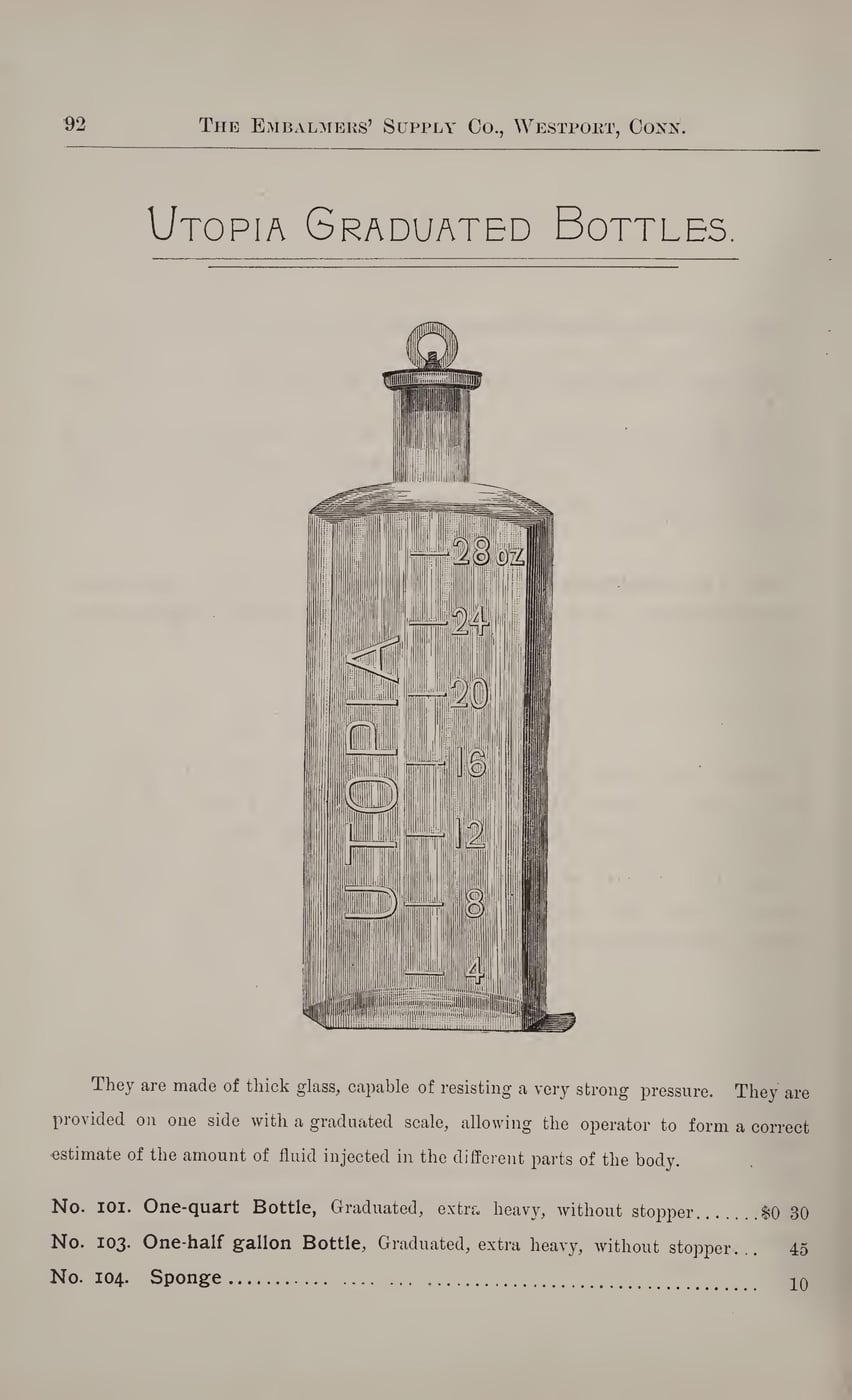
The end of this dive is the object on the shelf. Four volumes have described what a gravity outfit is — an elevated glass reservoir feeding fluid through tubing into an artery by nothing more than the weight of the column (Vol 1 — The Gravity Outfit) — the physics that makes it slow and self-weakening (Vol 2 — Head Pressure, Materials, and Survival), the people who built the method into a trade (Vol 3 — Gannal, Sucquet, Holmes, and the Civil War), and the toxic fluids it carried (Vol 4 — The Toxic-Fluid Era). This closing volume is for the person who now owns one of these rigs, or is about to: how to recognise it, date it, judge its condition, and display it without being fooled by a seller or harmed by a century-old residue.
Contents
| Section |
|---|
| About this volume |
| Recognising a gravity outfit |
| Dating the glass and its fittings |
| Condition and provenance |
| Value and the collecting field |
| Displaying one safely |
| Where this volume hands off |
| Sources |
5.1 About this volume
A complete gravity outfit is one of the harder objects in funeral-history collecting to find whole, and one of the easier to misidentify. What survives is almost never a “machine”: it is a large graduated glass bottle, sometimes with a metal suspension ring or a fragment of stand, and that is the whole of most surviving rigs. The tubing has perished, the cannula has wandered off, and the bottle itself has often been re-labelled by a hopeful seller as a laboratory flask, a chemist’s measure, or a moonshiner’s still-jar — all of which some of them genuinely became in a second life.
This volume assumes you have read the rest of the dive and refers back rather than repeats. The apparatus and the hydrostatic idea are laid out in Vol 1; the reason surviving rigs are almost always incomplete — glass endures, gum rubber does not — is argued in Vol 2; the makers and the Civil-War origin story are Vol 3; and the arsenic-and-metal-salt chemistry whose residue is the display-safety problem here is Vol 4. Here we catalogue the recognition cues, the dating evidence, and the safety case.
5.2 Recognising a gravity outfit
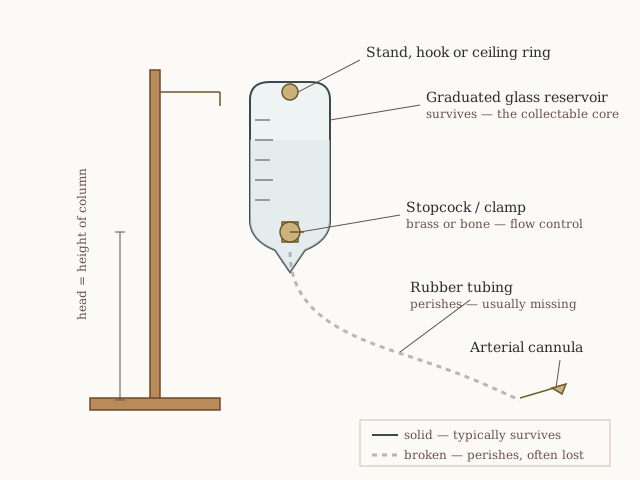
A gravity outfit is defined by what it lacks: there is no pump, no motor, no pressure gauge, no squeeze-bulb. Pressure came from height alone, so the apparatus is only ever a reservoir, a way to hang it up, a flow control, a length of tube, and a cannula. Recognising one is largely a matter of recognising the reservoir, because that is usually all that is left.
The reservoir is a large blown-glass bottle, commonly a gallon or more, frequently graduated up the side in ounces or cubic centimetres so the operator could see how much fluid remained and how fast it was falling. Trade practice hung it three to five feet above the body — because, as Vol 2 explains, a foot of near-water fluid supplies only about 0.43 psi of head, so even a five-foot column delivered barely two pounds per square inch, and that pressure fell as the bottle drained. (A common shop rule of thumb quoted “one pound of pressure per foot of height,” which roughly doubles the real figure; it was a working mnemonic, not physics.) Many bottles carry a metal or wire suspension ring, bail, or hook at the neck for hanging from a stand, a ceiling ring, or a wall bracket — a feature ordinary storage or laboratory bottles do not have, and a good first tell that a plain-looking jar is really a gravity reservoir.
Below the neck sits the stopcock or clamp — a brass, and occasionally bone, flow-control valve or a simple screw pinch-clamp on the tube — which was the only rate control the operator had beyond raising and lowering the whole bottle. Then the rubber tubing, and finally the arterial cannula or arterial tube, a small tapered brass fitting tied into a raised artery. The schematic above shows the complete assembly with the perishable rubber drawn as a broken line, because that is exactly how you will usually meet it: everything solid present, everything rubber gone.
5.3 Dating the glass and its fittings
With the rubber and paper long gone, the glass itself is usually the best-dated part of the object, and it is dated by the same diagnostic features archaeologists use for any bottle. The mould seams are the single most useful cue. On a mouth-blown bottle the vertical side seams fade out below the lip, and the finish shows hand-tooling or an applied ring; on a machine-made bottle the seams run all the way over the rim. Automatic bottle machines took over gradually — earlier for wide-mouth ware (from roughly 1905–1915) and a little later for narrow-bore bottles (from around 1910–1920) — so seams over the lip point past about 1915–1920, while a mouth-blown finish, or a pontil scar on the base, points earlier. These are the Society for Historical Archaeology’s standard criteria, and they apply to a gravity reservoir as well as to any patent-medicine bottle.
Embossed or engraved capacity marks give a second bracket. United States federal fluid-measure requirements from 1913 onward pushed makers toward explicit “FLUID OUNCES” wording, so a reservoir graduated and lettered in formal fluid measure is more likely to post-date the mid-1910s, whereas informal or unmarked graduation is consistent with an earlier bottle. Treat that as a soft indicator rather than a hard date — it turns on general bottle-labelling law rather than any embalming-specific statute, and I could not confirm a rule written specifically for mortician’s ware.
The fittings date the outfit too, where they survive. Brass or bone stopcocks and hand-tooled arterial cannulas belong to the mouth-blown, pre-supply-house era; nickel-plated fittings and standardised threaded couplings signal the catalogue supply trade — the world of the Hand Pump and Bulb Machines dive, which dates the founding of the Embalmers’ Supply Company (ESCO) to 1886 and the first American-made instruments to the year after. A maker’s or supply-house name — moulded into the glass, etched, or surviving on a label — is the best evidence of all, and worth cross-checking against the maker record rather than trusting a listing.
5.4 Condition and provenance
Grade a gravity rig on what is present and what it cost to lose.
The reservoir. Hold it to the light. Because these bottles are large and thin, they chip, star-crack, and craze readily, and it is genuinely rare to find one with no damage to the rim or base — the large mouth is the first casualty. Interior staining or a chemical film is common and is itself provenance: it is the ghost of the fluid the bottle carried, and (per the display section below) a reason for care.
The rubber. Assume it is gone or ruined. Natural gum-rubber and early latex tubing oxidises, hardens, and crumbles over decades; a surviving length is almost always brittle, sticky, or fused flat, and is a display prop, not a working part. As Vol 2 argues, this asymmetry — glass endures, rubber perishes — is why nearly every surviving outfit is incomplete, and it means a rig offered “complete with original tubing” deserves a hard look: intact century-old embalming tube is uncommon, and reproduction tube is easy to add.
The stand and small fittings. Stands, hooks, stopcocks, and cannulas are the parts most often married in from elsewhere or missing entirely. A rig where bottle, stand, and fittings share consistent wear, patina, and a plausible single origin is worth far more than an assembled group photographed together.
Provenance turns a curiosity into a document. A surviving supply-house label, a fluid-company name (Dodge, Eckels, ESCO, Undertakers’ Supply Co.), an undertaker’s shop mark, a receipt, or a trade-catalogue page ties the object to the exact drugstore-and-house-call world Vol 3 describes. Record where it came from and photograph every part; that record is the difference between “an old glass jar” and a dated, attributed artefact of early American undertaking.
5.5 Value and the collecting field
Gravity rigs sit within funeraria — the funeral-history collecting field, whose objects run from embalming-fluid bottles and undertakers’ advertising to cooling boards and the electric machines of the later dives, and which is served by museums such as the National Museum of Funeral History in Houston (whose History of Embalming hall includes a full-scale recreation of Thomas Holmes’s Civil-War embalming station) and by a lively secondary market on auction sites, Etsy, and dedicated collector groups.
Prices are modest and driven almost entirely by completeness and condition. Isolated graduated gravity jars/flasks commonly change hands at auction in roughly the US$130–210 range; a collector-quoted figure for a gravity bottle with its original suspension chain but without stand or tubing sits around US$200–250 in a private sale, and less at auction — these are secondary-market and hobbyist estimates, not appraisals, and should be treated as ballpark. A genuinely complete, single-provenance outfit — bottle, stand, fittings, and documentation — is far scarcer and worth a multiple of the loose-jar figure, precisely because the perishable parts so rarely survive together. Beware the reverse trap as well: because these bottles were widely repurposed into laboratory measures, still jars, and winemaking vessels, plenty of honest household glass gets optimistically listed as “embalming,” and plenty of real gravity reservoirs get sold as something more innocent.
5.6 Displaying one safely
The core safety message is short: a surviving gravity reservoir is very likely to hold the residue of a toxic embalming fluid, and it should be treated as a contaminated antique — displayed empty and clean, never used, and never drunk from or repurposed for anything that touches food, drink, or skin.
As Vol 4 sets out, nineteenth- and early-twentieth-century arterial fluids preserved because they were poisonous: they were built on salts of arsenic, and variously on mercury, zinc, and other heavy metals, before arsenical fluids were driven out of the trade in the early 1900s (formaldehyde, identified in 1867 and recognised as a fixative in the 1890s, replaced them). Arsenic does not decay, and a bottle that carried an arsenical fluid can retain a genuinely hazardous residue in its film and sediment more than a century later — the same persistence that, at cemetery scale, put arsenic into old grave soil. A reservoir from the formaldehyde era is chemically different but not benign: dried formaldehyde residues and old fluid are still an irritant and a recognised carcinogen.
The sensible posture follows directly. Display the bottle empty, rinsed, and sealed if possible; handle a stained or sedimented interior with gloves and avoid raising dust from any dried deposit; do not use compressed air or abrasive cleaning that would aerosolise it; keep it out of reach of children and pets and away from any food-preparation area; and — the point that bears repeating because these bottles are so often repurposed — do not press an old gravity reservoir into service as a decanter, a vase you drink plant water from, a still, or a fermentation vessel. If a residue’s identity actually matters to you (say, you intend to clean a heavily crusted bottle), the correct move is a test and hazardous-disposal handling, not guesswork. Described here as principle, not procedure: the safe way to own one of these is to admire the glass and leave the chemistry alone.
Displayed cold and clean, though, a gravity outfit is a superb object — the graduated bottle on its stand or hook, a period-correct (or clearly-reproduction) length of tube coiled below, the stopcock and cannula laid out, a supply-house label forward. Keep it dry to spare any iron hardware and out of direct sun, which yellows old glass and rots what rubber remains. It is the quiet, gravity-driven ancestor of everything the rest of this sub-project describes.
5.7 Where this volume hands off
This is the last volume of the Gravity Injection Systems dive, and gravity is where the whole Embalming Machines sub-project begins. From here the technology gains a pump and the operator gains control: the manual squeeze-bulbs and piston pumps of the Hand Pump and Bulb Machines dive, then the motor-driven, gauge-equipped Electric Embalming Machines (the Porti-Boy and its kin) that standardised arterial injection and completed the arsenic-to-formaldehyde arc begun here. The complementary cavity branch is the Trocars and Cavity Injection dive, and the pre-refrigeration furniture that surrounded all of it — cooling boards and corpse coolers — is its own dive. Each ends, as this one has, on the object a collector holds and how to read it; and the sub-project’s quack-medicine neighbours, from the Violet Ray Wands to the Radioactive Cures, close the same way.
Sources
- Antique Gravity Bottle Value — JustAnswer (antiques expert Q&A) — how a gravity bottle was carried and used, the “one pound of pressure per foot / three-to-five-foot” shop rule, the rarity of undamaged examples, the ~$200–250 (chain, no stand/tubing) and ~half-that-at-auction estimates, and the repurposing of bottles into stills and winemaking vessels. Hobbyist estimate, treated as ballpark.
- Society for Historical Archaeology — Bottle Dating — the authoritative diagnostic criteria used in the dating section: mould-seam position, mouth-blown vs. machine-made finishes, pontil scars, and the ~1905–1920 transition to automatic bottle machines.
- Guidelines for Determining the Age of Antique Bottles — Historic Glasshouse and glassbottlemarks.com — corroborating dating cues and the point that formal “FLUID OUNCES” capacity wording follows 1913-onward US fluid-measure requirements (a soft, general indicator, not an embalming-specific rule).
- National Museum of Funeral History — History of Embalming — the institutional home of this collecting field; the Holmes Civil-War embalming-tent recreation and early-apparatus displays that anchor “funeraria.”
- National Museum of Civil War Medicine — Embalming and the Civil War — Thomas Holmes as “father of modern embalming,” ~4,000 soldiers embalmed, Ellsworth and the Lincoln family, and the wartime demand that made embalming publicly acceptable (referenced here for handoff/context; detailed in Vol 3).
- Feet-to-PSI / hydrostatic-head conversion (0.433 psi per foot of water) and Engineering ToolBox — Hydrostatic Pressure — the real head figure (~0.43 psi/ft, from water’s ~62.4 lb/ft³) used to debunk the trade’s “one pound per foot” rule of thumb.
- Embalming chemicals — Wikipedia and Arsenic and Old Graves — Smithsonian Magazine — the arsenic/mercury/zinc composition of early fluids, arsenic’s non-degradation and persistence in bottles and grave soil, and formaldehyde’s later carcinogen status: the basis of the display-safety case.
- Antique embalming machine — Auction Finds (myauctionfinds.com) — a listing for a C. M. Sorensen “motorised machine,” cited here only to illustrate how later pump apparatus is described and priced at auction and to contrast with the pumpless gravity outfit. The object is not an embalming machine, and this is now settled rather than merely disputed — the maker’s own 1926 catalogue identifies it as an ear-nose-throat and anaesthesia outfit. The page’s comments were right to doubt it: a mortician of forty years had “NEVER seen this type of machine in the business,” though his guess of a dental tool was the right neighbourhood and the wrong specialty. The identification, and the catalogue page that proves it, is in C. M. Sorensen Pressure and Suction. Cited here as the textbook case of the misidentification this collecting section warns against, not as a museum-documented embalming example.
- Collecting vintage funeral memorabilia — Phoenix New Times — the “funeraria” collecting field, its objects, and its community, for the value/field section.
Comments (0)