Gravity Injection Systems · Volume 3
The Chemists, the War Dead, and the Making of a Trade
How arterial injection crossed from the French anatomy schools of Gannal and Sucquet to the battlefields of the American Civil War — and how Thomas Holmes, Colonel Ellsworth, and Lincoln's funeral train turned a dissecting-room technique into a national industry.
Where Vol 1 — The Gravity Outfit and the Hydrostatic Principle introduced the elevated bottle and its column of fluid, and Vol 2 — Head Pressure, Materials, and Survival took apart the physics and the perishable materials, this volume steps back from the hardware to the people. It is the origin story the gravity outfit carries for the whole Embalming Machines sub-project: how arterial injection was invented in the anatomy schools of France, sold across the Atlantic as a commercial secret, and turned by one war into a household expectation.
3.1 About this volume
The gravity injection outfit is a simple thing — a bottle, some tubing, a clamp, a cannula — but the idea it embodies has a specific and heavily mythologised history. Injecting a preservative fluid into an artery so that the body’s own vascular tree distributes it was not obvious; it had to be invented, refined into a chemistry, and then commercialised. That invention happened in France in the 1830s, and the technique reached ordinary American families through a national trauma: roughly 750,000 deaths in a four-year civil war, an unprecedented number of them far from home.
This volume traces that arc from Jean-Nicolas Gannal and Jean Pierre Sucquet in Paris to Dr. Thomas Holmes and the Union embalmers, and it is careful throughout, because embalming history is dense with repeated but shaky claims — inflated body counts, tidy “father of” titles, and a persistent confusion over who embalmed whom. Where a figure is a self-report or a much-copied round number, this volume says so. The physics stays in Vol 2; the toxic chemistry that these early fluids depended on is Vol 4 — The Toxic-Fluid Era’s subject, and is only sketched here; the collecting angle is Vol 5 — Collecting, Dating, and Displaying’s.
3.2 The European antecedent: Hunter and Gannal
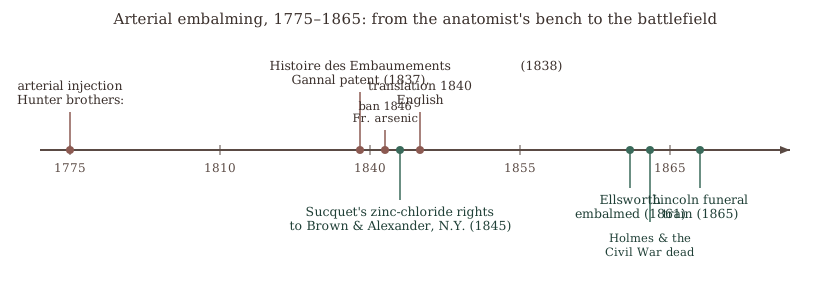
Arterial injection did not begin with embalming the dead for burial — it began as an anatomist’s technique for preserving dissection specimens and for filling blood vessels with coloured wax so they could be studied. The Scottish anatomists William Hunter (1718–1783) and his brother John Hunter (1728–1793) are generally credited with first fully describing arterial and cavity injection as a means of preserving a whole body; the celebrated instance is the preservation of Martin Van Butchell’s wife around 1775 — by most accounts the work of William Hunter, assisted by William Cruikshank, though some older and tertiary sources credit his brother John — a curiosity displayed in a glass-lidded case. This eighteenth-century work established the principle the gravity outfit later mechanised — put fluid into an artery under pressure and let the circulation carry it — but it remained a scientific and theatrical oddity, not a funeral practice.
The figure who turned it into a repeatable chemistry was Jean-Nicolas Gannal (1791–1852), a French chemist and pharmacist (and former military hospital assistant) working in Paris. In September 1837 Gannal took out a patent for an embalming method based on injecting a solution of sulphate of alumina — and, in his stronger formulations, arsenic — into the arterial system, entering by the carotid artery so that a single injection reached the whole body. He set out the method in Histoire des Embaumements, published in 1838, which appeared in an English translation by Dr. Richard Harlan in 1840 under the title History of Embalming — the text that carried the technique into the American medical world. Gannal’s work was decorated in France (he had earlier won a Montyon prize from the Institut de France for related preservation chemistry), and it made arterial injection a practical tool rather than a laboratory stunt.
The arsenic in Gannal’s fluids preserved because it was violently toxic — it poisoned the bacteria and enzymes of decay along with everything else. That is a chemistry this dive treats only as context, and Vol 4 takes up in full, but one consequence belongs here because it shaped the whole field: arsenic embalming collided with the law. Because an embalmed body was saturated with arsenic, a poisoning could no longer be detected at autopsy — the forensic test that convicted arsenic murderers now returned a positive on the innocent and guilty alike. France restricted arsenic in embalming by 1846, and Gannal himself moved toward acetate-of-alumina fluids. The toxic-preservative problem, and its eventual solution in formaldehyde, is the arc that runs from this volume through Vol 4 to the Electric Embalming Machines dive.
3.3 Sucquet, zinc chloride, and the crossing to America
Gannal’s chief methodological rival in France was Jean Pierre Sucquet, a physician who preserved bodies not with alumina or arsenic but with chloride of zinc. Period trade accounts describe his method as an injection of roughly five quarts of a concentrated zinc-chloride solution (on the order of 20 percent) by way of the popliteal artery behind the knee — a different point of entry from Gannal’s carotid — and note that besides arresting decay it gave the tissues a hard, white-marble appearance. One much-repeated demonstration had a Sucquet-treated body disinterred after two years in a state of good preservation. These particulars come from secondary embalming-trade histories rather than from a primary Sucquet text this volume could consult, so the exact concentrations and volumes should be read as the trade’s received account rather than as verified laboratory figures.
Sucquet matters to the American story less for his chemistry than for a business transaction. Around 1845, the U.S. rights to his zinc-chloride method were licensed to two New York practitioners — Dr. Charles D. Brown, a Manhattan dentist, and his partner Joseph Alexander, trading as Brown & Alexander. (The 1845 date sits a little early against Sucquet’s later fame and is worth flagging as uncertain; the licensing itself, and the Brown–Alexander firm, are well attested.) That firm is the hinge of this whole narrative: a New York dental-and-embalming partnership holding a French preservation patent, employing a young operator named Henry (Harry) P. Cattell — and, twenty years later, entrusted with the body of a president. Hold that thread; it closes the volume.
3.4 Thomas Holmes and the “Innominata”
The name that eclipses all the others in American memory is Dr. Thomas Holmes (c.1817–1900). Born in Brooklyn, Holmes is believed to have taken a medical degree at the College of Physicians and Surgeons at Columbia around 1845, though the record is thin enough that the detail carries a ⟨verify⟩ asterisk in every serious account. He is the man the trade later crowned “father of modern embalming” in the United States — a title that is as much a marketing legacy as a historical judgement, since Holmes was, above all, a relentless promoter of his own fluid and method.
That fluid he called “Innominata” (the un-named), and marketed as a safe, arsenic-free preservative — a pointed selling proposition in the years when arsenic embalming was becoming a legal and public-health liability. The claim deserves the plain debunking this collection applies to period marketing everywhere: analyses and later accounts indicate Holmes’s fluids in practice did contain arsenic (with zinc, mercury salts, and creosote among the agents variously attributed to his and contemporary formulas). The “safe” label was a commercial promise the chemistry did not honour — the very reason a preservative worked in this era is the reason it was poisonous, a tension Vol 4 develops. Holmes reportedly built a considerable business selling his fluid at about $3 a gallon and licensing his method to other operators.
Crucially, Holmes worked in the gravity-and-hand era: the apparatus of his practice was arterial cannulas, tubing, and injection by hydrostatic head or simple pump, not the motor-driven machine of the twentieth century (the Electric Embalming Machines dive). What he supplied was less a device than a system — a fluid, a technique, and a business model — arriving exactly when the country was about to need it on a scale no one had imagined.
3.5 Ellsworth: the first public embalming

On 24 May 1861, weeks into the war, Colonel Elmer E. Ellsworth — a 24-year-old militia officer, a law student in Lincoln’s Springfield office, and a personal friend of the president — was shot dead in Alexandria, Virginia while removing a Confederate flag from the roof of the Marshall House inn. As the first conspicuous Union officer killed, his death was a national event, and it handed embalming its first great public stage.
Thomas Holmes embalmed Ellsworth’s body — by several accounts at the Washington Navy Yard, having gained access through Lincoln’s circle — and the preserved remains lay in state in the East Room of the White House before travelling to New York, where thousands filed past the funeral cortège. For the first time, a mass public saw a body that, days after death and after a long journey, looked composed and recognisable. Embalming had been demonstrated not in a dissecting room but as a funeral — a way to bring a fallen man home and let his people say goodbye to his face. Ellsworth’s is the moment the technique became visible to the American public, and it primed the market that the next four years would flood.
3.6 The battlefield trade
The war produced dying on an industrial scale, much of it hundreds of miles from home, and it created a demand no prior American practice could meet: getting a recognisable body back to a grieving family across a summer’s rail journey. Into that gap moved a corps of embalming surgeons — some medically trained, many not — who followed the armies and set up near the field and the military hospitals. This is the commercial explosion that arterial injection had been waiting for, and it is where the gravity outfit and its hand-pump successors did their real work.
Holmes is the emblem of this trade. He himself claimed to have embalmed “4,028 soldiers and officers, field and staff” during the war — a figure copied everywhere and one that reputable sources, including the National Museum of Civil War Medicine, treat with open scepticism as likely inflated self-promotion. Prices ran by rank and by the market’s tolerance: accounts cite figures from a few dollars for an enlisted man up to around $100 for an officer (and higher still for a general), and the business drew the predictable abuses. In 1864 the Washington embalmer Dr. Richard Burr was accused of effectively holding an embalmed body for ransom, refusing to release it without payment — one of the scandals that pushed the government to regulate.
The trade grew disreputable enough that in January 1865 General Ulysses S. Grant revoked embalmers’ permits and ordered them beyond the army’s lines to protect the morale of the living, and in March 1865 the War Department imposed a licensing scheme on embalmers operating in the field. Within four years, arterial embalming had gone from a French patent to a regulated American occupation — the professionalisation story that the sibling Hand Pump and Bulb Machines dive picks up on the hardware side, as squeeze-bulbs and piston pumps gave the operator the control a bare gravity bottle could not.
3.7 Lincoln’s funeral train and the birth of a profession
The event that fixed embalming permanently in American life was the death it least expected. When Abraham Lincoln was assassinated in April 1865, the man who had authorised battlefield embalming and mourned Ellsworth became its most consequential subject — and here the record corrects a persistent myth. Lincoln was not embalmed by Thomas Holmes. He was embalmed by Dr. Charles D. Brown and Harry P. Cattell of Brown & Alexander — the same New York firm holding Sucquet’s zinc-chloride rights, the same Cattell who had earlier embalmed the Lincolns’ son Willie in 1862. The French method licensed in 1845 preserved the President in 1865: a clean line from a Paris anatomy school to a catafalque in Washington.
Then came the spectacle. Lincoln’s remains travelled home to Springfield, Illinois by a funeral train that ran roughly 1,650 miles over about thirteen days through seven states, retracing much of his 1861 inaugural route, with the coffin opened for public viewing in city after city. Hundreds of thousands — by common estimate, millions — of Americans saw the embalmed President’s face over nearly two weeks; Cattell reportedly retouched the preservation en route as the long exposure took its toll. Whatever the marketing excess of the day — Brown’s boast that “the body of the President will never know decay” was chemistry the fluid could not deliver — the demonstration was overwhelming. A body could be kept presentable across half a continent and two weeks of viewing.
That is the moment gravity-era arterial embalming stopped being a wartime expedient and became a civilian expectation. The undertaker, previously a supplier of coffins and a manager of the burial, acquired a skill — a chemistry and an apparatus — and with it the beginnings of a licensed profession. The supply houses, the embalming schools, and the branded machines that followed (the subject of the rest of this sub-project, from the Hand Pump and Bulb Machines to the Electric Embalming Machines and the Trocars and Cavity Injection dives) all grew from the market these two funerals opened.
3.8 Where this volume hands off
This volume has carried the origin story from Hunter’s dissecting bench, through Gannal’s and Sucquet’s Paris, to Holmes and the war dead, and finally to the funeral train that made embalming ordinary. What it deliberately left as context — why those early fluids preserved, and the toxic legacy they left in the soil of nineteenth-century cemeteries — is the whole subject of Vol 4 — The Toxic-Fluid Era and Its Public-Health Legacy, which follows the arsenic-to-formaldehyde arc that the Electric Embalming Machines dive finally closes. And the physical residue of this history — the surviving gravity bottles, stands, and perished tubing by which a collector recognises a rig of exactly this period — is the concern of Vol 5 — Collecting, Dating, and Displaying Gravity Rigs. The hydrostatic principle behind all of it remains where Vol 1 and Vol 2 left it: pressure here is the height of a column of fluid, not the push of a pump.
Sources
- Embalming and the Civil War — National Museum of Civil War Medicine — the primary museum source for this volume: Holmes as “father of modern embalming,” the ~4,000-body figure treated as likely inflated, the $100-per-officer pricing, Ellsworth’s May 1861 death and lying-in-state, Dr. Richard Burr’s 1864 ransom scandal, and Grant’s January 1865 revocation of embalmers’ permits.
- Thomas Holmes (mortician) — Wikipedia — Holmes’s c.1817 Brooklyn birth, 1900 death, the disputed Columbia P&S degree (~1845), his self-reported “4028 soldiers and officers” with the note that some believe it inflated, and his fluid built on Gannal’s work.
- History of Embalming, by J. N. Gannal, trans. R. Harlan (1840) — Project Gutenberg — the actual English translation of Gannal’s 1838 Histoire des Embaumements; used to confirm the book, its translator, and the arterial-injection method as Gannal set it out.
- Jean-Nicolas Gannal — Wikipedia — Gannal’s dates (Saarlouis 1791 – Paris 1852), his profession, the aluminium-salt injection method, the Montyon prize, and the 1838/1840 publication dates.
- Ellsworth, Embalming, and the Birth of the Modern American Funeral — Emerging Civil War — the Ellsworth embalming detail, Gannal and “Jean Pierre Sucquet” (zinc chloride), Dr. Charles Brown as the Manhattan dentist who licensed Sucquet’s formula, and Cattell (who embalmed Willie Lincoln) working for Brown.
- The Embalmed Soldiers of the American Civil War — Dr. Lindsey Fitzharris — Holmes’s “Innominata” marketed as toxin-free, his fluid sales (priced here at the canonical ~$3 per gallon, per Wikipedia and the National Museum of Civil War Medicine, matching Vol 1), the rank-based pricing schedule, and the March 1865 War Department regulation.
- Preserving the President — Mental Floss and Abraham Lincoln’s Funeral Train — HISTORY — Lincoln embalmed by Brown and Cattell (not Holmes), the jugular-drain/thigh-injection method, the ~1,654-mile / ~13-day / seven-state funeral train viewed by hundreds of thousands to millions, and Brown’s “never know decay” boast.
- Early American Embalming Methods — World History / A Social History of Embalming — Sucquet’s zinc-chloride particulars (≈20% solution, ≈5 quarts, popliteal artery, marble-white tissue, two-year disinterment) and the ~1845 licensing of his U.S. rights to Brown and Alexander of New York; treated here as the trade’s received account rather than verified figures.
- Secondary corroboration on the arsenic problem (William Hunter’s arterial-injection priority; France’s 1846 restriction of arsenic in embalming for forensic reasons) drawn from the Embalming and William Hunter (anatomist) Wikipedia leads and scholarship on nineteenth-century arsenic regulation; the toxic-fluid chemistry itself is deferred to Vol 4.
Comments (0)