Gravity Injection Systems · Volume 1
The Gravity Outfit and the Head of the Column
What a gravity injection outfit is — an elevated glass reservoir, rubber tubing, a stopcock, and an arterial cannula — and the founding idea of arterial embalming: that its pressure is the weight of a raised fluid column, not the push of a pump.
Contents
1.1 About this volume
This is the opening volume of a five-part deep dive on the earliest arterial embalming apparatus, and it carries the origin story for the whole Embalming Machines sub-project. Before there was an electric pump with a pressure gauge, before there was even a rubber squeeze-bulb, there was a bottle on a stand. An undertaker filled a graduated glass reservoir with preservative fluid, hung it a few feet above the preparation table, ran a length of rubber tubing down to a tube tied into a raised artery, opened a stopcock, and let gravity do the rest. That whole assembly — reservoir, tubing, stopcock, cannula — is the gravity outfit, and its single defining idea is that the pressure driving the fluid is nothing more than the weight of the raised column of liquid above the artery. There is no engine in it anywhere.
The volume’s job is deliberately narrow. It describes the object and the physical principle, and it establishes the historical framing that the rest of the dive builds on. It stops short of the arguments the later volumes take up. The detailed physics of head pressure, the perishable materials, and why surviving rigs are almost always incomplete are the work of Vol 2 — Head Pressure, Materials, and Survival, which also carries the labelled head-pressure diagram. The people and the priority disputes — Gannal, Sucquet, Thomas Holmes, and the Civil War that made embalming an American institution — belong to Vol 3 — Gannal, Holmes, and the Civil War. The toxic early fluids and the public-health legacy they left in cemetery soil are Vol 4 — The Toxic-Fluid Era, and the collector’s questions of dating, condition, and display are Vol 5 — Collecting and Displaying Gravity Rigs. This volume introduces each of those threads only far enough to hand them on.
1.2 The gravity outfit in the room
A gravity outfit has four parts, and a collector learns to read them as a set even when only one has survived.
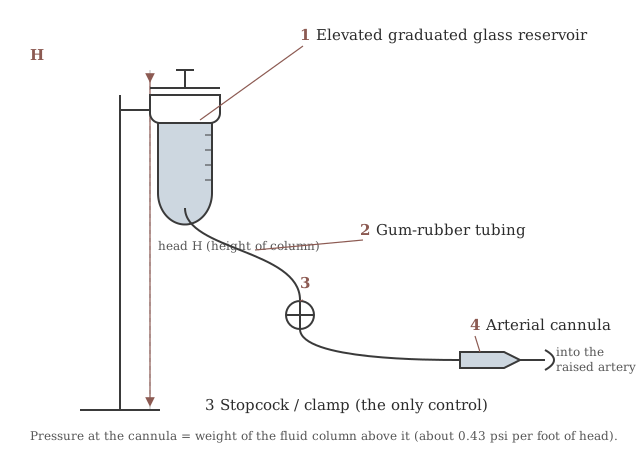
The reservoir is the heart of the thing: a blown-glass bottle, jar, or wide-mouthed “percolator” holding perhaps two to four quarts, frequently graduated with etched or moulded marks so the operator could read how much fluid had gone in. It sat high — on a tall floor stand, an adjustable bracket, a wall hook, or in the well-equipped shop a ceiling pulley — because, as the next section explains, its height was the entire source of pressure. From the bottom or the neck ran a length of rubber tubing (gum rubber or, later, latex), the most fragile and least survivable element of the whole assembly. Somewhere along that tube was a stopcock, pinch-clamp, or ground-glass valve — brass, bone, or glass — which was the operator’s only control: open it and fluid flowed, close it and it stopped. At the far end was the arterial tube, or cannula, a tapered metal or hard-rubber nozzle in a graded set of calibers, tied into an artery that had been raised and opened for the purpose.
That is the complete instrument. It has no moving parts beyond a valve, no cylinder, no piston, no motor, and no gauge. Everything that the later dives describe — the squeeze-bulb and piston pump of the Hand Pump and Bulb Machines dive, the centrifugal impeller and dial-faced pressure gauge of the Electric Embalming Machines dive — is an attempt to buy control and speed that the gravity outfit simply does not have. Understanding the gravity rig first is what makes those later machines legible: each one is answering a limitation that this section has just named.
1.3 Pressure is the head of the column, not a pump
The load-bearing correction of this volume is a physical one, and it is easy to state. When people picture “injecting” a fluid they imagine something pushing — a plunger, a bulb, a pump forcing liquid in under pressure. The gravity outfit does none of that. Its pressure is hydrostatic head: the static weight of the fluid standing in the tube and reservoir above the point where it enters the artery. Raise the bottle and you raise the pressure; there is no other engine involved.
The physics is the same relationship that governs any standing column of liquid, and it is genuinely simple. Pressure at the bottom of a column depends only on the height of the column and the density of the fluid, not on the shape or width of the vessel. For water, each foot of vertical height produces about 0.43 pounds per square inch of pressure at the bottom (more precisely, a one-foot column of water exerts roughly 0.433 psi). Embalming fluid is a water-based solution very close to water in density, so the same figure is used throughout the trade. Mortuary texts state the rule in exactly these terms: the gravity injector delivers about 0.43 psi per foot of elevation above the injection site. Put the reservoir five feet up and you have on the order of 2 psi at the cannula; the trade’s rough bench figures run about 28 inches of elevation to one pound, 56 inches to two pounds, and 84 inches — seven feet — to roughly three pounds. Those numbers should be treated as the working approximations they are rather than precision measurements, but the underlying conversion is textbook and reliable.
Two consequences follow immediately, and they define everything about how the outfit behaved. First, the pressures available are low. A rig you could physically hang in a room tops out at a few pounds per square inch — a fraction of what a later hand pump or electric machine could hold. Second, the only way to change the pressure is to change the height of the bottle. Raising the reservoir on its stand or pulley increased the head and sped the flow; lowering it slowed the flow to a trickle; the stopcock could stop it entirely but could not add force. There was no throttle, no rate dial, no gauge reading the result — the operator judged flow by eye and by the falling level in the graduated glass.
1.4 Slow by nature, and always fading
Because the driving pressure is small, gravity injection is inherently slow — and the trade came to see that slowness as a feature as much as a fault. A low, steady head pushed fluid gently into the arterial tree over a long interval, which many practitioners regarded as giving a more thorough, even distribution than a hard, fast injection. The chief practical complaint was mundane: a two-to-four-quart reservoir needed constant refilling, and the ceiling height of a room capped how much pressure you could ever muster.
There is a subtler behaviour worth naming here, because it is the physical signature of the whole method and Vol 2 develops it in full. The head pressure is set by the height of the fluid surface above the cannula — so as fluid drains out and the level in the bottle drops, the head falls and the flow slackens on its own. A gravity outfit does not hold a constant pressure the way a pumped machine does; it starts at its highest pressure with a full bottle and fades as it empties, unless the operator lifts the reservoir higher to compensate. That self-tapering flow, and the raising-and-lowering of the bottle as the sole means of control, are the tactile heart of what it was like to work a gravity rig — and precisely the frustrations that the squeeze-bulb, the hand pump, and finally the electric machine were built to remove.
1.5 A French idea and an American war
The gravity outfit is the apparatus that carried arterial embalming out of the anatomy laboratory and into the undertaker’s trade, and a compact version of that origin story belongs here; Vol 3 tells it in full and verifies every figure against the National Museum of Civil War Medicine, so this section only sets the scene.
The founding idea is French. The Paris chemist Jean-Nicolas Gannal (1791–1852) developed a method of preserving the body by injecting a chemical solution into the arterial system — he worked through the carotid artery — and took out a French patent in 1837; his account reached English readers when his History of Embalming was translated and published in 1840. Gannal’s early solutions were built around arsenic and aluminium salts, and a sensational court case in 1844 cost him the French monopoly he had claimed. A contemporary, J. P. Sucquet, advocated injecting a solution of zinc chloride through the popliteal artery; rights to his method were reportedly carried to America by two men, Charles D. Brown and Joseph Alexander. The exact commercial routes by which these French methods crossed the Atlantic in the 1840s are muddled in the sources and are flagged for careful handling in Vol 3; what is not in doubt is that the technique — preserve the whole body by injecting fluid through an artery — was European and pre-war.
What made it an American institution was the Civil War. Dr. Thomas Holmes (c. 1817–1900), often called the “father of modern embalming” in the United States, adapted arterial injection for battlefield use and, with a small trade of “embalming surgeons,” preserved Union dead for the long rail journey home. Holmes’s own claim was that he embalmed some 4,028 soldiers and officers, and his arterial fluid was sold at about $3.00 a gallon — figures that are widely repeated but originate largely with Holmes himself and deserve the skepticism Vol 3 applies to them. Two public bodies did more than any advertisement to make the practice respectable: Colonel Elmer Ellsworth, the first prominent Union officer killed (24 May 1861), embalmed and laid in state at the White House at Lincoln’s request; and Abraham Lincoln himself, whose embalmed body travelled by funeral train across the country in 1865 so that hundreds of thousands could file past it. After that spectacle, embalming ceased to be an oddity and became the foundation of the professional American funeral trade.
1.6 What the outfit could and could not do
It is worth being plain, in the sober spirit this collection keeps, about what a gravity outfit actually accomplished — because period selling was as inflated in the undertaking trade as in any other. The apparatus did one thing well: it distributed a preservative solution through the arterial tree slowly and at low pressure. It could not, by itself, guarantee a lasting result. The fluid did the preserving, and the earliest fluids preserved for a chemically ugly reason.
Gannal’s arsenic, Sucquet’s zinc chloride, and the mercury salts of other formulas all worked because they were toxic — they arrested decay by poisoning the microorganisms and enzymes that drive it, and by fixing or hardening tissue. The very property that preserved the body is what later made these fluids a genuine public-health problem: arsenic, in particular, does not break down, and the arsenical embalming of the nineteenth century left a legacy of contaminated ground around old cemeteries that regulators are still reckoning with. That toxic-fluid arc — and the eventual shift to formaldehyde that closes it — is the whole subject of Vol 4 and is developed there as contextual chemistry only, never as a formulation. The point to carry forward from this volume is simply that the gravity outfit was a delivery system; its virtues and its dangers alike came from what was in the bottle.
1.7 Where this volume hands off
You now have the object in hand — reservoir, tubing, stopcock, cannula — and its one governing principle: pressure here is the head of a raised fluid column, about 0.43 psi per foot, controlled only by how high the bottle hangs, fading as the bottle empties, and driving nothing faster than a slow, steady trickle. Everything else in the dive builds on that.
The immediate next step is the physics and the physical objects in detail: Vol 2 — Head Pressure, Materials, and Survival works through the head-pressure relationship with a labelled diagram, examines the blown glass, gum rubber, and brass the outfits were made of, and explains why the rubber almost never survives — so the graduated bottle a collector finds is usually an orphan. From there the dive turns to the people and the war that made the method matter (Vol 3), the toxic fluids and their long shadow (Vol 4), and the collector’s practical craft of recognising, dating, and safely displaying a gravity rig (Vol 5). Readers following the wider Embalming Machines arc can watch the limitations named here — low pressure, no rate control, constant refilling — drive the next two dives: the manual pressure of the Hand Pump and Bulb Machines dive, and the gauged, motorised control of the Electric Embalming Machines dive.
Sources
- Embalming and the Civil War — National Museum of Civil War Medicine — primary museum account: Gannal’s 1838 arsenic/carotid method, Thomas Holmes as popularizer, Ellsworth (24 May 1861) embalmed and laid in state, Holmes’s ~4,000 bodies at $100 each, early arsenical fluids, and the field-embalming trade.
- Thomas Holmes (mortician) — Wikipedia — leads only: Holmes c.1817–1900, arterial method based on Gannal, fluid sold at $3.00/gallon, his claim of 4,028 soldiers embalmed, and the note that some contemporaries doubted his figures.
- How Lincoln’s Embrace of Embalming Birthed the American Funeral Industry — Smithsonian Magazine — the acceptance narrative: ~40,000 of the war dead embalmed, Ellsworth at the White House, Willie Lincoln (1862), and Lincoln’s 1865 funeral train normalising the practice.
- Embalming — Wikipedia — leads only: the arterial-injection lineage (Harvey, Hunter) and Holmes’s Civil-War commission; used for orientation, not for the disputed nineteenth-century figures.
- Mortuary-science course material on injection apparatus and pressure (Quizlet embalming injection apparatus/pressure decks) — the trade’s working statement of the gravity outfit (glass reservoir/percolator, rubber tubing, elevated stand) and the pressure rule of ~0.43 psi per foot of elevation (28 in ≈ 1 psi, 5 ft ≈ 2.15 psi, 84 in ≈ 3 psi); treated as secondary/pedagogical, with the underlying hydrostatic conversion cross-checked against standard physics.
- History of Embalming, and of Preparations in Anatomy… — Jean-Nicolas Gannal (1840 English translation), Internet Archive — the primary source establishing Gannal’s arterial method and the 1840 English publication date.
- Anatomy and Embalming — Nunnamaker & Dhonau (1912), Project Gutenberg — early-twentieth-century trade text consulted for period embalming practice and terminology (the copy retrieved did not expose its apparatus chapters cleanly, so it is cited for general period context only).
Comments (0)