Gravity Injection Systems · Volume 2
Head Pressure, Materials, and Survival
Why a bottle on a stand is a pressure source at all — the hydrostatic physics of the gravity outfit, the blown glass, gum rubber, and brass it was built from, and why the rigs that survive are almost always missing half their parts.

2.1 About this volume
Vol 1 — The Gravity Outfit and the Hydrostatic Principle established what the apparatus is: an elevated glass reservoir, a length of rubber tubing, a stopcock or clamp, and an arterial cannula tied into a raised artery — the founding arterial technology of the whole undertaker’s trade. This volume takes the physics seriously and asks the question the marketing of the day never had to answer honestly: how does a bottle sitting on a stand, with no pump anywhere in the system, become a source of pressure at all?
The answer is one of the cleanest pieces of applied physics in this entire sub-project, and it explains every quirk of the method — why it is slow, why the pressure sags as the job proceeds, and why raising or lowering the reservoir was the operator’s only control. It also explains the objects a collector actually finds. The gravity outfit was built from blown glass, gum rubber, and brass, three materials with wildly different lifespans, and that mismatch is why a surviving rig is nearly always a beautiful graduated bottle attached to nothing.
This is sober trade history and engineering, not the debunking of a fraud — the gravity method genuinely worked within its limits. That distinguishes it sharply from the Quack Devices wing of this collection (the Violet Ray Wands and Radioactive Cures dives), where the physics was borrowed to dress up claims it could not support. Here the physics is honest; it is simply modest. The people who built the method — Gannal, Sucquet, Holmes — and the Civil-War story that made it a trade are the subject of Vol 3 — Gannal, Sucquet, Holmes, and the Civil War; the toxic chemistry of the early fluids belongs to Vol 4 — The Toxic-Fluid Era.
2.2 The head is the pressure
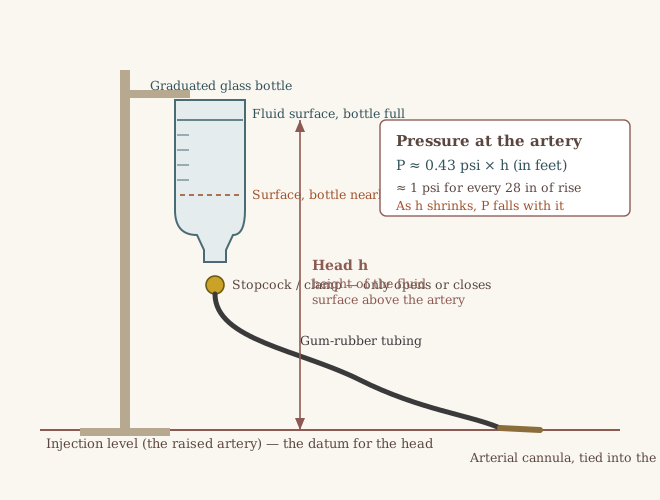
A pump adds energy to a fluid. A gravity outfit adds none: the only energy available is the potential energy the fluid already has by virtue of sitting up in the air. The pressure delivered to the artery is therefore hydrostatic head — the pressure at the bottom of a standing column of liquid, which depends only on the height of that column and the density of the liquid, and not at all on the shape or width of the vessel holding it.
The governing relation is the schoolroom one, P = ρgh: pressure equals fluid density times gravitational acceleration times the height of the fluid surface above the point of measurement. For water this reduces to a number the funeral trade still teaches: a column of water exerts about 0.433 pounds per square inch for every foot of height (hydrostatic-pressure references; Turn2Engineering fluid-pressure notes). Rounded to 0.43 psi per foot, this is the exact figure quoted in modern mortuary-science teaching for the gravity method (Wikipedia, “Embalming”; trade compendia). Turn it around and it says the column has to rise about 28 inches — roughly 2.3 feet — to make one pound of pressure, so that a reservoir 28 inches up gives ~1 psi, 56 inches ~2 psi, and 84 inches ~3 psi.
Two things make that constant usable here rather than merely quotable. First, arterial embalming fluid, as injected, is very close to the density of water. It is a dilute aqueous solution — concentrated fluid cut heavily with water in the reservoir, injected at only a couple of percent active preservative (embalming-dilution references) — so its specific gravity is near 1.0 and the 0.43-psi-per-foot figure applies with only trivial correction. A denser fluid would scale the number up in proportion to its specific gravity, but the difference at these dilutions is in the noise. Second, and crucially, the “height” in the formula is the height of the fluid surface above the artery, not the height of the bottle’s base or the length of the tubing. The tubing can loop down to the floor and back up; the bore can be wide or narrow; none of it matters to the static pressure. Only the vertical distance from the liquid’s top surface down to the opening of the cannula counts. That single fact is the key to everything that follows.
2.3 Reading the numbers: how high, how hard
Put realistic heights into the constant and the modesty of the method becomes obvious. Contemporary and modern descriptions of the gravity technique put the reservoir a few feet above the body — commonly cited as three to five feet of elevation in ordinary practice, with the operator raising it as high as the ceiling and the stand allowed when more push was wanted (trade descriptions of the gravity bottle). At three feet the head is about 1.3 psi; at five feet, about 2.2 psi. Even hauled up to seven feet — a stretch for a bottle a person had to fill and refill by hand — it reaches only about 3 psi.
Those are gentle numbers, and deliberately so. The gravity method was prized precisely for being low and slow: a soft, steady push that let the vascular tree fill gradually and evenly rather than being forced. Its recognised disadvantages in the same trade literature are the flip side of the same physics — the pressure is “limited due to height restrictions,” and the reservoir needs “constant refill” because a low column holds only so much fluid (gravity-method summaries). A powered machine, by contrast, can hold a chosen pressure indefinitely and reach far higher figures on demand. Where those machines fit — the hand pump and squeeze-bulb that gave the operator a throttle, then the electric pump with its gauges — is the story of the sibling Hand Pump and Bulb Machines and Electric Embalming Machines dives. The gravity outfit sits at the quiet bottom of that pressure ladder, which is exactly why it came first.
(A note on numbers: the “3–5 feet” and “28 inches per pound” figures are conventions of the trade rather than a single canonical primary source; the underlying 0.433-psi-per-foot constant, by contrast, is a hard physical fact and needs no hedging.)
2.4 Why the method is slow — and why the pressure fades
The gravity outfit has a peculiarity no pump shares: its pressure drops as it works. Because the pressure is set by the height of the fluid surface, and because that surface descends as the reservoir empties into the body, the head shrinks continuously throughout the injection. A bottle that started with its surface five feet up, delivering ~2.2 psi, is delivering appreciably less by the time it is half gone, and still less as it drains toward empty. The push is strongest at the start and fades to a trickle at the end — the opposite of what an operator wanting even, controlled delivery would design if starting from scratch.
This is the physical root of two practical facts the trade recorded. It is why the method is slow: a modest and falling head moves fluid unhurriedly, and gravity injection could legitimately be described as taking hours, or in anatomical/preservation contexts even continuing over a day or more (gravity-feed description, Wikipedia). And it is why the reservoir needed constant tending: to keep the pressure from sagging, the operator topped the bottle up, which raised the surface again and restored the head — the only way, short of moving the whole rig, to fight the built-in fade. A pump holds its set pressure whether its tank is full or nearly empty; a gravity bottle cannot, and that limitation is written into the geometry, not into any fault of construction.
2.5 The bottle is the only throttle
Follow the physics to its conclusion and a striking operational fact falls out: on a pure gravity outfit, the height of the reservoir is the only real control over pressure, and the stopcock is not a throttle at all. The clamp or stopcock on the tubing can be opened or closed, and pinching it part-way does momentarily restrict flow — but the static pressure available at the cannula the instant the fluid stops moving is fixed entirely by the head. To inject harder, the operator raised the bottle; to inject more gently, lowered it. There was no dial, no gauge, and no way to hold a chosen pressure independent of the reservoir’s height. The single lever of control was a physical one: where the bottle hung.
That is a genuinely important characterisation, because it is the exact capability the next generation of apparatus was built to add. The whole point of the squeeze-bulb and the hand pump — and later the gauged electric machine — was to divorce pressure and rate from the geometry of a hanging bottle, giving the operator a throttle he could set and hold. Understood that way, the gravity outfit is not a crude version of a pump; it is a different device entirely, one whose “settings” are literally its height off the floor. A collector who grasps this reads a surviving stand correctly: the hooks, notches, or sliding bracket that let the bottle be fixed at different heights are not incidental hardware but the machine’s entire user interface.
2.6 What the rig was made of
The gravity outfit was an assembly of three materials, and its whole character — including how it ages — follows from them.
Blown glass. The reservoir was a blown-glass bottle or jar, frequently graduated with moulded or etched marks so the operator could measure the fluid mixed and injected. Glass was the natural choice: it is chemically inert against the acidic, metal-salt and (later) formaldehyde fluids that would corrode most metals, it is transparent so the level and clarity of the fluid can be watched, and it takes graduations cleanly. It is also, by the standards of this apparatus, effectively immortal — barring breakage, a glass reservoir looks much the same after a century as it did new.
Gum rubber. The tubing was natural gum rubber (later vulcanised rubber and latex), chosen for flexibility and for a soft bore that would not injure the vessel. The stopcock or clamp that controlled flow was sometimes rubber (a simple pinch clamp) and sometimes brass or bone. Rubber was the enabling material — nothing else of the era offered a cheap, flexible, more-or-less inert conduit — but it is also the fatal weakness of the whole assembly, for reasons the next section takes up.
Brass and bone. The fittings — stopcocks, the junctions between tubing and cannula, and the arterial tubes (cannulas) themselves — were typically brass or German silver, sometimes nickel-plated, with the occasional turned bone or ivory tip or handle. These metal and bone parts sit between glass and rubber on the durability scale: they survive well but tarnish, corrode at threads, and are small enough to be lost. The Smithsonian’s National Museum of American History holds period embalming kits (for instance an Embalmers’ Supply Company outfit) whose surviving contents are exactly this durable core — glass, metal instruments, and cases — with the perishable soft goods conspicuously reduced (Smithsonian NMAH embalming kit, object 736866).
2.7 Why survivors are incomplete
Here the materials story and the collecting story meet, and the lesson is blunt: glass survives, rubber perishes, and so almost every gravity outfit you will ever handle is incomplete. The graduated bottle that is the visual signature of the rig is the part most likely to have come down to us intact; the tubing that made it work is the part most likely to be gone, or present only as a brittle, cracked, sticky remnant that crumbles at a touch.
The reason is straightforward polymer chemistry. Natural rubber degrades by oxidation and ozone attack, which break the polymer’s crosslinks and main chains — chain scission — and progressively rob the material of its elasticity. As the antioxidants originally compounded into the rubber are exhausted, the process accelerates, leaving the tubing hard, checked with fine cracks, and finally crumbling (ozone degradation of isoprene rubber; thermo-oxidative aging of natural rubber). A hundred years of ambient air is more than enough. The soft rubber pinch clamps and any latex bulbs suffer the same fate; even the metal fittings, if they were rubber-gasketed, come apart at the seals.
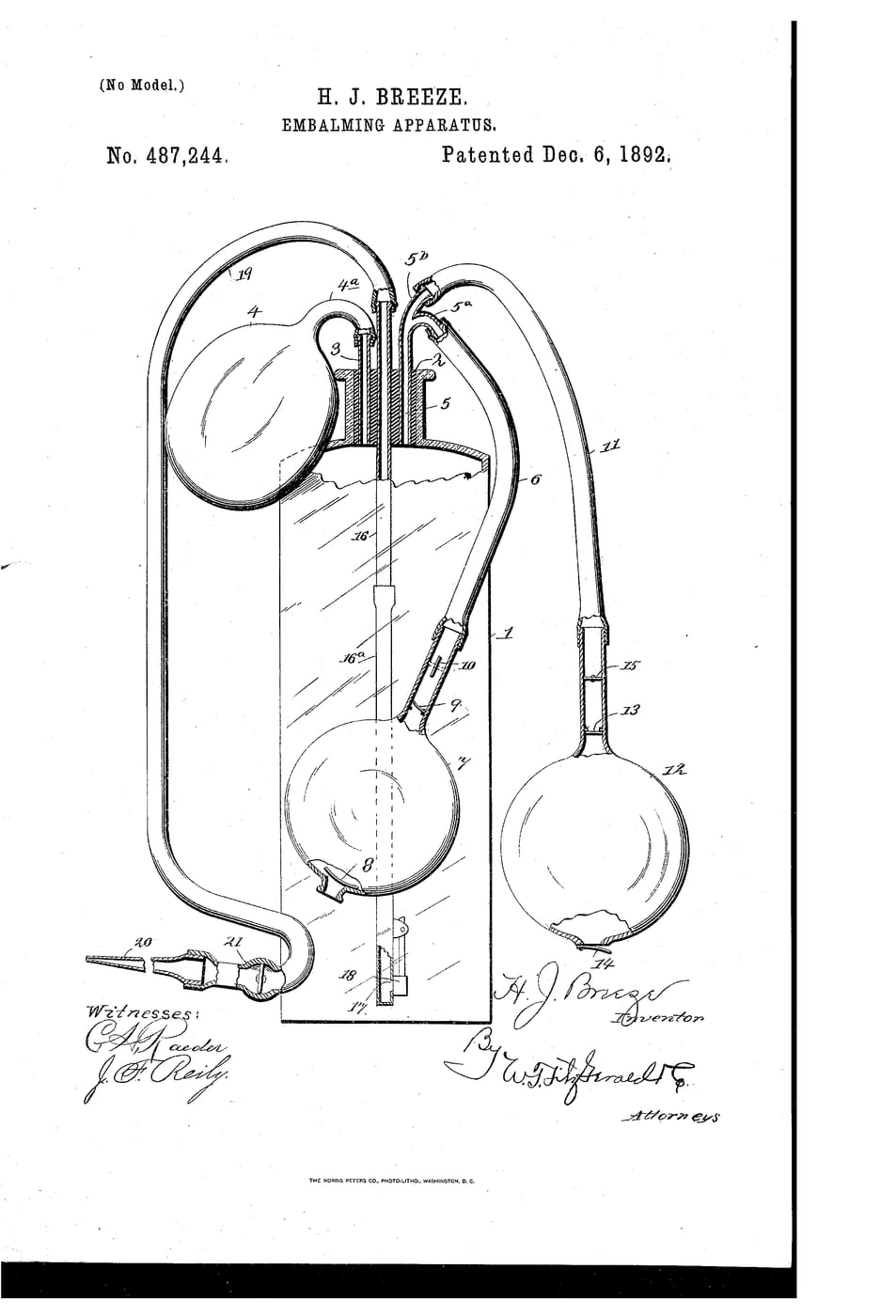
For a collector this hierarchy is itself a dating and condition tool, and it sets up the fuller treatment in Vol 5 — Collecting, Dating, and Displaying Gravity Rigs. A few working cues: an intact, supple length of tubing on a purported nineteenth-century outfit is a warning flag, not a bonus — original gum rubber of that age should be perished, so pliable tubing usually means a later replacement. The graduated glass, by contrast, carries the age and often the maker: moulding style, the form of the graduations, seams, and any embossed supply-house name are where provenance lives. And value turns heavily on completeness — a lone graduated bottle is a common find; the same bottle with its original stand, stopcock, and cannula is the rarity. The trade’s own catalog plates (see the figure above) are frequently the only surviving record of what the complete outfit’s fittings actually looked like.
2.8 Where this volume hands off
The physics and the materials are now on the table: a gravity outfit is a hydrostatic device whose pressure is its height, modest and self-fading, built from an immortal glass reservoir, a perishable rubber conduit, and a durable brass-and-bone core. From here the dive turns from the apparatus to the people and the consequences. Vol 3 — Gannal, Sucquet, Holmes, and the Civil War tells how this quiet technology became a trade — Jean-Nicolas Gannal’s carotid arterial injection, J. P. Sucquet’s popliteal route, and Dr. Thomas Holmes, who over the Civil War is credited by the National Museum of Civil War Medicine with embalming some 4,000 men, at reportedly $100 a corpse, and whose returned dead helped make embalming publicly acceptable. Vol 4 — The Toxic-Fluid Era takes up what actually filled these glass bottles — the arsenic, zinc, and mercury salts that preserved because they were poison, and the public-health reckoning that followed. Vol 5 — Collecting, Dating, and Displaying Gravity Rigs turns the survival lesson of this volume into a practical guide to recognising, dating, and safely showing a real one.
Sources
- Hydrostatic Pressure — Flow Measurements and Reynolds Numbers (control.com textbook) — supported the P = ρgh relation and the 0.433-psi-per-foot-of-water constant (the hard physical fact underpinning the whole volume).
- Fluid Pressure Calculator / hydrostatic notes — Turn2Engineering — cross-checked the 0.433 psi/ft gradient and the specific-gravity scaling used to justify treating near-water embalming fluid at the water figure.
- Embalming — Wikipedia — supported the description of gravity-feed embalming (elevated container, slow introduction over an extended time, the 0.43-lb-per-foot figure as taught) and the early arsenic/metal-salt fluid context handed to Vol 4.
- Embalming procedure overview — Medindia — supported the practical gravity-method figures: the ~3–5-foot reservoir height, the “simple, safe, slow” characterisation, and the recognised disadvantages (height-limited pressure, constant refill).
- US2233428A — Embalming fluid (Google Patents) — supported the point that injected arterial fluid is a heavily diluted aqueous solution, hence near-water density.
- Ozone degradation of vulcanized isoprene rubber (ScienceDirect) and Thermo-oxidative degradation of natural rubber (ScienceDirect) — supported the polymer-chemistry explanation (oxidation, ozone attack, chain scission) for why gum-rubber tubing perishes and survivors are incomplete.
- Embalming kit, object 736866 — Smithsonian National Museum of American History — cited for a period embalming outfit whose surviving durable core (glass, metal, case) illustrates the materials-survival argument.
- Embalming and the Civil War — National Museum of Civil War Medicine — source for the Holmes figures (~4,000 men, $100 per corpse; Gannal’s 1838 carotid injection) previewed here and carried in full into Vol 3.
- Cross-references (named in prose, not linked): the sibling Hand Pump and Bulb Machines and Electric Embalming Machines dives (where a settable, held pressure replaces the hanging bottle), and the Quack Devices wing’s Violet Ray Wands and Radioactive Cures dives (contrast: honest-but-modest physics here versus borrowed physics there).
Comments (0)