Embalming Machines · Volume 5
Collecting, Identifying and Displaying
5.1 Reading an object before you name it
The apparatus of the undertaker’s trade survives in surprising quantity. Gravity bottles, hand pumps, nickel-plated injectors, glass fluid bottles by the case, and mid-century electric machines all turn up at estate sales, in the back rooms of general antique dealers, and — increasingly — on the online auction platforms. They are collected, and legitimately so: this is the material history of a licensed profession, and dedicated institutions curate exactly this class of object. But it is a corner of the market where confident labels outrun evidence, and where a collector’s first discipline is to describe what is actually in front of them before accepting what a seller calls it.
That discipline has a cautionary tale attached, dealt with in full below: a machine sold across a decade of auctions as a “C. M. Sorensen embalming machine” that is nothing of the kind. The lesson generalizes. An object’s identity in the antique trade is established by consensus among sellers, and that consensus is self-reinforcing and, by default, evidence-free — each listing quietly copies the last. The corrective is the same one a museum registrar uses: read the object, then read the paper. Maker’s plates, patent stampings, catalog plates, and the physical style of the thing will carry you a long way, and where they run out, the honest label says so.
This volume is the collector’s companion to the five device dives — gravity injection, hand-pump and bulb machines, electric machines, trocars and cavity injection, and the pre-refrigeration cooling boards and corpse coolers. It covers how to identify and date the hardware, the real hazards of the objects themselves, the ethics of collecting and showing them, and where the finest examples are held.
5.2 Maker’s plates and patent stampings
The single most useful thing on any machine is its maker’s plate. On a period embalming or clinical apparatus it is usually a small stamped-brass or nickel escutcheon carrying the firm’s name, city, and often a machine or serial number; electrical machines add voltage and current data. A plate reading, for instance, 110 A.C. & D.C. tells you the motor was a universal series-wound type built to run on either alternating or direct current — a genuine selling point when much of the American mains supply was still direct current, which points broadly to the early decades of the twentieth century.
Patent markings are the collector’s best friend because they behave as a terminus post quem — a date the object cannot predate. A casting or plate stamped “PAT’D” with a date, or “PAT. APPLIED FOR,” or a patent number, was made on or after that date, never before. A patent number can be converted to a rough year through published patent-date tables, and reading the actual patent on Google Patents will often show you the exact mechanism you are holding. Two cautions travel with this. First, a patent date marks when the design was protected, not when your particular unit left the factory — machines carrying a 1920s patent were sold for decades afterward. Second, a serial or “machine number” is only a dating key if the maker kept a numbering ledger that survives and is public; many did not, and a low or high number tells you nothing on its own. Treat any auction claim of “serial number dates it to 19xx” as unproven unless a documented key is cited.
5.3 The styles that date the apparatus
Each apparatus family has a visual grammar that places it in the arc of the trade.
Gravity reservoirs are the oldest and simplest: a blown-glass bottle or graduated reservoir meant to hang from a stand or hook, feeding fluid through rubber tubing by nothing but the height of the column. Surviving rigs are almost always incomplete — the glass endures, the gum-rubber tubing perishes — so a complete period gravity outfit with intact tubing is both rare and, as a rule, restored. Hand-blown irregularities, applied or ground lips, and pontil marks push a reservoir toward the nineteenth century; machine-made uniformity pushes it later.
Hand-pump and bulb machines carry the marks of the professionalizing shop. Rubber squeeze-bulbs with one-way check valves are the crudest; self-contained brass or nickel-plated piston pumps with a glass or metal reservoir are the step up, delivering higher and steadier pressure. Nickel plating over brass, knurled fittings, and ground-glass or bone stopcocks are typical of roughly the 1890s–1920s instrument idiom.
Electric machines are unmistakable: a motor-driven pump feeding a graduated tank, with a pressure gauge reading in psi and a rate-of-flow control, so the operator can set and hold both quantities independently. The archetype is the ESCO Porti-Boy, whose name records its original portable design and whose model line runs through successive marks; competitors such as the Duotronic family followed. Gauge faces, tank glass, motor style, and cabinet materials all help place a unit within the twentieth century.
Glass fluid bottles are the most abundant survivor and often the most collectible in their own right — embossed with the fluid maker’s name, sometimes a city, sometimes “POISON” or “ANTISEPTIC,” in amber, aqua, or clear glass. Embossing style, seams, and closure type date the bottle; the brand name ties it to a supply house whose own history brackets the possible years.
5.4 The makers to recognize
A handful of firms dominate the catalog plates and embossed bottles, and learning their names lets a collector bracket a date at a glance.
The Embalmers’ Supply Company (ESCO) was founded on 13 April 1886 as a partnership between C. B. Dolge and Max Huncke, first in Brooklyn and from 1890 in Westport, Connecticut, incorporating under its present name after Dolge bought out Huncke in 1893. Dolge was a pioneer of formaldehyde fluid, importing the first supply from Germany in 1894 and compounding the first formaldehyde-based fluid in the Westport laboratory; ESCO went on to make the Porti-Boy machine that became the twentieth-century standard. The Dodge Company dates its origins to 1893, when A. Johnson Dodge and his brother acquired the Oriental School of Embalming, then supplied the practitioners it trained — a school-plus-supply model that grew Dodge into the continent’s largest supplier of embalming chemicals; the firm notes it became the first embalming chemical company to employ a dedicated chemist, in 1926. These two houses, and their many regional peers whose names survive mainly on embossed bottles, are the anchor points; recognizing them on a plate or a bottle is often the fastest route to a defensible date range.
5.5 The hazards are in the objects, not the use
This section is strictly about not being harmed by an antique — never about its original purpose. Old preparation apparatus can carry genuine chemical hazards, and a collector should treat any unknown residue as dangerous until proven otherwise.
The most serious concern is arsenic. Nineteenth-century embalming fluids were frequently arsenic-based — preservative precisely because they were toxic — with common formulas carrying several ounces of arsenious acid per gallon, and arsenic use remained widespread through the Civil War era until it was banned in the early 1900s (the ban driven both by the poisoning of those who handled the materials and by the way arsenic confounded murder investigations). Arsenic does not degrade. Dried residue in an antique bottle, a reservoir, or the internals of an early machine can therefore still be genuinely toxic a century later, and arsenic is a recognized carcinogen. Some fittings and instruments of the period may also carry mercury or mercury-salt residues. Add to this the ordinary risks of very old glass — stress-cracked, sometimes sealed under residual pressure or vacuum — and unknown dried chemistry of any kind.
The practical rule for a collector is simple and firm: do not open, taste, decant, or attempt to “clean out” a sealed antique bottle or the reservoir of an old machine, and do not energize a machine to test it with unknown residue inside. A sealed bottle should be read as a hazmat container, not a curiosity to be uncorked. Disposal of unknown old fluids is regulated as hazardous waste in most jurisdictions and should go through the proper channel rather than a household drain. Display the object as found, dry and closed; where a fluid bottle still holds liquid, the safest and most honest presentation is to leave it sealed and label it as containing unidentified period chemistry.
5.6 The Sorensen myth: a machine that isn’t one
No collecting guide to this equipment is complete without the field’s best-documented misidentification. For years a particular twin-bottle apparatus has sold at auction as a “C. M. Sorensen embalming machine.” It is not one. It is the No. 60, “Dr. S. Yankauer Outfit for Pressure and Suction” — an ear-nose-and-throat, anesthesia, and minor-surgical office apparatus that blows ether vapor to a face mask from one bottle while drawing secretions into the other. The correction rests on two independent primary documents: C. M. Sorensen Co.’s own 1926 Catalog of Sorensen Tankless Apparatus for the Nose and Throat Specialist and the Hospital (copyright 1925), which contains not one mortuary reference and describes the No. 60 down to its diagnostic detail — an 8-ounce square ether bottle and a 16-ounce round suction bottle, deliberately made unlike so “they can not be transposed” — and a 1917–1918 anesthesia-journal advertisement describing the same outfit, naming Yankauer, and marketing it “especially designed for tonsil and adenoid operations.”
Why does the wrong name stick? Because the resemblance is real. Period air-pressure embalming machines genuinely existed and genuinely worked in a similar way — a motor-driven air pump pressurizing a fluid bottle through a dip tube (see US Patent 2,252,624, an actual embalming machine granted to Gilmore and Junod in 1941, not to Sorensen). Someone who knows what that architecture looks like, and then sees the Sorensen outfit, is recognizing a genuine family resemblance, not being careless. What breaks the resemblance is the numbers: a 1/20-horsepower motor delivering 10–15 psi and an eight-ounce ether bottle are useless for arterial injection, which is measured in gallons and tens of psi. The full evidence, catalog page and advertisement reproduced, lives in the Surgical wing at /cm-sorensen-pressure-and-suction/. The takeaway for the embalming collector is the general one: a superficially similar architecture plus a ready-made market category is exactly how a wrong label propagates unchallenged.
5.7 The ethics of collecting and displaying
Mortuary apparatus asks for a care that most antiques do not. Two principles hold. First, label honestly and with dignity. The Sorensen case is one half of that — do not call a thing what it isn’t — and plain, factual, non-sensational description is the other. The apparatus is trade technology; presenting it as macabre spectacle serves neither history nor the families whose relatives the trade once served. Second, and most important, distinguish the apparatus from anything that touched human remains. A pump, a gauge, a fluid bottle, a maker’s plate, a cooling board as furniture — these are collectible engineering objects. Anything that was in contact with a body belongs to a different and far more sensitive category, and the sober convention of the funeral-history field is to keep the collectible firmly on the apparatus side of that line. The dedicated funeral-trade museums model the tone to aim for: respectful, educational, and matter-of-fact, treating the equipment as the record of a profession rather than as a curiosity of death.
5.8 Where this equipment lives
The reference collection for this material is the National Museum of Funeral History in Houston, Texas, which holds the country’s largest collection of funeral-service artifacts across more than 30,000 square feet. Its History of Embalming exhibit runs from ancient practice through a life-size recreation of Dr. Thomas Holmes’s Civil-War embalming tent to a vintage 1920s electric embalming machine, and includes documented apparatus such as the machine associated with the embalming of Harry Truman — precisely the kind of context that lets a collector see a dated, provenanced example rather than an unlabeled auction lot.
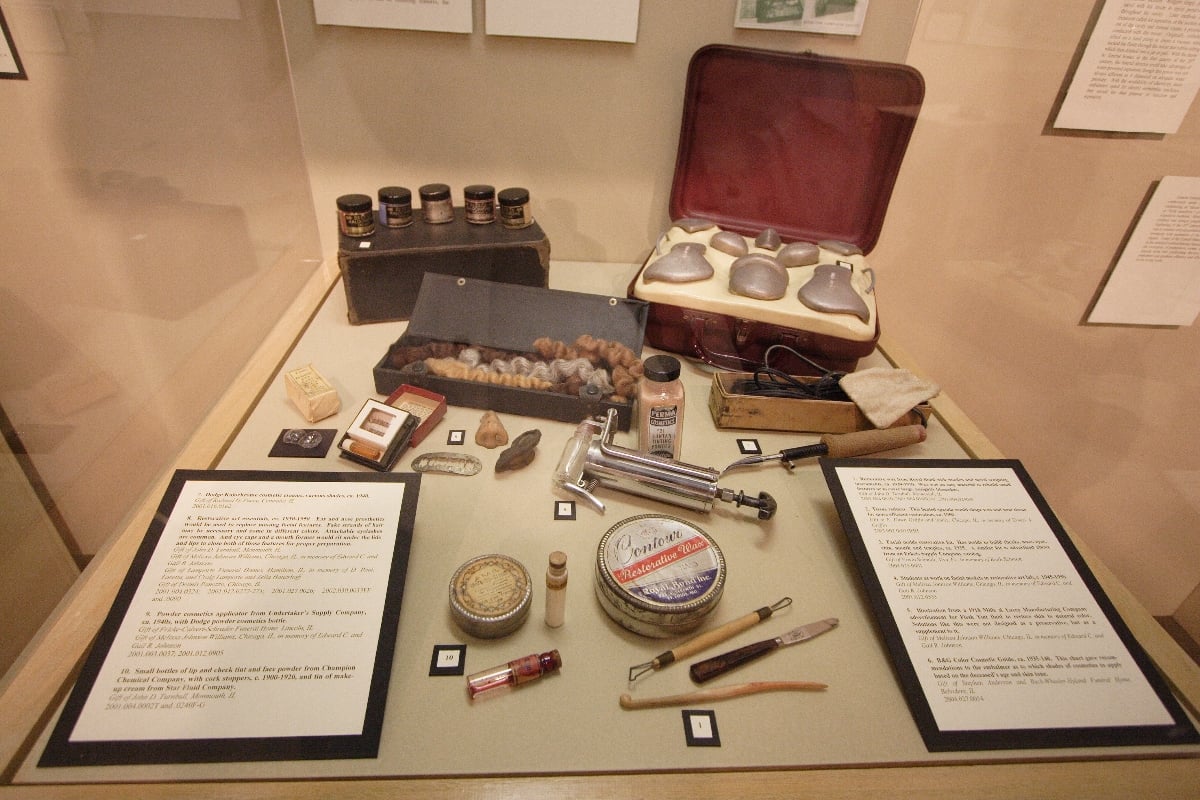
Beyond Houston, the National Museum of Civil War Medicine documents the war-era origins of the trade and the Holmes story that anchors the gravity-injection volume; broader medical and instrument collections — the Smithsonian’s National Museum of American History, the Wellcome Collection, and the Science Museum Group — hold related suction, pressure, and clinical apparatus that help a collector calibrate style and date across the wider field of early-twentieth-century medical machinery.
Sources
- National Museum of Funeral History — official site and Roadside America overview of the embalming exhibit
- ESCO’s History — Embalmers’ Supply Company
- The Dodge Company — Company History
- Everything You Need to Know About Embalmer Supply Companies — American Mortuary Coolers
- Arsenic and Old Graves: Civil War-Era Cemeteries May Be Leaking Toxins — Smithsonian Magazine
- Arsenic and Old Cemeteries — The Woodlands
- Embalming and the Civil War — National Museum of Civil War Medicine
- 1926 Catalog of Sorensen Tankless Apparatus (copyright 1925) — Internet Archive
- The American Year-Book of Anesthesia and Analgesia, 1917–1918 — Internet Archive (Yale copy)
- Antique embalming machine that’s unnerving — Auction Finds, 14 January 2015
- US 2,252,624 — “Embalming machine,” Gilmore & Junod, 1941 — Google Patents
Comments (0)