Embalming Machines · Volume 4
Cooling, Ice and the Pre-Refrigeration Undertaker
4.1 Before the Machine, the Cold
The four device families told across this dive — gravity outfits, hand pumps, electric machines, and the trocar and its aspirator — describe the chemical preservation of the dead. But for most nineteenth-century American families, chemistry was not the first line of defence against time. Cold was. Long before an undertaker owned a pump, and long after he owned one, the working problem was the same and profoundly ordinary: a body had to be kept presentable through a wake that ran a day or several, in a house with no refrigeration, often in summer heat. The technology that answered that problem was not a machine but a piece of furniture and a block of ice.
This volume is the frame around the machines — the object history of keeping the dead cool. It runs from the folding cooling board an undertaker carried under his arm, through the patented “corpse coolers” and ice caskets of the 1870s and 1880s, to the refrigerated holding rooms and metal tables that finally displaced ice-and-board practice in the twentieth century. It is also, unavoidably, a window on how Americans died and mourned: at home, in the parlor, until embalming and the funeral home moved the whole ritual out of the house. For the apparatus itself — surviving boards, coolers, and ice-casket hardware, with their joinery and dating cues — the companion device dive at /cooling-boards-and-corpse-coolers/ treats the objects in collector’s detail; this volume supplies the trade and engineering narrative around them.
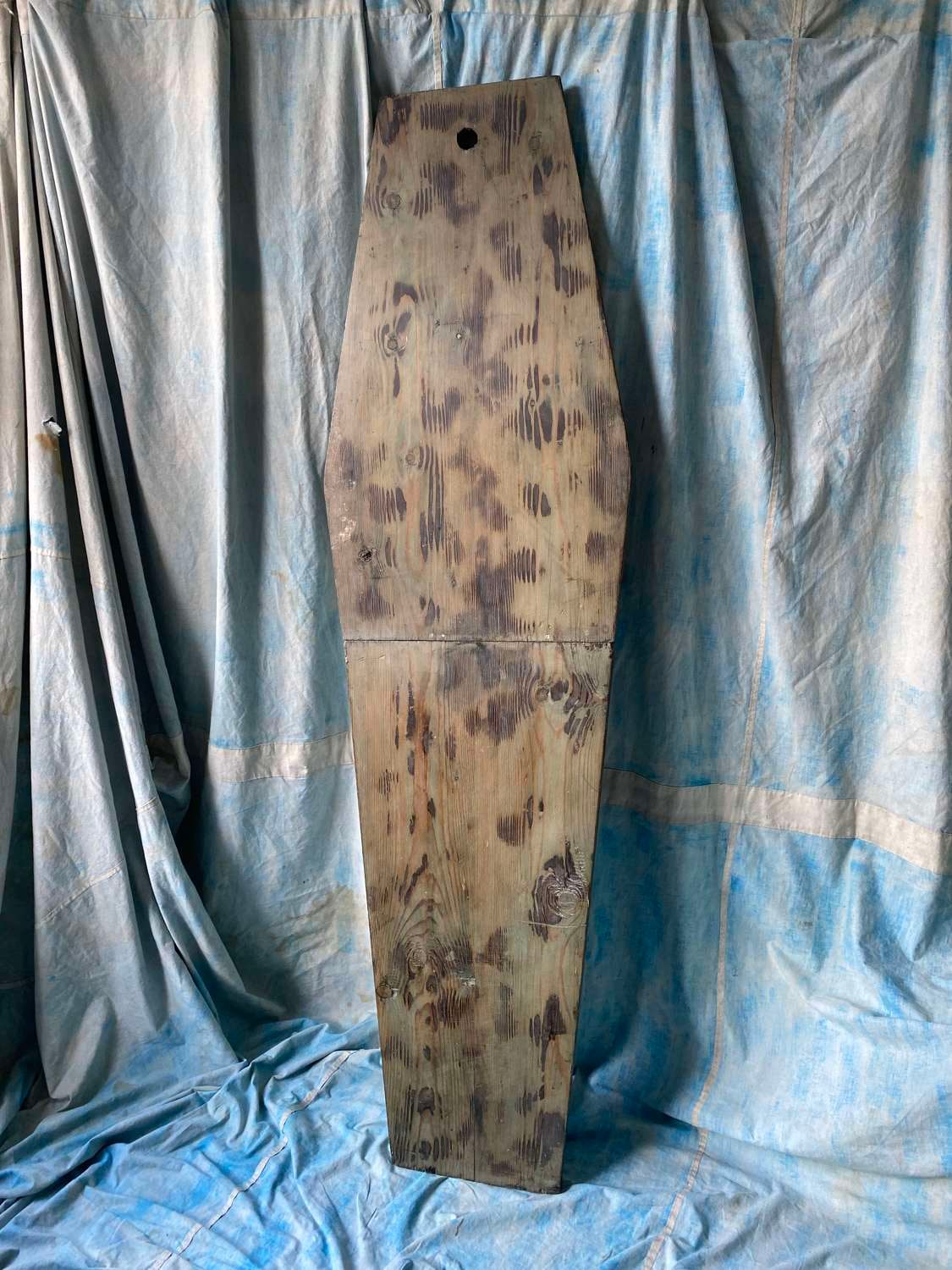
4.2 The Cooling Board
The cooling board was the humblest and most universal object in the pre-refrigeration undertaker’s kit. In its simplest form it was a perforated wooden platform on which the deceased was laid out for washing, dressing, and viewing. The perforations were the whole point of the engineering: they gave drainage, and they let cold air rise from ice placed beneath the board, so that the platform worked as a passive cooling surface rather than a mere table. Better examples replaced the solid plank with a lattice of woven cane, which improved airflow while keeping the surface light — a construction that also, incidentally, dates and grades surviving specimens for collectors.
Its second defining trait was portability. Death in nineteenth-century America was overwhelmingly a household event: people died in their own beds, and the wake was held in the front parlor. The undertaker — very often a local cabinet-maker or furniture dealer who had drifted into the trade, since he already had the woodworking skills and a wagon — came to the house. He therefore needed equipment that travelled. The cooling board obliged by folding. Surviving traveling boards collapse on brass hinges to a compact bundle with carry handles, then open to take a full-length adult; period and modern descriptions put the folded size at roughly 21 by 15 inches. When no purpose-made board was at hand, families improvised with the same physics — a door laid between two chairs, a dining table, or a plank — which is why the cooling board sits at the exact seam between household object and professional instrument.
The thermodynamics were as simple as the object. Chilling a body suppresses the bacterial and enzymatic activity that drives decomposition; ice beneath a ventilated board pulls heat out of the remains by conduction and by the convection of cold air through the perforations. This is preservation by temperature alone — no chemistry, no fixation of tissue, nothing that outlasts the ice. It bought a family the day or two of the wake, no more, and it demanded a steady resupply of ice for even that. Firms such as B. F. Gleason of Brockport, New York turned these boards out through the late 1800s, and the object was common enough to leave a long cultural shadow — “cooling board” recurs in blues lyric and folk speech as a plain synonym for death.
4.3 Corpse Coolers and the Ice-Box
The cooling board chilled from below and worked in the open. The next step in the trade’s thinking was to enclose the cold — to build a box around the ice and the body so that the chilling was continuous and contained. These devices went under the plain period name “corpse cooler,” and they ranged widely in ambition. Some were immense ice-chests that took the whole body; others were compact units designed to sit over only the abdomen and chest, chilling the torso where decomposition begins earliest while leaving the face free for viewing.
The corpse cooler was a genuine attempt at portable refrigeration, and it inherited the ordinary technology of the nineteenth-century icebox: an insulated chamber, a charge of ice, and a drainage path for the meltwater. That meltwater was the design’s persistent enemy and its clearest tell. Contemporary accounts describe hoses and buckets carrying water off, and the running of that water — its sound and, less delicately, its smell — as one of the “lost sensory landscapes” of the Victorian home wake. Managing drainage without fouling the room, and without the box itself sweating with condensation, is what most of the surviving patent drawings are actually about.
The public-health record around these boxes is worth stating plainly, because it explains why the trade eventually abandoned them. In the 1880s and 1890s, physicians — Dr. S. Oakley Vanderpoel, a former Health Officer of the Port of New York, is the named figure in the period debate — attacked the undertaker’s ice-box on two grounds. One was hygienic: meltwater, condensation, and the general difficulty of keeping an ice-chest clean between uses. The other was the era’s genuine dread of premature burial, sharpened here into a fear that packing a body in ice might harm someone in a cataleptic or otherwise unconfirmed state before death was medically certain. Embalmers, notably, turned this argument to their own advantage: their process required a physician’s death certificate before it could begin, so they could market chemical preservation as both more reliable than ice and, at least by their own arithmetic, no more expensive.
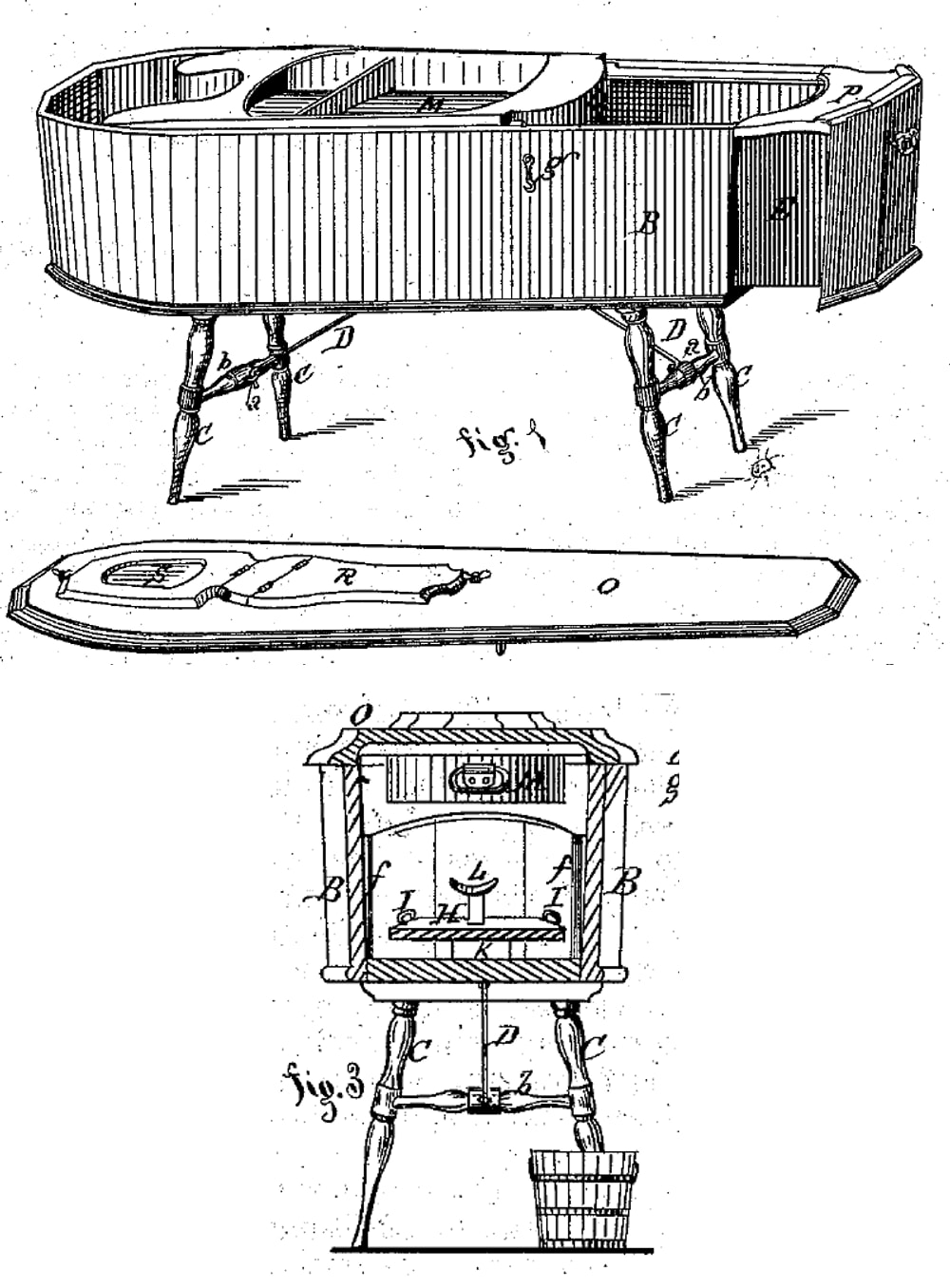
4.4 The Ice Casket
The most engineered branch of this family fused the cooler with the coffin itself, producing the “ice casket.” The archetype is John Gravenstine’s “Corpse-Preserving Casket” of 1871: an ice box set atop a sealed casket, so that the coffin a family already needed doubled as a refrigerator. Gravenstine’s own patent language shows how generally he thought about the cooling apparatus — he described it as adaptable not only to caskets but to “refrigerators, or to any closed vessel within which it is desired to maintain animal or vegetable matter in a cool condition,” which places the invention squarely in the wider nineteenth-century refrigeration boom that had produced the first ice-cooled railway boxcar two decades earlier, in 1851. The Library Company of Philadelphia documents Gravenstine’s casket and dates it to 1871; the specific U.S. patent number is not cleanly established in the readily available record.
The ice casket carried one hard engineering constraint that Gravenstine’s advertising made explicit and that defines the whole type: the lower casket had to be genuinely airtight. Chilling alone would not preserve a body if warm outside air could reach it, so the cold chamber only worked as one half of a sealed system — refrigeration above, an airtight coffin below. Later designs refined the details. Viewing windows, often tilting or sliding, let mourners see the face while shielding the remains from warm air; meltwater was routed to buckets whose filling told the undertaker when to re-ice; and the lining materials evolved from decorative but leak-prone felt toward, by about 1881, an asphaltum coating — a tar-like sealant said to cut both odor and external condensation.
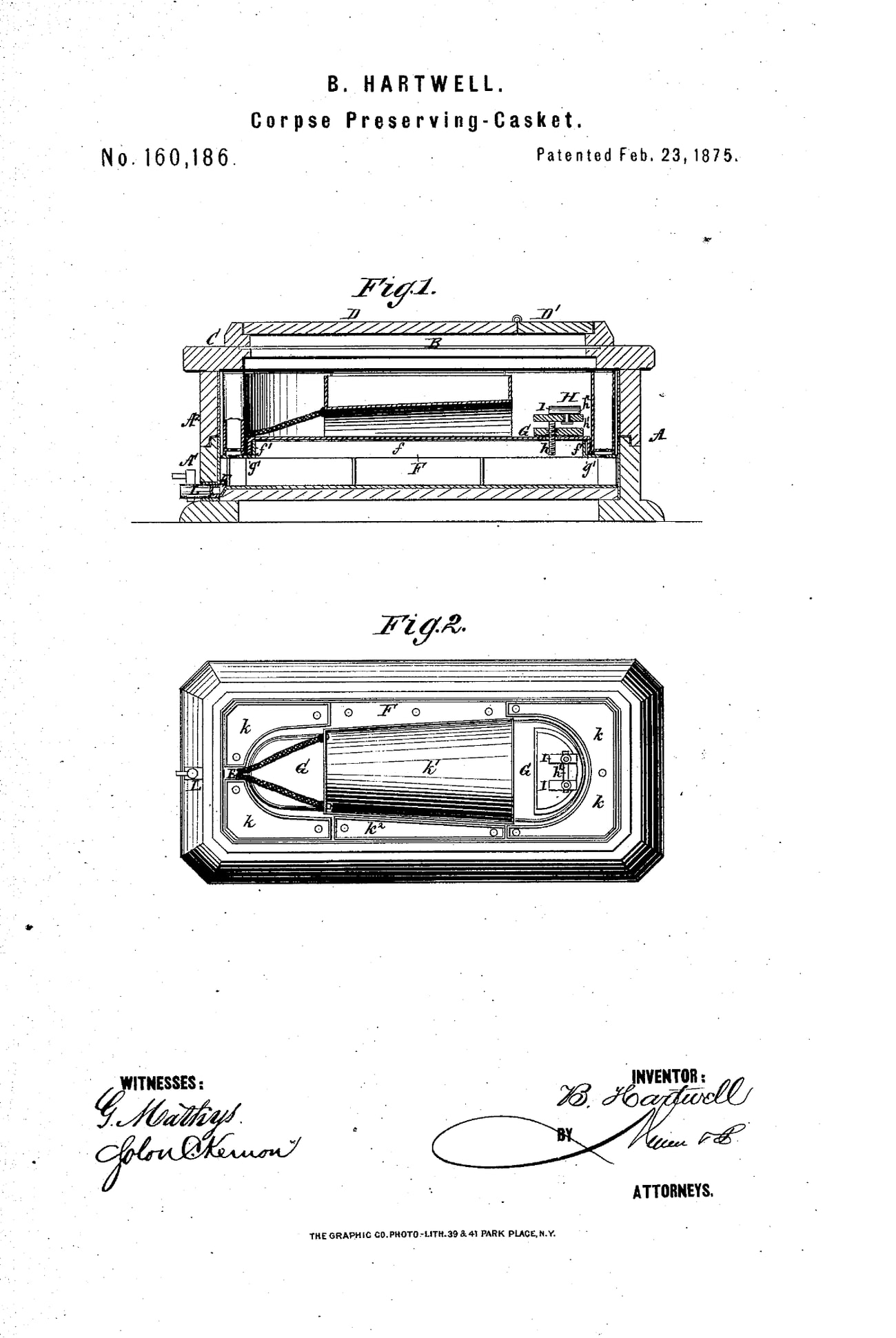
Gravenstine was not alone. The patent class for corpse-preserving caskets is crowded, and a well-documented second example is Bartholomew Hartwell of Baltimore, whose U.S. Patent 160,186, “Improvement in Corpse-Preserving Caskets,” was granted on 23 February 1875. Hartwell’s improvement is a revealing one: rather than have the undertaker haul in tubs of ice and shovel it noisily into the casket — a practice his patent calls “disagreeable” in a house of mourning — he divided the ice into separate end, side, and body sections that could be filled and swapped quietly, and he integrated a cooling board, an adjustable head-rest, and a faucet to draw off meltwater. The design effort going into keeping the process quiet and clean is itself the historical evidence: these were objects meant to operate inside a family’s parlor, under the family’s eye.
Ice caskets held their place for roughly thirty years before fading — long enough to be a real chapter of the trade, short enough to be almost forgotten.
4.5 From the Parlor to the Funeral Home
The decline of ice was not really a story about ice. It was a story about where the dead were kept, and by whom. Through most of the nineteenth century the answer was: at home, by the family, with the undertaker as a visiting tradesman. The room now called the “living room” was the parlor, and it was where the body was laid out; the cooling board and the corpse cooler existed precisely because the work happened in that domestic space, on the family’s timetable, for the one- or two-day viewing a block of ice could sustain.
Two things moved the work out of the house. The first was chemical embalming, which spread from its Civil War origins into mainstream American practice in the decades after the war. Embalming did something ice fundamentally could not: it decoupled the funeral from the clock. A body no longer had to be buried before the ice ran out, which meant a wake could wait for relatives travelling from a distance, and could run days rather than hours. The second was the professionalization of the undertaker himself. As embalming demanded fixed equipment, running water, and drainage, the tradesman who had once carried a folding board to the house began instead to bring the body to a dedicated room in his own place of business — and then to furnish that place as a substitute parlor. The operator Frank E. Campbell is the emblem of the shift, marketing his viewing rooms as “slumber rooms”; by 1910 the Ladies’ Home Journal could rename the domestic parlor the “living room,” a small linguistic marker for the wake’s departure from the home.
Cooling did not vanish in this transition so much as change address and mechanism. The passive board with ice beneath it gave way, inside the new funeral establishments, to metal preparation tables and to mechanically refrigerated holding rooms — the direct ancestors of today’s mortuary coolers. The physics the cooling board had exploited crudely, refrigeration now delivered on demand and without a resupply of ice. And the older practice never disappeared cleanly at the edges: in Appalachian communities a body might still be held through winter in a cold barn or spare room until the ground thawed enough to dig, a regional survival of exactly the reasoning that had put ice under a perforated board a century earlier.
The cooling board and the corpse cooler, then, are not a dead end but a bridge. They mark the era when the trade preserved by temperature because it could not yet preserve by chemistry, and they explain the shape of everything that followed: the chemical apparatus of this dive’s other volumes moved the work off the ice, and the refrigerated funeral home moved it out of the parlor. The apparatus that made all of it thinkable — the boards, the coolers, the ice caskets, and their surviving hardware — is examined object by object at /cooling-boards-and-corpse-coolers/.
Sources
- Cooling board — Wikipedia
- Corpse-Preserving Casket — Library Company of Philadelphia
- US160186A — Improvement in corpse-preserving caskets (Bartholomew Hartwell, 1875) — Google Patents
- Ice, Ice, Body: Introducing Ice Caskets — Burials & Beyond
- Corpses on Ice: The Dangers of the Undertaker’s Ice-Box — The Victorian Book of the Dead
- From Parlors to Slumber Rooms: The Evolution of the 19th Century Funeral — Remembering A Life
- Exploring the Function and Design of Antique Cooling Tables — American Mortuary Coolers
- Coffins, Gravestones, and Other Sepulchral Patents — Midwestern Death Trip
Comments (0)