Embalming Machines · Volume 3
The Machines
3.1 An engineering lineage, not a single invention
The apparatus of arterial embalming did not arrive fully formed. It evolved across roughly a century as a chain of solutions to one narrow engineering problem: how to move a measured volume of preservative fluid into a vascular system at a controlled pressure and a controlled rate of flow. Those two quantities — pressure (how hard the fluid is pushed, read in pounds per square inch) and rate of flow (how fast it moves, read in a graduated tank or a flow meter) — are the constants that run through every machine on this page. Each generation of hardware gave the operator finer, more independent command of the two.
The progression is clean enough to trace as a family tree. First came gravity injection, which used no machine at all — only a raised vessel and the weight of a column of liquid. Then came hand pressure: squeeze-bulbs and piston pumps that let an operator build and hold pressure beyond what gravity could supply. Finally came the electric machine, a motor-driven pump with gauges that set and held both pressure and flow automatically, and which by the mid-twentieth century had displaced almost everything before it. Alongside the arterial line ran a second, complementary branch of hardware — the trocar and cavity apparatus — engineered around suction rather than injection. This volume follows the machines and the firms that built them; the five device dives linked throughout treat each family in depth.
3.2 Gravity injection: a column of fluid and a few feet of head
The founding technology is the simplest possible pressure source. A reservoir — a graduated glass bottle or a small tank — is hung on a stand or hook above the working level, connected by gum-rubber tubing to an arterial tube, with a stopcock or clamp for the only control the system offers. There is no pump. The driving force is hydrostatic head: the pressure at the bottom of a fluid column depends only on the height of that column, at roughly 0.43 psi per foot of water (embalming fluid is close to water density). Raise the bottle a few feet and you have on the order of one to two psi — gentle, and falling steadily as the reservoir empties and the column shortens.
That single fact defines the method’s character. Raising or lowering the bottle was the only way to adjust pressure, the process was slow, and pressure could not be held constant. The rigs were correspondingly plain: a blown-glass reservoir (often graduated), perishable rubber tubing, a brass or bone stopcock, and metal arterial tubes. Because glass survives and rubber does not, surviving gravity outfits are almost always incomplete — a dating and condition cue collectors learn quickly. The full story of the method, its French antecedents (Gannal and Sucquet), and Thomas Holmes’s Civil-War work is told in the gravity injection systems dive.
3.3 Hand-pump and bulb machines: the operator takes the pressure
The limits of gravity were obvious to anyone who used it, and the answer was to put the pressure source in the operator’s hand. Three device families mark this middle era, and a collector distinguishes them by form.
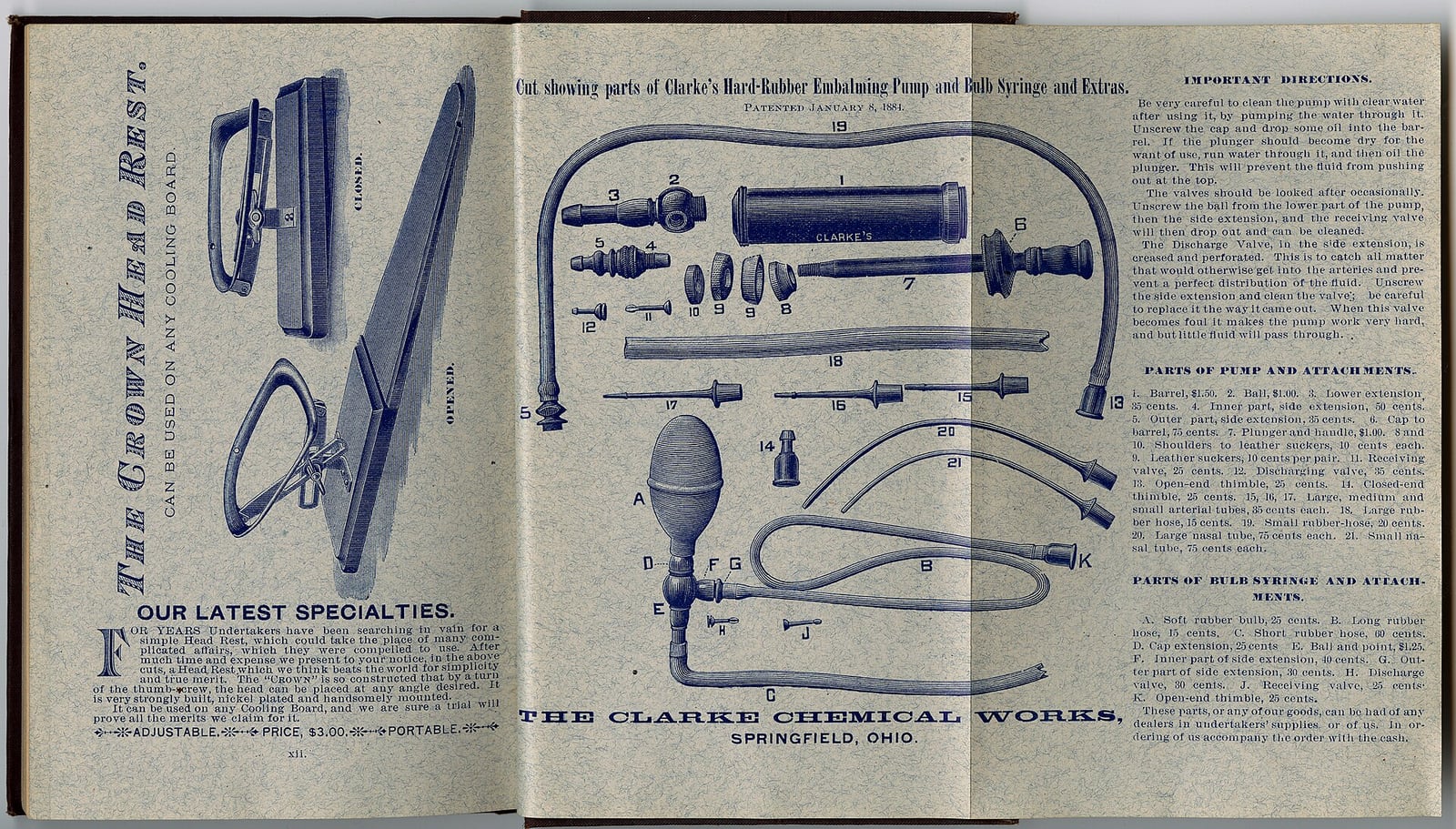
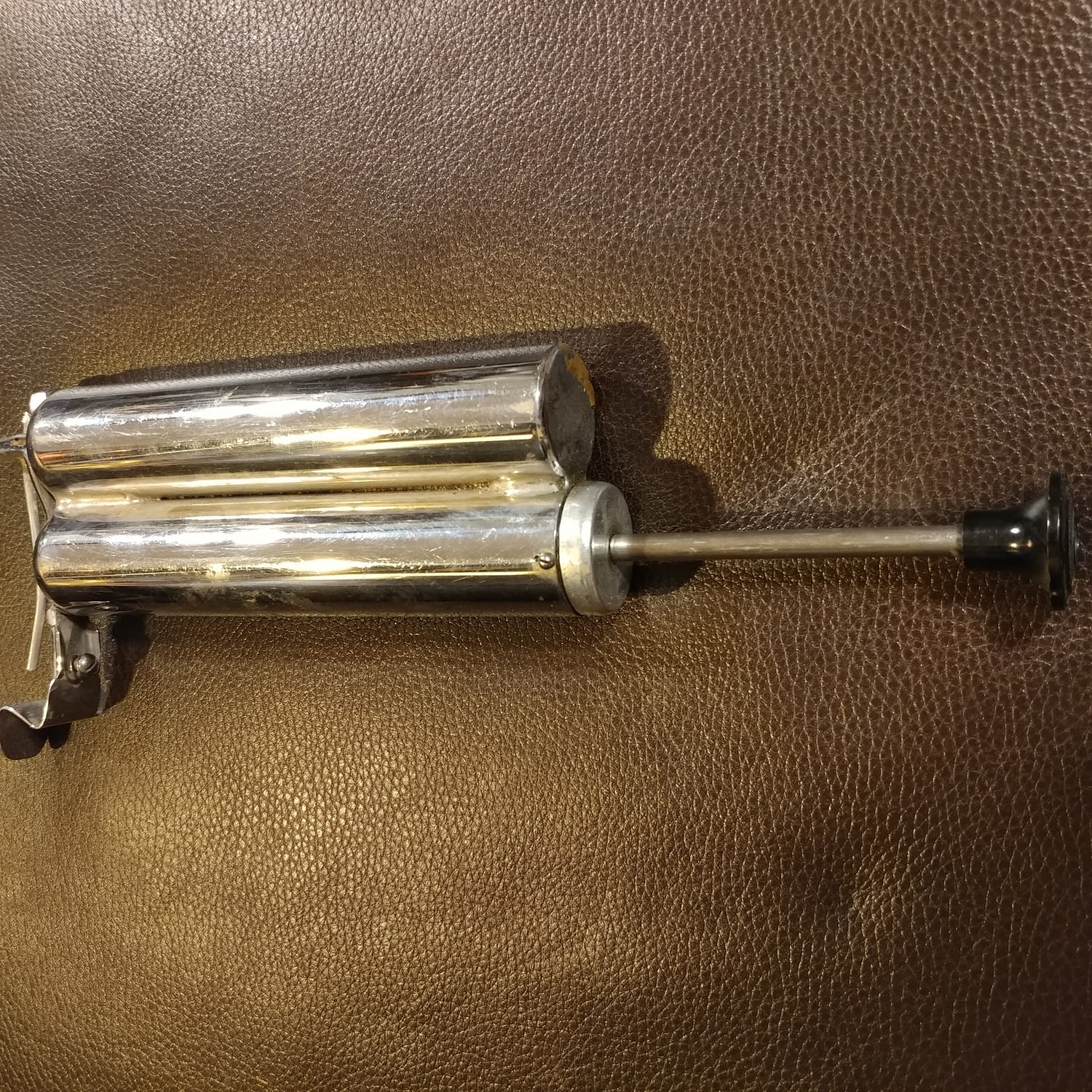
The bulb syringe is the simplest: a rubber squeeze-bulb with one-way check valves at each end and tubing running out. Each squeeze forces a slug of fluid forward; the check valves ensure it can only go one way, so the reciprocating squeeze-and-release becomes a one-direction delivery. The bulb also served as a crude pressure sense — it grows harder to compress as downstream pressure rises. The hand or piston pump is the next step up: a self-contained plunger pump, often in nickel-plated brass with a glass or metal reservoir, delivering higher and more sustained pressure than a bulb could. Finally, early continuous-pressure pumps — air-pressure and geared systems — let the operator choose a pressure and rate and hold them, rather than pulsing fluid by hand.
The engineering lesson of this era is exactly the one the trade would carry forward: pressure and rate of flow are two separate, independently controllable quantities, and a check valve is what turns any back-and-forth motion — a hand, a bulb, a piston — into net forward delivery. These mechanisms are covered in the hand-pump and bulb machines dive.
3.4 The electric machine: continuous pressure, held automatically
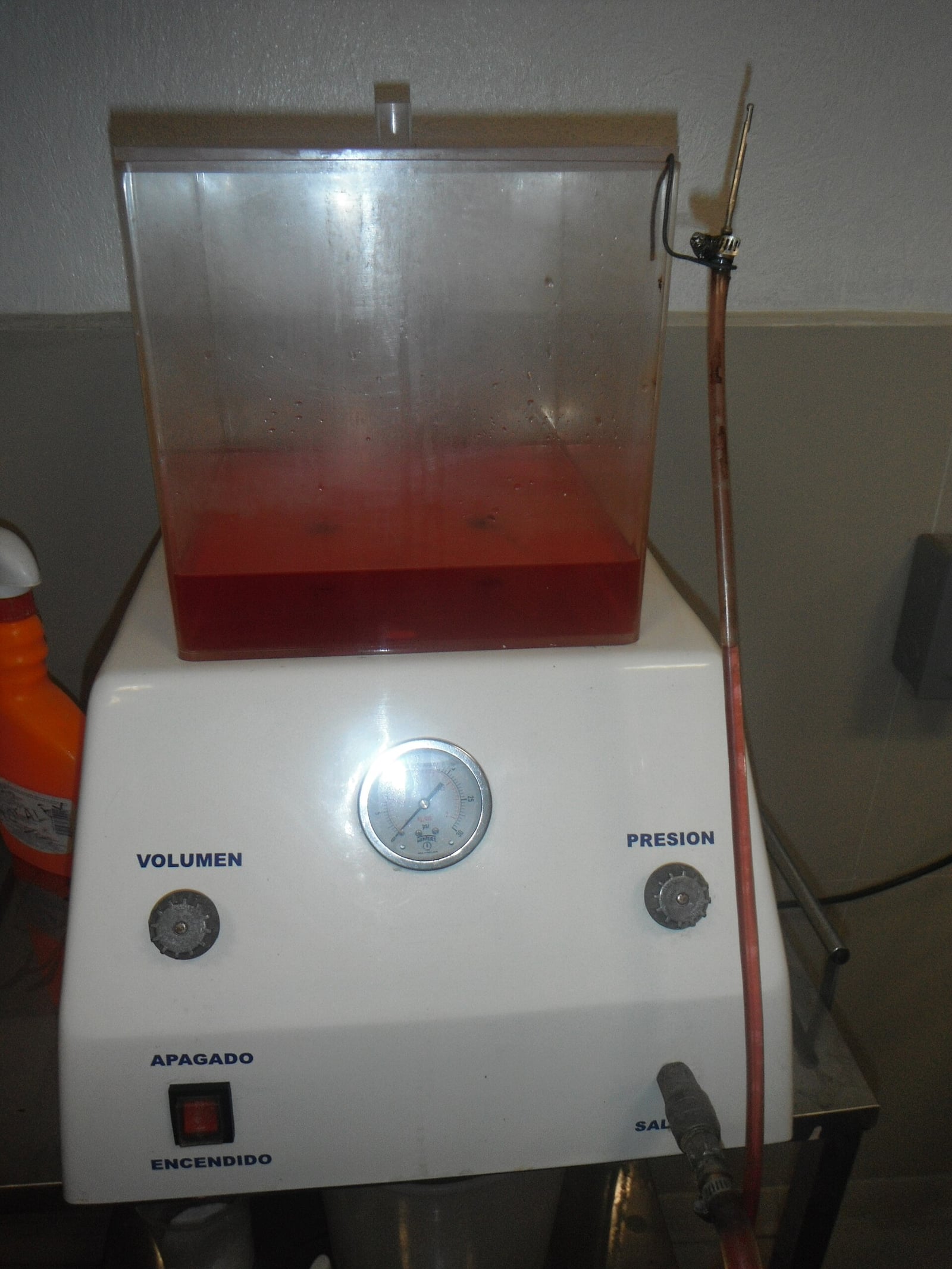
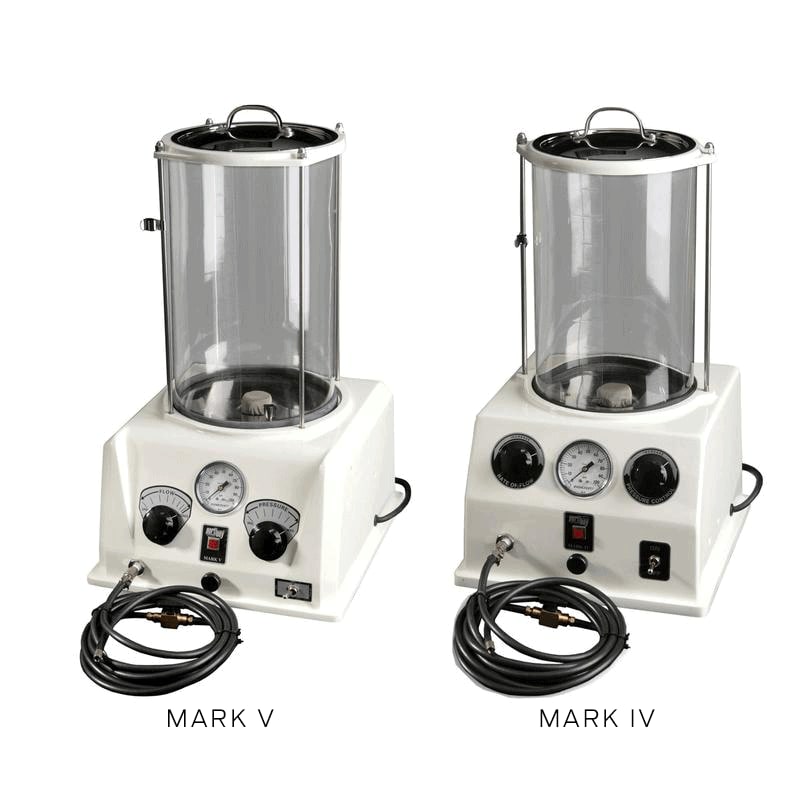
The twentieth-century machine did what no hand could: it set and held both pressure and flow indefinitely. An electric motor drives a pump feeding a graduated tank fitted with a pressure gauge and a rate-of-flow control, so the operator dials in a target and the machine maintains it. Most designs use a centrifugal (impeller) pump rather than a reciprocating one — a spinning impeller throws fluid outward continuously, giving smooth delivery instead of the pulse of a piston. Later machines deliberately re-introduced pulsation electronically, cycling the pressure to mimic a heartbeat, because a gently pulsing flow distributes fluid more evenly and helps clear minor blockages than a steady push. Modern units often use a magnetically coupled impeller — the motor drives the pump through a magnetic coupling with no shaft passing into the fluid — precisely because embalming chemicals destroy the seals a conventional drive shaft would need. It is an elegant answer to a corrosive-fluid problem.
The archetype is the Porti-Boy, whose name comes from its original portable design. Its history contains a common misattribution worth correcting: the Porti-Boy predates ESCO’s ownership of it — the Embalmers’ Supply Company (ESCO) acquired the Porti-Boy line in 1975 and has carried it forward since — the Mark IV, Mark V and later — under its own name. The competing landmark is the Duotronic, introduced in 1967 by Edwards Equipment of St. Louis (its name from duo, its two speeds, and tronic, for electronic control), built around a half-horsepower two-speed motor and a belt-driven centrifugal pump delivering up to about 30 psi. Roughly a decade later the Duotronic II added the pulsation feature; current models such as the Duotronic V reach far higher pressures with direct-drive magnetic pumps. The electric embalming machines dive traces this line in detail.
3.5 The cavity branch: the trocar and the water-jet aspirator
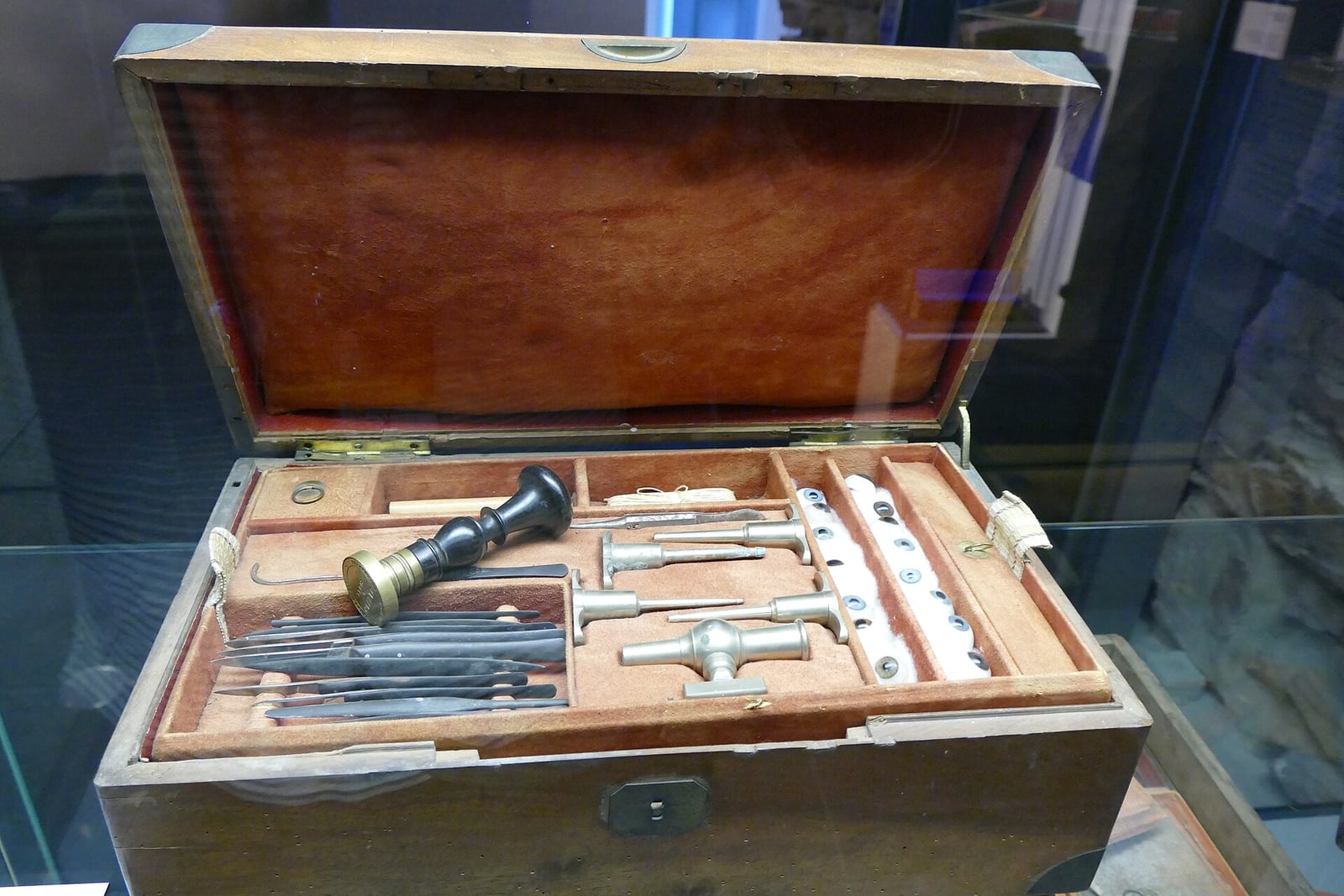
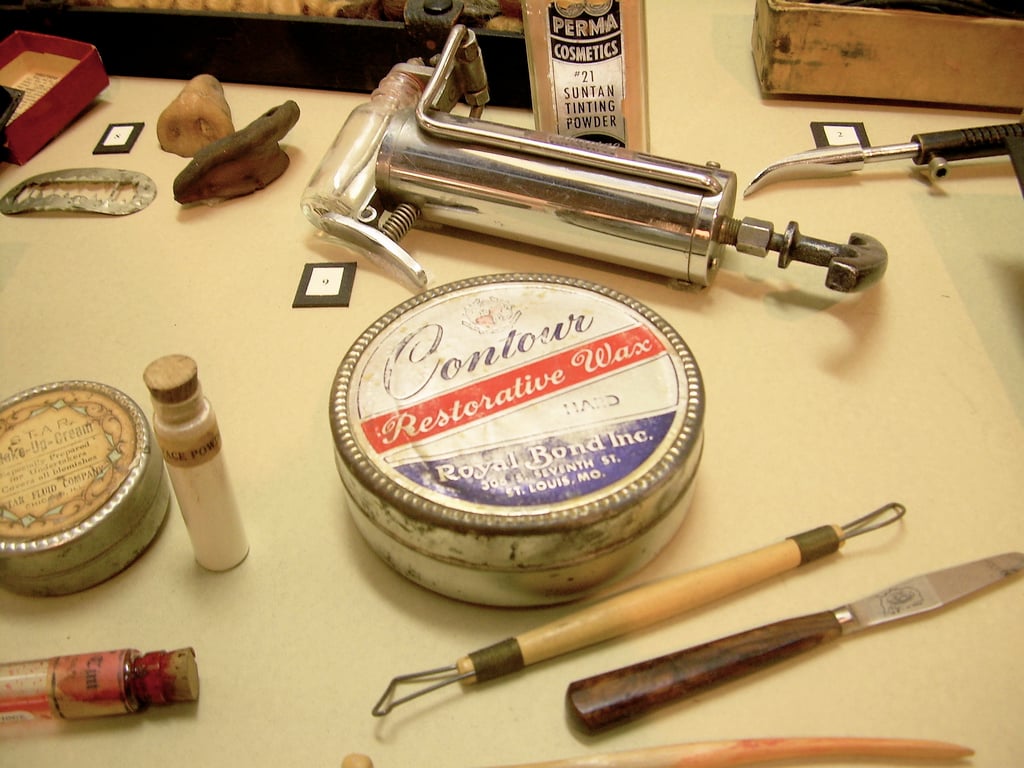
Running parallel to the arterial line was a second family of apparatus built around suction and drainage rather than injection, because arterial fluid does not reliably reach hollow organs. Its central instrument is the trocar — a long hollow metal tube with a pointed tip, descended from a surgical drainage instrument that long predates embalming — connected by tubing either to a suction device or to a fluid supply.
The most engineering-rich object in this branch is the hydro-aspirator, a suction device with no motor and no moving parts. Mains water is forced through a constriction (a Venturi); the stream speeds up through the narrow throat and, by the same principle that a thumb over a garden hose speeds the jet, the pressure at the throat drops below atmospheric. A side port opening into that low-pressure region is thereby put under suction — a jet pump, or water-driven aspirator. It needs only adequate line pressure to work, has nothing to wear out, and for that reason displaced hand- and foot-powered suction in many shops. The fluid mechanics and the instrument history are the subject of the trocars and cavity injection dive; this volume treats them purely as engineered objects.
3.6 The suppliers: who built the trade, and how
Hardware alone did not make the modern trade — the supply houses that manufactured, catalogued, and taught did. Two American firms dominate the story.
The Embalmers’ Supply Company (ESCO) was founded in April 1886 in the basement of a Brooklyn pharmacy, as a partnership between C. B. Dolge, a German-born inventor and engraver, and Max Huncke, a German-born pharmacist. It operated as the “Brooklyn Fluid Works” and “Dolge and Huncke,” moved to Westport, Connecticut in 1890, and was incorporated under its present name in 1893 after Dolge bought out Huncke. ESCO’s significance is twofold. It introduced early American-made embalming instruments, ending dependence on German imports; and Dolge founded the United States College of Embalming in 1889, one of the first permanent embalming schools — training operators in the method that used his products. Dolge was also a formaldehyde pioneer, importing the first supply from Germany in 1894 and compounding an early formaldehyde-based fluid in the Westport laboratory.
The Dodge Company followed the same education-first playbook from the other coast of the trade. Founded in 1893 in Boston by A. Johnson Dodge, who with his brother bought the Oriental School of Embalming that year, Dodge’s model was to train embalmers first and supply them second — a strategy that made it the largest North American embalming-chemical supplier. It hired its first research chemist in 1926, and remained independent until acquired by Matthews International in 2025. The recurring pattern across both firms is the same: the school sold the fluid, the fluid sold the school, and the catalog tied the whole apparatus together. Period supply catalogs — ESCO, Dodge, and peers such as the Champion Company — are among the best primary sources for dating machines and reading the trade’s own priorities.
3.7 Patents, plates and dating the objects
For a collector, the machines carry their own documentation. Patent drawings are the spine of the object trail: reading the figures of embalming-pump and aspirator patents shows how the check-valve, centrifugal, and Venturi-suction art evolved, and a patent number cast or stamped into a body dates it to no earlier than its grant. General self-priming and integral-motor centrifugal-pump patents illuminate the pump mechanism even when they are not embalming-specific. Beyond patents, the physical cues are the maker’s plate, the gauge and tank-glass style, the pump type, and — on older outfits — the perished-rubber-and-surviving-glass signature already noted. Because condition and residue matter here, any surviving machine or fluid bottle is treated as a hazardous-materials object for display, never use.
3.8 The bridge the machines rode in on
No account of the apparatus is complete without the furniture that surrounded it. Before mechanical refrigeration, preservation leaned on passive cooling — cooling boards and ice-packed “corpse coolers” — and the arterial machine spread into, and eventually displaced, that older practice. That transition from ice to injection to refrigeration is the frame around everything above, and it is covered in the cooling boards and corpse coolers dive. Taken together, the five dives trace a single arc: from a column of fluid and a few feet of head, to a sealed magnetic pump on a gauge-fronted panel, built and sold by firms that taught the trade to use them.
Sources
- The Dodge Company — Company History
- American Mortuary Coolers — The Complete Guide to The Dodge Company
- ESCO’s History (Embalmers Supply Company)
- MortuaryMall — Porti-Boy Mark IV Embalming Machine
- Connecting Directors — Porti-Boy Machines from the Embalmers’ Supply Company
- American Mortuary Coolers — An Essential Guide to Duotronic Embalming Machines
- Wilbert — Duotronic: Still Nifty at 50 (American Funeral Director, 2017, PDF)
- American Mortuary Coolers — Everything You Need to Know About Hydro Aspirators
- US Patent 2,836,877 — Embalming apparatus (Google Patents)
- Chemistry World — Formaldehyde
- Formacare — History of Formaldehyde
- National Museum of Funeral History — History of Embalming
Comments (0)