Embalming Machines · Volume 1
From Battlefield to Trade
The machines documented across this wing — the gravity bottles, the hand pumps, the motor-driven pressure units — did not appear because someone invented a better pump. They appeared because a specific historical demand called them into being, and then a new profession organized itself around meeting that demand reliably, at scale, and for money. This volume tells that social and commercial story: how the preservation of the American dead moved, in roughly forty years, from an occasional curiosity to a licensed trade with schools, examining boards, national associations, and a supply industry. It is a story about demand, practitioners, and professionalization — not about technique.
1.1 Before the War: Preservation as a Rarity
For most of the nineteenth century, the ordinary American dead were not preserved at all. Death was a domestic event: the body was washed and laid out by family, watched over at home, and buried within a day or two in a locally made coffin. The “undertaker” who existed was typically a cabinetmaker or livery operator who supplied the coffin and the hearse and undertook the arrangements — not a preservationist. Cooling was the only preservation most households ever used, achieved with ice and the perforated boards discussed in the cooling-and-corpse-cooler volume.
Chemical preservation existed, but almost entirely inside anatomy. European investigators had worked out arterial injection as a way to keep dissection-room cadavers usable. The French chemist Jean-Nicolas Gannal published his arterial method in 1838, and injection preservation circulated among physicians and anatomists as a laboratory art rather than a funeral service. When a body was preserved for a funeral before the 1860s, it was an exceptional act — a wealthy family, an unusual delay, a death far from home. The apparatus involved was the gravity rig covered in the gravity injection systems volume: an elevated reservoir, rubber tubing, and hydrostatic head. What was missing was not a machine. What was missing was a reason for hundreds of thousands of ordinary families to want the service.
1.2 The Civil War Hinge: A Nation’s Dead Far From Home
The American Civil War supplied that reason with terrible efficiency. Between 1861 and 1865 the war killed an enormous number of young men — most estimates place the death toll well above 600,000 — and, crucially, it killed them hundreds or thousands of miles from home. A farm boy from Ohio or Vermont died in Virginia or Tennessee, and his family, if they could afford it, wanted him back. In warm months an unpreserved body could not survive even the shortened journeys of the era.
This produced a demand that had never existed at scale before: the transport of recognizable, non-decomposing remains across long distances, on a schedule set by railroads. Embalming was the answer, and it spread through the officer class first — families with the money and the connections to arrange it — before becoming a visible feature of the war’s grief economy. The war did not invent arterial embalming; it converted an anatomist’s technique into a commercial service by attaching it to a mass, geographically dispersed, paying demand.
1.3 Thomas Holmes and the Embalming Surgeons
The figure the trade later canonized as the “father of modern embalming” was Dr. Thomas Holmes (1817–1900). Holmes graduated from the College of Physicians and Surgeons at Columbia in 1849 and worked in New York as a coroner’s physician, where handling the dead pushed him toward the problem of preservation. Through the 1850s he developed an arterial fluid — an arsenic-based solution, reportedly on the order of a few ounces of arsenous acid per gallon — that preserved without the harsh, tissue-destroying properties of some earlier laboratory mixtures. (The chemistry of these early metallic fluids, and the public-health reckoning they later forced, is the subject of the next volume.)
When the war came, Holmes went to Washington and made embalming a business. Over four years he is credited with preparing several thousand bodies — the figure most often repeated is around 4,000 — and he charged substantial fees, with the service to a single family sometimes cited as high as roughly $100 — his private rate, well above the $25–$50 per body the military paid. He also sold his fluid to other operators, reportedly at a few dollars a gallon, seeding competitors across the theater. He ran shops in Washington, Georgetown, and Alexandria.
Holmes was not alone. A loose fraternity of “embalming surgeons” followed the armies, working out of tents and requisitioned buildings and advertising their services to officers and families. Their reputations were decidedly mixed. The best were competent tradesmen filling a real need; the worst were opportunists, and the press of the day called some of them “vultures fattening themselves on the dead.” Documented abuses — one embalmer, Dr. Richard Burr, was accused of effectively holding a body for a ransom fee — hardened official attitudes. By early 1865 the military had lost patience: General Grant restricted embalmers’ access, and the War Department moved to license and regulate who could follow the armies and handle the dead: General Order No. 39 (“Order Concerning Embalmers,” March 15, 1865) required a license from the Provost Marshal and regulated prices. That regulatory instinct — that this work should be permitted, supervised, and accountable — is the first faint outline of the licensed profession to come.
1.4 The Railroads and the Logic of Distance
None of this would have mattered without the railroad. Embalming and the rail network were complementary technologies of distance: preservation bought time, and the railroad turned that time into miles. A preserved body could be crated, manifested, and shipped north on the same expanding network that moved troops and supplies south. The undertaker’s later fixture — the shipping case, the receiving of remains at a depot, the coordination of a funeral around a train’s arrival — grew directly out of this wartime pairing.
The point is worth stressing because it explains why embalming took hold in America specifically and so thoroughly. A large, continental country, a dispersed population, a catastrophic war fought far from where its soldiers lived, and a maturing rail system arrived together. Embalming was the service that made the geography survivable for grieving families, and the railroad was the reason the geography existed as a problem in the first place.
1.5 Lincoln’s Funeral Train, 1865
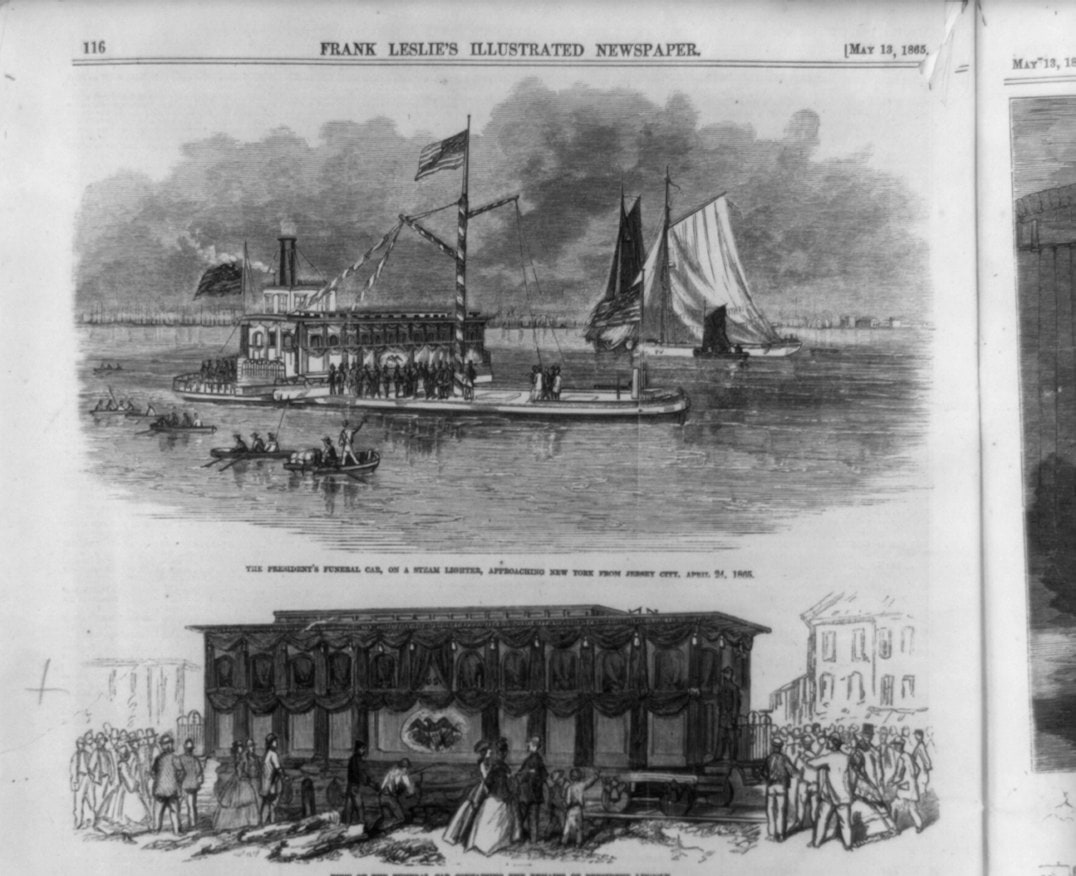
The event that fixed embalming in the national imagination was the death of the President who had presided over that war. When Abraham Lincoln was assassinated in April 1865, his body was embalmed for a funeral journey unlike anything the country had seen. It is worth correcting a persistent piece of folklore here: Lincoln was not embalmed by Thomas Holmes. The work was done by the Washington firm of Brown & Alexander — the embalmer Charles D. Brown and his assistant Harry Cattell — using arterial injection. Holmes’s fame has caused many popular accounts to attach his name to the President; the primary record credits Brown and Cattell.
The funeral train left Washington on April 21, 1865, and traced a roughly 1,700-mile route — retracing much of Lincoln’s 1861 inaugural journey in reverse — through some 180 cities and seven states before reaching Springfield, Illinois, for burial on May 4. Scheduled stops were published in newspapers so mourners could gather; in a series of cities the coffin was carried to a public building and opened for viewing. By the most-cited estimates, on the order of 1.5 million people filed past the body and some seven million watched the train pass. Cattell traveled with the train to tend the remains along the way, retouching the face as the long journey took its visible toll.
That toll matters to the honest history. Charles Brown had publicly promised the body would not perceptibly change — one widely repeated boast held that “the body of the President will never know decay” — and it did not entirely hold; observers in the later cities noted deterioration. But the demonstration worked as publicity regardless. For millions of Americans, the funeral train was their first encounter with a body that had been kept for public viewing across weeks and hundreds of miles. It made embalming visible, respectable, and associated with the highest dignity the nation could confer. What the war had made necessary, Lincoln’s funeral made normal.
1.6 From Battlefield Improvisation to Regulated Trade
When the armies disbanded, the embalming surgeons went home — and took a trade with them. Men who had learned arterial injection in the field returned to towns across the country and folded it into the undertaking businesses that were already handling coffins and hearses. Over the following two decades the combination — coffin, hearse, and now preservation — resolved into a single occupation: the funeral director and embalmer.
This is the pivot from craft to profession, and it followed the classic nineteenth-century pattern of a trade organizing itself: national association, then schools, then state licensure, with a supply industry growing up alongside. In 1882, funeral directors gathered in Rochester, New York, to form what became the National Funeral Directors Association, giving the trade a national voice, shared standards, and eventually its own trade press. Professional identity was now something one joined, not merely something one did.
1.7 Schools, Boards, and Suppliers
Formal instruction arrived the same year. Joseph Henry Clarke (born 1840), remembered as the father of American embalming schools, opened the Cincinnati School of Embalming; its first class convened on March 8, 1882 — reportedly at Pulte Medical College — with seven students and a six-day course, taught in partnership with the anatomist C. M. Lukens. The demand was immediate: Clarke is said to have instructed on the order of a hundred students that first year as he carried the course to Philadelphia, New York, and Boston. His institution evolved over the following decades into what is today the Cincinnati College of Mortuary Science. Other operators followed with their own courses, and much early instruction took the form of traveling demonstration schools run under the banner of the fluid companies — teaching, marketing, and supply braided together.
The suppliers were the third leg. Before the mid-1880s, an American embalmer’s instruments were largely imported from Germany or made by the user. That changed when the Embalmers’ Supply Company (ESCO) was founded on April 13, 1886, by C. B. Dolge and Max Huncke — first in Brooklyn, then relocating to Westport, Connecticut — and introduced American-made embalming instruments and accessories the following year. Dolge went on to establish an embalming school of his own late in the decade. A domestic industry now designed, manufactured, and sold the apparatus the trade depended on, and the same firms that sold the fluid sold the pumps — a commercial thread that runs directly into the hand pump and bulb machines and, in the next century, the electric embalming machines that standardized the work.
The final piece was the force of law. In 1894 Virginia became the first state to regulate embalming, creating a state board of embalming with the stated purpose of protecting public health, limiting the spread of contagious disease, and governing the care of the dead. Other states moved quickly: by 1900, on the order of two dozen states had enacted embalming laws with examining boards and licenses. The itinerant “embalming surgeon” of 1863 had, within a single generation, become a licensed practitioner who had passed a board examination, very possibly trained at a named school, belonged to a national association, and bought standardized instruments from an American manufacturer.
1.8 The Shape of a Profession
By the turn of the twentieth century the essential architecture of the American funeral trade was in place, and every later development documented in this wing sits inside it. The demand born of the Civil War, made national by Lincoln’s funeral train, and made routine by the railroad had been captured by an organized profession with schools, boards, associations, and a supply industry. The machines that follow — the gravity outfits, the hand and bulb pumps, the motorized pressure units, the trocars and the cooling furniture — are the material culture of that profession. They were built, bought, patented, and advertised by the very institutions this volume has described. Understanding where the trade came from is the necessary frame for understanding the apparatus it made.
Sources
- National Museum of Civil War Medicine — Embalming and the Civil War
- Thomas Holmes (mortician) — Wikipedia
- Embalming — Wikipedia
- Modern Embalming — William L. Clements Library, University of Michigan
- Smithsonian Magazine — How Lincoln’s Assassination Launched the Funeral Industry
- Smithsonian Magazine — How Lincoln’s Embrace of Embalming Birthed the American Funeral Industry
- Mental Floss — Preserving the President: Abraham Lincoln, Grave Robbers, and an Excellent Embalmer
- Illinois History and Lincoln Collections — The Lincoln Funeral Train
- HISTORY — Abraham Lincoln’s Funeral Train: How America Mourned for Three Weeks
- Cincinnati College of Mortuary Science — Wikipedia
- Cincinnati College of Mortuary Science — History
- National Funeral Directors Association — About NFDA
- Embalmers’ Supply Company — Company History
- Elite CME — History of Embalming (Chapter 6, PDF)
- Library of Congress Law Blog — Evolution of American Funerary Customs and Laws
Comments (0)