Electrotherapy Devices · Volume 2
The Physicians' Currents
By the middle of the nineteenth century the two foundational quarrels of the previous volume — Galvani’s “animal electricity” against Volta’s pile — had been settled enough to be useful. Electricity was no longer a philosophical marvel drawn from a spinning glass globe; it was a bench tool a physician could carry in a fitted wooden case. The question shifted from what is electricity? to what, precisely, does a given current do to a nerve, a muscle, a paralysed limb — and, inevitably, what can we sell it as? This is the volume where the honest clinical core of medical electricity is laid down, and where the enthusiasm that outran the evidence begins in the same rooms, on the same apparatus, in the same breath.
2.1 Three kinds of current, and why the distinction mattered
The era’s medicine turned on a distinction that is worth getting exactly right, because the sellers deliberately blurred it. There were, in practical terms, three currents in the physician’s cabinet.
Static, or “franklinic,” electricity was the oldest: very high voltage at vanishingly small current, produced by frictional and later influence machines and stored in Leyden jars — the technology treated in depth in the static-electricity machines dive. Its therapeutic use was named Franklinization after Benjamin Franklin, who in the 1750s applied Leyden-jar shocks and static charging to paralytics. Franklin was scrupulously honest about the result: he wrote that he “never knew any advantage from electricity in palsies that was permanent,” and reported to the Royal Society that the improvements he saw faded within days. Franklinization nonetheless survived as respectable practice — Golding Bird ran an electrical-treatment room at Guy’s Hospital in London in the 1840s — precisely because its high-voltage, low-current effects (the skin-tingling “electric breeze,” the counter-irritant spark, the sensation of the “static bath”) were real, if modest, and reliably impressive to patients.
Galvanic current is continuous, steady direct current (DC) drawn from a chemical battery — an unbroken flow in one direction. Applied to the body it produces genuine electrochemical effects at the electrodes: it can drive ionised substances through skin (the principle later formalised as iontophoresis) and, at the negative pole, decompose tissue (the basis of electrolytic hair removal and of galvanocautery). Because a galvanic pulse can be made long in duration, it will also make a denervated muscle — one cut off from its motor nerve — contract, where a brief pulse will not. That single fact turned galvanic current into a diagnostic instrument.
Faradic current is the era’s workhorse and its namesake honour to Michael Faraday, whose 1831 discovery of electromagnetic induction made it possible. It is an interrupted, induced current: not steady DC but a rapid train of pulses, roughly alternating, generated by an induction coil. A primary winding carries direct current from a battery; an automatic interrupter — a vibrating spring-and-hammer “make-and-break,” the buzzing you hear in any surviving medical battery — repeatedly cuts and restores that current, and each interruption induces a sharp high-voltage pulse in the secondary winding. Heinrich Daniel Ruhmkorff patented the compact, efficient version of this induction coil in 1851 and built a Paris workshop around it from 1855; the faradic-and-galvanic machines dive follows that hardware in detail. Physiologically, faradic pulses depolarise motor nerves, producing muscle twitch or, at higher interruption rates, sustained tetanic contraction. This is the direct ancestor of modern neuromuscular electrical stimulation.
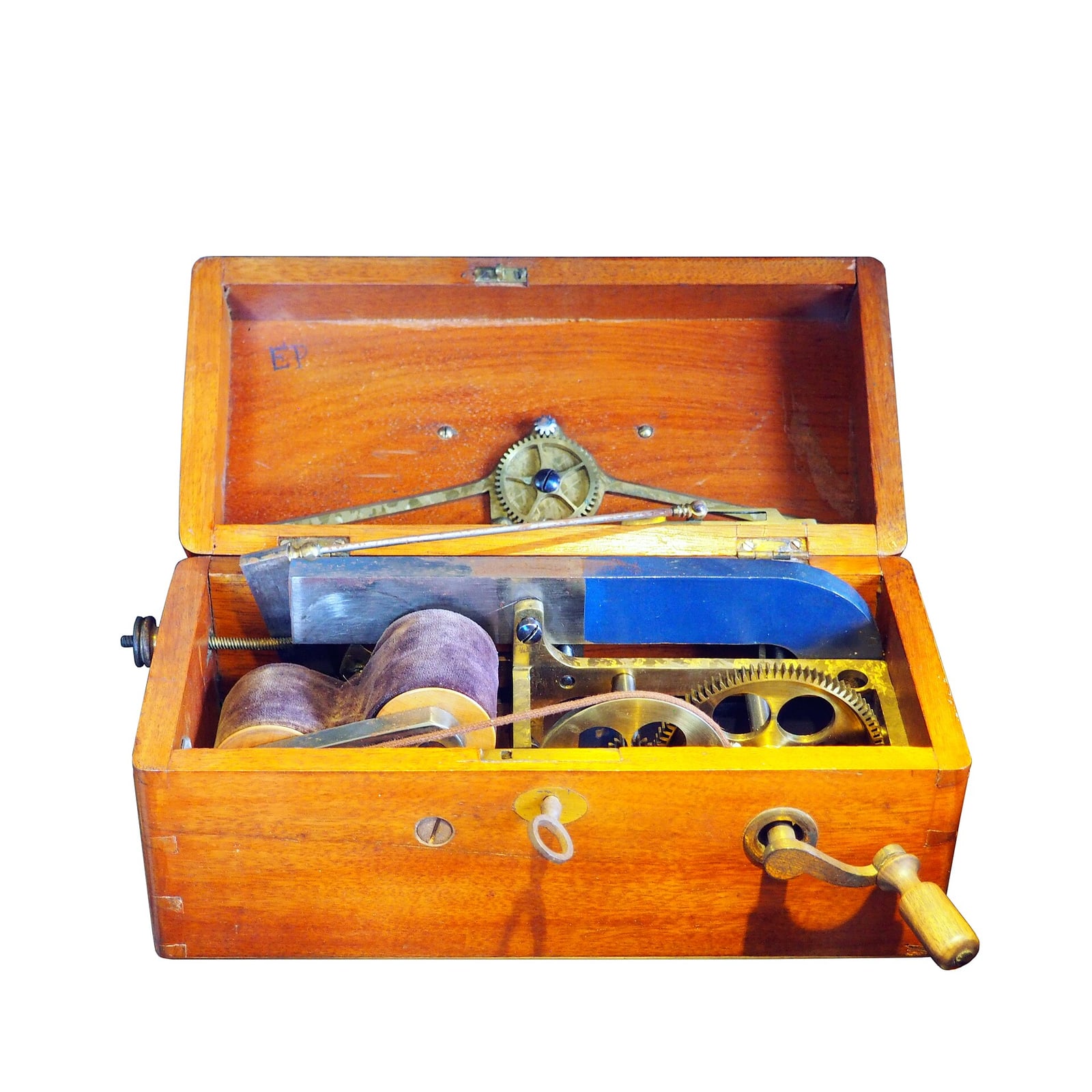
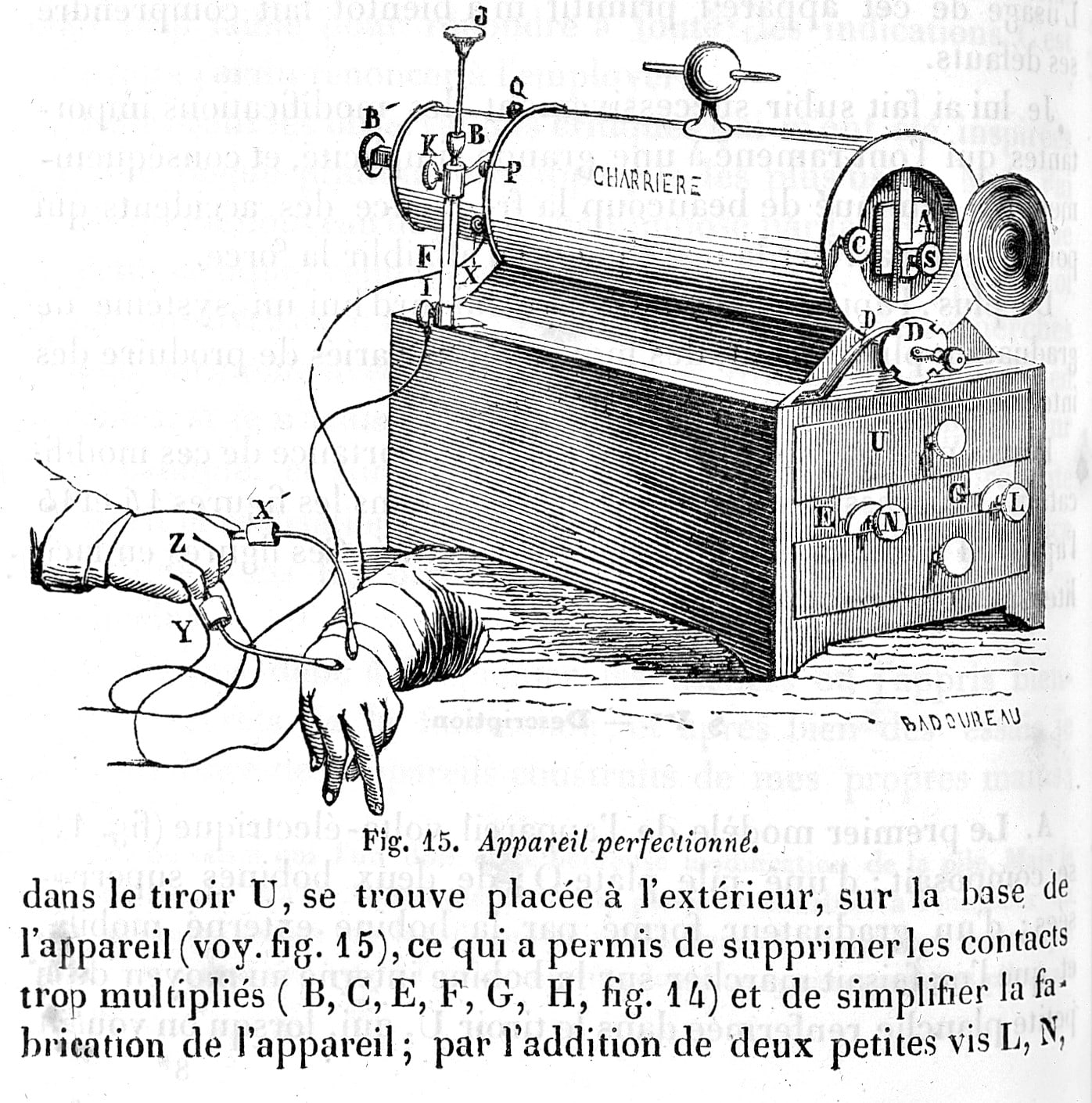
It is worth naming what, from this cabinet, is still medicine. Galvanic current’s electrochemical action at the electrodes survives as iontophoresis — using DC to drive an ionised drug through the skin — and as electrolytic hair removal, both still practised. Faradic stimulation of motor nerves survives as neuromuscular electrical stimulation, used in rehabilitation to re-educate weakened muscle and prevent wasting. And the diagnostic logic Duchenne pioneered survives, hugely refined, in electromyography and nerve-conduction studies. None of these cured the ailments the tonic-sellers advertised; all of them do exactly what the nineteenth-century physiology said the current does, and no more.
The clinical payoff of holding these three apart was electrodiagnosis. A muscle with a healthy nerve supply answered a brief faradic pulse briskly. A muscle whose nerve had been injured would fail to respond to faradic stimulation yet still contract — sluggishly — to a long galvanic pulse. This divergence, later systematised as the “reaction of degeneration,” let a physician localise and grade a nerve lesion at the bedside, decades before the electromyograph. It was real, reproducible neurology done with a coil, a battery, and a pair of moistened electrodes.
2.2 Duchenne de Boulogne and the making of real electrophysiology
No one did more to turn that promise into a discipline than Guillaume-Benjamin-Amand Duchenne (1806–1875), known as Duchenne de Boulogne for his birthplace of Boulogne-sur-Mer. Working largely outside the hospital hierarchy — a physician without a formal appointment who moved through the wards of Paris examining patients other doctors had given up on — Duchenne built the foundations of clinical neurology on the induction coil.
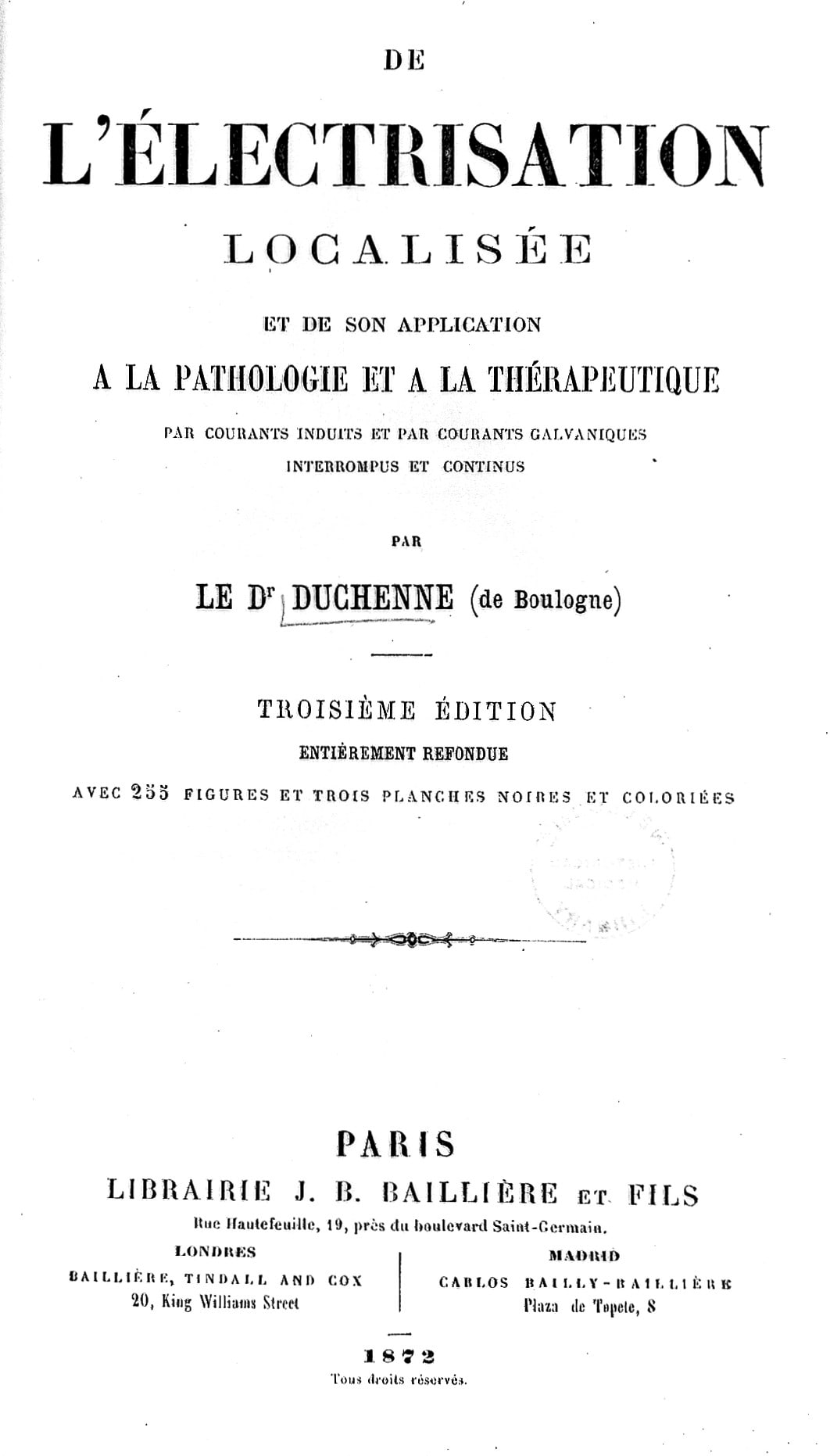
In the 1830s he began with électropuncture, driving current beneath the skin through needle electrodes. By the 1840s, in Paris, he had developed the far more consequential technique he called localised electrisation (électrisation localisée): applying faradic current through moistened surface electrodes so that he could stimulate one muscle, or one muscle group, at a time without breaking the skin. By methodically mapping which surface points made which muscles contract, he effectively charted the motor anatomy of the living human body. He gathered this into De l’électrisation localisée et de son application à la pathologie et à la thérapeutique, first published in 1855 and expanded through later editions — the founding textbook of the field, and the work that established the diagnostic use of electricity.
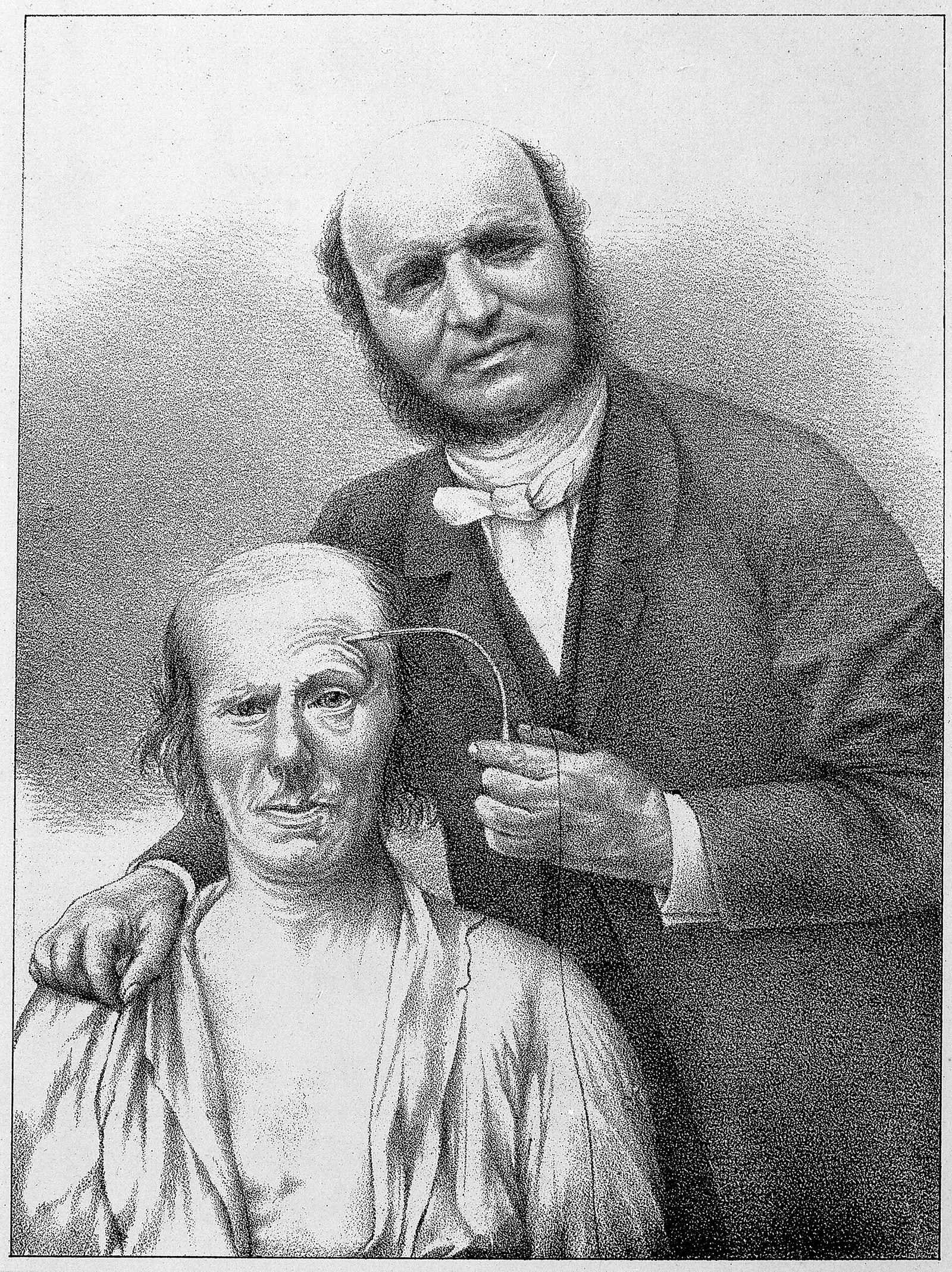
Duchenne’s clinical eye, sharpened by this method, produced descriptions that still carry his name. He gave the first detailed account of the childhood muscle-wasting disease now called Duchenne muscular dystrophy, characterised progressive locomotor ataxia (tabes dorsalis), and described the bulbar palsy long known as Duchenne’s paralysis. These were not electrotherapeutic cures — they were diagnoses, made possible because he had a rigorous way to interrogate nerve and muscle.
He is most widely remembered, though, for a project at the boundary of physiology and art. From 1852 Duchenne began photographing patients while faradising individual facial muscles, and in 1862 published Mécanisme de la physionomie humaine — the “mechanism of human facial expression.” By stimulating single muscles he showed which ones produce which expressions, and distinguished the muscles of a genuine, felt smile from those of a posed one — the observation now called the “Duchenne smile.” Charles Darwin drew directly on Duchenne’s plates for The Expression of the Emotions in Man and Animals (1872). Here the induction coil was doing something no cure-all ever did: generating durable, falsifiable knowledge about how the body works. Duchenne is, with justice, called a founder of electrophysiology and of electrodiagnosis; the coil in his hand was an instrument of measurement, not a promise.
2.3 Societies, journals, and the professionalising impulse
By the last quarter of the century electrotherapy had enough legitimate practitioners to organise. In the United States the American Electro-Therapeutic Association was founded in January 1891 at the New York Academy of Medicine, with G. Betton Massey as its first president and William H. Walling as secretary; its stated object was “the cultivation and promotion of knowledge in whatever relates to the application of electricity in medicine and surgery,” and its first annual meeting convened in Philadelphia that September. Specialist journals — the Journal of Electrotherapeutics and its kin — carried case reports, apparatus reviews, and, tellingly, running arguments about which claims the field could actually stand behind.
That professionalising impulse is the honest heart of the volume. The men who founded these societies were trying to fence real practice off from the patent-medicine trade — to say, in effect, electrolysis and electrodiagnosis and iontophoresis are ours; the shock-for-a-nickel arcade box is not. They did not entirely succeed, because the apparatus refused to respect the fence.
2.4 Where the current outran the evidence
The trouble was that a “medical battery” was one object with two audiences. In Duchenne’s hands it localised a nerve lesion; in a druggist’s window it was a tonic for whatever ailed you. The nineteenth-century faith that vitality was a kind of electrical charge — a folk inheritance from Galvani’s “animal electricity,” now stripped of its careful physiology — made electricity marketable as a restorative for conditions no current could touch.
The clearest case is neurasthenia. The American neurologist George Miller Beard (1839–1883) popularised the term from 1869 and, in American Nervousness (1881), framed it as a depletion of nervous “energy” brought on by the pace of modern civilisation. Beard was a serious clinician — his treatise on the medical uses of electricity codified “general faradization” and “central galvanization” as named techniques — but the framework licensed treating exhaustion, anxiety, dyspepsia and low spirits by, essentially, recharging the patient. General faradization, in which mild faradic current was passed broadly over the whole body rather than aimed at a specific muscle, is the emblem of the overreach: physiologically it did little beyond producing warmth, sensation, and the powerful conviction of having been treated. From there it was a short slide to electrical “tonics” for “nervous exhaustion,” for genito-urinary complaints and impotence, and for the vague debilities that filled the era’s advertisements.
The same coil that Duchenne used to found a science was, at the cheaper end of the trade, sold door to door and reduced to a fairground amusement — the “grip test” shock box. And the galvanic principle was stitched into wearable quackery: the galvanic “electric belt,” promising to steep the wearer’s organs in restorative current through the night. That trade belongs to the Quack wing, and the boundary is deliberately porous — the electropathic belts dive picks up exactly where a legitimate galvanic electrode shades into a mail-order cure-all. The lesson of this volume is that you cannot tell the honest instrument from the fraud by looking at the hardware; you can only tell by looking at the claim.
2.5 The current that would not tetanise
One line of genuinely new physics was already forming as the century closed, and it would reset the whole field. Investigators found that when the frequency of an alternating current was pushed high enough — into the many thousands of cycles per second — it stopped producing the violent muscle contraction and pain of ordinary faradic shock, and instead deposited its energy in tissue as heat. That discovery, associated above all with Jacques-Arsène d’Arsonval, splits off from the clinical currents of this volume and drives the next: the high-frequency currents that lead to diathermy — and, at the retail counter, to the glowing “violet ray” wand. The physicians’ currents had mapped the nerve and the muscle; the next generation would learn to warm the flesh itself.
Sources
- Duchenne de Boulogne — Britannica
- Guillaume Duchenne — Engineering and Technology History Wiki (ETHW)
- Duchenne de Boulogne — Hektoen International
- Vignettes in Neurology: Duchenne de Boulogne (1806–1875)
- Duchenne De Boulogne: a pioneer in neurology and medical photography — PubMed
- Faradic Stimulation — Physiopedia
- “Ruhmkorff’s” induction coil — Chemistry World
- A Biographical History of Induction Coils (Dean/Currier) — Maynooth University
- Electric bath (electrotherapy) / Franklinization — Wikipedia
- “Fishy” Science Part 2: Ben Franklin and Electrical Medicine — American Philosophical Society
- Biography: George Beard — U.S. National Library of Medicine
- “Neurasthenia gastrica” revisited — PMC
- The American Electro-Therapeutic Association — PMC
Comments (0)