Electrotherapy Devices · Volume 4
The Dark Turn: Electroconvulsive Therapy
4.1 A note before the history
This volume is object, portrait, and document history. It is about where a still-current medical treatment came from, the people who built its first apparatus, and how that apparatus lodged itself in the public imagination — not about how the treatment is done. It contains no operating parameters of any kind, and nothing in it is clinical guidance or a comment on any individual’s care.
It is worth stating plainly, and at the start, what modern electroconvulsive therapy is, because the rest of this account looks backward into a harsher era. Today ECT is a consented, anesthetized, muscle-relaxed, monitored medical procedure. It is administered under general anesthesia, with a muscle relaxant that prevents the physical convulsion the early machines produced, for a small set of specific and severe conditions — most often treatment-resistant major depression, and catatonia, where it can be strikingly effective — and it remains in the guidelines of national psychiatric bodies as an evidence-based option. That is the destination. The history that produced it was, for a long stretch of the twentieth century, neither gentle nor careful, and the two facts have to be held together: the genuine harms of the unmodified era are real, and so is the treatment’s legitimate place in medicine now.
This volume is the social and material history that sits behind the device dive; for the apparatus itself as an object, see the companion dive on early electroconvulsive therapy.
4.2 The convulsion as cure: an idea before its machine
The electrical machine of 1938 was the last arrival in a short, intense sequence of “shock” therapies that swept European and American psychiatry in the 1930s. To understand the machine, you have to understand the idea it inherited — that a violent physiological crisis, deliberately induced, might reset a disordered mind. It was a desperate idea in a desperate field: the asylums of the early twentieth century were vast, overcrowded, and largely without effective treatments for psychosis. Anything that seemed to work was seized upon.
The first of the modern shock treatments came from Vienna. Manfred Sakel (1900–1957), an Austrian physician trained at the University of Vienna, had been using insulin to sedate patients withdrawing from morphine when he observed that accidental overdoses — producing hypoglycemic coma — seemed to calm agitated and psychotic patients. By 1933 he was presenting insulin coma therapy to the Medical Society of Vienna, reporting high improvement rates among recent-onset schizophrenia cases. Insulin coma therapy spread rapidly through the world’s mental hospitals and remained in use for two decades, despite being labor-intensive, dangerous, and — as later controlled trials suggested — of doubtful benefit. Sakel, who was Jewish, fled the Nazis in 1936 and finished his career in the United States.
The second idea came from Budapest. Ladislas Meduna (1896–1964), a Hungarian neuropathologist, had convinced himself — on the basis of tissue observations later shown to be mistaken — that epilepsy and schizophrenia were somehow biologically antagonistic, and that inducing a seizure might drive out psychosis. On 23 January 1934 he injected a catatonic patient with camphor in oil; the patient convulsed and, after a course of treatments, reportedly recovered. Camphor was unreliable and unpleasant, so Meduna switched to a synthetic circulatory stimulant, pentylenetetrazol, sold in Europe as Cardiazol and in America as Metrazol. Chemical convulsive therapy was faster than insulin but carried a particular terror of its own: there was a delay of many seconds between injection and seizure, during which fully conscious patients experienced an overwhelming sense of impending doom and dread. Many came to fear the injection above all else. It is precisely that flaw — the uncontrollable, dread-laden chemical convulsion — that set the stage for an electrical alternative.
4.3 Rome, 1938: Cerletti and Bini
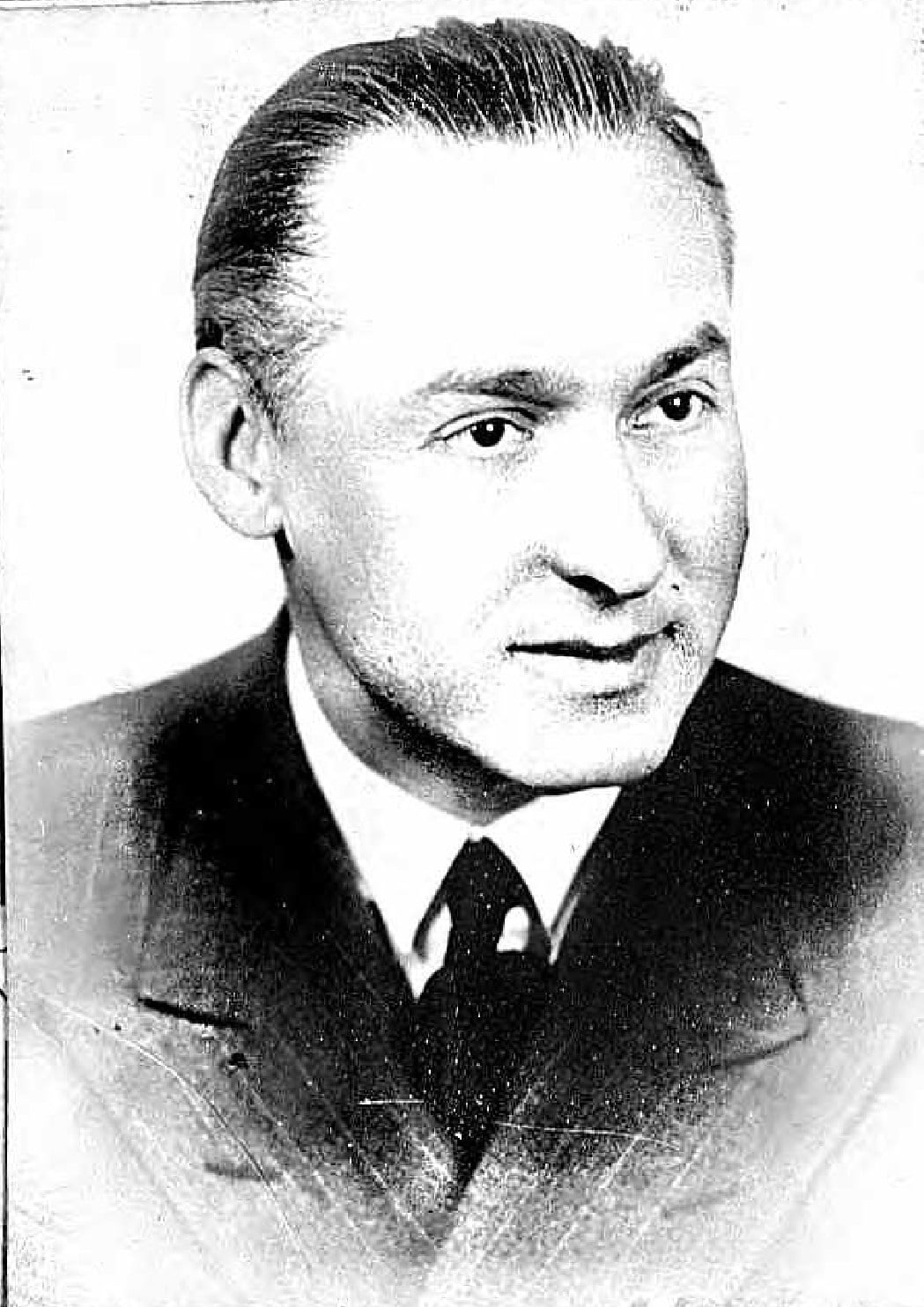
Ugo Cerletti (1877–1963) was a neurologist and the director of the Clinic for Nervous and Mental Diseases at La Sapienza, the University of Rome. He had spent years studying epilepsy in the laboratory, using electric current to induce seizures in dogs so that he could examine the resulting changes in brain tissue. The method had a grim problem: many of the animals died, because the electrodes were placed so that the current passed through the heart. The work stalled there for some time.
Two things moved it forward. First, Cerletti’s assistant Lucio Bini (1908–1964), a talented and meticulous younger physician, worked out that changing how the current was applied could induce the seizure without the lethal cardiac effect — making a reliably survivable electrical convulsion conceivable. Second, and famously, Cerletti visited a Rome slaughterhouse where pigs were subdued with electricity before slaughter. He observed that the current did not kill the animals; it stunned them into a convulsion, and the butcher’s knife did the killing. If electricity could reliably produce a survivable convulsion in a pig, Cerletti reasoned, it might safely produce Meduna’s therapeutic seizure in a person — and do so instantly, without the dread-filled delay of Metrazol.
The first human treatment took place in the spring of 1938. (Sources give the date as either 11 April or 21 April 1938; the discrepancy is common in the secondary literature.) The patient was a man found wandering and confused at Rome’s railway station, brought in by the police, with no fixed identity — he is usually referred to only by an initial in the accounts, and no reliable full name survives. The first application, deliberately cautious, produced only a partial response; Cerletti and Bini conferred about whether to proceed. According to the often-repeated account, the patient — who had been mute or incoherent — spoke up clearly to object to a further, stronger application. They proceeded anyway; a full convulsion followed, and over a course of treatments the man was reported to have improved markedly. Whatever the precise words, the anecdote captured something that would haunt the treatment’s whole history: the tension between a patient’s fear and a clinician’s judgment.
Cerletti himself remained ambivalent about what he had made. He is often quoted as regarding ECT as a “monstrous” or brutal thing even as he defended its results, and he spent his later years hoping to find the chemical substance he believed the convulsion released — so that the shock itself might be dispensed with. He never found it.
4.4 The apparatus as an object
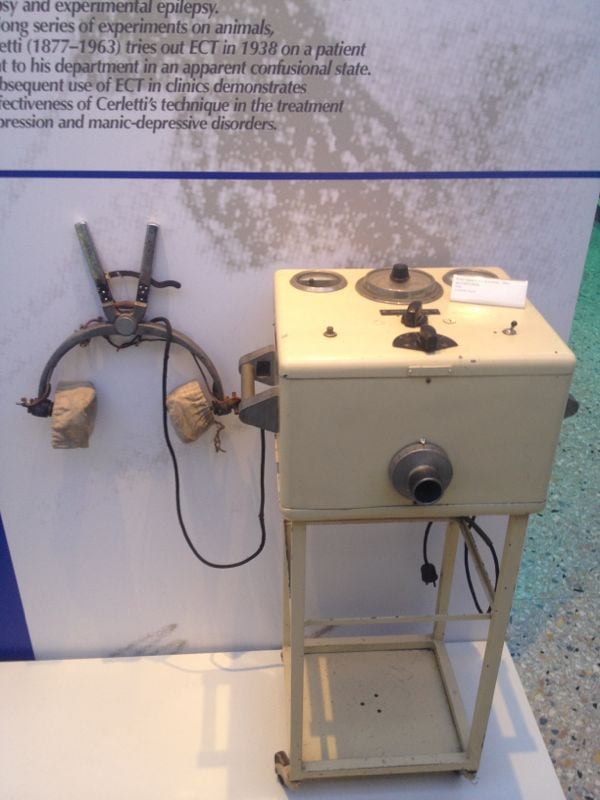
The device Bini built is a genuine museum object, and it survives. Bini filed for a patent in the autumn of 1938, and the first licensed manufacturer of the apparatus was the Italian firm Officine Elettrotecniche Italiane Ing. Vittorio Arcioni. The original prototype is held and displayed at the Museo di Storia della Medicina (Museum of the History of Medicine) at Sapienza in Rome, where it has been the subject of scholarly writing on how such a fraught object should be exhibited.
As an artifact it is unassuming — a boxed instrument of the interwar laboratory, with dials and terminals, closer in appearance to a piece of electrical test gear than to anything one would imagine at the center of so much later controversy. That ordinariness is part of the story. The machine spread across Europe and to North America with remarkable speed in the years around the Second World War, precisely because it was cheaper, faster, and simpler to operate than either insulin coma units or the fraught business of chemical convulsion. Within roughly a decade the electrical method had displaced Metrazol almost entirely, and it steadily eroded the use of insulin coma as well.
The earliest machines used a simple alternating current; the waveform, the placement, and every technical detail of administration changed many times over the following decades as the treatment was refined — details that belong to clinical practice and are deliberately left out of this history. What matters for a collection is that the object marks a hinge point: the moment a therapeutic convulsion became something a clinician could deliver at the turn of a switch.
4.5 The unmodified era and its abuses
For its first fifteen years or so, ECT was administered in what is now called its unmodified form: the electrically induced seizure produced a full-body convulsion in a conscious patient. The convulsion itself could be violent enough to cause injury, and the experience — sudden loss of consciousness without warning or sedation — was frightening. This is the version of the treatment that entered popular memory, and it is the version whose abuses are real and documented.
The modifications that define the treatment today arrived in stages during the 1940s and 1950s. Barbiturate anesthesia came into use in the early 1940s so that patients would be unconscious. Muscle relaxants followed — first curare, experimented with in the early 1940s to soften the force of the convulsion, then the far more manageable agent succinylcholine, introduced clinically in the early 1950s — which relaxed the body so that the outward convulsion, and the fractures it could cause, were largely eliminated. Anesthesia and relaxation together turned a violent visible seizure into a controlled procedure. These are the changes, alongside consent and monitoring, that separate modern ECT from the machine of 1938.
But the technology’s very convenience was also its danger. Because ECT was quick, cheap, and required little in the way of staff or aftercare, it was open to overuse in the crowded mid-century asylum — applied too widely, too frequently, to conditions for which it was never indicated, and in some institutions used less as a considered treatment than as a means of managing difficult wards. Records from the period document its use as a tool of control and even punishment in some settings. These were failures of institutions and oversight rather than of the physics, but they were failures with real human cost, and they are inseparable from the treatment’s reputation. The history is not served by pretending they did not happen, any more than it is served by pretending the treatment has no legitimate use.
4.6 Cultural memory: the bolt from the machine
By the early 1960s, ECT had become, in the public imagination, the emblem of everything feared about the psychiatric hospital — and it acquired that status largely through two works of literature.
Sylvia Plath’s semi-autobiographical novel The Bell Jar, published in January 1963 under the pseudonym Victoria Lucas, drew on her own hospitalization and ECT in 1953. The novel is often remembered simply as an indictment of the treatment, but it is more precise than that, and the precision matters for this history: its narrator, Esther Greenwood, undergoes a first course of ECT that is a traumatic ordeal, given without preparation or sedation, and later a second course, carefully administered, that she experiences as genuinely lifting the “bell jar” of her depression. Embedded in the century’s most famous literary account of the treatment, in other words, is exactly the distinction this volume draws — between the frightening unmodified procedure and the modified one that helped.
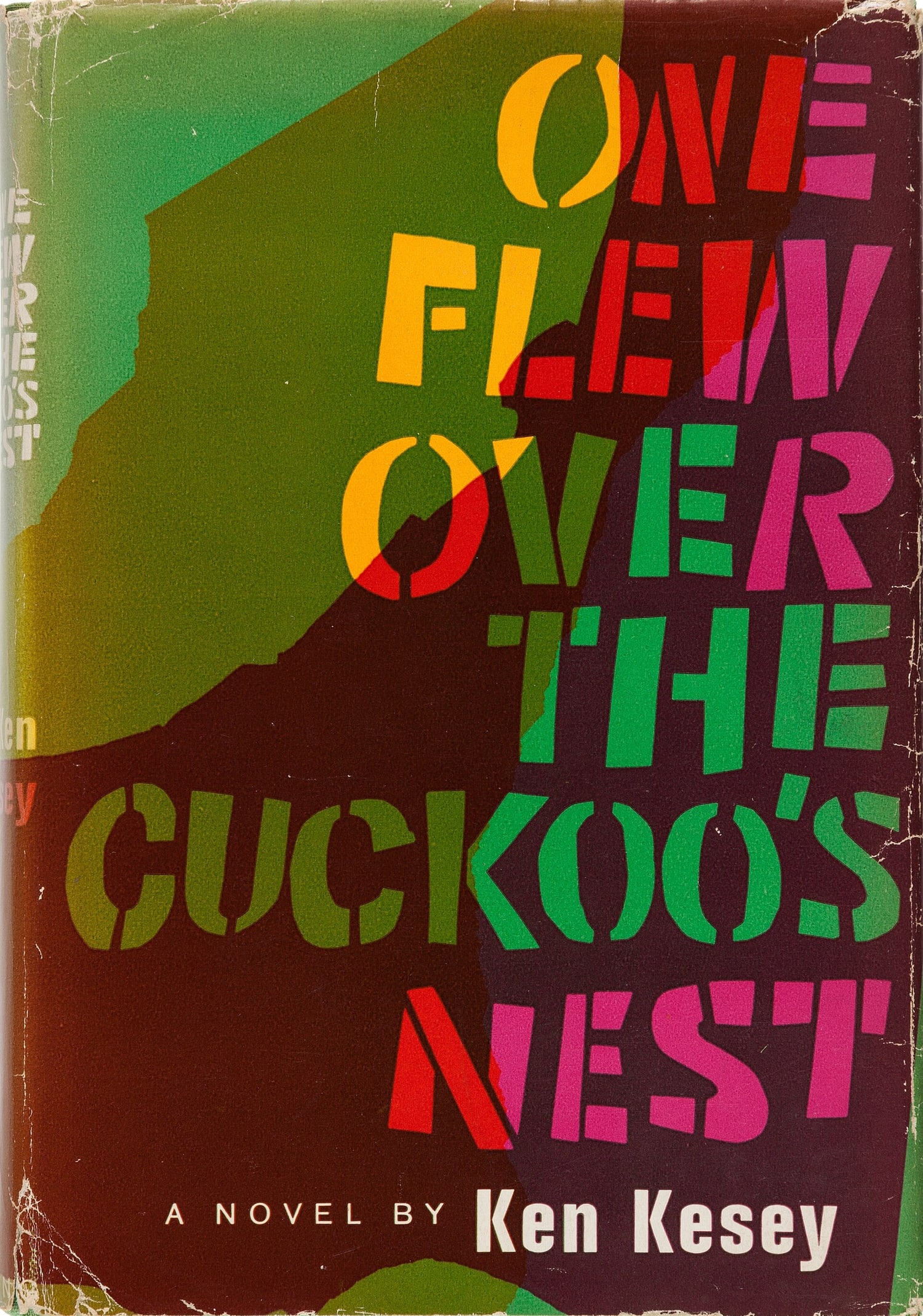
Ken Kesey’s One Flew Over the Cuckoo’s Nest (1962), and still more Miloš Forman’s 1975 film of it, fixed the harsher image permanently. Kesey had worked as a night aide in a veterans’ hospital psychiatric ward and reportedly arranged to undergo electroshock himself to write about it accurately; in the story, ECT and lobotomy are instruments of the institution’s power over the individual, administered to the rebellious McMurphy as a means of subjugation. The film’s imagery became the reference point through which a generation understood the treatment — a portrayal that psychiatry has spent decades arguing is a depiction of the abuses of a particular era and setting, not of the modern procedure.
The result is a lasting gap between perception and clinical reality. For much of the public, the picture of ECT is still the mid-century one; for psychiatry, it is a modified, consented, evidence-based treatment used in narrow circumstances. Both pictures come from real history. Holding them apart — the genuine harms of the unmodified asylum era on one side, the genuine therapeutic role today on the other — is the whole task of telling this story honestly.
4.7 Where this sits in the collection
Of everything in the electrotherapy wing, the ECT apparatus is the one object that traveled the full distance from experimental curiosity to abuse to legitimate, regulated medicine — and is still in use. It is the counterpart, on the serious side of the collection, to the quack devices’ unfulfilled promises: here the electricity genuinely did something, the something was powerful and double-edged, and the history is the record of a profession slowly learning to use a strong tool carefully. For the machine itself — its form, its makers, its place in the museum case — continue to the early electroconvulsive therapy device dive.
Sources
- History of Electroconvulsive Therapy (ECT) — LITFL Eponymictionary
- Ugo Cerletti — LITFL Medical Eponym Library
- Lucio Bini — LITFL Medical Eponym Library
- Cerletti and Bini Use Electroshock to Treat Schizophrenia — EBSCO Research Starters
- The Origins of Electroconvulsive Therapy (ECT) — PubMed
- Ladislas J. Meduna — Wikipedia
- Ladislas Meduna — LITFL Medical Eponym Library
- The History of Shock Therapy in Psychiatry — Cerebro & Mente
- Manfred Sakel — Wikipedia
- Dr Manfred J. Sakel: discoverer of insulin shock therapy — British Journal of Psychiatry (Cambridge Core)
- Shock therapy — Encyclopædia Britannica
- The History of ECT: Unsolved Mysteries — Psychiatric Times
- ECT Treatment: A History of Helping Patients at McLean Hospital
- What is Electroconvulsive Therapy (ECT)? — American Psychiatric Association
- Anesthetic Considerations in Electroconvulsive Therapy — StatPearls, NCBI Bookshelf
- One Flew East, One Flew West, 65 Years of the Cuckoo’s Nest — American Journal of Psychiatry Residents’ Journal
- Electroconvulsive therapy (ECT) in literature: Sylvia Plath’s The Bell Jar — PubMed
- The Bell Jar — Encyclopædia Britannica
Comments (0)