Electrotherapy Devices · Volume 3
High Frequency and Deep Heat
3.1 The threshold that changed everything
Every current a nineteenth-century physician could deliver had one thing in common: the patient felt it. Galvanic direct current bit and burned at the electrodes; faradic pulses from an induction coil jerked the muscles into twitch and tetanus. That sensation was the whole point of the older electrotherapy and also its ceiling. You could not pass a large current through a limb, let alone the trunk, because at ordinary frequencies the body answers with pain, involuntary contraction, and — at enough amperage — the arrest of the heart. The nerve and muscle of a living animal are exquisite low-frequency detectors, and they veto any current strong enough to do real heating.
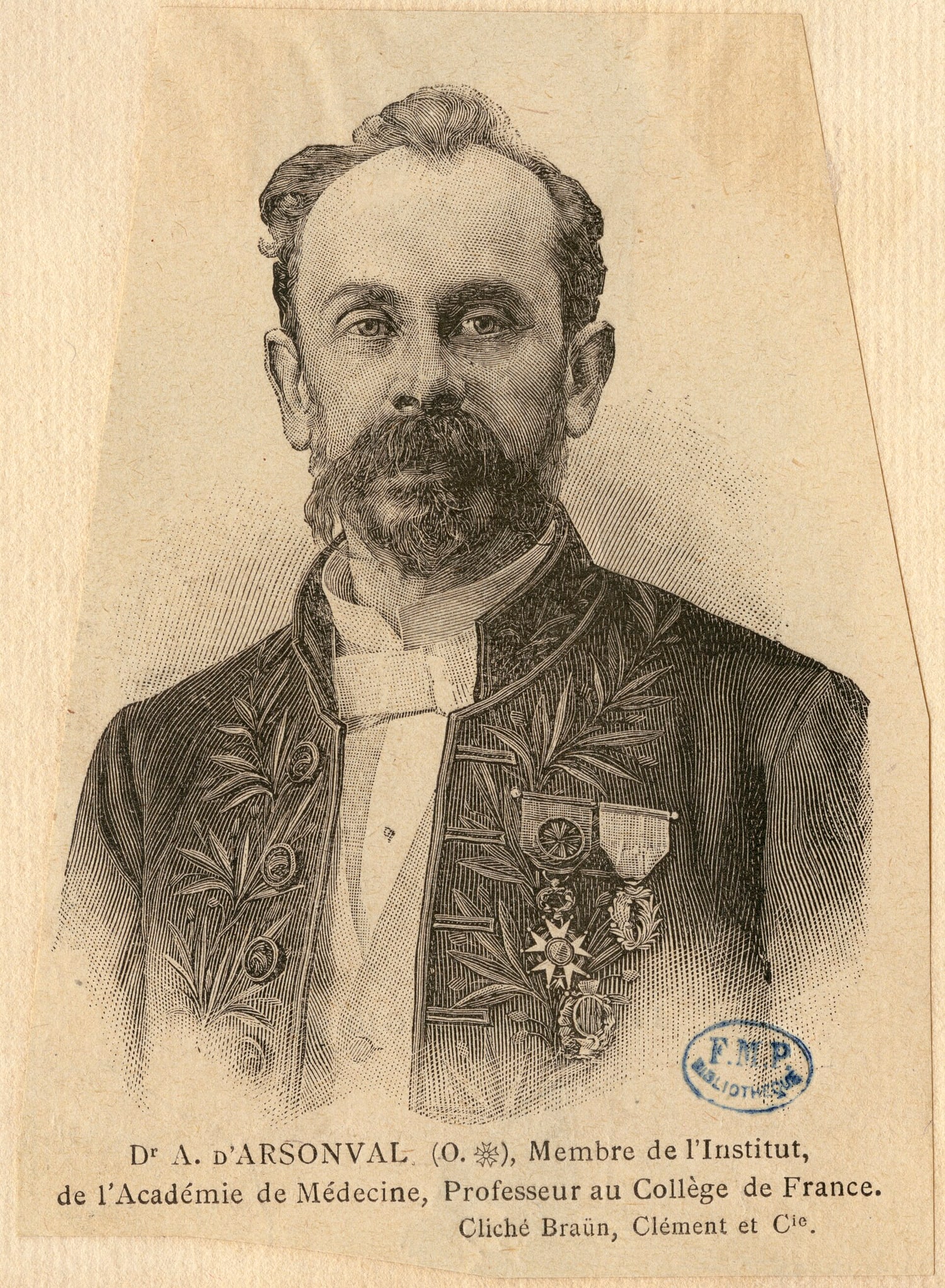
The discovery that dissolved that ceiling belongs to Jacques-Arsène d’Arsonval (1851–1940), the French physician and biophysicist who, from 1889, ran the first systematic studies of what alternating current actually does to the body as its frequency climbs. His finding was clean and counterintuitive. Below roughly ten cycles a second the body registers each pulse as a separate shock. As the frequency rises the shocks fuse into tetanus, then into a steady burn — and then, past a threshold he placed at several thousand cycles per second, the sensation vanishes altogether. D’Arsonval reported that above about 5,000 hertz the current no longer excited nerve or muscle; by 1891 he could state that high-frequency current evoked no sensory or motor response at all. The only physiological effect that remained was heat. The reason is a matter of timescale. A nerve fibre fires only when a stimulus pushes its membrane past threshold and holds it there long enough for ions to move — a process with a characteristic time of roughly a millisecond. An alternating current reversing tens of thousands of times a second never dwells in one direction long enough to accumulate that displacement; each half-cycle is undone before the membrane can respond, so no action potential is triggered. The tissue still has electrical resistance, though, and resistance turns current into heat regardless of frequency. Strip away the nerve’s ability to object and you are left with a pure heating element that happens to be made of muscle, fat, and blood. That single fact — high-frequency current heats without shocking — is the seed of everything in this volume, and of a good deal of the quackery in the wing next door.
3.2 D’Arsonval, Tesla, and the resonators
The 1890s were a crowded moment for high-frequency electricity, and the medical and the purely electrical strands ran side by side. Nikola Tesla, working in New York, patented his resonant air-core transformer — the Tesla coil — in 1891, and it was Tesla who first suggested publicly that high-frequency currents might be passed through the body harmlessly and even beneficially. D’Arsonval, approaching from physiology rather than power engineering, arrived at overlapping conclusions in the same 1890–91 window. The two are properly credited together as the independent discoverers of the therapeutic possibilities of high-frequency current, though their instruments and interests differed: Tesla wanted enormous voltages for wireless power and lighting, d’Arsonval wanted a controllable current to put into a patient.
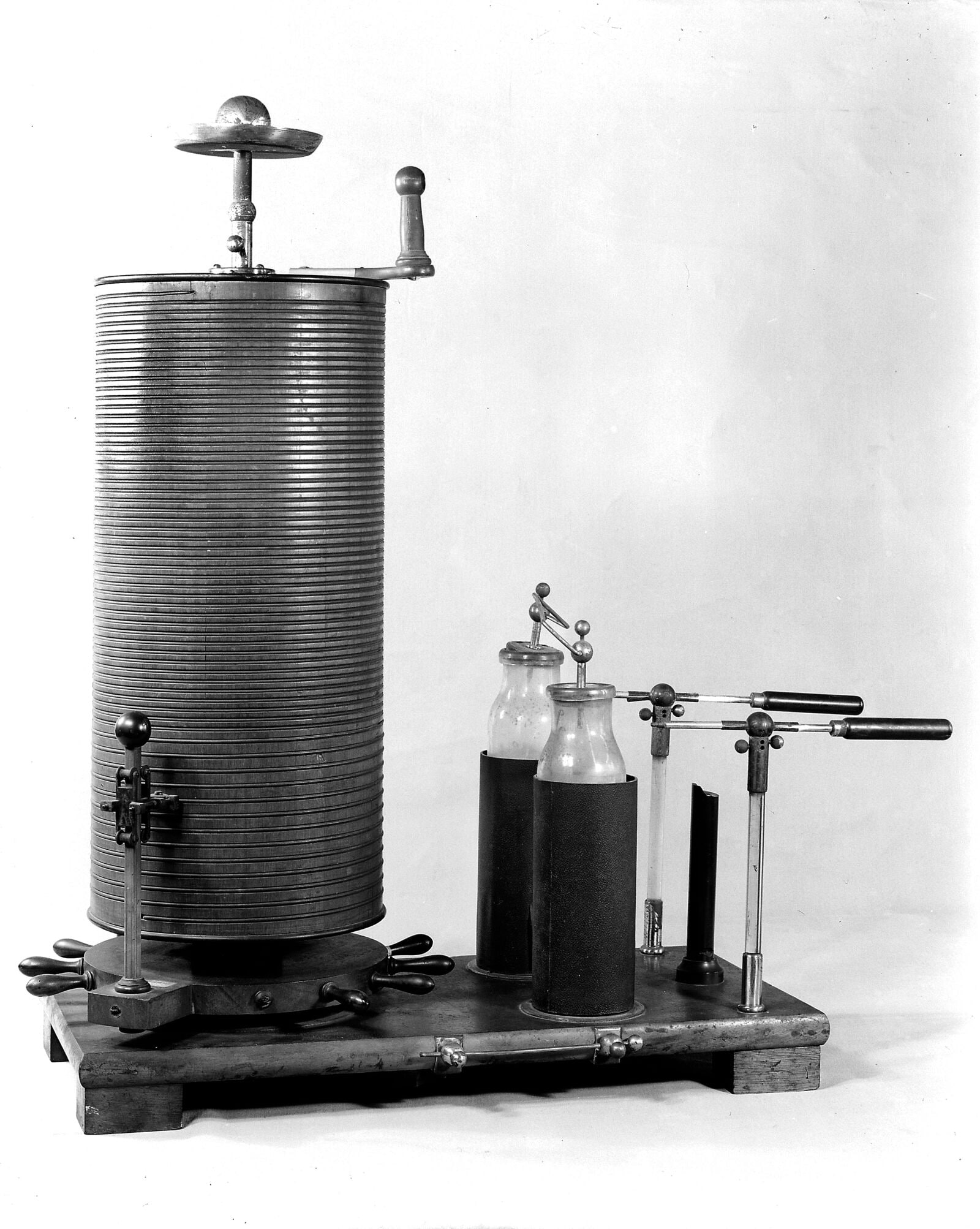
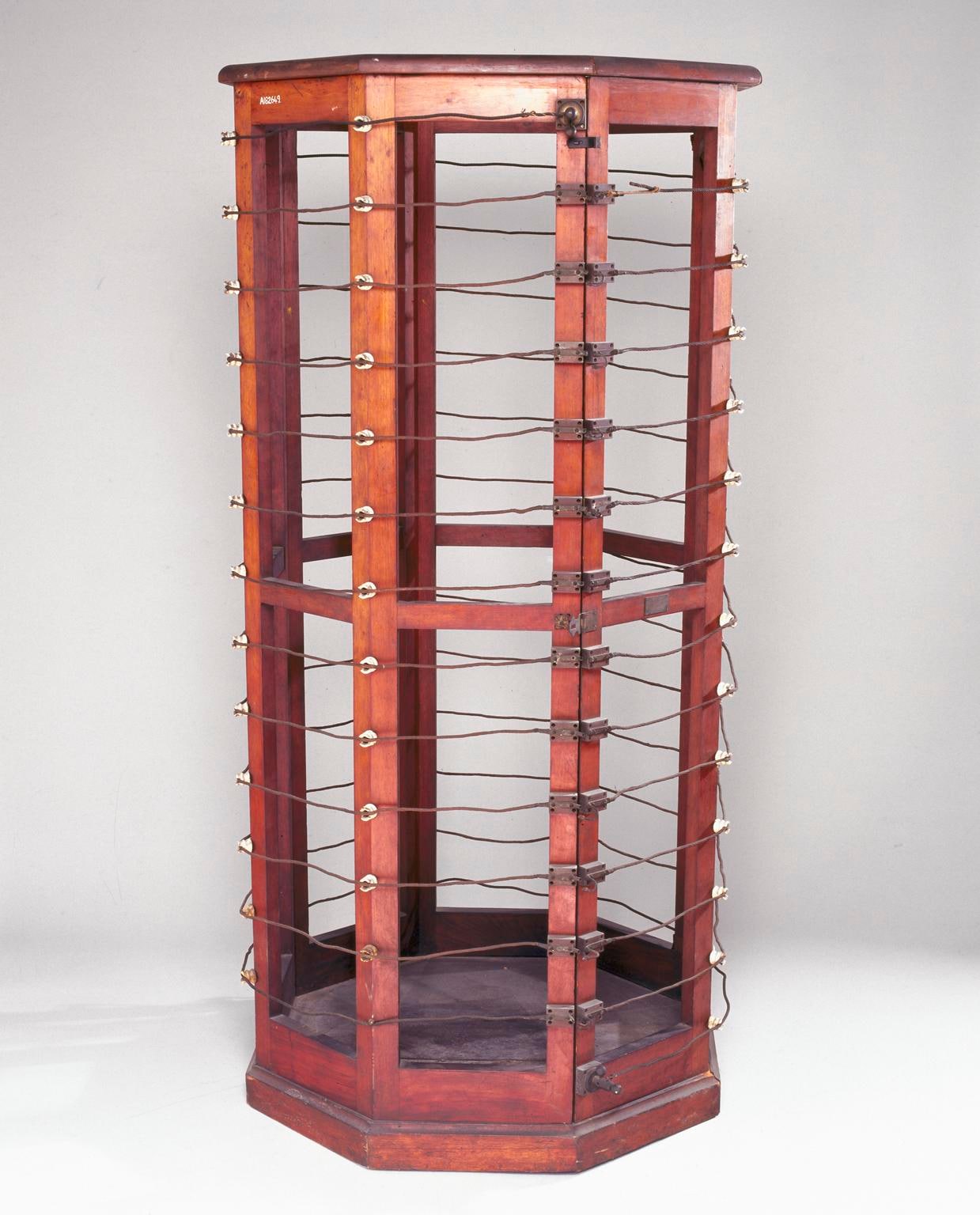
The apparatus of the era sorted into three recognizable types, and period authors were careful to distinguish them. The d’Arsonval circuit delivered comparatively low voltage and high current, and was the form used to pass current through the body — through a limb held between electrodes, or through the whole patient by two dramatic methods d’Arsonval devised. In autoconduction the patient sat inside a large solenoid, a cage-like coil, and the oscillating magnetic field induced currents in the body without any wire touching it. In autocondensation the patient sat on one plate of a large capacitor and became part of the resonant circuit. Both could raise the body’s temperature measurably — the first genuine, instrument-verified deep heating of a living human. The Tesla circuit ran the other way: very high voltage, very low current, spectacular sparks.
The third type belongs to Paul Marie Oudin (1851–1923), a physician who collaborated directly with d’Arsonval. In 1893 Oudin modified d’Arsonval’s apparatus by adding a resonating coil wired as an autotransformer, producing the high-voltage, low-current Oudin resonator. Very similar to a Tesla coil in principle — the chief difference is the autotransformer connection — the Oudin coil could reach hundreds of thousands of volts and threw a long, thin, purple spark from its terminal. That spark, drawn to or near the skin, was the workhorse of turn-of-the-century high-frequency therapy, and the resonator paired with a d’Arsonval primary became the standard hospital rig. The name d’Arsonvalization was in general use by 1913 — d’Arsonval himself published La technique … de la d’arsonvalisation that year.
The full engineering account of these machines — the spark gap, the tank capacitor, the resonant coil, and the glowing vacuum electrodes that grew out of Oudin’s work — lives in the device dive at /high-frequency-currents/. What matters here is the physiological pivot: d’Arsonval and Oudin had a device that could deposit heat deep in tissue on purpose. The next generation gave that act a name.
3.3 Naming the deep heat: diathermy is born
The word diathermy was coined by the German physician Karl Franz Nagelschmidt, who introduced the term around 1907–1908 and performed the first extensive clinical experiments applying high-frequency current for deliberate deep heating. It is built straight from the Greek — dia (through) and thermē (heat) — “heating through,” and Nagelschmidt is generally credited as the founder of the field; he published the first textbook on it in 1913. He did not work from nothing. The Austrian physiologist R. R. von Zeynek (the name is often transliterated von Zaynek) had, around 1905, measured how much heat high-frequency current produces in tissue as a function of frequency and current density, and had proposed on that basis using such currents for therapeutic deep heating — coining his own term, thermopenetration, in a 1908 Viennese paper. The physical chemist Walther Nernst supplied theory from the other direction, with a model of nerve stimulation that explained why the high-frequency application was painless — precisely the threshold effect d’Arsonval had found empirically. Nagelschmidt drew these threads together, standardized the vocabulary on diathermy, and turned a laboratory curiosity into a bedside treatment for pain, stiffness, and poor circulation. This earliest form is now called long-wave diathermy. It used the spark-gap and Oudin-type generators inherited directly from d’Arsonval, oscillating in the range of roughly 0.1 to 2 megahertz — low radio frequencies by later standards. Energy went into the patient largely through contact electrodes, and the machines were noisy, hard to tune, and prone to producing more heat at the skin than in the depths one wanted to reach. But the principle was sound and, for the first time in this history, genuinely and measurably therapeutic: controlled deep heat is a real intervention for muscle and joint pain, and diathermy delivered it.
3.4 Spark to tube: short-wave diathermy
The transformation of diathermy from a temperamental spark machine into standard hospital equipment came with the vacuum tube. Through the 1920s, triode-oscillator circuits replaced the spark gap, giving a clean, continuous, tunable high-frequency output instead of a train of damped bursts. Higher and steadier frequencies became practical, and the field moved up-band into what was named short-wave diathermy — radio-frequency energy with wavelengths of roughly ten to a hundred metres, corresponding to frequencies from about 3 to 30 megahertz (the high-frequency “short-wave” band). Short-wave diathermy was developed in the 1920s and became a fixture of physiotherapy and rehabilitation departments through the 1930s and the mid-century decades that followed.
Short-wave machines coupled energy into the body without necessarily touching it. A capacitive applicator placed the patient’s tissue between two plates, like the dielectric of a capacitor; an inductive applicator wrapped a coil or drum around the part, heating it in an oscillating magnetic field. Both spread the energy over a volume rather than concentrating it at a contact point, which reduced the surface burns that plagued the long-wave contact method. Because these powerful oscillators radiated freely and threatened to interfere with radio communication, international agreement eventually confined medical equipment to designated industrial, scientific, and medical (ISM) bands — of which 27.12 MHz (a wavelength near eleven metres) became the one most associated with short-wave diathermy, alongside allocations at 13.56 and 40.68 MHz. A later branch pushed higher still into microwave diathermy at frequencies such as 915 MHz or 2,450 MHz, using antenna-like applicators to direct the heat.
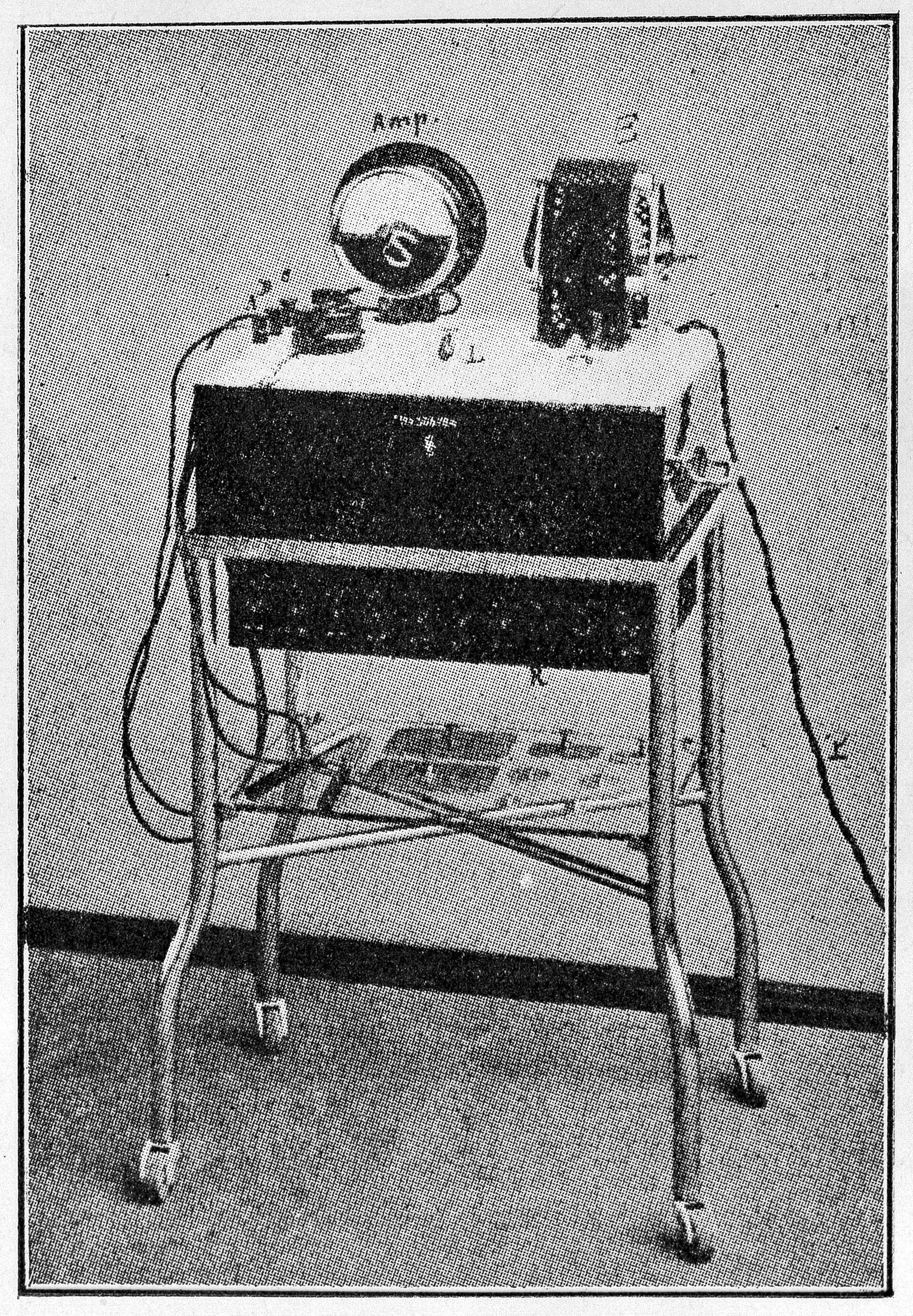
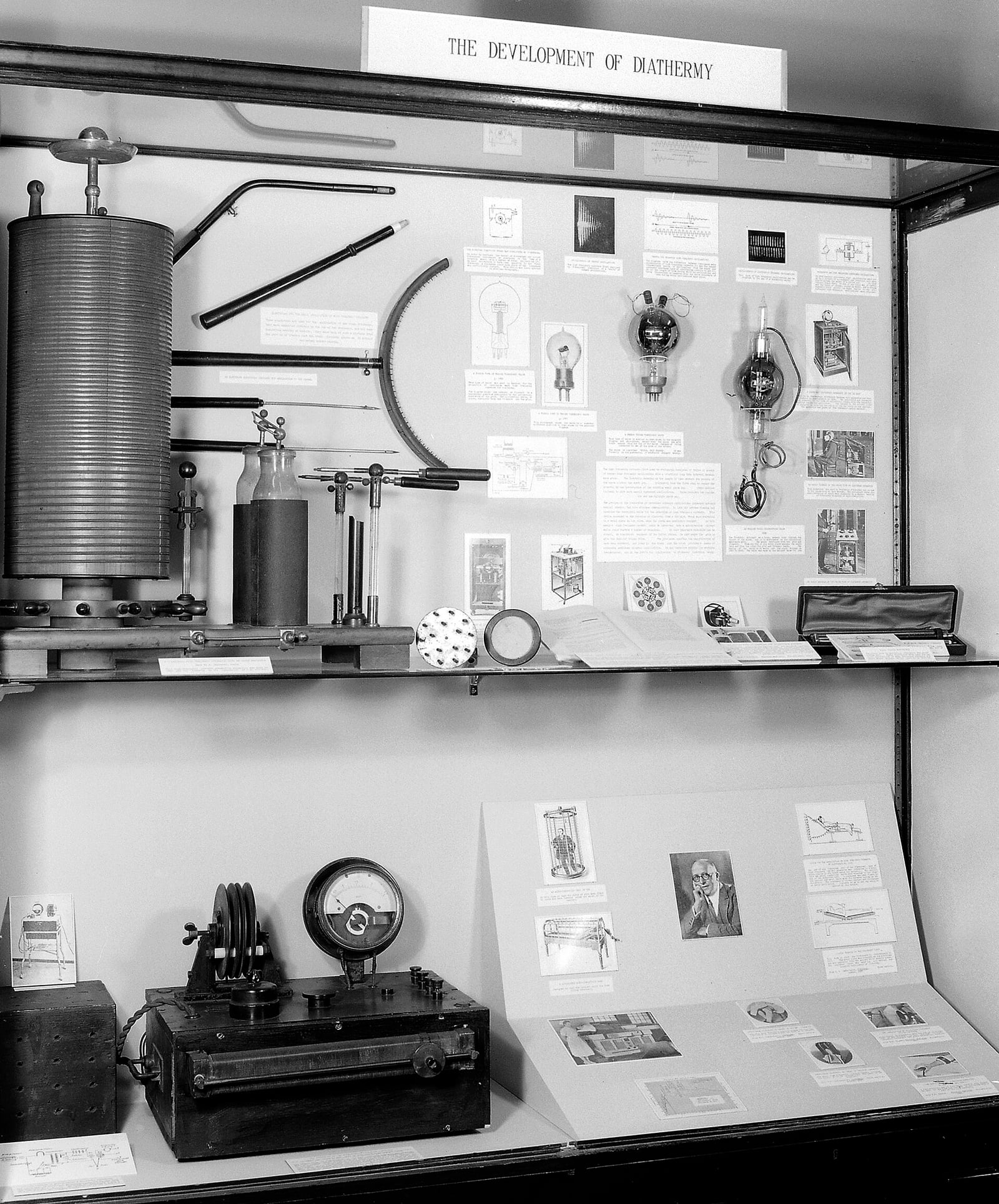
It is worth marking a boundary that the shared hardware constantly blurs. Therapeutic diathermy heats tissue gently to treat it. Surgical diathermy — better known as electrosurgery, the Bovie unit — uses very similar high-frequency current, but concentrated at a fine electrode to cut or coagulate. They are cousins in physics and opposites in intent, and the same word covers both; when a modern surgeon says “diathermy” they usually mean the cutting instrument, not the physiotherapist’s heat lamp of radio waves. The therapeutic device and its full technical lineage are treated in the dive at /diathermy-machines/.
3.5 What was real, and what was oversold
Short-wave diathermy earned a place in medicine and has kept it. Controlled deep heating genuinely relaxes muscle, eases joint stiffness, increases local blood flow, and raises the pain threshold — legitimate physiotherapy, used in modified and carefully regulated forms to this day. This is one of the few devices in the entire electrotherapy collection whose clinical value was never seriously in doubt: the physics is honest, the effect is measurable, and the mechanism — resistive and dielectric heating of tissue by radio-frequency current — is exactly what it claims to be.
The field also did real work in medical safety. Depositing radio-frequency energy inside a living body carries real hazards: deep burns when the field concentrates unexpectedly, dangerous heating around metal implants and effusions, and — recognized later — the risks of chronic RF exposure to operators. Much of the modern discipline of electromedical safety and device regulation was worked out on diathermy machines, precisely because they were powerful enough to hurt someone who used them carelessly.
But the honest record must also mark the overreach. At the height of its popularity diathermy accreted claims well beyond deep heating — that it could resolve infections, arrest cancers, or serve as a general restorative — and mid-century advertising was rarely shy. Heat is a useful adjunct; it is not an antibiotic or an oncologic cure, and the grander promises outran the physiology. Diathermy’s real virtue is modest and specific, and it was routinely inflated.
3.6 The porous boundary: from the clinic to the drugstore wand
Nowhere in this collection is the line between medicine and merchandise thinner than here. The very effect d’Arsonval and Oudin discovered — high-frequency current that sparks, warms, and reddens the skin without a shock — was irresistibly marketable. Strip the hospital d’Arsonval-Oudin rig down to a handheld coil and a glowing evacuated glass electrode, put it in a fitted case, and you have the violet-ray wand: a genuine high-frequency device, working on exactly the physics laid out above, sold door-to-door and through the drugstore as a cure for baldness, deafness, “nervous” complaints, “female disorders,” and nearly anything else a catalogue could name. The purple glow is real — it is ionized residual gas inside the electrode — but it is a surface phenomenon and a counter-irritant, not the deep, dose-controlled heating of a clinical diathermy machine, and none of the sweeping cures survive contact with the evidence.
That is the shape of the whole overreach in miniature. The same discovery produced short-wave diathermy, which is real medicine, and the violet-ray wand, which is a period cure-all built on the reputation of the real thing. The retail version — its history, its makers, and the gulf between what it did and what it promised — is dissected in the Quack wing at /violet-ray-wands/. The two dives describe one technology; the difference is entirely in the honesty of the label on the box.
Nothing in this article is medical advice; it is the history of the apparatus and the physics behind it. Modern short-wave diathermy is a regulated physiotherapy modality administered by trained clinicians, and the historical claims described here are recounted as history, not endorsed.
Sources
- Jacques-Arsène d’Arsonval — Wikipedia
- Arsène d’Arsonval — Encyclopedia.com
- d’Arsonval, His Life and Contributions… Part III: High-Frequency Experiences and the Beginnings of Diathermy (ResearchGate)
- Paul Marie Oudin — Wikipedia
- Oudin coil — Wikipedia
- Tesla coil — Wikipedia
- Diathermy — Wikipedia
- Diathermy — Britannica
- Diathermy — Encyclopedia.com
- Short-wave diathermy — history.physio
- Über Diathermie (Transthermie, Thermopenetration), Nagelschmidt — HistoryofMedicine.com
- Essential Facts on the History of Hyperthermia and their Connections with Electromedicine (Academia.edu)
- Diathermy Machine — Smithsonian National Museum of American History
- Wellcome Collection — “Tesla, quacks and violet rays”
Comments (0)