Electrotherapy Devices · Volume 1
From Amber to the Leyden Jar
1.1 The problem of a fluid you cannot see
Long before anyone could measure a volt or draw a circuit, electricity was a rumour that lived in objects. Rub a piece of amber — Greek elektron — and it draws chaff and hair toward it. Rub a glass rod and it will spit a spark to your knuckle. For most of two thousand years that was the whole of the subject: a parlour surprise with no theory behind it and no way to store the effect. What changed in the eighteenth century, and what makes this the true starting point for every machine in this wing, was that the surprise became reproducible, then storable, then — fatefully — medical. The moment electricity could be bottled and delivered to a human body on demand, someone was going to point it at disease.
This first volume traces that origin: the frictional machines and the Leyden jar that made a controllable shock possible; Benjamin Franklin and the first physicians who turned that shock on paralysis; and the founding scientific quarrel between Luigi Galvani and Alessandro Volta, which simultaneously created the science of electrophysiology and handed every later “vital force” salesman his vocabulary. Real discovery and its imitation were, from the very beginning, born in the same room.
1.2 Bottling the spark: the Leyden jar of 1745
The first frictional generators of the early 1700s could raise a large charge but could not keep it; the electricity leaked away as fast as it was made. The breakthrough was a way to accumulate charge, and it arrived, as such things often do, twice and by accident.
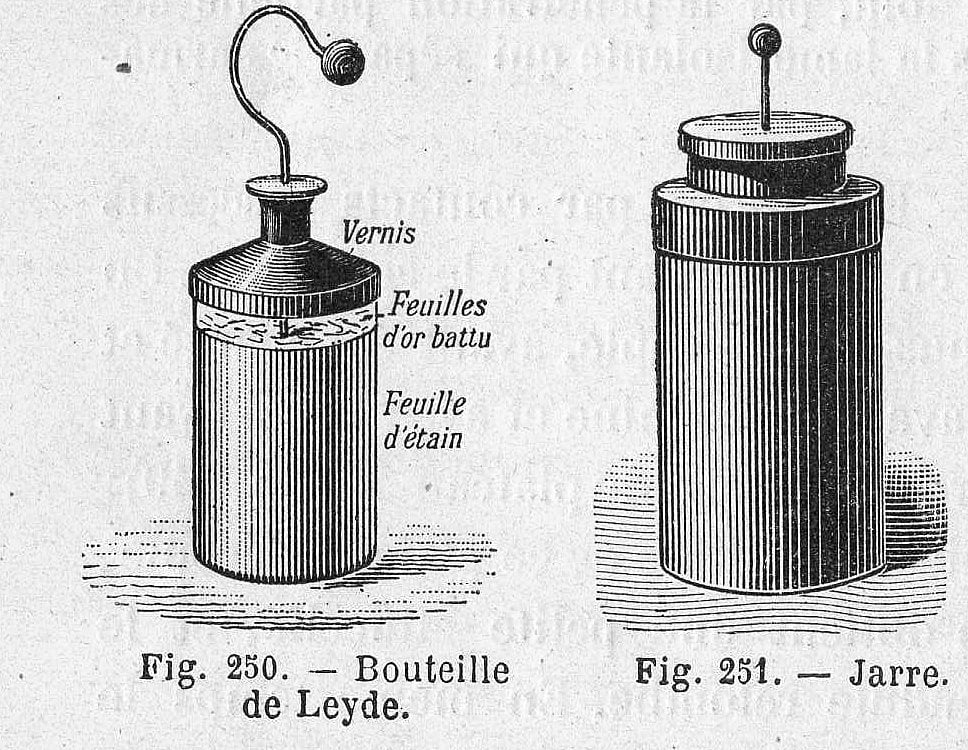
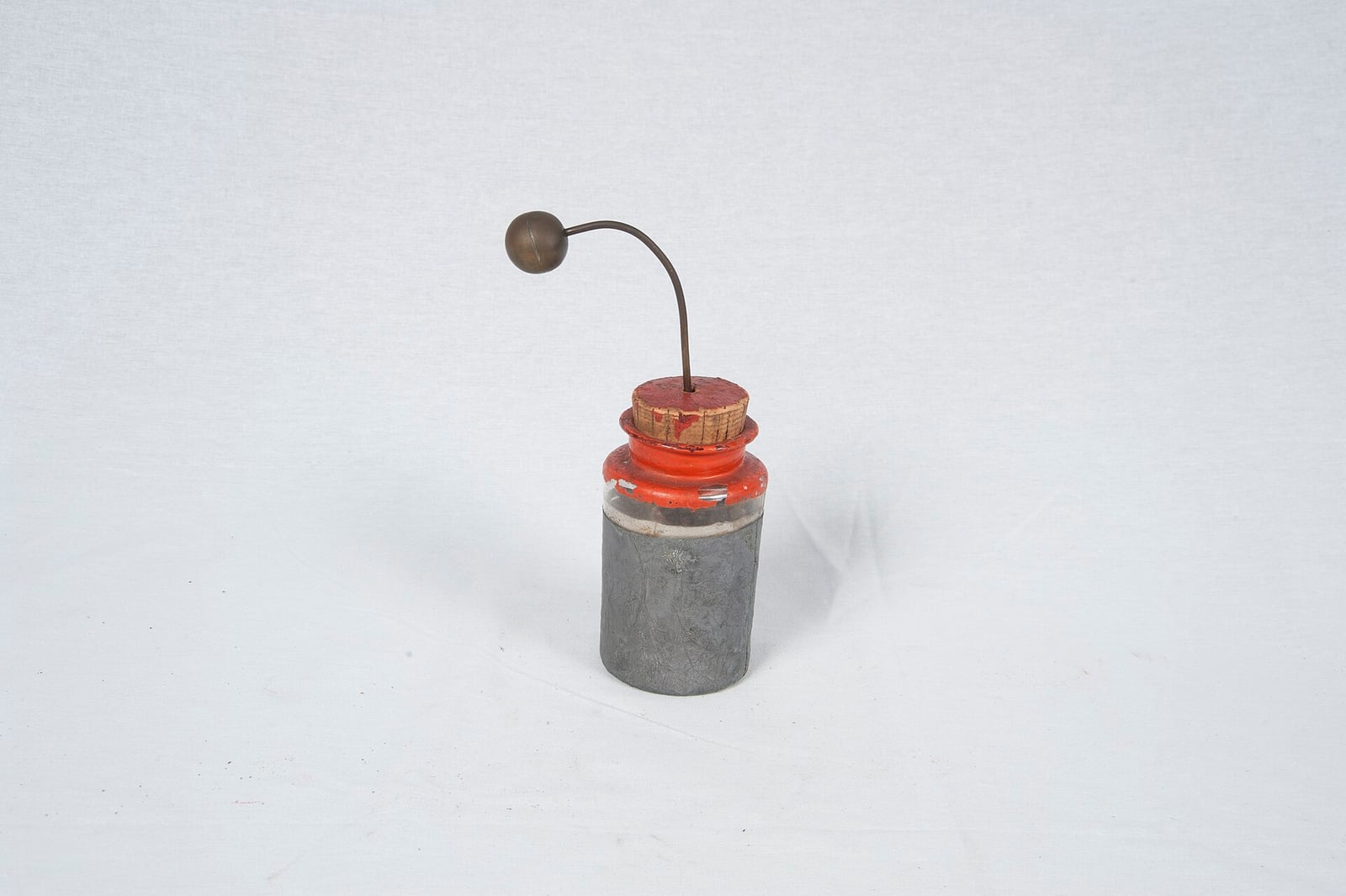
In the autumn of 1745, the German cleric and experimenter Ewald Georg von Kleist ran a wire from an electrical machine into a small medicine bottle partly filled with water and held it in his hand. When he touched the wire he received a violent shock — far stronger than anything the bare machine produced. He had, without understanding it, built a capacitor. Independently, at the University of Leiden in the Netherlands, Pieter (Petrus) van Musschenbroek and his associates reproduced the effect in 1745–46; Musschenbroek’s famous, half-terrified letter describing the jolt spread the news across Europe, and the device took the name of his city: the Leyden jar. In its earliest form the jar was exactly that — a glass vessel with water inside and a wire through the cork; the water was one conductor, the experimenter’s hand the other, and the glass between them the dielectric. Later jars replaced the water and hand with foil coatings inside and out. What mattered medically was simple and enormous: for the first time a physician could store a known charge and release it when he chose, through a body, through a limb, through a nerve. The demonstration lecture and the sickroom were now using the same hardware. The Leyden jar remains the direct ancestor of the condensers built into every later influence machine — see the Static Electricity Machines dive, where Leyden-jar capacitors sit beside the spinning discs of a Wimshurst.
1.3 Franklin, and the first electrical medicine
The man who imposed order on all of this was Benjamin Franklin (1706–1790). Franklin’s kite and his single-fluid theory of positive and negative charge gave the field its language — he coined positive, negative, charge, conductor, battery (of jars) — and turned a heap of tricks into a science. It was inevitable that a public so dazzled by the Leyden jar would ask whether the shock could heal, and Franklin was among the first serious investigators to test it honestly.
In the 1750s Franklin applied Leyden-jar shocks to patients with palsies — paralysis, often following stroke. He reported his results to the Royal Society around 1757–58, and the report is remarkable precisely for its restraint. Franklin noticed that some patients regained a little movement and warmth in a limb, but that the improvement faded within days and that the patients’ own hope may have done as much as the current. He declined to claim a cure. This is the honest, sceptical pole of the whole subject, present at its very birth: the recognition of what is now called the placebo effect, written down by the most famous electrician alive.
Franklin was not working alone in a vacuum. A generation of European experimenters had already tried the frictional machine and the jar on the sick:
- Christian Gottlieb Kratzenstein, in the mid-1740s, is often named the first to report therapy with electricity, describing improvement of paralysed or weakened limbs treated with the machine.- Jean Jallabert, professor of physics at Geneva, published in 1748 his treatment of a locksmith named Nogues whose arm had been paralysed for years; drawing sparks from the arm, he observed muscle contractions and claimed real recovery of function — arguably the first documented electrotherapeutic “success.”- The Abbé Jean-Antoine Nollet, whose machines were a European standard, both promoted and disputed such claims south of the Alps.
- Later, Pierre-Nicolas Bertholon de Saint-Lazare (1741–1800) at Montpellier systematised “medical electricity” in the 1780s, devising positive and negative electric “baths.”
Out of this ferment came a durable word. Static, high-voltage electrical treatment — the effluve or “electric breeze,” the insulated “electric bath,” sparks drawn from the skin — became known in the following century as Franklinization, after the man whose name lent it authority. Its apparatus, methods, and honest limits are the subject of the Static Electricity Machines dive; the point here is only that by 1760 the idea of curing with stored charge was fully formed, and already outrunning its evidence.
1.4 Galvani’s frogs and the birth of “animal electricity”
The subject’s centre of gravity now shifts to Bologna, and to a discovery that would split the field in two.
Luigi Galvani (1737–1798) was an anatomist and obstetrician at the University of Bologna. Through the 1780s he pursued a long series of experiments on “prepared” frogs — the legs severed and the crural nerves left exposed. His pivotal observations came when a frog’s leg twitched as a scalpel touched its nerve while an electrical machine sparked nearby, and, in a version dated to 20 September 1786, when legs hung by brass hooks from an iron railing contracted seemingly on their own during changes in the weather. To Galvani the conclusion was irresistible: the animal itself was the source. He proposed an “animal electricity” — a subtle electrical fluid secreted by the brain, stored in the muscle like charge in a tiny Leyden jar, and discharged through the nerve to produce motion. He published the theory in 1791 as De viribus electricitatis in motu musculari commentarius (“Commentary on the effect of electricity on muscular motion”). Galvani was, in a real sense, right about the largest thing: living nerve and muscle are electrical. His Commentary is the founding document of electrophysiology — the science that runs forward through Duchenne’s nineteenth-century muscle mapping (see Faradic and Galvanic Machines) to the electrocardiogram, the electromyogram, and the modern understanding of the nerve impulse. But he was wrong about the mechanism, and his rival was about to prove it.
1.5 Volta’s answer: the pile of 1800
Alessandro Volta (1745–1827), professor of physics at Pavia, at first admired Galvani’s work and repeated it. But he came to a very different reading of the brass-hook experiment. The electricity, Volta argued, did not come from the animal at all. It came from the contact of two dissimilar metals — the brass hook and the iron railing — bridged by the moist, salty, conducting tissue of the frog. The frog’s leg was not a source; it was merely a sensitive detector, twitching in response to a current the metals themselves generated. This was Volta’s theory of contact electricity, and to prove it he needed a source of steady current that contained no animal tissue whatever.
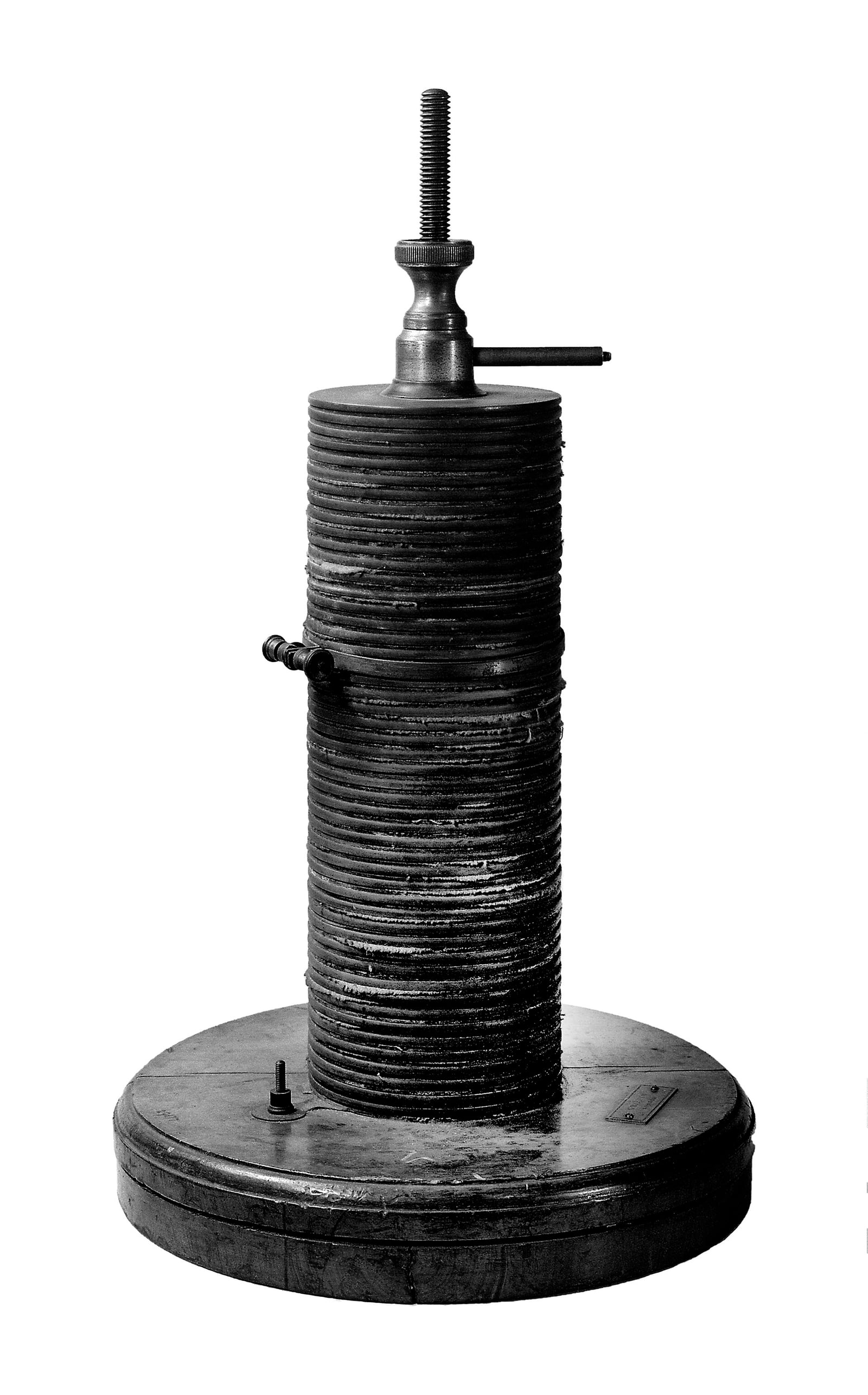
That source was the voltaic pile. Around 1799–1800 Volta stacked alternating discs of two metals — copper (or silver) and zinc — separated by pasteboard or cloth soaked in brine, and found that the stack delivered a continuous current, not the single snap of a Leyden jar. He announced it in a long letter in French, sent from Como to Sir Joseph Banks, president of the Royal Society, dated 20 March 1800; it was read to the Society and published in the Philosophical Transactions as On the Electricity Excited by the Mere Contact of Conducting Substances of Different Kinds. The pile was the first true battery — the first source of sustained current in history — and it changed everything downstream of it. It made Humphry Davy’s electrochemistry possible, and Faraday’s, and eventually the induction coil and the “medical battery” that would define nineteenth-century electrotherapy. In the immediate quarrel, Volta appeared to win outright: he had produced Galvani’s effect with no animal present, and the scientific community swung to contact theory. Galvani, by then old and stripped of his university post for refusing to swear loyalty to Napoleon’s new republic, died in 1798, before the pile was even announced.
1.6 Who was right — and why it matters for everything that follows
The tidy verdict “Volta won” is only half true, and the untidy remainder is the moral of this whole wing.
Volta was right that his pile produced current by chemistry, not biology, and right that the specific brass-hook experiment was contaminated by dissimilar-metal contact. But Galvani was right that living tissue is genuinely electrical: nerves and muscles do generate and conduct their own potentials, as later work — beginning with Carlo Matteucci and Emil du Bois-Reymond in the nineteenth century — decisively confirmed. Both men, in other words, were partly correct, and the modern sciences of electrochemistry (Volta) and electrophysiology (Galvani) both descend, legitimately, from this argument.
The trouble is what happened to the word. “Galvanism” — animal electricity, a vital electrical fluid animating flesh — escaped the laboratory and became a cultural sensation. Galvani’s nephew Giovanni Aldini toured Europe applying voltaic current to the bodies of executed criminals; at a notorious demonstration at the Royal College of Surgeons in London in 1803, current from a battery made the corpse of the hanged murderer George Forster open an eye, clench a fist, and kick, to the horror and delight of the audience. These spectacles fed directly into the Romantic imagination — Mary Shelley named “galvanism” among the ideas behind Frankenstein (1818) — and, more corrosively for this history, they planted the enduring popular belief that electricity is a life force that can be poured into a failing body to restore its vitality.
That belief is the reason this volume is the scene-setter for the entire collection. The legitimate line runs one way: stored charge → controllable current → the measurement of the body’s own electricity → real neuromuscular medicine, the through-line into Faradic and Galvanic Machines and, later, the deep-heating currents of High Frequency Currents. The illegitimate line runs the other way, from the same starting point: electricity as vital essence, a universal tonic, a cure for whatever ails you — the language that would eventually be printed on the box of a drugstore violet-ray wand. The boundary between the two was never a clean wall. It was porous from 1745 onward, because the honest scientist and the hopeful quack were reaching into the same jar.
Franklin, testing shocks on the paralysed and refusing to overclaim, and Aldini, making a dead man’s face twitch for a paying crowd, are the two poles of everything that follows. The remaining volumes of this wing are, in a sense, the long working-out of which apparatus fell to which side — and how often a single machine managed to be on both at once.
Sources
- Leyden jar — Engineering and Technology History Wiki (ETHW)
- Leyden jar — Encyclopædia Britannica
- Leyden Jars, 1745 — National MagLab / Magnet Academy
- Ewald Jürgen von Kleist — Linda Hall Library, Scientist of the Day
- “Fishy” Science Part 2: Ben Franklin and Electrical Medicine — American Philosophical Society
- Benjamin Franklin’s place in the history of medicine — The James Lind Library
- Benjamin Franklin, electricity, and the palsies — PubMed 16717219
- Electric bath (electrotherapy) — Wikipedia
- Therapeutic Attractions: Early Applications of Electricity to the Art of Healing — SpringerLink
- Christian Gottlieb Kratzenstein — Wikipedia
- Sparking controversy: Jean-Antoine Nollet and medical electricity south of the Alps — ResearchGate
- Frogs and Animal Electricity — Whipple Museum of the History of Science, Cambridge
- Luigi Galvani — Encyclopædia Britannica
- Luigi Galvani — National MagLab / Magnet Academy
- Luigi Galvani: beginnings of electrophysiology — Hektoen International
- The Long Journey from Animal Electricity to the Discovery of Ion Channels — PMC
- Alessandro Volta — Linda Hall Library, Scientist of the Day
- Alessandro Volta’s letter to the Royal Society, 20 March 1800 — Science & Society Picture Library
- Volta Invents the Battery — EBSCO Research Starters
- Giovanni Aldini: from animal electricity to human brain stimulation — PubMed 15595271
Comments (0)