Electropathic Belts · Volume 5
Collecting, Identifying, and Displaying
How a collector tells a genuine voltaic chain from an inert 'electric' belt, reads maker marks and power grades, dates a set, conserves leather and metal, and displays the object honestly — with no use as a treatment.
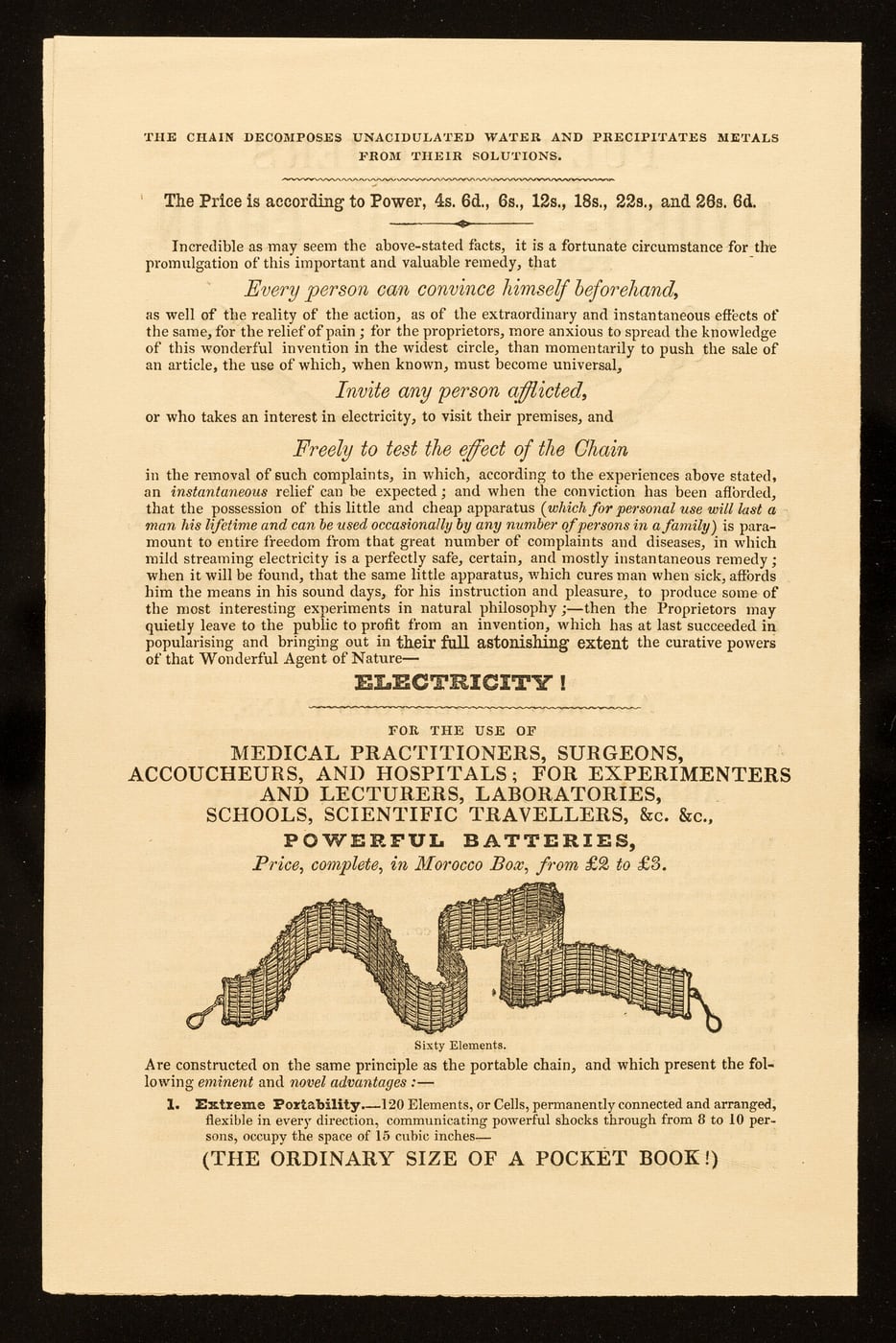
Four volumes have explained what an electropathic belt is — a wearable appliance sold to pass a faint current and “restore vitality” (Vol 1 — The Belt and Its World), what that current actually was and did (Vol 2 — What It Actually Did: The Current), who made them (Vol 3 — The Makers and Their Appliances), and how the whole trade collapsed under exposure and law (Vol 4 — The Promise and the Reckoning). This closing volume is for the person who now owns a belt, chain, or corset, or is about to. The central skill it teaches is a single distinction: is this a genuine voltaic appliance, or an inert prop? Both survive in quantity, both were sold as cures, and telling them apart is the whole game in identifying, dating, and honestly labelling one.
5.1 About this volume
Electropathic belts are among the most collectable objects in the quack-medicine field because they are humble, plentiful, and photogenic: a strip of leather or webbing, some metal discs or a chain of little copper-and-zinc barrels, often a suspensory or corset variant, and — if you are lucky — a printed booklet promising the cure of every “weakness peculiar to men.” They turn up at auction, in militaria and medical-antique sales, and in house clearances, usually cheap and almost always described with more romance than accuracy.
This volume assumes you have read the rest of the dive and refers back rather than repeats. The physics of galvanic versus faradic current — and why transcutaneous direct current at these levels does nothing systemic — is Vol 2; the makers whose names you will read on a plate or booklet are Vol 3. Here the concern is the object in the hand: distinguishing real from inert, decoding the grade, dating the piece, stabilising fragile leather and corroding metal, and framing it for a shelf without repeating the lie that sold it.
5.2 Genuine chain vs. inert belt: the key distinction
Everything starts here, because the two families look superficially alike and are worth remembering as different kinds of thing.
A genuine voltaic appliance — the Pulvermacher chain being the archetype — really was a tiny battery. Each cell was a short wooden dowel, helically grooved like a screw thread, wound bifilar with a copper wire and a zinc wire set close together but never touching, the ends fitted with hooks and eyes so cells could be linked into a chain of any length. Soaked in vinegar (or another weak acid), the porous wood held electrolyte and the assembly evolved a small galvanic current — feeble, and falling steadily as the wood dried. Wikipedia’s summary of the design, drawn from period patents, and the Science Museum Group’s own chain records (gilt copper, zinc, and resin) both describe exactly this construction. A collector can recognise a real chain by that anatomy: paired dissimilar metals with an absorbent carrier between them and a means of wetting it.
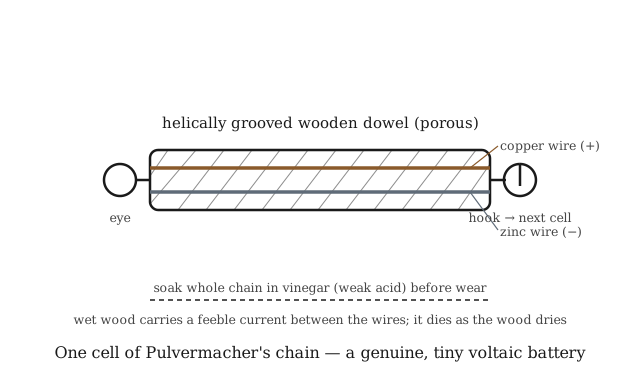
An inert “electric” belt had no working cell at all. Many later products relied on magnets, or on nothing — a tingle, a little warmth, a graded “power” number, and suggestion. The most quoted proof of this is a courtroom demonstration: at the Harness libel proceedings, Lord Kelvin — then President of the Royal Society — examined one of the Medical Battery Company’s belts and found it “incapable of generating an electric current without additional connecting wires to complete the circuit between the copper and zinc discs,” so that worn on the body as sold it “would be electrically ineffective.” That single sentence is the collector’s touchstone. Even where a belt contains copper and zinc, the question is whether the metals form a completed cell across a moist electrolyte, or merely sit as decorative discs with no circuit and no wetting.
Note the sober honesty required either way: a working chain produced a current too weak to treat any systemic disease, and a non-working belt produced none at all. The genuine-versus-inert distinction is about identifying and describing the object, not rehabilitating it — neither did what was promised (see Vol 2). Dr. Scott’s famous “Electric” corset is the cautionary example: the original was magnetic, built around magnetised steel busk plates, and “electric” only in the advertising.
5.3 Reading maker marks and power grades
Because the belts were sold on a promise of strength, they were graded, numbered, and branded — and those marks are your best identifiers.
Maker names and successors. The Pulvermacher chain, first sold in the 1850s from the London firm associated with Isaac Louis Pulvermacher (194 Regent Street), was later marketed under a string of successor and imitator names — Addison’s, Owen’s, and above all Harness’ “Electropathic” belts of The Medical Battery Company. A chain or booklet carrying “Pulvermacher’s of London” branding may in fact be later and made elsewhere; the firm kept the prestigious London style even after operations shifted (the Wikipedia account records the company’s headquarters being moved to Cincinnati by the 1880s as the Pulvermacher Galvanic Company — see Vol 3). Read any maker’s plate, embossed leather, or booklet imprint against the maker table in Vol 3 rather than trusting a seller’s attribution.
Power grades. The clearest grade system belongs to the Heidelberg Electric Belt, sold mail-order through Sears, Roebuck. Its catalogue offered a ladder of “gauges,” from a roughly 20-gauge belt at about $4 up to the “Giant Power” 80-gauge model at $18 in the 1902 catalogue (the $18 figure is roughly $600–$680 in today’s money). The gauge number was marketing for current strength, not a count of working cells — the higher grades simply added discs, larger electrodes, and, for men, a suspensory attachment, all sold as “more power.” A surviving Heidelberg is therefore datable and gradable straight from the number stamped or printed on it, cross-checked to the Sears catalogue year.
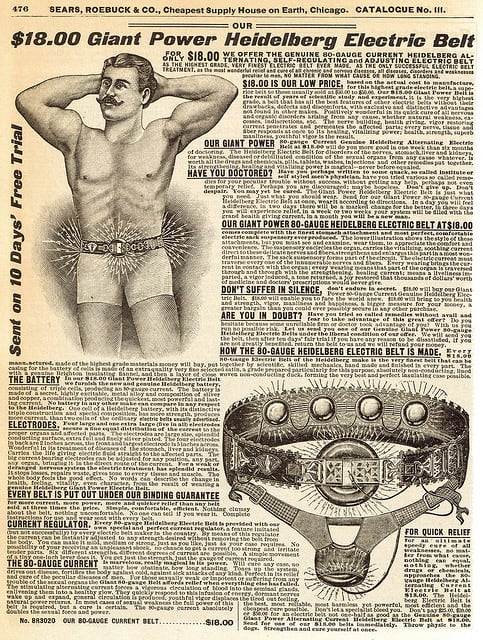
Booklets and certificates. The persuasion lived in print as much as in metal, so an accompanying instruction booklet, testimonial pamphlet, or “physician’s” endorsement leaflet is both an identifier and a large part of a set’s value. Titles such as Electricity, Nature’s Chief Restorer (a Pulvermacher chain-belt pamphlet) tie an object to a firm and a decade.
5.4 Dating a belt or chain
Date from the evidence outward, cheapest clue first.
- Named brand + grade → catalogue year. A Heidelberg gauge number places the piece against a specific Sears catalogue (the belts run roughly 1890s–1900s); a Harness “Electropathic” mark places it against The Medical Battery Company, whose London trade peaked before its 1893 collapse (see Vol 4). Museum records date surviving Pulvermacher chains broadly to 1860–1910.
- Construction. A true bifilar copper/zinc-on-dowel chain points to the Pulvermacher lineage of the mid-to-late 19th century; flat stamped-disc belts on webbing with a battery pocket point to the later mail-order era (the 1890s–1900s Heidelberg/Boyd generation); magnetic plates with no cell at all point to the Dr. Scott “electric” family.
- Materials and hardware. Gilt (gold-plated) copper over zinc, natural rubber or gutta-percha insulation, hand-finished leather, and split-pin or hook-and-eye linkages read earlier; machine-stamped fittings, printed cloth labels, and mass-catalogue styling read later.
Where a date is only inferable, say so on the label. Museum catalogue ranges (the Science Museum Group’s “1860–1910,” the Didusch urology museum’s circa dates) are themselves estimates, and a collector should adopt the same honest hedging rather than inventing a precise year.
5.5 Conservation: leather, fabric, and metal
An electropathic belt is a mixed-materials object — the hardest kind to keep — and the materials actively harm each other, so conservation is mostly about a stable, gentle environment rather than intervention.
Metal (copper, zinc, gilt). Do not routinely polish. Standard museum guidance is that regular polishing “eventually wears down the surface and removes details” — and on a gilt chain it would strip the very plating that identifies it. Zinc normally self-protects with a thin oxide, but active corrosion (white powdery bloom, verdigris on the copper) signals a humidity or pollutant problem to fix at the source. Keep relative humidity low and stable; conservation references note steel will not rust and brass will not tarnish below about 15% RH, and low, steady RH suppresses zinc and copper corrosion too. A microcrystalline wax such as Renaissance Wax, applied sparingly by a conservator, is the accepted barrier coating for stable metal — not a cleaner for active corrosion.
Leather and fabric. These are the fragile, value-carrying parts (the carrier strap, corset fabric, velvet, suspensory webbing). Handle minimally, support the whole length when lifting, and keep the piece out of direct light (which fades and embrittles) and away from swings in humidity (which crack leather and foster mould). Crucially, leather and many fabrics emit organic acids and sulphur compounds — and acetic and formic acid are the dominant indoor-display pollutants — which accelerate metal corrosion when the two share a sealed case. That is the single most important conservation fact for these objects: a belt’s own strap can be quietly attacking its own metal.
What not to do. Do not soak a chain in vinegar “to see if it still works” — that is re-running the original wet-cell chemistry on a fragile antique and will drive fresh corrosion into century-old metal and wood. There is no reason to energise or activate one of these appliances; it never had a legitimate use, and its value now is entirely as an artefact.
5.6 Display and honest labelling
Displayed cold and dry, an electropathic belt is a superb object. Lay a chain flat so the alternating copper and zinc barrels read as a series; show a Heidelberg with its grade number forward and its booklet open beside it; mount a corset or suspensory on an inert form that supports the fabric without stress. Use an acid-free, chemically-stable case (avoid raw wood and unstable plastics, which off-gas the very acids that corrode metal), buffer the humidity, and keep light low.
The label is where a collector honours the history. State the marketing claim, then the physics, then the outcome — the discipline of this whole dive. A good caption names the maker and grade, gives the honest date range, notes whether the object is a genuine (if feeble) voltaic chain or an inert “electric” prop (citing, where apt, Kelvin’s verdict on the Harness belt), and says plainly that the promised cures were false and the trade ended in exposure and prosecution. Provenance — a booklet, a Sears catalogue page, a receipt, a chemist’s or utility retailer’s label — turns “an old electric belt” into a dated, attributed document of the electric-medicine craze. What a label must never do is imply the thing can be worn or works; the correct posture, exactly as with the violet-ray wand, is display, not use.
5.7 Where this volume hands off
This is the last volume of the Electropathic Belts dive. Its central lesson — read the object, then tell the truth about it — carries across the whole Quack Devices wing, each of whose dives ends on the surviving artefact and how to identify it honestly. The porous boundary noted throughout also points outward: the legitimate cousin of the “medical battery,” the physician’s faradic and galvanic apparatus that was a real (if limited) clinical tool rather than a mail-order cure-all, belongs to the Electrotherapy Devices wing — see Electrotherapy → Faradic and Galvanic Machines, where the same copper, zinc, and coils are treated as instruments instead of impostures.
Sources
- Pulvermacher chain, European, 1860–1910 — Science Museum Group Collection (A602759) — a catalogued chain: gilt copper, zinc, and red resin, about 530 × 35 × 7 mm, dated 1860–1910; supports the object description, materials, and honest date range.
- Pulvermacher belt (soaked in vinegar before applying) — Science Museum Group Collection and Lady’s galvanic belt (Pulvermacher) — vinegar activation and the “cure all nervous diseases” claim, on real objects.
- Pulvermacher’s chain — Wikipedia — the bifilar copper/zinc-on-grooved-dowel cell construction, hook-and-eye linking, vinegar activation, current that falls as the wood dries, and the Addison/Owen/Harness marketing succession (leads verified against museum records).
- Harness’s Electric Corset / “The Harness Electropathic Swindle” — The Quack Doctor and Harness’ Electropathic Belts — The Ardross-man — Lord Kelvin’s courtroom finding that the belt was “incapable of generating an electric current without additional connecting wires… electrically ineffective,” the 1893 Pall Mall Gazette exposé, and the arrests of Harness and McCully; supports the genuine-vs-inert test and the debunking framing.
- Electropathic Cure: Quackery in the Electric Era — New York Almanack — the graded Heidelberg belts, the 1902 Sears “Giant Power” belt at $18, and the mail-order/consumer-vs-clinic framing.
- Heidelberg Alternating Current Electric Belt — Museum of Quackery and Running with the Current: Quackery in Electrical Medicine — William P. Didusch Museum of Urology — Heidelberg/Pulvermacher belts as cloth-covered vinegar-soaked appliances for “weaknesses peculiar to men,” a dated museum specimen, and the suspensory/male-appliance context.
- Dr. Scott’s Electric Corset — The Ardross-man — that Dr. Scott’s “electric” corset was in fact a magnetic device (magnetised steel plates), the key inert-prop example.
- Caring for metal objects — Canadian Conservation Institute, Metal collections care — Museums Galleries Scotland, and Corrosion Risk to Metal-Based Artefacts in a Museum — PMC — low, stable relative humidity; the harm of over-polishing; and that leather and fabric emit organic (acetic/formic) acids and sulphides that corrode metal displayed alongside them; supports the mixed-materials conservation section.
- Using Renaissance Wax for metal preservation — Preservation Equipment Ltd — microcrystalline wax as the accepted barrier coating for stable metal (a protectant, not a cleaner).
Comments (0)