Electropathic Belts · Volume 2
What It Actually Did: The Current
One genuine but feeble voltaic pile, a crowd of inert imitators, and the honest electrochemistry that explains why a belt of copper and zinc against the skin cannot reach an organ.
2.1 About this volume
Vol 1 — The Belt and Its World placed the electropathic belt in its Victorian setting: a waist-worn appliance sold to a newly electrified public as bottled “vitality.” This volume opens it up and asks the only question a museum reader should care about — did any current actually flow, and if it did, could it have done anything? The honest answer splits the whole product category in two. A small number of these appliances, headed by Pulvermacher’s galvanic chain, were genuine voltaic batteries that produced a real, if feeble, current. The great majority of the later “electric” belts, corsets, and body-batteries produced no meaningful current at all, trading on magnetism, warmth, a faint chemical tingle, and suggestion.
Neither group could deliver on the promises catalogued in Vol 4 — The Promise and the Reckoning, and the reason is the same for both: the electrochemistry is real but the physiology is not. This volume tells the physics plainly, keeps the vocabulary honest — galvanic and faradic are not interchangeable, however loosely the advertisements used them — and draws the line to the one place where a “medical battery” was a legitimate instrument, treated in the Electrotherapy Devices → Faradic and Galvanic Machines dive.
2.2 The one that really was a battery
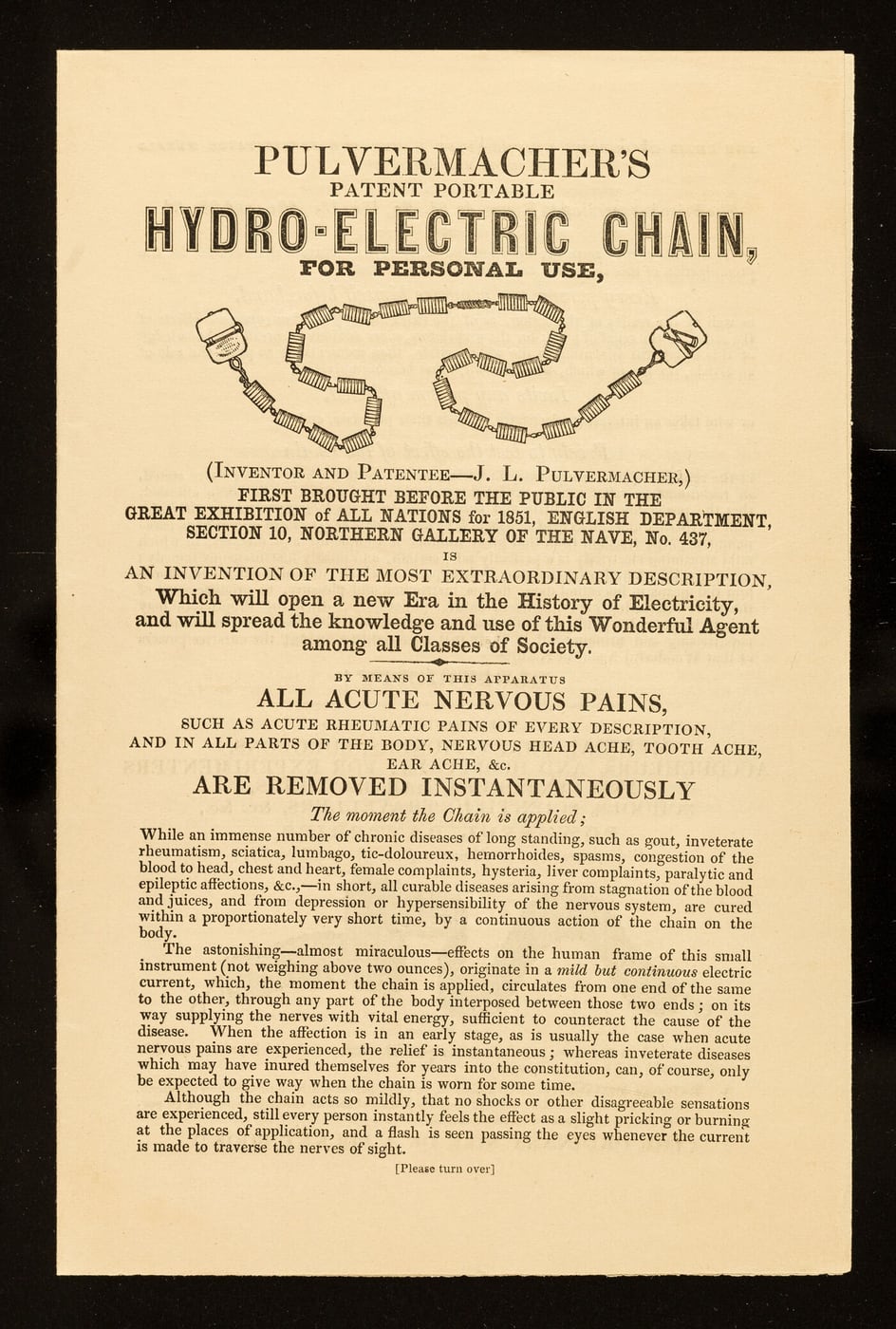
The Pulvermacher hydro-electric chain deserves its reputation as the honest member of the family, because electrically it worked exactly as its inventor said. Isaac Lewis (Louis) Pulvermacher — an inventor whose 1853 US patent gives his residence as Breslau — first published the design in German in August 1850 and brought it to Britain that winter, establishing the firm long associated with 194 Regent Street, London (Wikipedia; New York Almanack).
The chain was a voltaic pile built as jewellery. Each cell was a short wooden dowel wound with a bifilar (two-wire) helix — one wire copper, one wire zinc — the turns set in helical grooves so the two metals ran side by side without touching. Dozens of these cells were linked end to end into a flexible chain or sewn onto a fabric carrier as a belt. Before wear the whole thing was dipped in vinegar (dilute acetic acid; a salt solution or other weak acid worked too). The vinegar was the electrolyte: with copper as the positive electrode, zinc as the negative electrode, and acid between them, each cell became a working galvanic couple (Wikipedia; Science Museum Group).
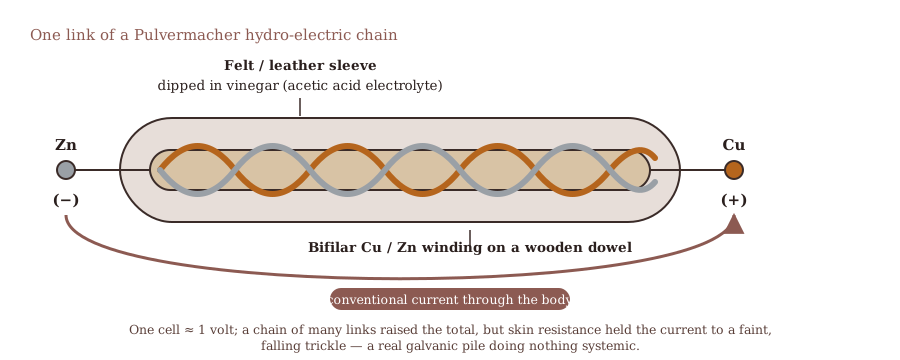
Because the output rose with the number of links, the chain was effectively a battery with a variable count of cells in series. Period descriptions record that a chain of about 50 links gave a “sharp” shock and one of about 120 links a “strong” one — the user tuned the dose by choosing how much chain to wear (Wikipedia). At roughly a volt per cell this is real electricity, and a long chain could raise a genuinely uncomfortable potential. But two facts hem it in. First, an acetic-acid cell is a weak cell to begin with. Second — and decisively — the belt sat against skin, whose electrical resistance is high and whose contact was only ever a damp cloth. As the vinegar dried, the electrolyte thinned, the internal resistance climbed, and the current sagged toward nothing. A Pulvermacher belt was therefore a battery that was strongest at the moment it was least like a therapy and weakest for the hours it was actually worn.
That it worked at all made it the respectable face of the trade. The physician Golding Bird examined a sample in early 1851 and, in an October 1851 note in The Lancet, praised the apparatus — an initial, favourable notice the firm advertised widely. By the time of his dispute with the company, however, Bird’s endorsement had cooled to a pointedly qualified one: writing in the Association Medical Journal on 15 April 1853, he called the chain “an ingenious and useful source of electricity” while criticising the company’s extravagant advertising (Wikipedia; Golding Bird, Association Medical Journal, vol. 1 n.s., no. 15, 15 April 1853). A qualified endorsement of the apparatus was quietly inflated into an endorsement of the cures — a pattern that recurs throughout Vol 3 — The Makers and Their Appliances.
2.3 Galvanic versus faradic: getting the words right
The belts advertised themselves with a slippery vocabulary — “galvanic,” “electropathic,” “electric,” sometimes even “alternating current” — and it is worth fixing the terms, because the difference is exactly what separates these appliances from real electrotherapy.
Galvanic current is steady direct current (DC): a constant one-way flow, of the kind a voltaic cell like Pulvermacher’s produces. Clinically its effects are chemical and sensory — a slow drift of ions, a tingling or warmth under the electrode — and the one narrow legitimate use built on it is iontophoresis, driving a charged drug a short way through the skin (Hospital Store, “Faradic vs. Galvanic”; Physiopedia).
Faradic current is different: a rapidly interrupted or induced current, short pulses at roughly 50–100 Hz, produced not by a wet pile but by an induction coil — the “shocking coil” of the Victorian medical battery. Its defining property is that it makes motor nerves fire and muscles contract; that is what made it a real diagnostic and therapeutic tool for innervated muscle (Physiopedia; Hospital Store).
The electropathic belt is squarely a galvanic object — a feeble DC source when it worked at all. It had no interrupter, no induction coil, and produced none of the twitch of a faradic device. This matters for the debunking: even at its honest best, a belt could not do the one physiologically vivid thing — contract a muscle — that made the faradic medical battery look like medicine. It offered only the sensory low end of the galvanic range, and even that faintly.
2.4 Why transcutaneous DC at these levels does nothing
Grant the best case: a fresh, thoroughly vinegar-soaked Pulvermacher belt of many links, pressed to the skin. Why does the physics still refuse to deliver a systemic cure?
Start with resistance. Dry human skin presents a large barrier to current — on the order of tens to hundreds of thousands of ohms — and a belt’s contact is a strip of drying cloth, not a clinical electrode with conductive gel. A weak acetic-acid pile pushing against that resistance drives only a tiny current, in the microamp-to-low-milliamp range, most of it spreading through the moist surface layers rather than plunging inward. The energy that reaches any internal organ is negligible.
Next, direction and depth. Galvanic DC does not radiate or penetrate; it simply completes a circuit through whatever conductive path lies between the electrodes, which for a surface belt means the skin and the shallow tissue just beneath it. There is no mechanism by which a steady one-way trickle at the body surface reaches a kidney, a liver, a nerve plexus, or the reproductive organs in any dose that could “restore” them. The sensations the wearer did feel — a prickle, a little warmth, a metallic taste of the acid on abraded skin — are real surface effects and were easily mistaken for the medicine working.
Finally, the claims don’t match any known action of current. Rheumatism, “torpid liver,” hernia, impotence, “spermatorrhoea,” and neurasthenia are not conditions that a milliamp of transcutaneous DC addresses, then or now. The belt’s genuine outputs are a mild counter-irritant tingle and a powerful expectation — the same placebo engine that ran the whole electric age. That is the entire honest ledger: a real but trivial current, real surface sensation, and no route to the organs the advertising named.
2.5 The inert majority: magnets, tingles, and nothing at all
If Pulvermacher’s chain was the honest end of the trade, the boom that followed was mostly hollow. By the 1880s and 1890s “electric” belts poured out of firms whose appliances contained no working cell. The most notorious, C. B. Harness’s Medical Battery Company of London, sold an “Electropathic Belt” of zinc and copper plates that was supposed to generate a “health-giving current” but in practice “produced no sensation whatsoever,” while the companion electric corset was frankly magnetic rather than electric — its only special part a magnetised steel busk, with no battery at all (The Quack Doctor; British Newspaper Archive blog). The American Dr. Scott’s Electric line — corsets, hair brushes, flesh brushes — was the same trick under a different name: the “electricity” was really the weak field of magnetised iron, delivering no current to anything (New York Almanack). Where a belt did include dissimilar metals and a damp pad, wearers might feel a faint galvanic tingle when they perspired — an effect indistinguishable, to the buyer, from the magnetic belts that did nothing measurable at all.
Onto this vacuum the sellers bolted a masterstroke of marketing: the graded “power” number. Mail-order belts such as the Heidelberg Electric Belt, whose 1902 Sears, Roebuck ladder of “gauges” ran from about $4 for the cheapest 20-gauge belt up to $18 for the premium 80-gauge “Giant Power” grade (the frequently-cited $12 Heidelberg being a mid/standard grade rather than the entry price), invited the customer to buy a higher number for a harder case (New York Almanack; Didusch Museum). The grade was a price tier dressed as a dose. Since the underlying appliance produced little or nothing, a “stronger” belt mostly delivered a stronger expectation — and a larger bill. (⟨verify — specific Heidelberg price points and “Giant Power” grade names vary between catalogue years and between secondary retellings; treat exact figures as approximate.⟩)
2.6 The line to the legitimate medical battery
None of this means electricity had no place in nineteenth-century medicine. It had a real one — which is why the belts could borrow its language so profitably. The genuine article was the faradic (and galvanic) medical battery: a wooden or leather case holding a cell, an induction coil with a vibrating interrupter, and a pair of handheld electrodes, used by clinicians to stimulate muscles and nerves. Beard and Rockwell’s 1871 Medical and Surgical Electricity already described, for instance, faradization applied to the neck of the bladder for incontinence — a serious clinical technique, not a cure-all (Didusch Museum).
The difference between that instrument and the electropathic belt is the whole moral of this volume. The medical battery was faradic — it could contract a muscle — operator-controlled, and applied deliberately by someone who could see the effect. The belt was galvanic at best, inert at worst, worn passively for hours in the hope that mere contact would work. Same borrowed vocabulary; opposite objects. The legitimate hardware, its interrupter, and its honest and dishonest uses belong to the Electrotherapy Devices → Faradic and Galvanic Machines dive, and the high-frequency cousin — the violet-ray wand — is dissected in the Violet Ray Wands dive of this same collection. The electropathic belt is what happens when that real technology is stripped of its coil, its operator, and its honesty, and sewn into underwear.
2.7 Where this volume hands off
With the electrochemistry settled — one genuine feeble pile, a crowd of inert imitators, and no path to the organs — the story turns to the people who sold it. Vol 3 — The Makers and Their Appliances profiles Pulvermacher, Harness’s Medical Battery Company, Dr. Scott, the Heidelberg mail-order trade, and Overbeck’s later “Rejuvenator,” and shows how a qualified endorsement of the apparatus became an advertisement for impossible cures. Vol 4 — The Promise and the Reckoning sets those claims against the physiology established here and tells the debunking: the 1893 Pall Mall Gazette “Harness Electropathic Swindle,” the collapse of the Medical Battery Company, and the later fraud actions. Vol 5 — Collecting, Identifying, and Displaying closes on how a collector tells a genuine Pulvermacher chain from an inert magnetic belt on the bench today.
Sources
- Pulvermacher’s chain — Wikipedia — supported Pulvermacher’s biography and 1850 publication, the copper-cathode/zinc-anode/vinegar construction, the bifilar wooden-dowel cell, and the 50-link “sharp” / 120-link “strong” dose. Golding Bird’s initial October 1851 Lancet notice is recorded via Wikipedia; the specific phrase “an ingenious and useful source of electricity” is from his later, qualified assessment in the Association Medical Journal (vol. 1 n.s., no. 15, 15 April 1853), not the 1851 Lancet piece.
- Pulvermacher belt object record — Science Museum Group Collection — supported the surviving belt described as having to be soaked in vinegar before wear, and its “cure all nervous” marketing.
- Electropathic Cure: Quackery in the Electric Era — New York Almanack — supported the 194 Regent Street firm, the suspensory variant, the Harness and Dr. Scott magnetic appliances, and the 1902 Sears Heidelberg belt at about $12.
- Running with the Current: Quackery in Electrical Medicine — William P. Didusch Museum — supported the vinegar-soaked “cloth-covered voltaic battery” description, the “weaknesses peculiar to men” claims, and Beard and Rockwell’s legitimate faradization of the bladder neck.
- Harness electric corset — The Quack Doctor — supported the corset being magnetic (a magnetised steel busk) rather than electric, with no battery.
- Currents Comparison: Faradic vs. Galvanic — Hospital Store and Faradic Stimulation — Physiopedia — supported the galvanic-DC versus faradic-interrupted distinction, the ~50–100 Hz faradic pulse producing muscle contraction, and galvanic use in iontophoresis.
- Cross-references (named in prose): Electrotherapy Devices → Faradic and Galvanic Machines for the legitimate medical battery and its induction coil; the Violet Ray Wands dive for the high-frequency retail cousin.
Comments (0)