Electropathic Belts · Volume 4
The Promise and the Reckoning
What the electropathic belt was sold to cure — above all the anxious male body — and how the 1893 Pall Mall Gazette exposé of the Harness 'Electropathic Swindle', the AMA's 'Nostrums and Quackery', and the American mails-and-FDA enforcement that followed turned the belt into the emblem of Victorian quackery.
Contents
4.1 About this volume
The volumes around this one describe an object and its trade: the belt and the world that wore it (Vol 1 — The Belt and Its World), the real electrical physics of the current it did or did not pass (Vol 2 — What It Actually Did: The Current), and the makers and their competing appliances (Vol 3 — The Makers and Their Appliances). This volume is about the words and the ending: what the electropathic belt was sold to cure, why it became the byword for medical fraud, and how — first in a British newspaper war and then in decades of American enforcement — the promise was taken apart.
A note on discipline, because this field is thick with repeated myths and inflated numbers. Where a date, quotation, or court outcome could be pinned to a museum, an archive, or a government record it is cited as such below; where it survives only in secondary accounts it is flagged in the prose as reported or commonly cited. Nothing here is medical advice. The belt is presented as history and as a cautionary tale — the marketing claim first, then the physics and medicine, then the historical reckoning.
4.2 The vitality pitch: fear sold back as a cure
The electropathic belt did not sell a current. It sold vitality — and it manufactured the anxiety it then offered to relieve. The recurring keyword across a generation of advertising is “vigour”: Harness’s belts were “scientifically constructed for new life and vigour”; the Heidelberg belt promised to bring “back lost strength and power”; Dr. Sanden’s belt told the reader that “when a man is broken down by the results of hard usage — when his vitality is low — Electricity poured into his nerves will build him up.” The pitch worked by naming a private dread — that a man’s store of “vital force” or “nerve force” was a finite quantity being drained away — and then presenting a wearable, discreet, mail-order refill.
That model of the body was itself period pseudoscience, but it was pervasive enough to feel like common sense. Vitality was imagined as a kind of electrical charge; illness and exhaustion were a discharge; and the belt, worn against the skin, was a battery to top it up overnight. The visible apparatus did the persuading — the copper-and-zinc studs, the numbered “power” grades, the warmth and faint tingle described in Vol 2 — none of which required any therapeutic current to be present, only the belief that one was.
4.3 The cure-all and its favourite target
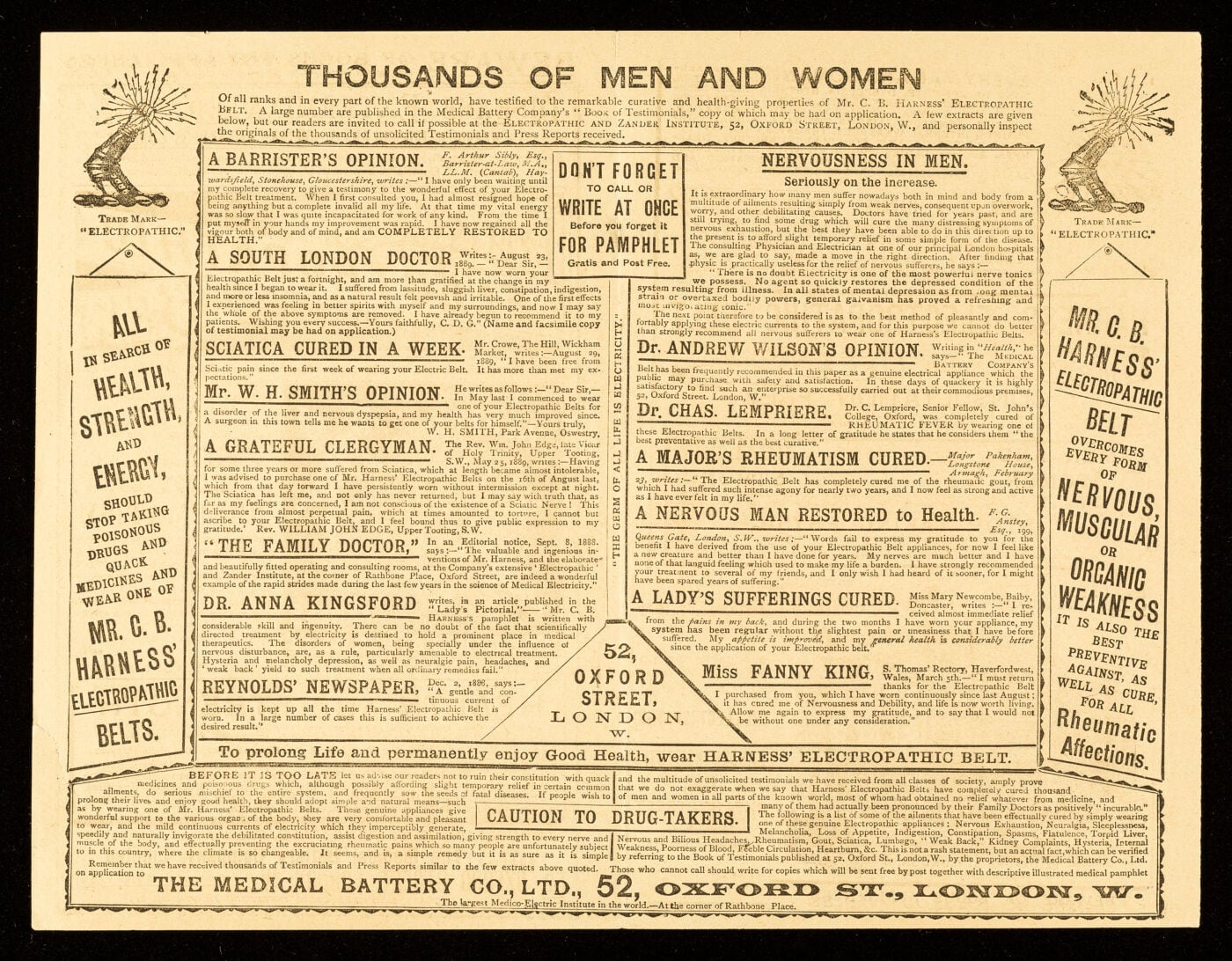
On paper the claims were universal. Dr. Scott’s “electric” flesh brush — marketed in America and Britain by the Pall Mall Electric Association, and in fact magnetic rather than electric (Vol 3) — was advertised as a cure for “rheumatism, sciatica, gout, nervous debility, lumbago, neuralgia, toothache, malarial lameness, aches and pains from colds, impure blood and impaired circulation.” Harness’s belts were offered against nervous complaints, indigestion, sleeplessness, “kidney and liver” disorders, hernia, and general debility, per the surviving advertising catalogued by The National Archives and the Wellcome Collection. The Heidelberg belt, sold by mail through Sears, Roebuck & Co. — a ladder of “gauges” in the 1902 catalogue running from about $4 for the cheapest 20-gauge belt up to $18 for the top-of-the-range 80-gauge “Giant Power” model, with the frequently-cited $12 Heidelberg sitting as a mid/standard grade rather than the entry price — claimed “the most wonderful relief and cure of all chronic and nervous diseases.”
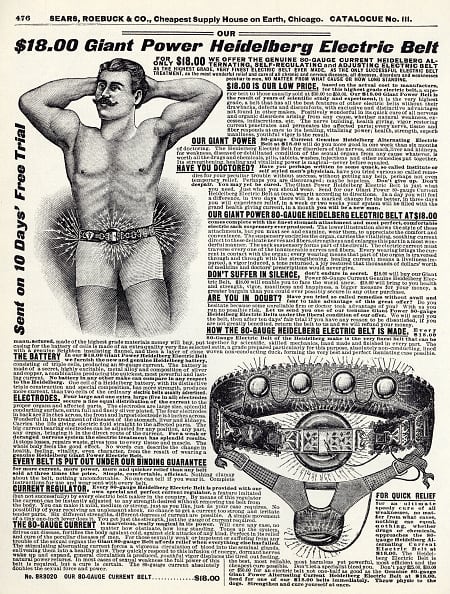
But behind the long alphabetical lists sat a smaller, sharper set of promises aimed at a single anxious customer: the man who feared he was failing. The William P. Didusch Museum’s urological history notes that the most famous belts — Heidelberg and Pulvermacher among them — were sold above all to cure “weaknesses peculiar to men”: impotence, incontinence, and “nervous maladies.” The Victorian and Edwardian vocabulary for this ran through impotence, “spermatorrhoea” (an invented disease of involuntary seminal loss, blamed on masturbation), “lost manhood,” neurasthenia, and general “nervous exhaustion.” Pulvermacher’s firm sold a dedicated “suspensory” appliance for the male genitals and openly linked masturbation to a loss of “vigour” the chain would supposedly restore. Dr. Sanden’s product was, explicitly, an “Electric Belt and Suspensory for Men.”
This is worth stating soberly rather than sensationally: the electropathic belt’s commercial engine was male sexual shame. The wider rheumatism-and-lumbago list gave the product respectability and a mainstream shop window; the private “weakness” claims — advertised in code, sold by post, worn under the clothes — were where the fear, and much of the money, actually lived.
4.4 From doctor’s tool to emblem of quackery
The belt had a brief period of borrowed respectability. Genuine galvanism and faradism were real tools of Victorian medicine — the physician’s “medical battery,” a legitimate faradic and galvanic instrument, is the honest cousin of this whole trade and is treated in its own right in Electrotherapy → Faradic and Galvanic Machines. Early on, real names lent the appliances credibility: the London physician Golding Bird praised Pulvermacher’s chain as “an ingenious and useful source of electricity” (Association Medical Journal, vol. 1 n.s., no. 15, 15 April 1853), and Pulvermacher advertised the endorsement widely. Bird’s notice was qualified from the outset, and he soon recoiled further, publicly objecting that the company had misused his testimonial to make curative claims he never supported; by 1853, medical journals had begun refusing Pulvermacher’s advertisements outright.
That arc — respectable notice, then repudiation — repeated across the industry, and by the 1890s the electric belt had become the very emblem of quackery. The Didusch Museum puts it plainly: though electric belts were briefly promoted by physicians, “by the 1890s they had come to symbolize quackery,” rejected by practitioners as fraud once medical research had moved on. The devices had not changed; the profession, and eventually the press, had simply stopped indulging them.
4.5 1893: the Harness “Electropathic Swindle”
The reckoning had a flashpoint, and it was British. Cornelius Bennett Harness — a former jeweller and furniture salesman with, as his critics stressed, no medical or scientific training — had built the largest electropathic enterprise in London. Trading as the Medical Battery Company from 52 Oxford Street (his “Electropathic and Zander Institute,” founded 1885), Harness sold belts, corsets, and appliances on an industrial advertising budget.
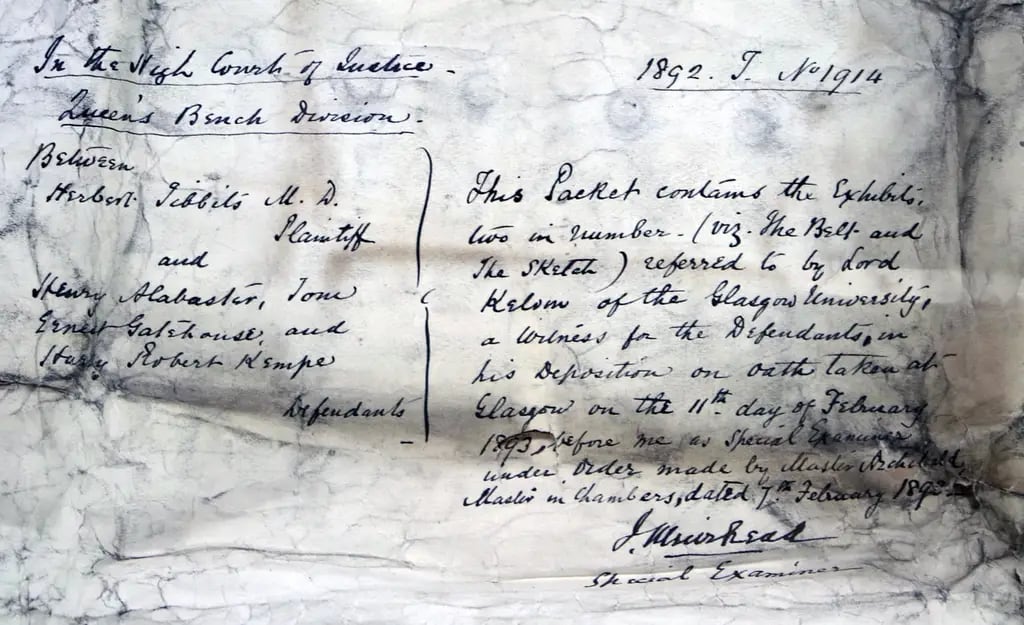
Two things brought him down. The first was scientific testimony. In a libel action arising from the trade — Dr. Herbert Tibbits, an ally of the company, had sued the proprietors of The Electrical Review for £5,000 over their exposés — the defence called Lord Kelvin, then President of the Royal Society. On 11 February 1893, Kelvin examined one of Harness’s belts and testified that it was “incapable of generating an electric current without additional connecting wires… if worn on the body as it is, it would be electrically ineffective.” The Electrical Review won. A former jeweller’s central product had been declared electrically dead by the most eminent electrical physicist in the country.
The second was the popular press. In October 1893 the Pall Mall Gazette stopped taking the company’s advertising and ran a series headed “The Harness ‘Electropathic’ Swindle,” opening with the line that “The Medical Battery Company has for years past been fattening on a system of fraud and imposture which is absolutely unequalled in the annals of swindling,” and dismissing Harness himself as “a common, illiterate and unscrupulous charlatan.” Customers began demanding refunds. Harness retaliated by circularising newsagents, threatening to hold them liable as publishers of “malicious libels” if they kept selling the offending papers — a move that only widened the scandal.
In early November 1893 Harness and his associate Dr. James McCully (a physician struck from the Medical Register) were arrested and charged with conspiracy to defraud. The prosecution did not deliver the clean conviction the story is sometimes remembered to have produced: McCully was acquitted, and the jury could not agree on a verdict for Harness. The commercial verdict, however, was decisive. The Medical Battery Company was driven into a compulsory winding-up (reported variously as beginning in late 1893 and completed in 1894), and Harness’s attempt to relaunch as the “Medical Electrical Institute” collapsed within months under his ruined reputation. He eventually emigrated to Christchurch, New Zealand, where he is reported to have died in 1921. (Accuracy flags: the exact winding-up date is given inconsistently across secondary accounts — 1893 vs. 1894 — and Harness’s death year rests on a single secondary source; both should be confirmed against the London Gazette insolvency notices and New Zealand records.)
4.6 The American reckoning: Nostrums, the mails, and the FDA
America’s belt trade was larger, more mail-order, and slower to die. Tens of thousands of electric belts were sold in the United States between the 1890s and the 1920s — Dr. Sanden, Dr. Bell, the Heidelberg, and dozens of drugstore and catalogue brands — precisely because the U.S. lacked a British-style press-and-courts flashpoint. The reckoning there was documentary and administrative rather than dramatic.
Its central monument is the American Medical Association’s “Nostrums and Quackery,” compiled largely by Arthur J. Cramp of the AMA’s Bureau of Investigation and issued in book form by the AMA Press in Chicago (editions in 1911, 1921, and 1936), gathering material first printed in the Journal of the American Medical Association. Cramp’s volumes catalogued the electric-belt makers by name, reproduced their advertising, and set beside it the analyses showing the devices were inert or trivial — the paper indictment that made “electric belt” a synonym for fraud in American medicine.
The enforcement muscle behind that indictment came from two directions. The U.S. Post Office held the older weapon: the mail-fraud statutes and the Postmaster General’s power to issue “fraud orders” barring a scheme from the mails — the standard federal tool against mail-order medical humbug in the belt era, since a fraud order could sever a catalogue business from its customers overnight. Later, after the Federal Food, Drug, and Cosmetic Act of 1938 for the first time extended federal authority to medical devices, surviving “electro-therapeutic” belts and their descendants became subject to FDA seizure and misbranding action. (Accuracy flag: that the Post Office fraud-order power and, later, FDA device authority were the operative U.S. mechanisms is well established in the general regulatory history; this volume could not, in this pass, pin a specific dated fraud order or FDA seizure to a named belt maker such as Heidelberg or Sanden. Treat the U.S. enforcement here as the correct mechanism and pattern rather than a sourced individual case, and confirm specifics against the FDA Notices of Judgment and Post Office fraud-order records before citing a particular action.)
4.7 Why none of it could have worked
The regulators and the physicists were right, and the reason is the physics set out in Vol 2, summarised here only as the ground of the reckoning. Two honest points settle it.
First, most “electric” belts had no working cell at all. Dr. Scott’s appliances were magnetic, not electric. Countless catalogue belts contained inert metal, a token or nothing. The “power grade” was a number on a label, not a measured output.
Second — and this is the point that defeats even the genuine Pulvermacher chain, which really was a feeble copper-zinc voltaic pile activated in vinegar — transcutaneous direct current at these levels does nothing systemic. Dry skin is a high-resistance barrier; a weak galvanic source dabbed on it drives a current far too small to reach, let alone “recharge,” an organ, and the output falls further as the electrolyte dries. Kelvin’s verdict on the Harness belt — “electrically ineffective” — was not rhetoric; it was measurement. Whatever relief wearers reported came from warmth, counter-irritation, and suggestion: the placebo of an impressive, numbered, faintly-tingling ritual worn in private hope. That is the same verdict organized medicine reached on every device in this collection, and it is why the trade ended not with a discovery but with an exposure.
4.8 Where this volume hands off
This volume closed the historical arc — from the vitality pitch and the male-weakness claims, through the 1893 collapse of the Medical Battery Company, to the AMA’s documentary indictment and the American mails-and-FDA enforcement that finished the trade. The final volume, Vol 5 — Collecting, Identifying, and Displaying, returns the belt to the present as a collector’s object: how to identify and date a Pulvermacher chain, a Harness belt, a Heidelberg or a Dr. Scott appliance; how to read genuine hardware against inert stage-dressing; and how to display an antique whose only remaining charge is historical.
Sources
- A misleading Victorian medical device — The National Archives (UK); Harness and the Medical Battery Company at 52 Oxford Street, the belt’s claims, the Tibbits £5,000 libel suit, and Lord Kelvin’s 11 February 1893 testimony that the belt “would be electrically ineffective.”
- Harness’ Electropathic Belts — The Ardross-man (secondary); the October 1893 Pall Mall Gazette “Harness ‘Electropathic’ Swindle” quote, the November 1893 arrests, the McCully acquittal and hung jury on Harness, the winding-up, and Harness’s later life (used cautiously; see accuracy flags).
- Electropathic Cure: Quackery in the Electric Era — New York Almanack; Pulvermacher biography (b. 15 March 1815, Breslau; J. L. Pulvermacher, 194 Regent Street), the male-vigour/suspensory marketing, Harness’s origins, and the U.S. scale of the trade.
- Running with the Current: Quackery in Electrical Medicine — William P. Didusch Museum of Urology; Heidelberg and Pulvermacher belts as vinegar-soaked voltaic batteries curing “weaknesses peculiar to men,” and that by the 1890s the belt “had come to symbolize quackery.”
- Pulvermacher’s chain — Wikipedia (leads only); the Cu/Zn-plus-vinegar construction, the 1850 demonstrations and 1853 US patent, Golding Bird’s endorsement and its withdrawal, the April 1853 advertising ban, and the impotence/paralysis claims.
- Heidelberg Alternating Current Electric Belt — Museum of Quackery; the Sears-catalogue Heidelberg belt, its “impotency” and “lost strength and power” claims, and the “all that electricity will do for you” pitch (with the $12 / “Giant Power” grade from the 1902 Sears catalogue via secondary listings).
- Dr. Scott’s electric corset (Pall Mall Electric Association) — Wellcome Collection; the Dr. Scott / Pall Mall Electric Association advertising and its universal-cure claims (George A. Scott’s 1872 hairbrush-handle patent and the magnetic-not-electric construction via associated museum/secondary records).
- 19th-century medical fraudsters who got caught out — British Newspaper Archive blog; the Pall Mall Gazette campaign and Harness’s threatening circular to newsagents.
- Nostrums and Quackery — Science History Institute Digital Collections; Arthur J. Cramp’s AMA compilation (Chicago, AMA Press, 1921 ed.), the documentary American indictment of electric-belt and allied quackery.
Comments (0)