Electropathic Belts · Volume 1
The Belt and Its World
What an electropathic belt is — the galvanic chain, corset, 'body battery,' and suspensory worn against the skin — and the drugstore-and-mail-order marketplace that strapped one around a hundred thousand Victorian and Edwardian waists.
Contents
| Section |
|---|
| About this volume |
| The object against the skin |
| A whole family of appliances |
| Sold across the counter and by mail |
| What it was worn to do |
| Why this object matters |
| Where this volume hands off |
1.1 About this volume
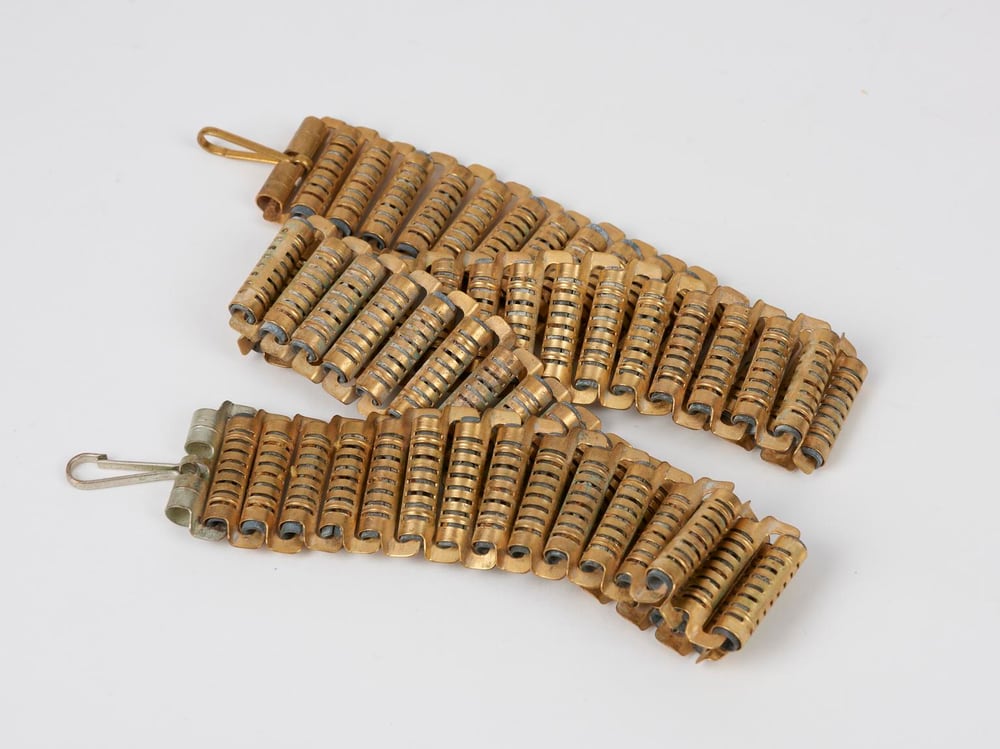
Hold a Pulvermacher galvanic chain in your hands and it feels less like a medical instrument than like a piece of jewellery for a machine: a supple ladder of short, varnished wooden rods, each no thicker than a pencil, each wound with fine copper and zinc wire lying in helical grooves so the two metals run side by side without ever quite touching. Link enough of these little cells together and you have a flexible band you can wrap around a waist, a wrist, a leg — or, in the versions the trade grew coy about, around the loins. Soak it first in vinegar. That was the ritual the whole industry was built on.
This is the establishing volume of a five-part deep dive, and its job is deliberately narrow: to describe the object and the world it lived in — what an electropathic or “galvanic” belt physically is, the family of chains, corsets, “body batteries,” and suspensories it belonged to, and the counter-and-catalogue marketplace that put one against so many bodies between roughly the 1850s and the 1920s. It stops short of the arguments that follow. The real electrical question — whether any current flowed, how much, and why a feeble transcutaneous current at these levels does nothing to systemic disease — is the whole subject of Vol 2 — What It Actually Did. The makers and their competing brands are catalogued in Vol 3 — The Makers and Their Appliances; the promises, the exposés, and the collapse of the trade in Vol 4 — The Promise and the Reckoning; and identifying, dating, and displaying a surviving belt in Vol 5 — Collecting, Identifying, and Displaying.
One caution belongs at the front, because the category name is itself a small deception. “Electric belt” invites you to imagine a device humming with current. Some genuinely held a working voltaic cell — feeble, and fading as it dried. Many held no working cell at all: a row of magnets, a strip of inert metal, or simply nothing electrical whatever. What almost all of them delivered reliably was warmth, a faint tingle where damp metal met skin, and the powerful suggestion carried by a printed “power” grade. The honest account of which belts did what is Vol 2’s to make; this volume simply refuses to take the word “electric” at face value.
1.2 The object against the skin
The archetype is Pulvermacher’s chain. As the Science Museum Group’s own object records describe it, each cell was “a wooden rod concentrically wound with copper and zinc wires” seated in grooves “that brought the wires close to each other without touching,” and “soaking the rods in an electrolyte, such as vinegar, activated the battery action” — copper the cathode, zinc the anode, the vinegar (or “some other weak acid, or a salt solution”) the electrolyte between them. String many rods in series and, in principle, the small per-cell voltage adds up. The chain kept working “until the dowels dried out, then the chain would have to be resoaked.” That drying-out is the physical heart of the whole story, and Vol 2 returns to it: whatever the appliance did, it did less of it by the minute.
From that one idea the trade spun a hundred forms. The bare chain was sold as a band you looped over an aching joint. The worn variant — the object most collectors mean by “electropathic belt” — was a chain (or a strip pretending to be one) sewn into a fabric or leather carrier with buckle and strap, “intended to be worn wrapped on parts of the body for long periods,” in the Science Museum Group’s phrase, and marketed to “cure all nervous, chronic and functional diseases.” The museum holds several: worn belts, a lady’s galvanic belt, chains from the European period of roughly 1860–1910 in copper-gilt, zinc, and resin. Each is unmistakably the same idea dressed for a different customer.
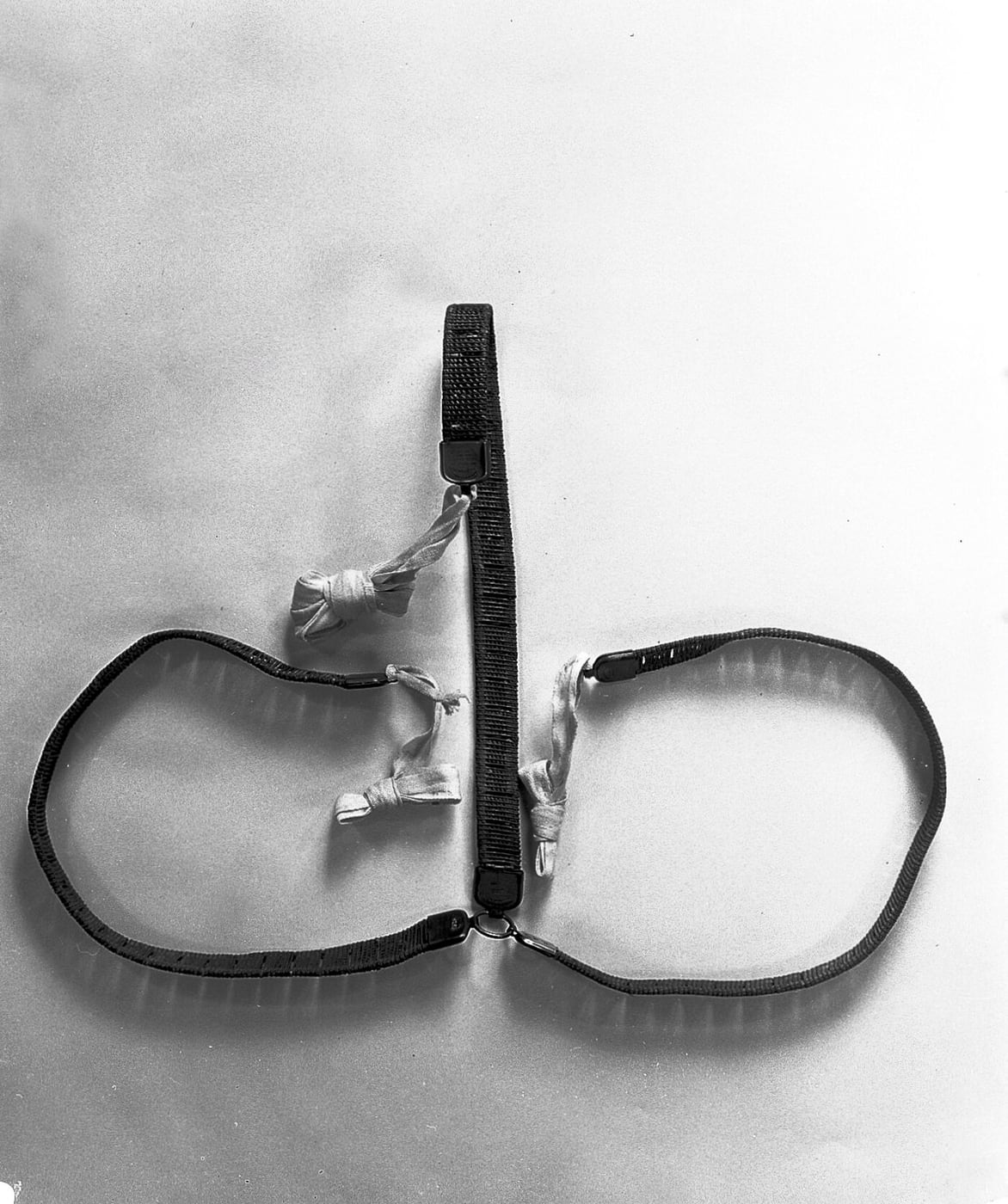
Later “electric” belts abandoned even the pretence of a proper pile. The category slid steadily away from Pulvermacher’s genuine (if weak) galvanism toward objects that were electric in name only — a lesson this volume flags and Vol 2 dissects. The point to hold onto here is physical: an electropathic belt is a wearable, a thing pressed against the skin for hours, not a machine a physician switched on for minutes. Everything about how it was sold followed from that.
1.3 A whole family of appliances
The belt was only the flagship. Around it grew an entire wardrobe of galvanic and “electric” appliances, each mapped to a body part and, not coincidentally, to a customer’s anxiety.
- Chains and bands for the limbs and joints — the original Pulvermacher form, sold against rheumatism and “lameness.”
- Belts and corsets for the trunk. Pulvermacher’s own catalogue, per the Didusch Museum of urology, offered belts for “every conceivable part of the human anatomy: limbs, abdomen, chest, neck.” Later firms sold laced electric corsets as ladies’ health-and-figure garments.
- Suspensories — the loin and genital appliances that the male-directed trade grew rich on. The most notorious mail-order belt, the Sears Heidelberg, was topped by a “Giant Power” grade that reportedly incorporated an attachment “designed to hold the male genitalia” and deliver a current to it. This volume names the object plainly and clinically; the marketing psychology behind it is Vol 4’s subject.
- Caps, insoles, and brushes. The line ran to the head and feet: electric (in fact magnetic) hair brushes, flesh brushes, tooth brushes, and shoe insoles, most famously under the Dr. Scott’s name marketed by London’s Pall Mall Electric Association. As the surviving trade cards and the Wellcome Collection’s advertising holdings make clear, “Dr. Scott’s Electric Hair Brush” contained a magnetised iron rod, not a battery — “electric” was a mood, not a mechanism.
That breadth is the tell. A genuine therapeutic device tends to do one thing; this family did everything, because its unifying principle was not a treatment but a marketing word. The full roster of makers who built out this wardrobe — Pulvermacher, and the later Addison’s, Owen’s, Harness’, Dr. Scott’s, Heidelberg, and Overbeck’s — is Vol 3’s to catalogue. What matters here is that a Victorian or Edwardian buyer met not a single product but a whole department of them.
1.4 Sold across the counter and by mail
The electropathic belt is inseparable from how it was sold, because the selling was most of the product. Three channels carried it.
First, the flagship showroom. Pulvermacher’s London operation — the Pulvermacher Galvanic Establishment — traded from a prestige address at 194 Regent Street, exactly the kind of frontage that let a galvanic chain borrow the authority of the West End. When later proprietors moved manufacture abroad, they kept the London name, in the Wikipedia account, “for the prestige of a European connection.” The address was part of the therapy.
Second, branded appliance houses with their own trade identities. In London the Medical Battery Company, run by Cornelius Bennett Harness (a former jeweller and furniture salesman, established around 1885), sold the “Electropathic Belt” and an Electric Corset through aggressive advertising; the Pall Mall Electric Association did the same for the Dr. Scott’s range. These were retail brands built on testimonials and consultation, and their spectacular unravelling — the failed 1892–93 libel action that a company ally, Dr. Herbert Tibbits, brought against The Electrical Review (and lost, after Lord Kelvin’s February 1893 testimony), and the 1893 Pall Mall Gazette exposé headlined “The Harness Electropathic Swindle” — is the reckoning Vol 4 tells in full.
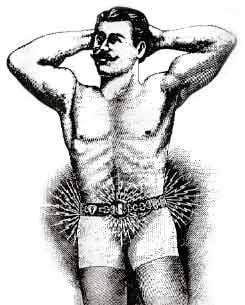
Third — and this is what made the belt a mass object — the mail-order catalogue. In the United States the appliance reached its widest public not through a Regent Street window but through the post. The Heidelberg Electric Belt appeared in the Sears, Roebuck & Co. catalogue around 1900–1902, offered as a graded ladder of “power” running from roughly $4 for the cheapest 20-gauge belt up to $18 for the 80-gauge “Giant Power” model — the frequently-cited $12 Heidelberg being a mid/standard grade on that ladder, not the entry price. The Sears copy promised that “all that electricity will do for you will be received through the use of our electric belt,” against a menu that ran from “over brain work” and “vital [impotency]” to rheumatism, sciatica, insomnia, kidney disorder, Bright’s disease, and “female weakness.” A buyer never had to meet a salesman or a doctor; a coupon and a postal order brought the whole apparatus to the door. Tens of thousands were sold in America in the decades around 1900.
The graded “power” number deserves a moment, because it is doing quiet work. A higher grade cost more and promised more, yet — as Vol 2 will show — the electrical difference between grades was frequently negligible or fictional. The grade sold confidence, not current. That substitution, of a printed number for a measured effect, is one of the most modern-feeling things about the whole trade.
1.5 What it was worn to do
The promise was, in a word, vitality — and the belt was pitched hardest at the places a person felt its loss most privately. The recurring headline claim, across Pulvermacher, Heidelberg, and Harness alike, was the cure of the “weaknesses peculiar to men”: impotence, “spermatorrhoea” (the era’s anxious term for involuntary seminal loss), and the exhaustion then labelled nervous debility or neurasthenia. Around that core sat a broad general menu — rheumatism, sciatica, “lame back,” kidney and liver complaints, dyspepsia, hernia, poor circulation, sleeplessness — and, for the ladies’ corset lines, “female weakness” and delicacy.
That targeting is the sober centre of the object, and this dive treats it as social history, not innuendo: the electropathic belt monetised male sexual anxiety with remarkable precision, wrapping a private fear in the reassuring language of electricity, physiology, and a numbered dose. Exactly why the tingle and warmth of a damp galvanic chain felt convincing — and why a graded current at these levels could not touch any of the conditions named — is the physics and physiology of Vol 2. Here it is enough to record what the buyer thought they were strapping on: not a comfort, but a cure.
1.6 Why this object matters
An electropathic belt is a nearly perfect specimen of a particular kind of medical fraud — not a crude swindle but a designed one, engineered to persuade through the body and the post. Some genuinely carried a working cell, so the category could always point to real galvanism as its alibi. It sat against the skin all day, so the wearer’s own warmth and the faint prickle of damp metal furnished a continuous, plausible sensation. And it arrived graded, numbered, catalogued, and endorsed, so it wore the costume of a serious instrument. Every one of those features is real; not one of them adds up to a treatment. The gap between the vivid, all-day sensation and the empty therapy is the entire story of the object.
It also sits on a genuinely porous boundary. The same era’s physicians used real galvanic and faradic batteries as legitimate, if limited, tools of medical electricity — apparatus a doctor applied deliberately and briefly. The sober engineering account of those lives in the Faradic and Galvanic Machines dive (in Electrotherapy Devices), and Vol 2 draws the line between the clinic’s battery and the catalogue’s belt carefully. The electropathic belt is what happens when a modest real phenomenon is detached from clinical judgement, sewn into a garment, numbered by grade, and sold to everyone for everything.
1.7 Where this volume hands off
You now have the object against the skin and the marketplace around it: the vinegar-soaked chain, the corset and the suspensory, the Regent Street showroom and the Sears coupon, and the promise of restored vitality it carried to the door. The next question is the one the marketing worked hardest to blur: what, if anything, was actually happening when the damp chain touched the body. That is Vol 2 — What It Actually Did, which follows the current — where there was one — from copper and zinc through vinegar and skin, distinguishes galvanic from faradic honestly, and explains why transcutaneous direct current at these feeble, falling levels does nothing to systemic disease. From there the dive turns to the makers and their competing brands (Vol 3), the promises and the reckoning of the 1890s (Vol 4), and the collector’s practical questions of identifying and displaying a surviving belt (Vol 5).
Sources
- Pulvermacher chain, European 1860–1910 — Science Museum Group Collection (Wellcome, object A602759) — physical construction of a chain cell (wooden rod wound with copper and zinc wire in non-touching grooves; vinegar electrolyte activating the battery action; copper cathode / zinc anode); the worn “electric belt” variant to be wrapped on the body.
- Pulvermacher belt (“had to soak it in vinegar before applying to the body, supposed to cure all nervous…”) — Science Museum Group Collection — a made-up worn belt and its all-diseases claim; used for the worn-belt figure.
- Running with the Current: Quackery in Electrical Medicine — William P. Didusch Museum (Scope of Urology, Winter 2022) — Heidelberg and Pulvermacher belts as “cloth-covered voltaic batteries soaked in a vinegar solution and worn around the waist”; the “weaknesses peculiar to men” framing; belts for “every conceivable part of the human anatomy”; Sears mail-order distribution.
- Electropathic Cure: Quackery in the Electric Era — New York Almanack — Pulvermacher at 194 Regent Street, London; the “magic band” selling in its thousands across Europe and the US; Cornelius Bennett Harness / Medical Battery Company (est. ~1885), the failed 1892–93 libel action against The Electrical Review and the 1893 Pall Mall Gazette “Harness Electropathic Swindle”; the ~$12 Heidelberg belt in the 1902 Sears catalogue; belts symbolising quackery by the 1890s. (Birth-date “15 March 1815, Breslau” recorded here but contested — see verify note.)
- Heidelberg Alternating Current Electric Belt — Museum of Quackery (Sears c. 1900 catalogue text) — the graded “power” ladder and the Sears menu of claims (“all that electricity will do for you…”; over-brain-work, “vital impotency,” rheumatism, Bright’s disease, “female weakness,” etc.).
- Dr. Scott’s electric hair brush / electric corset advertising — Wellcome Collection — the Dr. Scott’s range (hair, flesh, tooth brushes, corsets, insoles) marketed by the Pall Mall Electric Association; the “electric” brush in fact containing a magnetised iron rod, not a cell.
- Pulvermacher’s chain — Wikipedia — leads only: Isaac Lewis Pulvermacher’s origins (Vienna/Breslau, contested), the 1850 publication and 1850 London/Edinburgh demonstrations, the “universal panacea” marketing, competing brands (Addison’s, Owen’s, Heidelberg’s, the Medical Battery Company), and the later use of the London name “for the prestige of a European connection.”
Comments (0)