Electropathic Belts · Volume 3
The Makers and Their Appliances
Pulvermacher's Regent Street firm and its chain-belt; the muddled succession of Addison's, Owen's and Harness's Medical Battery Co.; Dr. Scott's magnetised 'electric' line; the mail-order Heidelberg belt with its Sears 'Giant Power' grades; and Overbeck's Rejuvenator — sorting the cities, dates, and priority stories that the trade deliberately blurred.
Where Vol 1 — The Belt and Its World placed the electropathic belt in its Victorian setting and Vol 2 — What It Actually Did worked through the electricity honestly, this volume is about the firms and their products — who made these appliances, in which cities, under what names, and which of the loudly-claimed origin stories survive checking. The trade traded on confusion: names were borrowed, “of London” was a marketing flourish, and rival belts were sold as though each held a unique secret. The job here is to untangle as much of that as the record allows, and to say plainly where it cannot be untangled.
3.1 About this volume
The electropathic-belt trade was never a single industry with a clean genealogy. It was a scrum of competing firms — Wikipedia’s account calls it a “battle of the belts” — in which Pulvermacher, Addison’s, Owen’s, Harness’s Medical Battery Company, the German Electric Belt Company (in fact New York-based), Dr. Sanden, Heidelberg and a dozen lesser names all sold broadly the same promise. Because these were consumer goods pushed by advertising rather than instruments described in the medical press, the surviving documentation is advertising: the firms’ own pamphlets, a handful of museum-held examples, and the newspaper exposés that finally sank them.
That matters for accuracy. The brief for this dive frames Addison’s, Owen’s and Harness’s as a “rebranding chain” descended from Pulvermacher — and the trade certainly behaved as if belts were interchangeable and pedigrees transferable. But the sources consulted here present Addison’s, Owen’s and Harness’s as separate competing firms in the same business rather than proven successive renamings of one company; the clean “Pulvermacher → Addison → Owen → Harness” lineage is not something these sources establish, and it is flagged as such below. Throughout, this volume names the city and date where they can be verified and hedges where they cannot, rather than smoothing the story into a false tidiness. The electrical detail stays in Vol 2; the promises, the debunking and the regulatory endgame stay in Vol 4 — The Promise and the Reckoning; condition, identification and display stay in Vol 5 — Collecting, Identifying, and Displaying.
3.2 Pulvermacher and the Regent Street firm
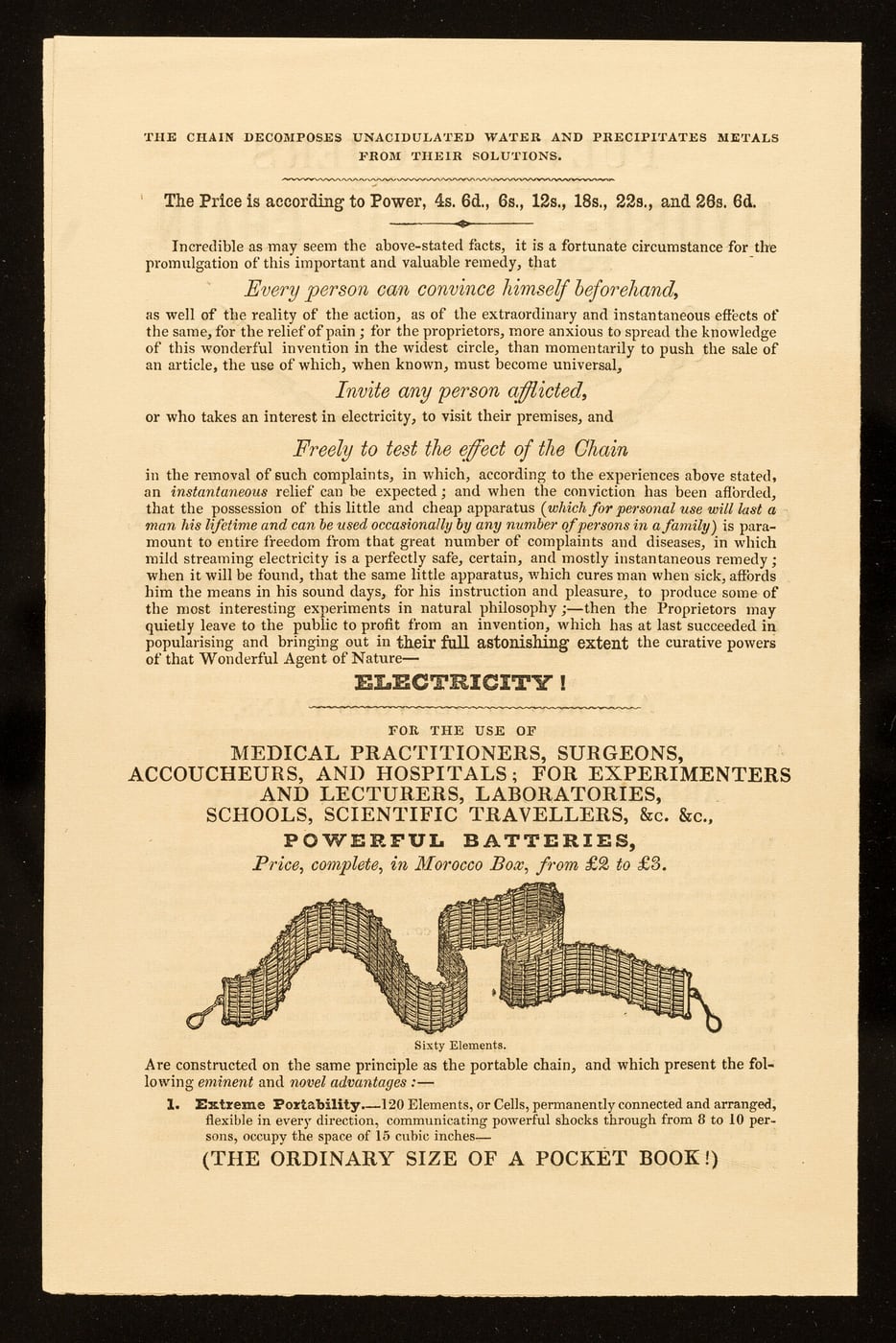
Isaac Lewis Pulvermacher (also rendered Isaak Louis; born, by one secondary account, on 15 March 1815 in Breslau, then in the Kingdom of Prussia — though contemporary British sources described him simply as “of Vienna” and his birthplace is genuinely contested; his 1853 US patent gives his residence as Breslau) began as a worker on electric telegraphs. He first published details of his chain in August 1850 in German, then travelled to Britain that winter to demonstrate it to physicians, and secured a US patent in 1853, in which he gave his residence as Breslau. He settled in London and established the firm J. L. Pulvermacher at 194 Regent Street, from which he produced and sold the chains and their belt variants. Related London addresses recur in the advertising — a “Pulvermacher Galvanic Establishment” at 200 Regent Street, and depots run by his manager Meinig at 103 Leadenhall Street and 71 Quadrant, Regent Street — and by the 1880s the business had relocated to Cincinnati while still trading on “Pulvermacher’s of London” for the prestige of the address. (These several street numbers come from advertising and encyclopaedic leads rather than a single archival register, so treat the exact roster as indicative.)
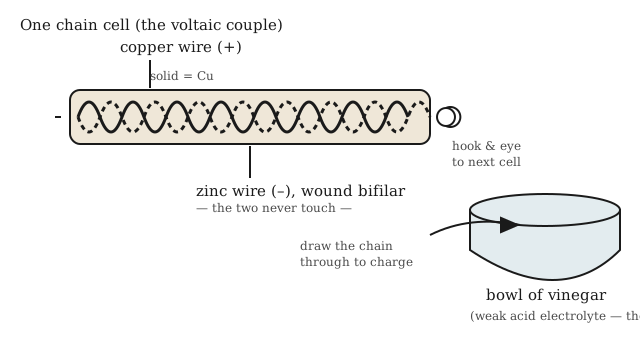
The Pulvermacher hydro-electric chain is the one appliance in this dive that was a real, if feeble, battery. Each cell was a short wooden dowel, helically grooved and wound bifilar with a copper wire (the cathode) and a zinc wire (the anode) that ran alongside each other without touching; cells were linked end-to-end by hooks and eyes into a flexible chain, and a belt variant wrapped a run of them around the body. It was activated — “charged” — by drawing it through a bowl of vinegar or another weak acid or salt solution, wetting each copper–zinc pair into a voltaic couple. A later (post-1869) variant replaced the wooden dowels with hollow zinc or magnesium tubes. The output was genuine galvanic current, but small, and it fell as the vinegar dried — the physics that Vol 2 works through, and the same voltaic principle a legitimate medical battery used in the electrotherapy trade (cross-referenced in Electrotherapy → Faradic and Galvanic Machines).
The chain was, for a time, respectable enough that Charles Dickens is recorded as having ordered one in June 1870, and Pulvermacher advertising leaned heavily on physicians’ names — a practice that turned the medical community against the firm once those names appeared without permission and beside cure-all claims.
3.3 The succession tangle: Addison’s, Owen’s, Harness’s
By the 1880s the belt trade had many players, and it is here that the “rebranding” story needs care. Pulvermacher’s US-side competitors named in the record include Addison’s, Owen’s (originally New York-based, later expanding across the country before being shut down for fraud), the misleadingly-titled German Electric Belt Company (New York), Dr. Sanden, and Heidelberg. Whether Addison’s and Owen’s were literal renamings of the Pulvermacher business or simply rivals riding its reputation is not settled by the sources here — they read as separate firms in a crowded field. A collector should record the exact name and address a belt actually bears rather than assume a descent from Pulvermacher.
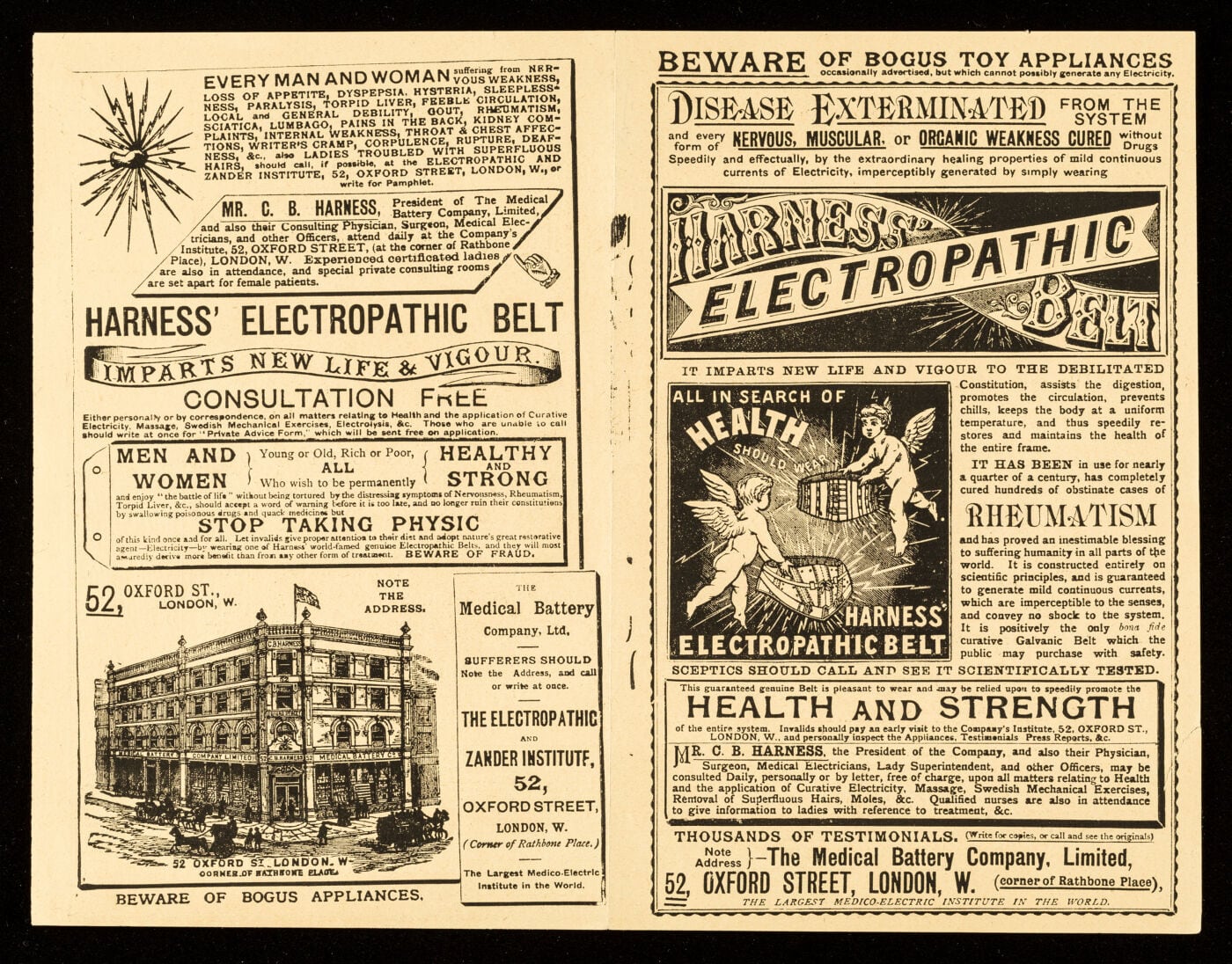
The best-documented of the group is the British one. The Medical Battery Company was founded in London in 1885 by Cornelius Bennett Harness, a former jeweller and furniture salesman who styled himself a “medical electrician” after running an electric-hairbrush business in New York; his associate was Dr. James McCully, a qualified physician who had been struck off the Medical Register. The company’s flagship was Harness’s Electropathic Belt, and it advertised on a scale that made “electropathic” a household word. Its unravelling was public and swift. After an unsuccessful 1892 attempt to sue the Electrical Review for calling the trade quackery, and a fraud action brought by a hernia patient, the Pall Mall Gazette ran a series in October 1893 headed “The Harness ‘Electropathic’ Swindle,” declaring that the Medical Battery Company had “for years past been fattening on a system of fraud and imposture which is absolutely unequalled in the annals of swindling.” Refunds were demanded, Harness and McCully were arrested in early November 1893 and charged with conspiracy to defraud, and the company collapsed. That reckoning is developed in Vol 4; it is placed here because the firm — not just the belt — is the object of study.
3.4 Dr. Scott’s “electric” line
The most instructive counter-example — because it was barely electric at all — is the range built by George A. Scott, an American businessman with no medical training who obtained a US patent for a moulded brush handle in 1872 and, through the 1880s, sold a whole “Dr. Scott’s Electric” line in America and England: hair brushes, flesh brushes, tooth brushes, corsets (advertised from 1883), belts and shoe insoles. The “electric” label was marketing: the appliances contained slightly magnetised iron rods embedded in the handle or garment, not any voltaic cell — magnetism dressed in the language of electricity. Scott’s own patent was refreshingly candid about the mechanism, describing magnets that “according to the belief of many persons” were thought useful for “relieving headache, preventing baldness, and other similar purposes.” The claims made in the advertising were not candid at all: an 1882 notice for the flesh brush promised cures for rheumatism, sciatica, gout, “nervous debility,” lumbago, neuralgia, toothache, “impure blood and impaired circulation.” In Britain the line was marketed through the Pall Mall Electric Association of 21 Holborn Viaduct, London. Scott’s products are the clearest illustration of a theme Vol 2 sets out: by the 1880s many “electric” appliances had no working cell at all, and depended on suggestion, warmth and the prestige of the word.
3.5 The Heidelberg belt and the Sears “Giant Power” grades
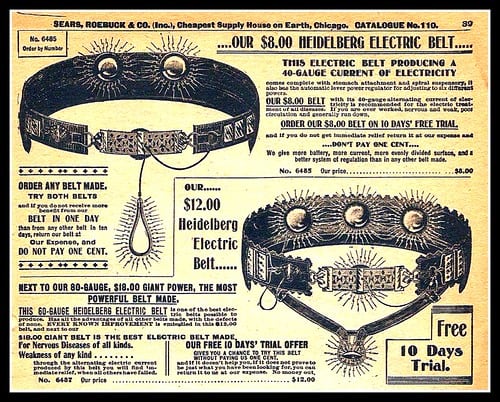
The American mail-order chapter belongs to the Heidelberg Electric Belt, sold through the Sears, Roebuck & Co. catalogue. A $12 “Heidelberg” belt appears in the 1902 Sears catalogue; museum descriptions place the type from the late 1880s. Structurally it returned to Pulvermacher’s principle — cloth-covered voltaic elements soaked in vinegar and worn around the waist — but its marketing innovation was a graded “power” scale. Sears offered ascending grades, and the top-of-range “Giant Power” model was pitched squarely at male sexual anxiety: the 1902 catalogue promised that “for those sexually weak or impotent … the Giant 80-gauge Belt affords relief when everything else has failed.” The broader copy claimed relief for nervous diseases, “lost strength and power,” rheumatism, sciatica, insomnia, melancholia, kidney and Bright’s disease, dyspepsia and liver complaints. The “gauge” and grade numbers were a sales ladder — a higher number for more money — rather than a measured electrical rating, the placebo-of-a-power-number that Vol 2 examines. The belts could raise sores where the damp elements pressed the skin, and around 1910, as the American Medical Association’s campaign against nostrums gathered force, the Heidelberg belt faded from the Sears “Big Book.”
3.6 Overbeck’s Rejuvenator
The wearable-current idea outlived the Victorian belt and surfaced again in the 1920s as Overbeck’s Rejuvenator. Otto Overbeck (1860–1937) was a British chemist who spent 1891–1928 as scientific director of a brewery in Grimsby; he claimed to have begun experimenting with low-power batteries and brass wire against the skin as early as 1893. On 17 May 1924 he deposited a British patent for an “Electric Multiple Body Comb for Use All Over the Body,” and had the device manufactured at scale by the reputable Ediswan company, patenting it in eleven countries and advertising it in several languages. The Rejuvenator applied a very small, harmless current through shaped electrodes drawn over the skin, promising to recharge the body’s “exhausted batteries” and restore youth. It sold well through the late 1920s and 1930s; a Science Museum Group example is catalogued as an Overbeck Rejuvenator, Grimsby, 1930. Overbeck himself grew wealthy enough to buy the Devon house now held by the National Trust under his name — a reminder that the appliance’s commercial life, if not its medical one, was entirely real. (The specific dates and manufacturing detail here rest on a single scholarly study and museum catalogue entries and are cited as such below.)
3.7 Where this volume hands off
With the makers, cities and dates set out — and the priority stories deflated where they deserved it — the narrative turns to what these appliances claimed and how those claims were stopped: Vol 4 — The Promise and the Reckoning takes up the male-weakness marketing, the 1893 Harness prosecution in full, the AMA’s Nostrums and Quackery record, and the later US Post Office fraud orders and FDA seizures. The physical follow-through — how to tell a genuine Pulvermacher chain from an inert “magnetic” belt on the bench, and how to date and display one — is the subject of Vol 5 — Collecting, Identifying, and Displaying.
Sources
- Pulvermacher’s chain — Wikipedia — the 1850 German publication and 1853 US patent, the copper/zinc bifilar-on-dowel construction charged in vinegar, the 1869 tube variant, the relocation to Cincinnati as “Pulvermacher’s of London,” and the “battle of the belts” naming Addison’s, Owen’s, the German Electric Belt Co. and Heidelberg. (Wikipedia and contemporary British sources describe Pulvermacher as “of Vienna” and give no birth date; they do not support the “15 March 1815, Breslau” birth.)
- Electropathic Cure: Quackery in the Electric Era — New York Almanack — the “15 March 1815, Breslau” birth detail (a secondary account, contested — see the “of Vienna” note above); 194 Regent Street and 1850 founding; Charles Dickens’s June 1870 order; Cornelius Bennett Harness, the Medical Battery Company (1885), the 1892 case and the 1893 Pall Mall Gazette “Harness Electropathic Swindle”; the $12 Heidelberg belt in the 1902 Sears catalogue.
- Galvanic Pulvermacher belt — Science Museum Group Collection — a surviving Pulvermacher belt requiring vinegar activation before wear; used for the lead-figure object and construction detail.
- Running with the Current: Quackery in Electrical Medicine — William P. Didusch Museum (urology) — the Heidelberg belt as vinegar-soaked voltaic batteries claiming to cure “weaknesses peculiar to men,” the 1902 Sears “Alternating Current” advertising, and the galvanic/faradic framing.
- Heidelberg Alternating Current Electric Belt — Museum of Quackery and the Smithsonian NMAH advertising feature — the graded “Giant Power”/“80-gauge” belt aimed at impotence and its long cure-all claim list.
- From electric hairbrushes to toning sneakers — Smithsonian National Museum of American History — George A. Scott’s 1872 brush-handle patent, the magnetised-iron (not electric) mechanism, the candid patent language, and the 1882 flesh-brush cure claims.
- Dr. Scott’s electric corset / hair brush / flesh brush — Wellcome Collection — the Pall Mall Electric Association’s marketing of the Dr. Scott line in Britain and the range of appliances (corset, brushes, belts, insoles).
- ‘Recharge My Exhausted Batteries’: Overbeck’s Rejuvenator, 1924–37 — Medical History (Cambridge, via PMC) and Overbeck Rejuvenator, Grimsby, 1930 — Science Museum Group — Otto Overbeck (1860–1937), the Grimsby brewery post, the 17 May 1924 “Electric Multiple Body Comb” patent, Ediswan manufacture, and the low-current mechanism.
Comments (0)