Quack Devices · Volume 5
Collecting, Identifying and Displaying
The devices in this wing have outlived their own trade by a century, and a good many of them still turn up — in estate sales, on auction sites, in the backs of antique-mall cabinets, and occasionally in a relative’s attic. This closing volume is written for the person who ends up holding one. It is about how to read an object — to date it, name its maker, and tell a working galvanic cell from an inert prop — and about the two real hazards these things still carry: the radioactivity of the “radium cures,” and the shock-and-fire risk of a century-old mains appliance. It is not medical advice, and nothing here is an instruction to switch a device on, drink from it, or wear it. The whole point of collecting this material soberly is that these objects are cautionary history, and they are most honest sitting dark and cold on a shelf.
5.1 Dating and Identifying the Object
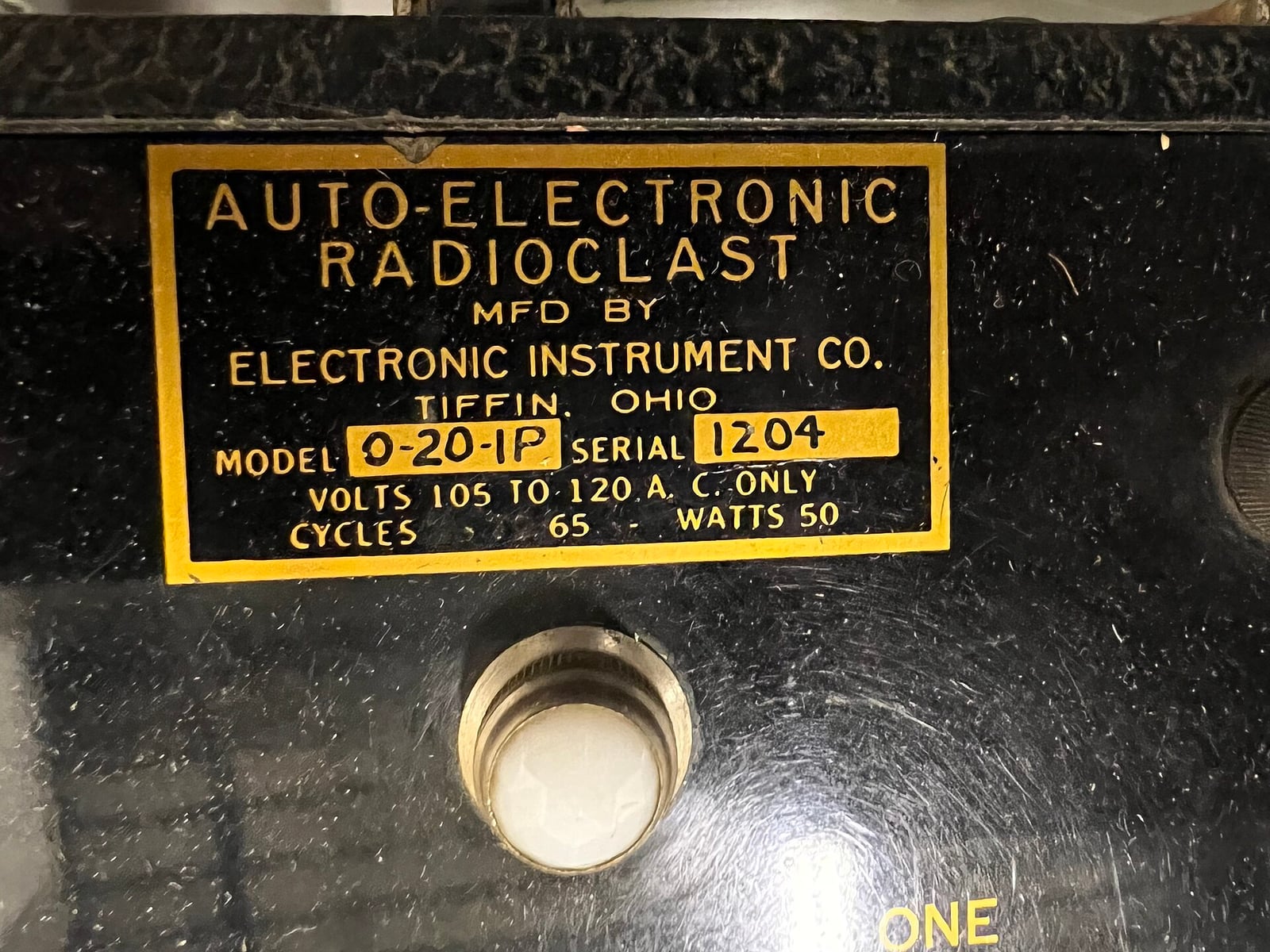
Most quack apparatus was made to look like instrumentation, so the identifying marks are usually where a real instrument-maker would put them. Start with the maker’s plate — an engraved or stamped brass or nickel escutcheon, or a printed label under the lid of the fitted case. Renulife handsets, for example, carry Detroit maker plates; violet-ray sets came in velvet-lined cases with a printed model card. Record the maker, model, and city verbatim before doing anything else, because the marketing name and the corporate name often differ, and the same box was frequently re-badged for drugstore chains.
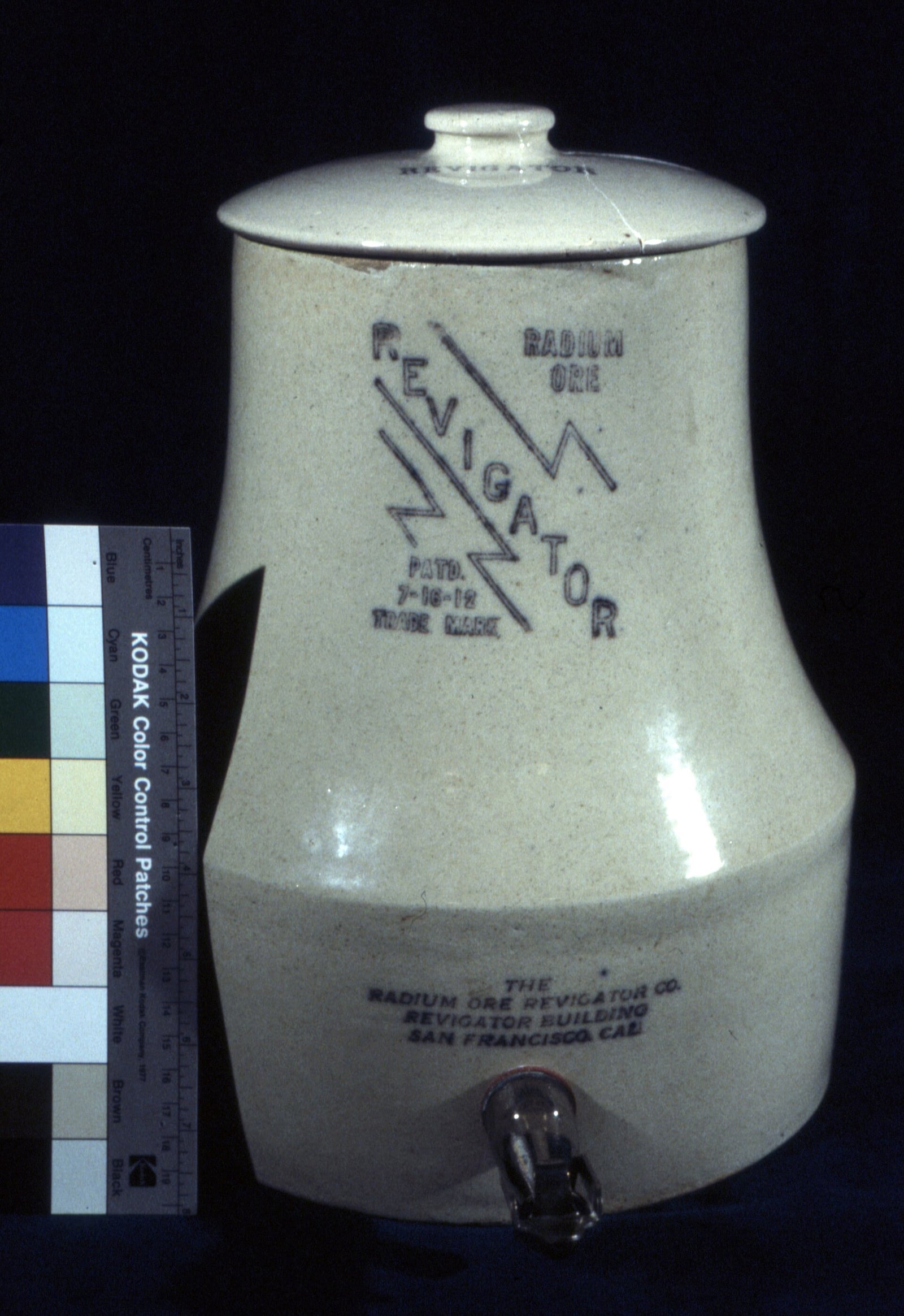
The single most useful hard date is a patent number. Treat it as a floor, never a manufacture date: a device stamped with a patent can only have been made after that patent issued, and popular products kept the same number stamped on them for decades (Antique Clocks Price Guide, “Dating by Patents”). US utility patent numbers map cleanly to years, so a number resolves to an “earliest possible” date you can then narrow with other evidence. British objects before 1884 may carry a diamond-shaped registration “lozenge” rather than a number, itself a datable code (ASCAS, “The Victorian Lozenge”). The Revigator crock, to take a concrete case, was patented in 1912, which bounds the whole product line (Wikipedia, “Radium ore Revigator”).
Catalogue cross-reference is how you convert a floor date into a real range. The electropathic belts, violet-ray sets, and vibrators were mail-order goods, and the Sears, Montgomery Ward, and drug-trade catalogues that sold them are dated and increasingly digitised — the electric belt appears in a 1906 Sears catalogue, for instance (lflank, “Medical Quackery in the Early 20th Century”). Match your object’s model name and grade to a catalogue page and you have both a date window and the original price. The AMA’s fraud files (below) and the Science Museum Group’s dated object records are the other cross-check.
Finally, read the construction. Bakelite and moulded phenolic handles point to the 1910s or later; earlier work is hard rubber, wood, and machined brass. Cloth-covered (braided-cotton) mains cord, two-pin ungrounded plugs, and no fuse are all consistent with pre-1940s manufacture — and, as the next sections stress, also the reason not to plug the thing in. For per-object identifying detail — Renulife’s model range, Pulvermacher’s copper-zinc chain versus the later inert imitations, the meaningless internals of an Abrams box — see the individual dives: /violet-ray-wands/, /electropathic-belts/, and /radionics-and-abrams-boxes/.
5.2 The Radioactive Hazard — Real, and Still Live
Of everything in this wing, the radioactive cures are the one family that remains physically dangerous, and a collector must treat them as such. These are not “hot” as a figure of speech — surviving examples are measurably radioactive today, because the isotopes involved have long half-lives.
Radithor was distilled water certified to contain at least one microcurie each of radium-226 and radium-228 per half-ounce bottle (Wikipedia, “Radithor”; ORAU Museum, “Radithor”). Radium-226 has a half-life of about 1,600 years, so a 1928 bottle is essentially as radioactive now as the day it was sold. The Radiendocrinator — Bailey’s gold-plated, credit-card-sized radium pad meant to be worn over the glands — is the starkest example: when a museum went to display one, the beta-gamma reading was on the order of 200 mR/hr on contact, high enough that the radium source had to be removed before the case could be shown to the public (ORAU Museum, “The Radiendocrinator”).
The Revigator works differently and is more insidious. Its stoneware crock is lined with crushed uranium ore (carnotite); water left in it overnight dissolves radon gas from the decaying radium in the liner, so the jar itself is the radioactive source and the “tonic” was radon-laced water (National Geographic, “Radioactive Water Jugs”; ORAU Museum, “Revigator”). A Revigator on a shelf is a low-level but genuine source; a Revigator you actually used as intended would produce radon-bearing water, which is why no surviving crock should ever be filled. Doramad toothpaste and similar thoriated products draw their activity from thorium recovered from monazite sand — the same rare-earth stream that fed gas-lantern mantles (Wikipedia, “Doramad Radioactive Toothpaste”) — and thorium-232 likewise has a half-life measured in billions of years.
Practical points for a collector, framed strictly around not being harmed:
- A Geiger counter settles the question. These items are the reason surplus radiation-survey meters are worth owning; a pancake-probe GM detector will read a Radithor bottle, a Revigator, a Radiendocrinator, or a thoriated item clearly above background. If an object is suspected radium and you cannot check it, treat it as active until proven otherwise.
- Alpha and radon are the concern, not the intact glass. The real risk from radium sources is internal — inhaling radon or ingesting or handling flaking material — not brief external exposure to a sealed bottle. Keep such items sealed, unbroken, in a ventilated place, away from living and sleeping areas, and do not open, sand, or “clean” them.
- Disposal is a regulated matter, not a trash question. Radium is a licensed radioactive material; a Radithor bottle or a Radiendocrinator cannot lawfully go in household waste. State radiation-control programs and the collections that specialise in this material (the ORAU Museum of Radiation and Radioactivity being the reference example) are the correct point of contact for anyone who wants such an object out of their house (ORAU Museum, “Radioactive Quack Cures”).
5.3 Ozone, Ultraviolet, and the Live-Mains Hazard
The violet-ray wands are not radioactive, but they are the objects collectors are most tempted to switch on, because the violet glow is genuinely striking. Two reasons not to. First, an operating wand is a spark discharge in air, and it produces ozone and only trace ultraviolet — far below any therapeutic level — as by-products of the discharge, ozone that people with asthma or other respiratory disease in particular should not be breathing (IEEE Spectrum, “What Was the Violet Ray Machine?”; Wikipedia, “Violet ray”). (Note the marketing lie embedded in the name: the device was sold as “ultraviolet therapy,” but the violet is a low-pressure gas-discharge glow inside the electrode, not therapeutic UV — that debunking lives in the device dive.)
Second, and far more important, is the electrical hazard shared by every mains-powered appliance in this collection — violet-ray handsets, electric vibrators, diathermy and high-frequency sets, and the electric embalming machines in the neighbouring wing. A century-old appliance typically has braided-cotton insulation that has gone brittle and cracked, no earth/ground connection, no fuse, and, in a violet-ray set, an open high-voltage secondary. Powering one up risks a short, an arc, an insulation fire, and — with a step-up coil — a genuinely dangerous high-voltage exposure. The standing rule among conservators is simple: do not connect antique mains apparatus to power. If a device must be shown “live” for an exhibit, that is a job for a qualified restorer who has rewired it with modern insulated cable, an earth where appropriate, an in-line fuse or RCD/GFCI, and often an isolation transformer — not something to try because the glow looks good in a photograph. For display, the object tells its whole story unpowered.
5.4 The Ethics of Displaying Fraud
Collecting medical fraud carries a duty the objects’ original sellers ignored: label it honestly. These devices did not work; several caused real harm; people died believing them. A display that reproduces the period advertising copy as though it were product description — “restores vitality,” “cures over 150 conditions,” “attuned color waves” — launders the fraud a second time. Present the marketing claim, then the reality, exactly as the individual dives do: the radionics box diagnosed disease from a blood spot and its innards were meaningless wiring; Spectro-Chrome was a lamp behind coloured glass sold as a cure for essentially everything; the mechanical and vibratory cures blur into legitimate physiotherapy and so demand especially careful captioning about where the real effect stopped and the overclaim began. The tone that works is the museum’s, not the carnival’s: quote the claim inside quotation marks, attribute it, and let the debunking stand beside it. Never write a label, or a listing, or a caption that a reader could mistake for a medical recommendation.
5.5 Where the Objects Live
The definitive documentary collection is the American Medical Association’s Historical Health Fraud and Alternative Medicine Collection, held at AMA headquarters in Chicago: roughly a thousand boxes of advertising, correspondence, product containers, and apparatus covering more than 3,500 practitioners, products, and businesses the AMA investigated between 1906 and 1975. It is the only AMA archive open to non-member researchers, by appointment, and much of it is described in an online finding aid (Guide to the AMA Historical Health Fraud Collection, PMC; AMA Journal of Ethics, “Ads and Labels From Early 20th-Century Health Fraud”).
For the apparatus itself, four collections do most of the work. The Science Museum Group (UK) holds well-catalogued, dated electro-medical objects, including violet-ray sets and electropathic belts, with object records that are themselves a dating resource (Science Museum Group, “High frequency ‘violet ray’ electrotherapy apparatus”). The Bakken Museum in Minneapolis — founded by Medtronic co-founder Earl Bakken around the story of electricity and medicine — keeps some 2,500 artefacts and a large body of electro-medical ephemera, quack devices among them (The Bakken Museum, Collections). The ORAU Museum of Radiation and Radioactivity in Oak Ridge is the reference holding for the radioactive cures specifically, with detailed, measured object pages for Radithor, the Revigator, the Radiendocrinator, and the emanators (ORAU Museum, “Radioactive Quack Cures”). For the violet-ray and electro-dental instruments, the Sindecuse Museum of Dentistry and, for the electric-belt/urological quackery, the Didusch Museum’s “Running with the Current” hold good material (Didusch Museum). The Wellcome Collection and Smithsonian NMAH round out the list.
5.6 The Collector Market
These objects trade steadily but unevenly. Complete violet-ray sets in their fitted, velvet-lined cases with a full fan of glass electrodes are the most common and command modest prices; loose handsets and lone electrodes are cheaper. Electropathic belts, Spectro-Chrome projectors with their filter sets, and intact Abrams-type boxes are scarcer. The radioactive items are a market of their own, driven partly by novelty — a Radithor bottle with its certificate, or a boxed Radiendocrinator, is a genuine rarity — and priced accordingly, with all the safety and disposal caveats above attached.
Two rules carry over from the rest of this project. First, provenance beats the auction story. Sellers routinely inflate or invent history (“embalming machine,” “ultraviolet therapy,” “the doctor’s own”); the corrective is the dated museum object record, the catalogue page, and the patent number, not the listing. Second, an auction listing is evidence an object exists, not evidence of what it is or that it worked — the identification comes from the marks on the object and the documentary record behind it. Buy the artefact for what it actually is: a well-made, thoroughly dishonest machine, and a small monument to how convincingly the last century sold electricity, rays, radioactivity, and coloured light as medicine.
Sources
- Guide to the American Medical Association Historical Health Fraud and Alternative Medicine Collection (PMC)
- AMA Journal of Ethics — “Ads and Labels From Early 20th-Century Health Fraud Promotions”
- Science Museum Group Collection — high frequency “violet ray” electrotherapy apparatus
- The Bakken Museum — Collections
- ORAU Museum of Radiation and Radioactivity — Radioactive Quack Cures
- ORAU Museum — Radithor
- ORAU Museum — The Radiendocrinator
- ORAU Museum — Revigator (ca. 1924–1926)
- Wikipedia — Radithor
- Wikipedia — Radium ore Revigator
- Wikipedia — Doramad Radioactive Toothpaste
- National Geographic — “Radioactive Water Jugs Not as Healthy as Advertised”
- IEEE Spectrum — “What Was the Violet Ray Machine?”
- Wikipedia — Violet ray
- Didusch Museum — “Running with the Current: Quackery in Electrical Medicine”
- Antique Clocks Price Guide — Dating by Patents
- ASCAS — “The Victorian Lozenge” (registration marks)
- lflank — “Medical Quackery in the Early 20th Century”
Comments (0)