Quack Devices · Volume 4
The Reckoning
4.1 A slow death, not a single blow
The golden age of medical fraud did not end at a single stroke. There was no one law, no one trial, no one exposé that swept the violet-ray wands and the radium tonics and the sealed black boxes off the market together. What actually happened was slower and more piecemeal: a private medical society waging a decades-long paper war; a postal bureaucracy quietly refusing to deliver the mail; a magazine spending a fortune to test a machine; a socialite dying with his jaw removed; and a federal food-and-drug law that took thirty years to grow teeth and another thirty-eight to grow them for devices specifically. Each of these ended some practices and merely inconvenienced others. Understanding the reckoning means being precise about which was which — because a great deal of this trade was not killed so much as pushed underground, where its descendants still operate.
4.2 The AMA and its Bureau of Investigation
The earliest sustained assault came not from the government but from the American Medical Association. In 1906 — the same year the first federal food- and-drug law passed — the AMA established a Propaganda Department (the word then meant “propagation of information,” without the sinister modern connotation) to collect and publicise evidence against patent medicines and medical devices. Its long-serving director was Arthur J. Cramp (1872–1951), a physician who ran the operation from 1906 until 1936, and whose personal motive was reportedly the death of his young daughter from a worthless nostrum. The department was later renamed the Bureau of Investigation and, later still, the Department of Investigation, which the AMA maintained into the 1970s.
Cramp’s chemists tested products, gathered advertising, corresponded with victims, and — crucially — published. His findings ran first in the Journal of the American Medical Association, then were reprinted as pamphlets and collected into the three-volume compendium Nostrums and Quackery, a reference work that named names and reproduced the fraudulent claims beside the laboratory results. The AMA had no police power; it could not arrest, fine, or seize. Its weapon was publicity and its archive — the surviving material now held as the AMA’s Historical Health Fraud and Alternative Medicine Collection — became the documentary backbone that regulators, prosecutors, and journalists drew on for the rest of the century. The Bureau’s real function was to make quackery legible: to convert a diffuse cloud of advertising into a filed, cross-referenced, citable record of who was selling what and what it actually contained.
4.3 The Post Office and the fraud order
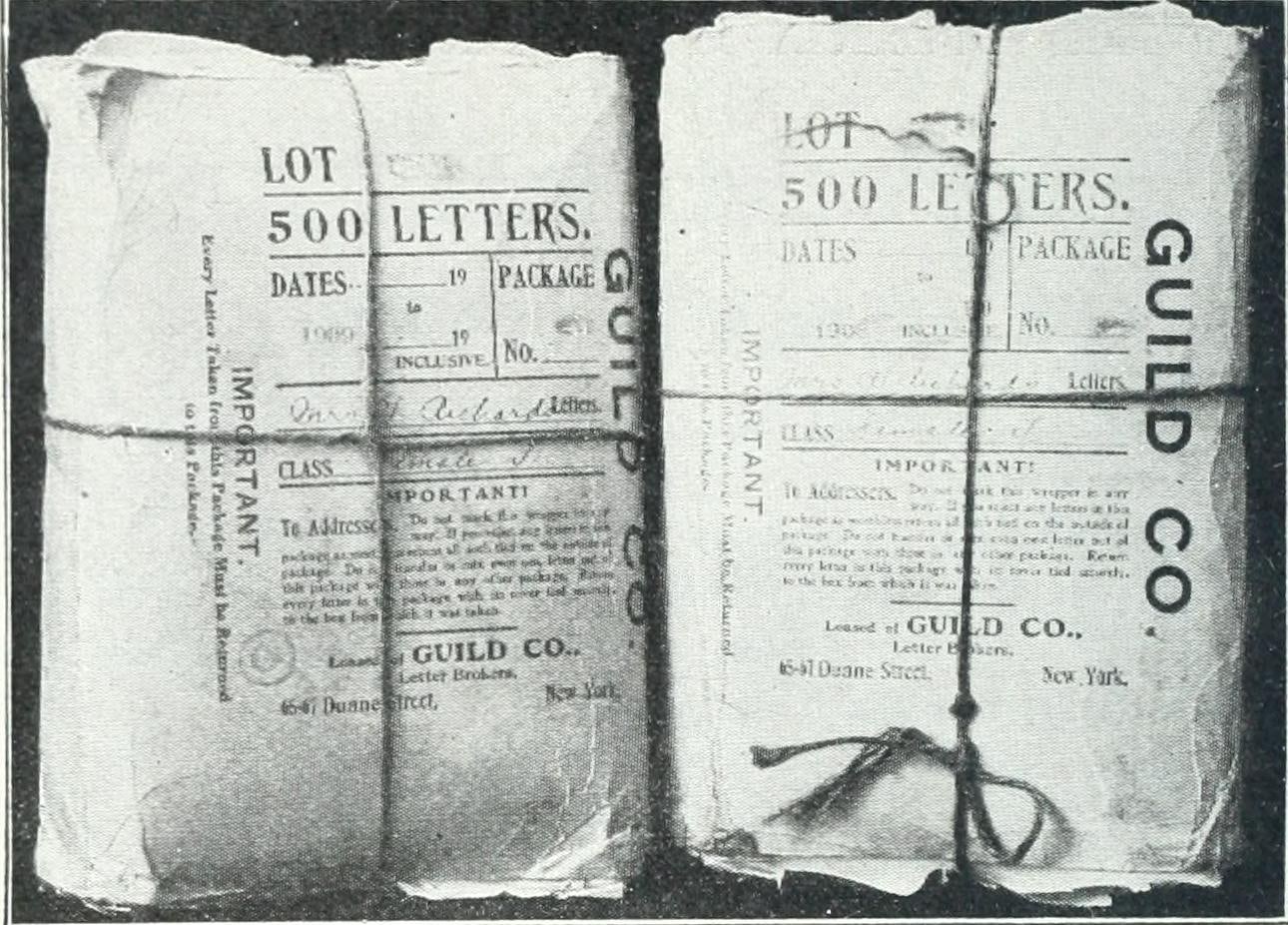
The oldest enforcement tool of all was the mail. Congress had passed a Mail Fraud Statute in 1872, giving postal inspectors authority over schemes to defraud conducted through the post. Because the overwhelming majority of these devices were sold by mail order and their proceeds collected by mail, the Post Office Department held a genuine chokepoint. Its administrative instrument was the fraud order: the Postmaster General could declare a business fraudulent, whereupon the post office would refuse to deliver its mail and refuse to pay out its money orders, stamping returned envelopes “Fraudulent.”
This was powerful and fast — no criminal conviction was required — but it was also blunt and easily evaded. A fraud order stopped payments to a named enterprise at a named address; the operator could reincorporate under a new name, move states, and resume. Postal action therefore excelled at strangling the cash flow of a specific mail-order scheme and was nearly useless at ending a category of fraud. It is the clearest early example of a pattern that recurs throughout the reckoning: the trade could be disrupted enterprise by enterprise long before any law could reach the idea being sold.
4.4 The law grows teeth — very slowly
Federal statute law arrived in three widely separated steps, and the gap between them is the whole story.
The Pure Food and Drugs Act of 1906, signed by Theodore Roosevelt on June 30, prohibited interstate commerce in misbranded and adulterated foods and drugs. It was a labelling law, not an efficacy law: it could punish a false statement on a package, but it did not require that a product work, and — for present purposes — it did not cover therapeutic devices at all. A violet-ray generator or an Abrams box was, in the eyes of the 1906 Act, essentially invisible.
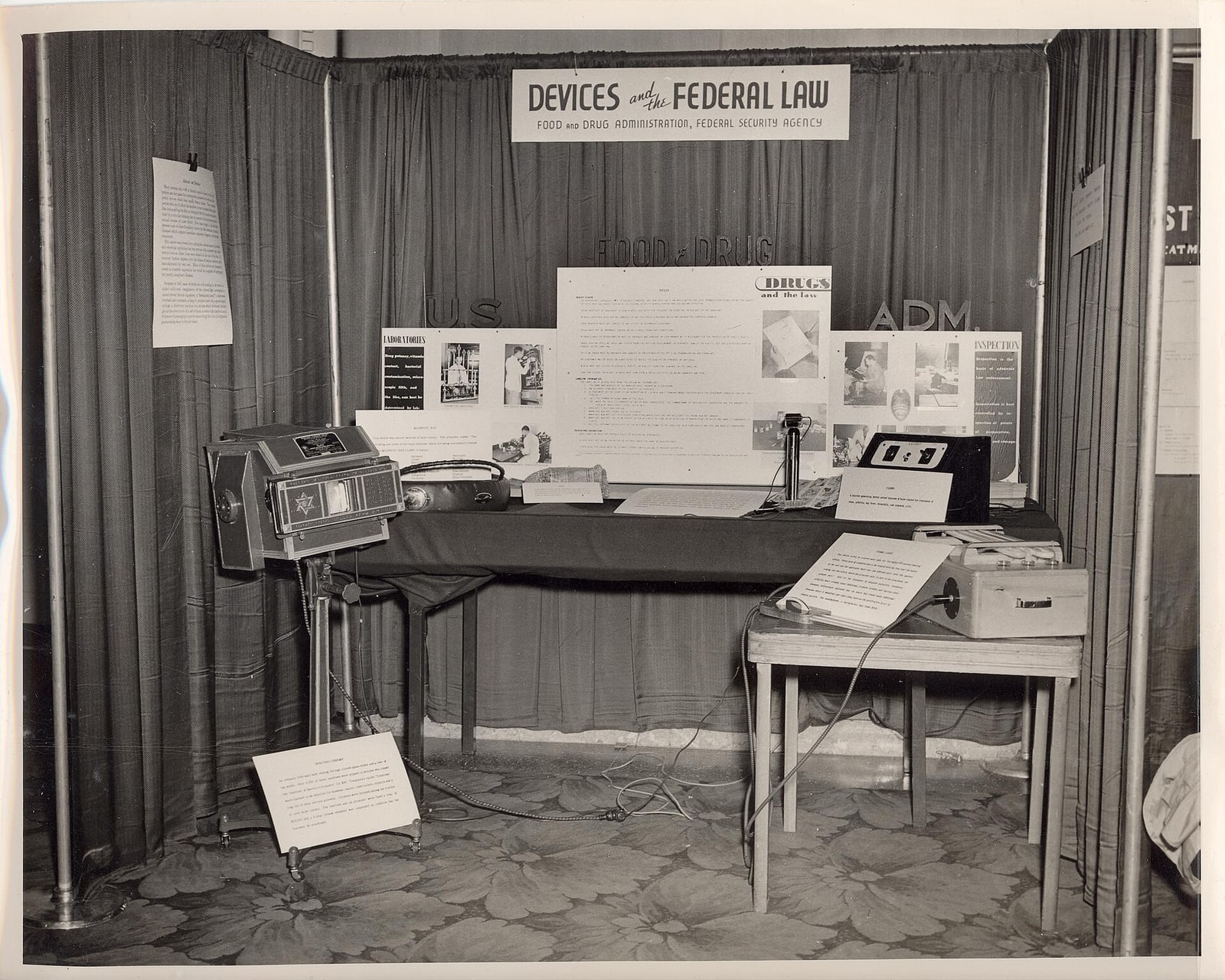
The Federal Food, Drug, and Cosmetic Act of 1938 closed part of that gap. Prompted by the 1937 Elixir Sulfanilamide disaster (a solvent-poisoned “medicine” that killed more than a hundred people), the new law extended the FDA’s reach to cosmetics and therapeutic devices for the first time. This is the statute that finally gave regulators explicit jurisdiction over the machines. But its device authority was strikingly limited: the 1938 Act did not authorise premarket review of devices. The FDA could seize a device, or seek an injunction against it, only after it was on the market and only on the grounds that it was misbranded or adulterated — in practice, that its labelling made false therapeutic claims. The agency could chase the claims, but it could not require a maker to prove a device safe or effective before selling it.
The full authority came only with the Medical Device Amendments of 1976, enacted after a string of genuine device catastrophes (the Dalkon Shield intrauterine device, faulty pacemakers, defective intraocular lenses). The 1976 amendments sorted devices into three risk classes (I, II, III), imposed registration and “general controls,” and for the highest-risk devices required premarket approval — proof of safety and effectiveness before sale. By 1976, though, the classic golden-age quack devices were already historical objects. The amendments were the tombstone, not the cause of death: the era’s frauds had been fought and largely broken under the weaker misbranding tools of the 1938 Act and the ad-hoc pressure of the AMA, the Post Office, and the courts.
4.5 Abrams, and the magazine that paid to be sure
The most famous single exposure targeted Albert Abrams (1863–1924) and his Electronic Reactions of Abrams (ERA) — the sealed diagnostic-and-treatment boxes, leased to practitioners, that claimed to read disease from a spot of dried blood. (The devices themselves are treated in the radionics dive.) In 1923–24 the magazine Scientific American convened a committee and ran a public investigation, reporting monthly from October 1923 to September 1924. The exercise reportedly cost on the order of $30,000 — an enormous sum — and the AMA lent its weight alongside.
The tests were devastating precisely because they were simple. Investigators submitted blood samples the practitioners could not have read honestly: healthy sheep’s blood came back diagnosed with hereditary syphilis, with a $250 cure offered; chicken blood — and a sample of plain red ink — were likewise “diagnosed” and cured for the same price. The committee’s verdict was flat: the Abrams reactions were “the height of absurdity,” and did “not exist — at least objectively.” Abrams himself never submitted to the test and cast himself as a persecuted genius; he died of pneumonia in January 1924, before the investigation concluded. Radionics did not die with him. His Electronic Medical Foundation kept leasing devices for decades; its president Fred J. Hart was ordered by a federal court to stop distributing them only in 1954, and when the FDA opened one of the boxes around 1960 it found a trivial low-power transmitter and a doorbell-grade magnet. Imitators carried the trade onward — the chiropractor Ruth Drown, prosecuted federally in 1951 for shipping a misbranded device and again charged with grand theft in California in 1963 (she died in 1965 before that case was tried), and in Britain George De la Warr, whose radionic “camera” survived a 1960 London civil suit. The lesson is stark: a definitive public debunking destroyed Abrams’ reputation but not his market.
4.6 Radithor, and the death of Eben Byers
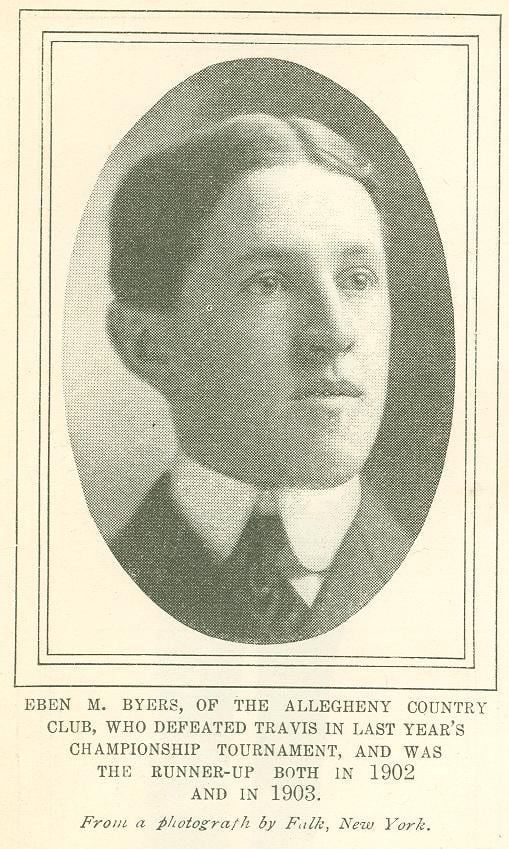
Where Abrams’s boxes did nothing, the radium tonics did real, measurable harm — which is why one death did more to end that trade than any lawsuit. Eben Byers (1880–1932), a wealthy Pittsburgh industrialist and amateur golf champion, was prescribed Radithor — radium dissolved in water, made by William J. A. Bailey’s Bailey Radium Laboratories of East Orange, New Jersey — after a 1927 injury. He drank an estimated 1,400 bottles between 1927 and 1930, far past a lethal dose. Radium is a bone-seeker; it lodged in his skeleton and irradiated it from within. His jaw disintegrated and had to be largely removed, holes opened in his skull, and he died on March 31, 1932. He was buried in a lead-lined coffin; when the physicist Robley Evans exhumed the body in 1965, it was still measurably radioactive. (The chemistry and the wider radium fad are covered in the radioactive-cures dive.)
The regulatory response ran through the Federal Trade Commission, which in 1931 sought Byers’s testimony — too ill to travel, he was documented at home — and after his death issued a cease-and-desist order against Bailey’s representations. Byers’s death is popularly summed up by the headline “The Radium Water Worked Fine Until His Jaw Came Off”; that memorable phrasing comes from a 1990 Wall Street Journal retrospective by Ron Winslow, not a contemporary 1932 banner (the line is routinely misdated to the era of his death). What ended the radium-tonic trade was less any single order than the collision of a vivid, well-connected death with an emerging scientific and public understanding — reinforced by the parallel tragedy of the Radium Girls dial-painters — that ingested radioactivity was not a tonic but a poison. The market collapsed from horror as much as from law.
4.7 Ghadiali and the Spectro-Chrome injunctions
Dinshah P. Ghadiali (1873–1966) sold the Spectro-Chrome — a thousand-watt lamp behind coloured glass slides, projected on the patient to “balance” the body (see the Spectro-Chrome dive). His prosecution history is the clearest illustration of how hard these cases were to win before 1976. In 1931 he was tried in New York on second-degree grand larceny after a former student complained; unable to prove intent to defraud, and faced with satisfied patients (some of them physicians) testifying for the defence, the prosecution lost — Ghadiali was acquitted.
Only under the 1938 Act’s misbranding provisions did the government finally prevail. Charged with introducing a misbranded device into interstate commerce, Ghadiali was convicted in 1947; he was fined $20,000, placed on five years’ probation, and his books and lamps were seized (he served no prison time for this case). Even that did not stop him. In 1958 the government obtained a permanent injunction against interstate shipment of the devices through a successor entity — and Ghadiali simply kept selling within New Jersey, operating inside the injunction’s limits until his death in 1966. Three prosecutions across a quarter-century did not end Spectro-Chrome; they confined it to a single state and outlived their target only barely.
4.8 What actually ended it — and what went underground
Set the cases side by side and the pattern is consistent. A definitive exposé (Scientific American on Abrams) shattered credibility but left the leasing business running for thirty more years. Postal fraud orders and FTC cease-and- desist actions choked individual enterprises but not the underlying ideas. Federal misbranding prosecutions under the 1938 Act — the sharpest legal tool of the era — could convict a maker and seize his stock, yet a Ghadiali or an Electronic Medical Foundation could reconstitute and carry on. The things that genuinely killed a whole practice were rarer and blunter: an unmistakable, publicised death (Byers) that made radium tonics unsellable, and eventually a premarket-approval regime (1976) that changed the default from “sell first, be seized later” to “prove it first” — by which time the golden-age devices were already relics.
The rest merely migrated. Radionics survives today as an alternative-medicine practice; chromotherapy and coloured-light “healing” persist online; violet-ray wands reappeared as novelty and adult-market items; and the descendants of the electropathic belt live on in every mail-order gadget promising “energy” or “vitality.” The reckoning, in the end, was real but partial: it built the modern apparatus of medical regulation — the AMA’s archive, the FDA’s device authority, the postal and trade-commission powers — largely by fighting these very frauds, and in doing so it drove the trade from the pharmacy counter to the margins. It did not abolish the impulse that bought the machines in the first place.

Sources
- AMA history — American Medical Association
- Ads and Labels From Early 20th-Century Health Fraud Promotions — AMA Journal of Ethics
- “AMA’s Bureau of Investigation exposed fraud” — JAMA
- Arthur J. Cramp — Wikipedia
- Nostrums and Quackery (vol. 2) — Internet Archive
- A History of Medical Device Regulation & Oversight in the United States — FDA
- Part II: 1938, Food, Drug, Cosmetic Act — FDA
- Pure Food and Drug Act — Wikipedia
- Federal Food, Drug, and Cosmetic Act — Wikipedia
- History of the Mail Fraud Statute — U.S. Postal Inspection Service
- Mail Fraud and False Representation Statutes — Encyclopedia.com
- Radionics and Albert Abrams, M.D. — Quackwatch
- “Our Abrams Investigation—I” — Scientific American (1923)
- Albert Abrams and the Medical Fraud Debunked Using Red Ink and Sheep’s Blood — IFLScience
- The Incredible Drown Case — Quackwatch
- Ruth B. Drown — Wikipedia
- Eben Byers — Wikipedia
- Colorful Nonsense: Dinshah Ghadiali and His Spectro-Chrome Device — Quackwatch
- Colourful conman — McGill Office for Science and Society
Comments (0)