Quack Devices · Volume 2
How the Machines Pretended to Work
2.1 The grammar of the pretend cure
Every machine in this wing sold the same thing under different labels: vitality. Whatever the physical principle on the nameplate — a violet spark, a trickle of galvanic current, a “vibratory rate,” an invisible emanation, a beam of coloured light — the pitch resolved to one idea, that the body was a battery running low and the device would top it up. That framing is what made a drugstore handset and a leased black box feel like the same category as the genuine electrical medicine being practised in real clinics down the street. The persuasion worked precisely because it borrowed the vocabulary of legitimate science just as that science was arriving.
This volume takes each family’s mechanism in turn and does one thing to it: sets the marketing claim beside the actual physics or physiology, and marks the exact point where a small, real effect got inflated into a universal cure. The device dives linked throughout carry the makers, models, prices, and courtroom histories in full; here the subject is only the pretended mechanism, told honestly against the real one.
2.2 High frequency and the violet glow
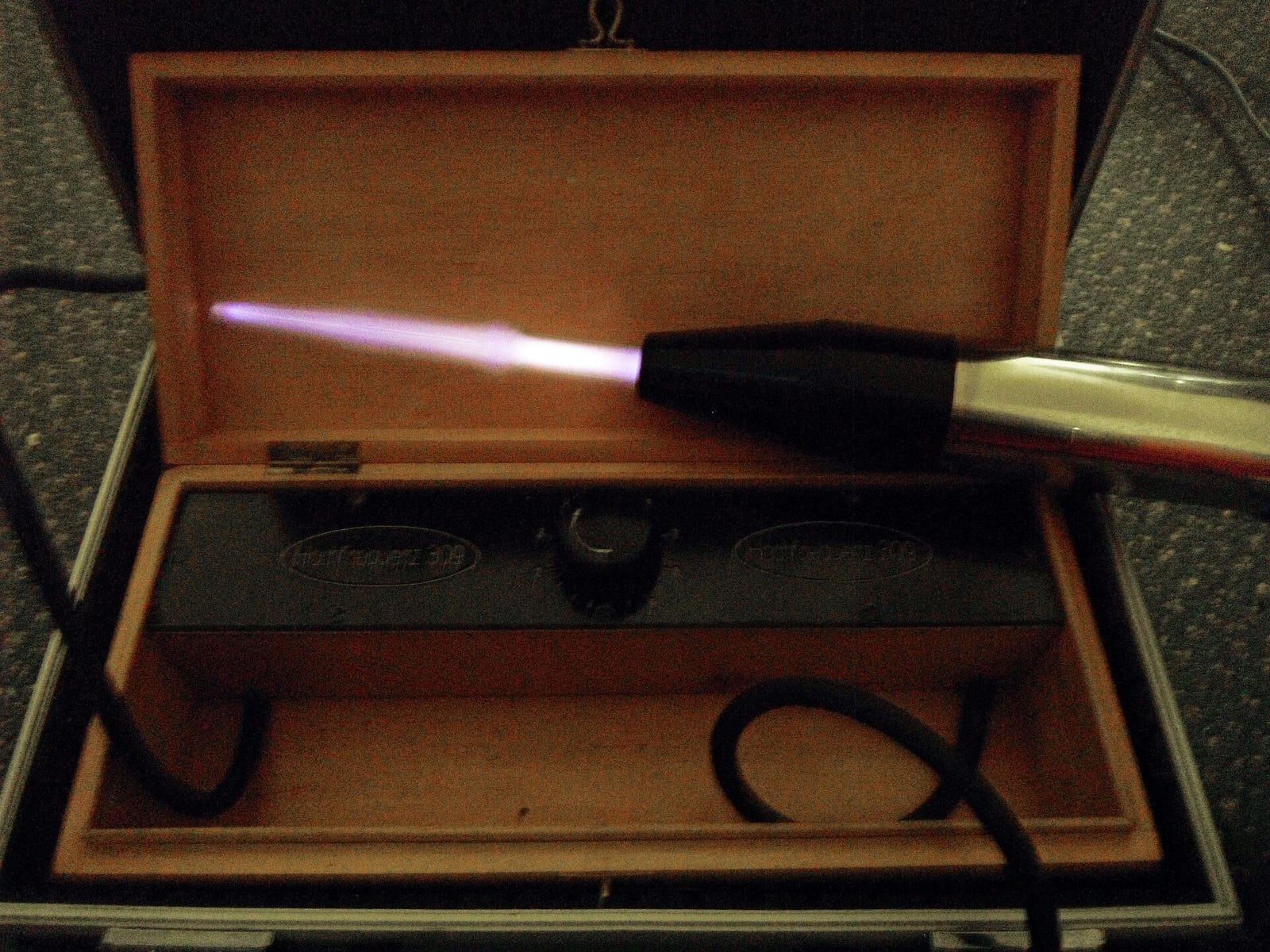
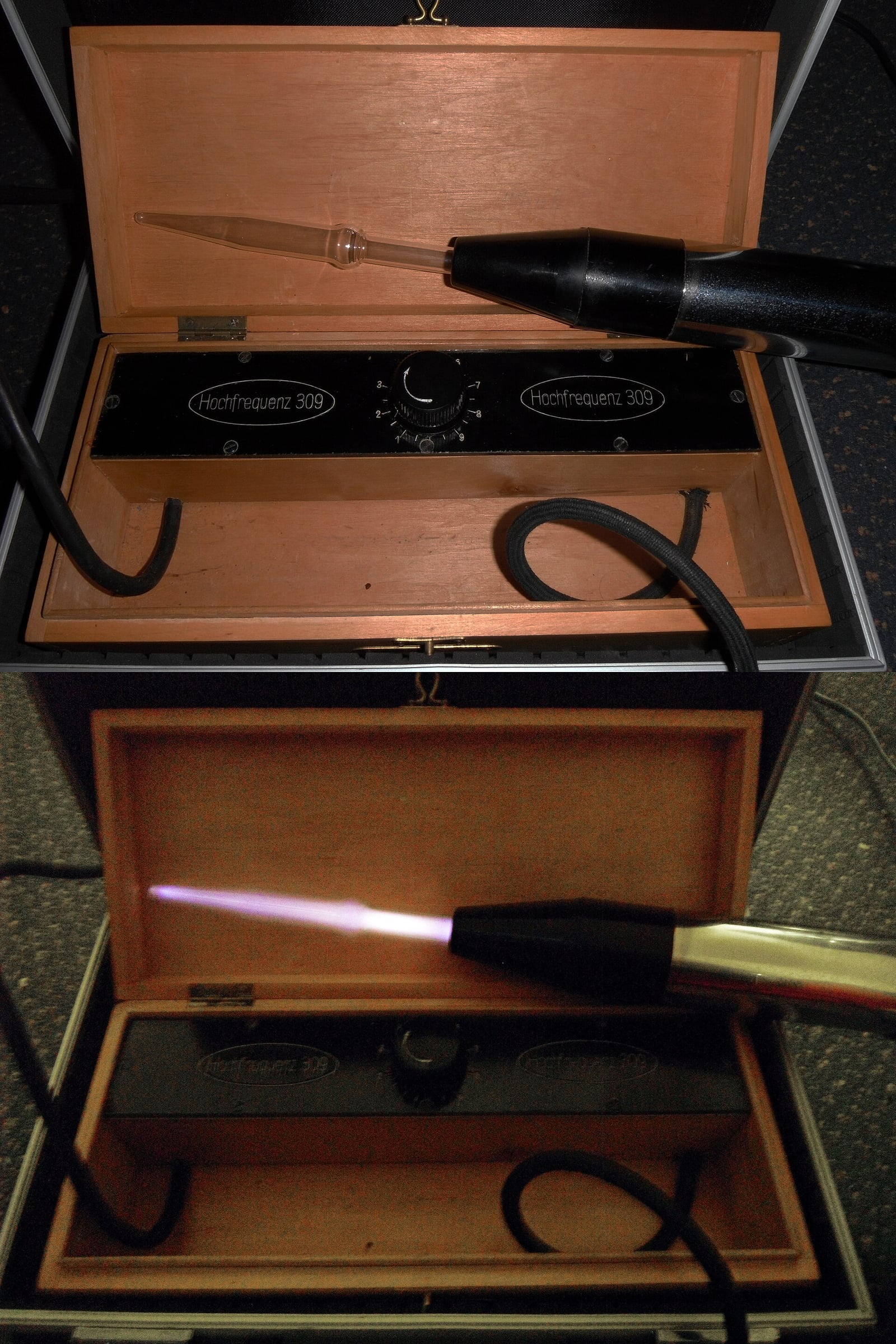
The most theatrical machines were the violet-ray wands and their clinical cousins in high-frequency currents. Their physics is genuinely interesting, which is exactly why the fraud was durable. Inside the handset an interrupter chops the mains supply and feeds a resonant air-core coil. The medical tradition here runs through three real inventors: Jacques-Arsène d’Arsonval, whose bipolar circuit produced high-frequency currents at perhaps 30 kV; Nikola Tesla, whose coils reached 100–250 kV; and Paul Oudin, who in 1893 rewired d’Arsonval’s apparatus as a unipolar autotransformer — the “Oudin resonator” — to push the potential to a quarter-million volts and beyond. The consumer violet-ray wand is a small, cheap Oudin resonator.
What the wand actually does is narrow and superficial. The output is very high in voltage and frequency but minuscule in current, so it cannot drive a dangerous current through tissue; at high frequency the charge stays near the skin surface. The evacuated glass electrode glows violet because a thin low-pressure gas discharges inside it — a light effect, not a therapy. The spark at the skin ionises the surrounding air, producing the characteristic smell of ozone together with nitrogen oxides. That smell was sold as proof of potency.
Here the physics matters most, because the name was engineered to deceive. “Violet ray” invited the buyer to think of ultraviolet light and Niels Finsen’s Nobel-winning UV treatment of lupus vulgaris. But the wand emits essentially no ultraviolet: its glow is visible violet gas discharge, and its ozone comes from corona discharge through air, not from the short-wave UV photolysis that a genuine germicidal lamp uses. The real, defensible effects are a warm tingle, mild superficial skin stimulation, a little counter-irritation, and the ozone odour. From that grain of sensation the advertising grew cures for baldness, deafness, impotence, rheumatism, and cancer — none of which a surface spark can touch. Modern violet wands survive only as novelty items; the ozone they make sits within occupational exposure limits and does nothing systemic.
2.3 Galvanic and faradic “vitality”
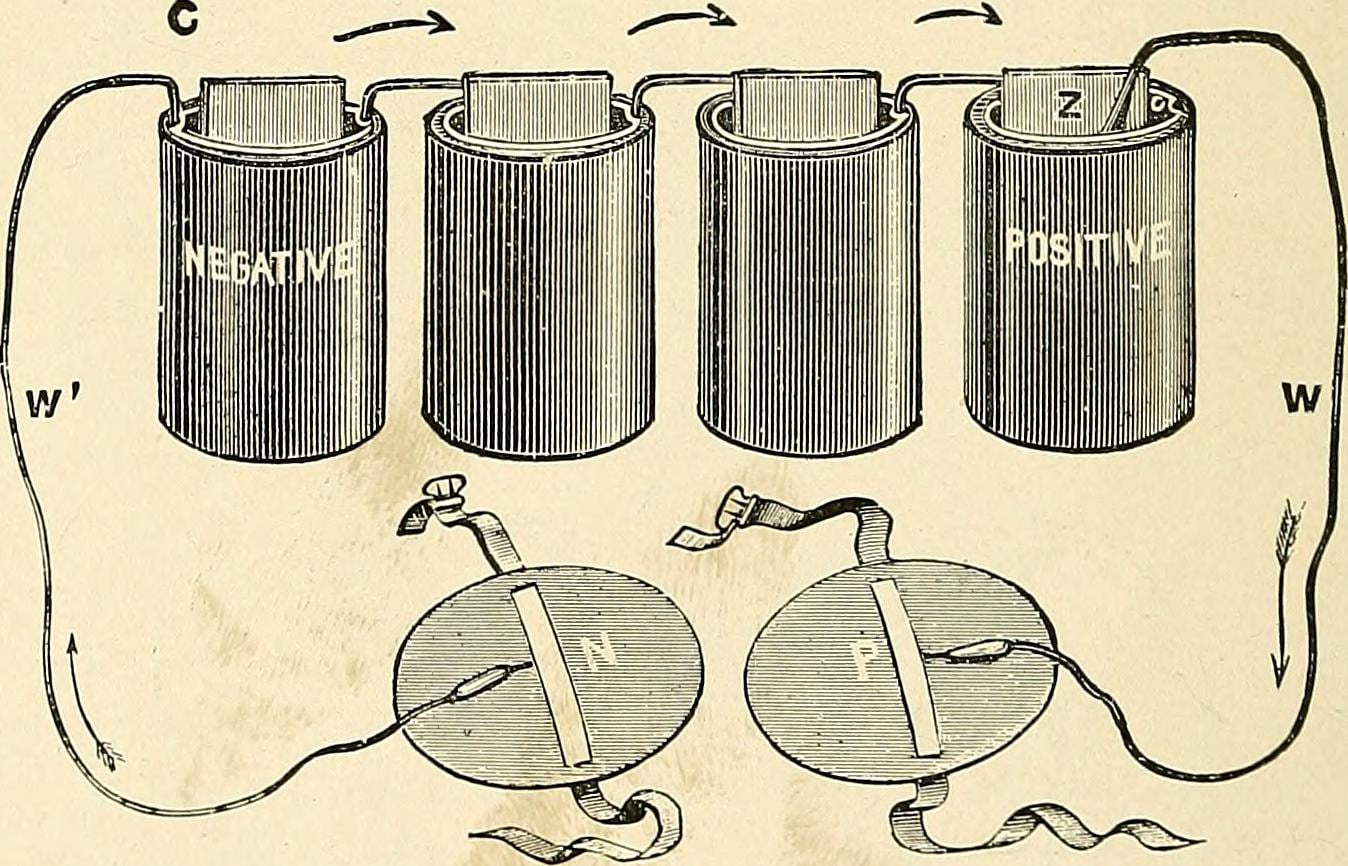
The electropathic belts worked, when they worked at all, on real but feeble electricity, and they leaned on a genuine distinction from the faradic and galvanic machines of legitimate practice. Galvanic current is direct current — a steady one-way flow, named for Luigi Galvani, whose 1791 frog-leg experiments launched the whole science of bioelectricity. Faradic current is an interrupted, rapidly reversing current, named for Michael Faraday; at roughly 50–100 Hz with short pulses it makes an intact, innervated muscle contract, which is why faradic stimulation had real use in muscle re-education and why denervated muscle instead responds to long galvanic pulses. These are legitimate tools; they are still, in refined form, the basis of clinical electrotherapy.
The belt trade parasitised that legitimacy. Pulvermacher’s galvanic chain-belt was an honest, if trivial, voltaic pile: alternating copper and zinc elements on a fabric carrier, activated by dipping in vinegar, producing a small direct current that faded as it dried. The output was too weak, and skin too resistive, for transcutaneous DC at that level to reach any organ or “restore” anything systemic. Many later “electric” belts were worse than weak — they contained magnets, or nothing at all, and delivered only warmth, mild pressure, and the tingle of expectation. The persuasion was the graded “power number” on the label. What the buyer felt was suggestion and a faint galvanic prickle; what he was promised was the reversal of impotence, “spermatorrhoea,” neurasthenia, and lost “vital force.” The gap between a Faraday-honest muscle twitch and a cure for nervous exhaustion is the whole fraud.
2.4 Radionics and the “vibratory rate”
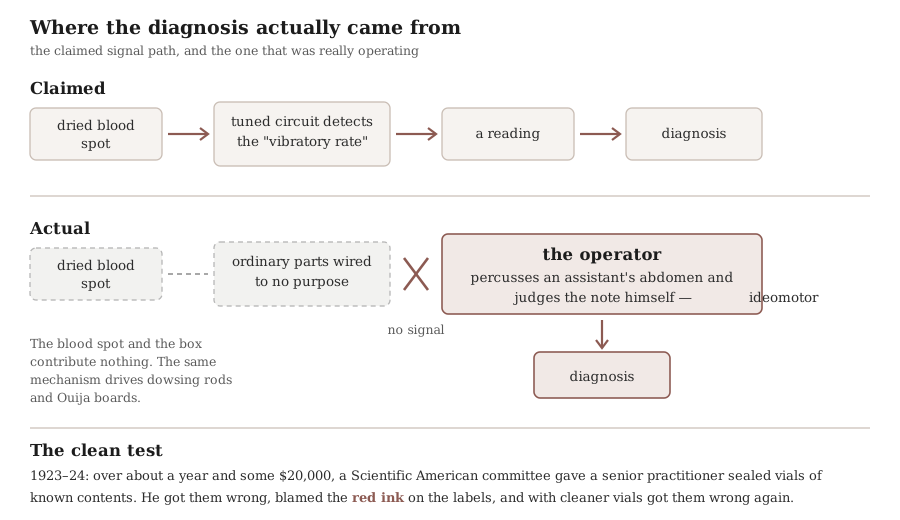
The radionics and Abrams boxes are the purest case, because there is no physical mechanism to debunk — only a psychological one. Albert Abrams (1863–1924) claimed his “Electronic Reactions of Abrams” could read a disease, and even a patient’s race or religion, from a dried spot of blood placed in a leased box, the diagnosis taken by percussing the abdomen of a healthy assistant wired into the circuit. Every element of that is a tell. A dull or resonant percussion note struck on a person’s belly is a subjective judgement made by the operator; the blood spot and the wiring do nothing. The “reading” is an ideomotor effect — the operator’s own unconscious expectation, expressed through tiny movements and interpretive choices, exactly the mechanism behind dowsing rods and Ouija boards. The claimed “vibratory rates” of specific diseases correspond to no measurable quantity; there is no frequency, no field, no signal.
The 1923–1924 Scientific American investigation is the clean demonstration. Over about a year and some $20,000, the committee tested a senior practitioner (“Doctor X”) against sealed vials of known contents. He got them wrong, then blamed the red ink on the labels for confounding the instrument; given cleaner vials, he got them wrong again. Related debunks returned “diagnoses” from a spot of red ink and healthy animal blood. The committee’s verdict was that the claims were “not substantiated” and had “no basis in fact.” Abrams died of pneumonia in 1924 as the report was concluding. His imitators — Ruth Drown with her “radio-vision,” George De la Warr with his “camera” — inherited the same empty circuit. Opening the boxes, as investigators repeatedly did, revealed ordinary components wired to no coherent purpose. Radionics is a sealed-box confidence scheme dressed as radio.
2.5 Radioactive “emanation”
The radioactive cures are the family where the mechanism was frighteningly real and the claim exactly inverted its effect. Radium and its daughter radon do emit energy — alpha and beta particles and gamma rays — and in the 1910s and 1920s “energy” was loosely equated with “vitality.” Radithor (William J. A. Bailey’s radium-laced water), the Revigator “radioactive water crock,” the gold-cased Radiendocrinator worn over the glands, radium tonics, suppositories, and even radioactive toothpaste all sold this category error: that absorbing radioactivity would recharge the body.
The biology is the opposite of a tonic. Radium is chemically a bone-seeker — it behaves like calcium and deposits in the skeleton, where its alpha emitters, which travel less than a tenth of a millimetre and so are relatively harmless outside the body, sit lodged against living bone marrow and bone cells and deliver intense, localised ionising damage at point-blank range. The result is anaemia, necrosis of the jaw, and osteosarcoma — the same bone cancer, by the same route, that killed the radium-dial painters. Alpha radiation is dangerous precisely when a “tonic” carries the emitter inside, past the skin that would otherwise stop it.
The reckoning came through the industrialist and socialite Eben Byers, who drank an estimated 1,400 bottles of Radithor, lost much of his jaw to radiation necrosis, and died in 1932; he was buried in a lead-lined coffin — and when his body was exhumed for study in 1965, the remains were still measurably radioactive (radium-226 has a half-life of about 1,600 years). His death broke the fad and hardened federal control of radioactive nostrums. The grain of truth here is real medicine’s mirror image: radium and controlled radiation genuinely treat some cancers, and bone-seeking alpha emitters are used deliberately today against bone metastases. The quackery was not that radiation is inert — it was that ionising energy, aimed at no target and swallowed daily, could be health rather than injury.
2.6 Colour “attuned” to the body
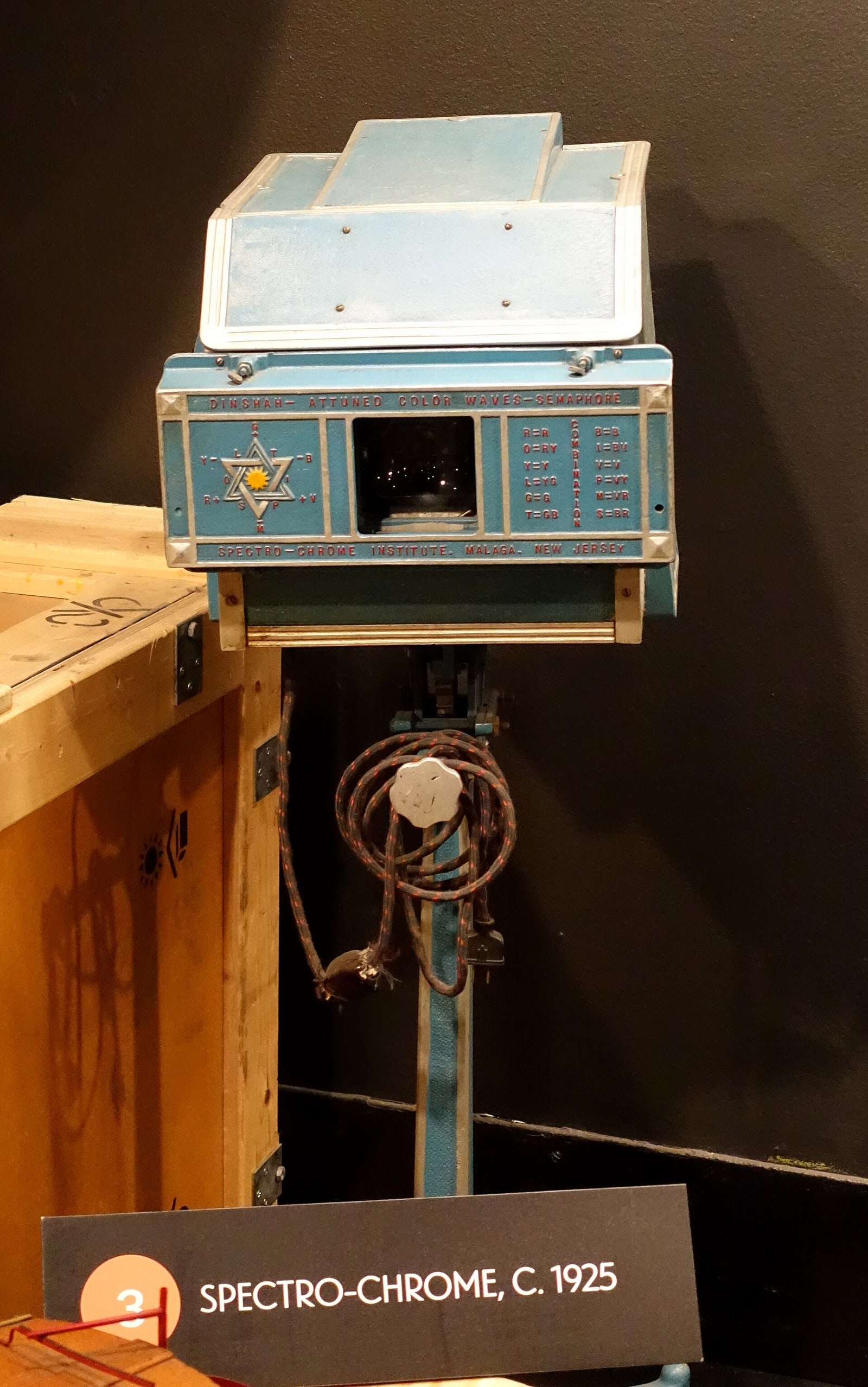
The Spectro-Chrome and colour-therapy tradition made the gentlest device with the largest claim. Dinshah Ghadiali’s Spectro-Chrome was an incandescent lamp behind a set of coloured glass filters, projected on the naked patient according to a timed, quasi-astrological schedule of “attuned colour waves” mapped to organs and elements. The predecessors were Edwin Babbitt’s 1878 Principles of Light and Color and the 1870s “blue-glass” craze.
Physically, a coloured filter over a light bulb yields filtered visible light and nothing else. Visible light does not carry organ-specific “attunement,” does not penetrate to “balance” internal chemistry, and has no element-tuned therapeutic frequency. What makes this family instructive is how close it sits to genuine phototherapy, which it imitated and inflated. Finsen’s ultraviolet treatment of lupus vulgaris won the 1903 Nobel Prize; modern neonatal jaundice is treated with blue light near 460 nm, which matches bilirubin’s absorption peak and photochemically breaks it down so an infant’s liver can clear it. Those are real, specific, wavelength-matched mechanisms with defined targets. Spectro-Chrome had the form — coloured light on a body — with none of the specificity, and it claimed to cure essentially everything. Chromotherapy in its universal-cure sense remains classed as pseudoscience; the honest science it borrowed from is exactly the narrow, targeted phototherapy it did not resemble.
2.7 The common anatomy of a pretend mechanism
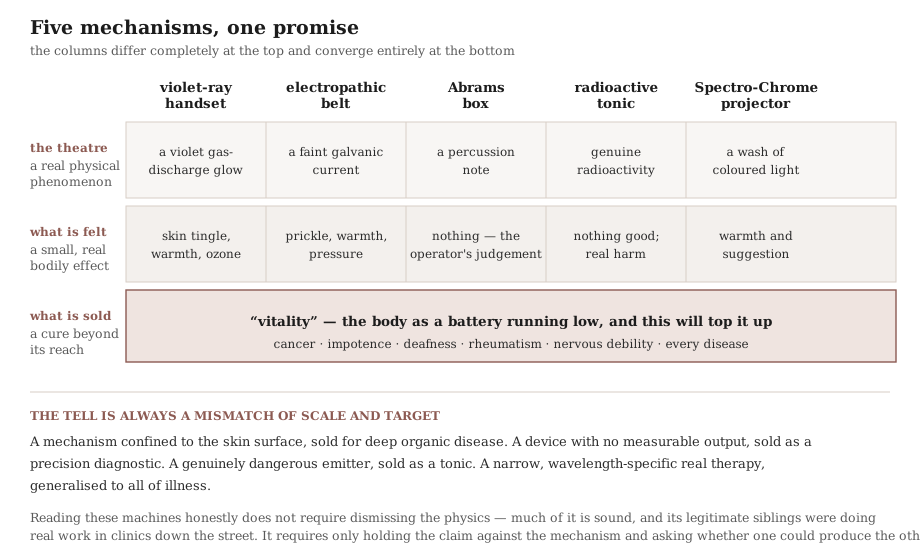
Set the five side by side and the same skeleton shows through each. First, a real physical phenomenon supplies the theatre: a violet glow, a galvanic prickle, a percussion note, a ticking of genuine radioactivity, a wash of coloured light. Second, a small and real bodily effect — warmth, counter-irritation, a muscle twitch, or simple placebo — gives the user something to feel. The neurology of that last point is worth stating plainly: counter-irritation and distraction can genuinely, if briefly, dampen pain, a mechanism later formalised in Melzack and Wall’s 1965 gate-control theory, and suggestion alone produced enough apparent cures that even Freud concluded his electrotherapeutic successes were the work of suggestion, not current. Third — the fraud — that felt effect is scaled up to a systemic, universal cure the mechanism cannot possibly reach: a skin spark for cancer, a fading vinegar battery for impotence, an ideomotor twitch for a diagnosis, a swallowed emitter for vitality, a filtered lamp for every disease.
The tell is always the mismatch of scale and target. A mechanism confined to the skin surface was sold for deep organic disease; a device with no measurable output was sold as a precision diagnostic; a genuinely dangerous emitter was sold as a tonic; a narrow, wavelength-specific real therapy was generalised to all of illness. Reading these machines honestly does not require dismissing the physics — much of it is sound, and its legitimate siblings in the high-frequency-current and static-electricity clinics were doing real work at the same moment. It requires only holding the claim against the mechanism and asking whether the one could ever produce the other. In every case in this wing, it could not.
Sources
- Oudin coil — Wikipedia
- Paul Oudin — Wikipedia
- Tesla, d’Arsonval and Oudin electrotherapy circuits — Wikimedia Commons
- Talk:Violet wand (UV vs. ozone/NOx discussion) — Wikipedia
- Ozone production and destruction using UV technology — OTSIL
- Galvanic current — an overview, ScienceDirect Topics
- Faradic vs. galvanic current — Physio-pedia / Faradic Stimulation
- What the American Medical Association Thinks of the Electronic Reactions of Abrams — JAMA reprint, PMC
- “The Electronic Reactions of Abrams” — Nature (1925)
- Albert Abrams — Wikipedia
- Albert Abrams debunked using red ink and sheep’s blood — IFLScience
- Radithor (ca. 1928) — ORAU Museum of Radiation and Radioactivity
- Eben Byers — Wikipedia
- Byers’ lead coffin — IOP Spark, Institute of Physics
- Bone-seeking radiopharmaceuticals: radium-223 α-therapy — Journal of Nuclear Medicine
- Niels Ryberg Finsen — NobelPrize.org (1903 Physiology or Medicine)
- Efficacy of phototherapy of neonatal jaundice — light wavelength matters, Pediatric Research
- Chromotherapy — Wikipedia
- Neurophysiological mechanisms of counterirritation — Springer
- Cured with sparks: a history of electrotherapy for functional neurological symptoms — OUPblog

Comments (0)